Contigo AUTOSEAL: Steel Body, Lid Care and Testing Limits

Last reviewed: by the MicroPlastics Research Desk. Submit a correction or see our editorial standards.
Quick answer
Got a different brand in the cupboard? Review its packaging inputs and Product Contact Signal, then compare a lower-contact option.
Scan my product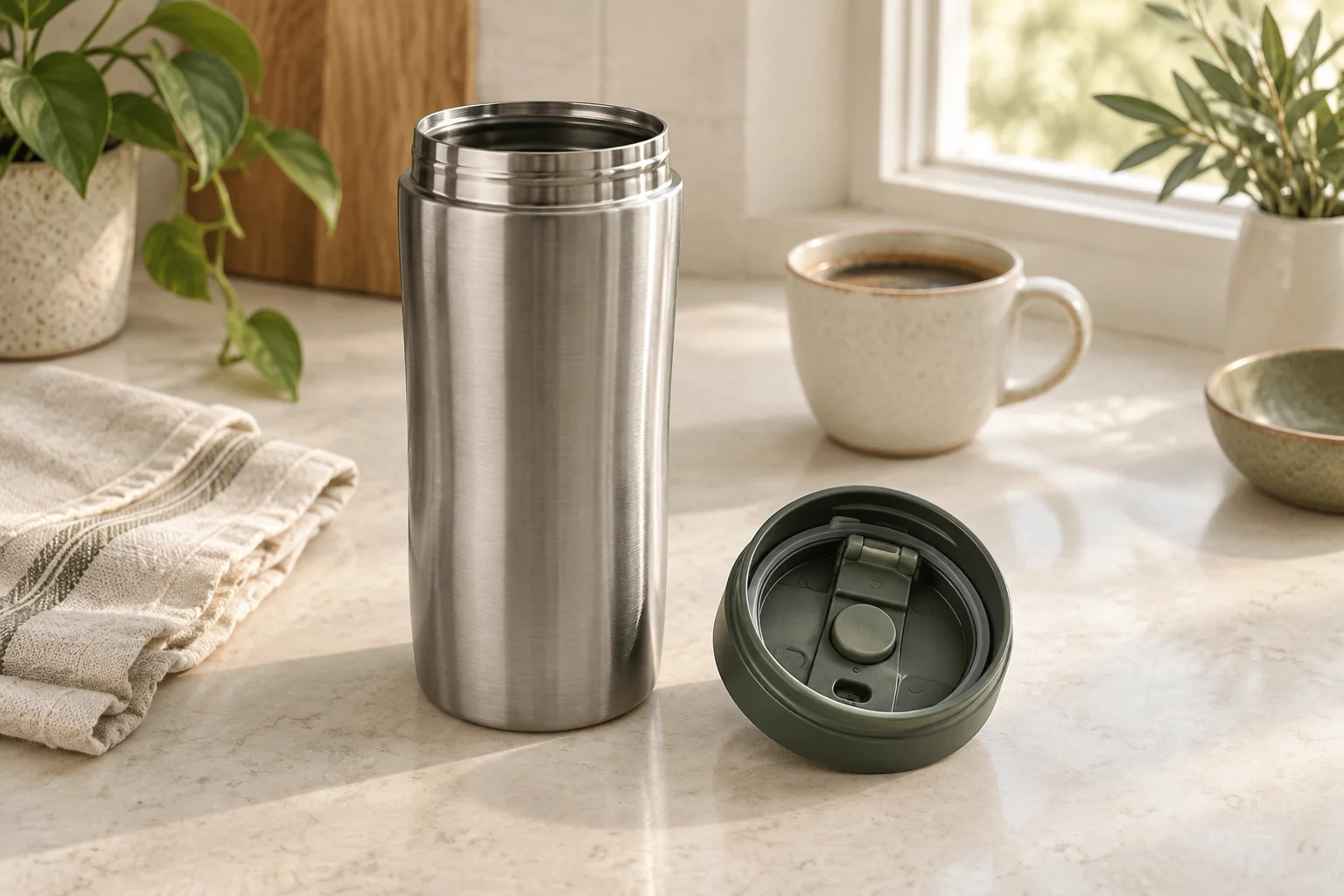
Key Takeaways
- This guide covers adult West Loop travel mugs, rather than every Contigo bottle or children’s cup.
- AUTOSEAL describes a press-to-drink closure mechanism. It is not a material or microplastic certification.
- The storage wall and the drinking assembly need separate checks; the word stainless does not describe every part.
- The 3.0 manual and product listing differ on dishwasher advice for the body. Match the instructions to your finish and model.
- A clean, working closure and a measured particle-release rate are different forms of evidence.
Which Contigo mug are we talking about?
“Contigo microplastics” is a broad search. A steel coffee mug, a clear cold-water bottle and a child’s drinking cup can have different vessels, valves and care requirements. A conclusion about one assembly cannot automatically cover the others. This guide reviews the adult West Loop 3.0 16oz listing, item SAP_2201635, and the West Loop 12oz listing, item SAP_2201661, as available on October 6, 2026.
The 16oz page expressly names West Loop 3.0. The 12oz page names West Loop with an Easy-Clean lid. We keep that distinction instead of assigning a generation from a customer review. Capacity alone is not a dependable identifier, and reviews displayed together on a product page can refer to another size or version.
| Listing | Declared vessel | Listed care |
|---|---|---|
| West Loop 3.0, 16oz — SAP_2201635 | Vacuum-insulated stainless steel; BPA-free | Top-rack lid; hand-wash body |
| West Loop Easy-Clean, 12oz — SAP_2201661 | Vacuum-insulated stainless steel; BPA-free | Top-rack lid; hand-wash body |
Before using instructions from a search result, record the name and item number from your purchase or packaging. Note the finish and any replacement lid. Start with Contigo’s travel-mug care index, which lists West Loop, West Loop 2.0 and West Loop 3.0 separately. AUTOSEAL also appears on other families; the shared closure name does not make every part interchangeable.
Follow the drink through the lid
A mug has at least two jobs: storing a beverage and delivering it to your mouth. The steel wall answers the first materials question. When you tilt a closed mug to drink, the beverage also passes through its lid opening. Inspect the underside, the sealing areas and the drinking spout, rather than assuming the vessel’s material describes the complete path.
Contigo describes the reviewed lid as opening when the button is pressed and sealing when it is released. Its Easy-Clean interior opens for washing while remaining a connected assembly. These are useful construction details. They do not identify every polymer, gasket formulation or internal part. The sources reviewed here do not provide a component-by-component resin list, so we do not label the entire closure polypropylene or identify every seal as silicone from appearance alone.
That disclosure gap matters if your buying requirement is no polymer contact. A steel-body listing cannot establish that requirement for the assembled mug. Ask the manufacturer which materials touch the liquid in your exact lid, and whether any lining or coating is present on the inside of the vessel. An exterior colour finish is a separate question from the interior contact surface; do not move a claim about one onto the other.
Our HydroJug Traveler comparison illustrates a different lid-and-straw path. The adult CamelBak Eddy+ guide covers a bite valve. Neither supplies a particle count for AUTOSEAL. Comparing designs can help you choose an interface; it cannot substitute for testing the finished product.
Does BPA-free mean microplastic-free?
No. BPA-free concerns a chemical claim. Microplastic testing concerns physical particles and requires methods that identify their size and composition. A declaration about BPA does not count pieces of polymer released by a closure. Conversely, identifying a polymer component does not establish that a particular mug releases a particular amount during everyday use.
A leak claim answers another question: whether liquid escapes under the claimed conditions. A temperature-retention claim answers how long the mug keeps a beverage hot or cold under its test conditions. Neither tells us how many particles are in the drink. Read each claim within its own scope, even when the claims appear together in a reassuring product description.
The FDA’s food guidance describes measurement gaps and says available evidence does not demonstrate that detected levels pose a human-health risk. That is broad context, not certification of this mug. A preference for fewer polymer contact surfaces is a practical design preference; a promised reduction in disease risk would need additional evidence.
What has actually been measured?
The manufacturer documents reviewed for this article do not report a West Loop-specific particle-release measurement. We have not tested a Contigo mug. “Not reported in these sources” should not be inflated into “nobody has ever tested one,” and a missing result should not be converted into either zero particles or a frightening numerical estimate.
Sobhani and colleagues’ 2020 packaging study found particle generation during mechanical actions including opening plastic packaging. It supports investigating wear mechanisms. It did not establish a release rate for a West Loop button, seal or drinking spout. The motion, materials and contact conditions need to match before a result can be transferred.
A useful mug study would compare the beverage before and after contact, include contamination blanks, identify particle polymers, state the detection-size range and repeat realistic use and cleaning cycles. It should distinguish a new assembly from an aged one. Otherwise, particles already present in the fill water or introduced during sampling could be mistaken for release from the mug.
It would also help to test the body and lid separately, then the assembled drinking path. That would show which parts contribute under the chosen conditions. Without that evidence, “the lid contributes all the particles” is as unsupported as “the lid contributes none.” A design review can map possible contact, but it cannot quantify the contribution of each part.
How to clean the Easy-Clean lid
The linked West Loop 2.0 guide tells owners to open the interior cover before washing and rinse promptly, pressing the button so water passes through the spout and vent. For hand washing, it specifies a ten-minute soak in hot soapy tap water, a thorough rinse and returning the interior to its closed position before use. It also says to store the mug with the lid removed so the parts dry.
Opening the intended cleaning cover is different from dismantling the entire mechanism. Use the supplied guide to find the accessible surfaces. Do not prise apart a connected assembly or adapt a straw-bottle cleaning sequence because the same company made both products. If residue remains in an inaccessible place, ask Contigo about the exact part instead of improvising a repair.
A cleaning routine should address the route through which you drink, not just the smooth steel vessel. A mug that looks clean from above can still need attention underneath its lid. Appearance is a prompt for inspection, however, not a home test for microscopic particles. Clear rinse water does not prove zero release, and visible residue does not identify its chemical composition.
Can the body go in the dishwasher?
There is a real document discrepancy. The West Loop 3.0 manual allows top-rack washing for the lid and an unpainted steel body, while requiring hand washing for painted bodies. The reviewed 16oz listing says the steel body is hand-wash only. Use the instructions supplied with your exact finish; where documentation is unclear, hand-wash the body and ask the manufacturer to resolve the difference.
Dishwasher suitability is a care instruction, not a particle-release measurement. We cannot assign a percentage reduction to hand washing from these documents. Nor should every painted mug be described as having a polymer-coated interior. Identify which surface is being discussed before applying advice about wear, coating damage or liquid contact.
Hot coffee: pressure and drinking temperature still matter
The 3.0 manual says to let boiling liquid cool with the lid off for at least three minutes before closing. It instructs users to release pressure with the mug upright and away from the face, avoid overfilling, and not microwave or freeze the mug. It also excludes carbonated or pulpy drinks and warns against bleach, chlorine and abrasive cleaners. See the complete guide rather than treating this summary as a replacement.
Three minutes is the manufacturer’s minimum handling instruction, not proof that a drink has reached a comfortable sipping temperature. Insulation can retain heat. Test the temperature cautiously and follow the supplied instructions before drinking; removing a lid to avoid a material contact does not remove the burn or spill problem.
Similarly, a bare steel surface is not universally chemically inert. Kamerud and colleagues’ cookware study measured nickel and chromium release under acidic tomato-sauce cooking conditions. It concerns metals, not microplastics, and cannot predict release into coffee from this mug. It does show why a materials comparison should avoid promising that steel contributes nothing under every condition.
Keep it, replace the lid or choose another format?
| Situation | Next step |
|---|---|
| An intact mug works and can be cleaned as instructed | Keep using its model-specific care routine; this review does not establish a need to discard it |
| Closure is damaged or no longer works correctly | Stop using the damaged product; ask about an exact compatible replacement |
| You want to avoid drinking through a lid | Consider an open mug for stationary use, accounting for heat and spill handling |
| You need a quantified particle reduction | Seek a controlled finished-product comparison; a materials listing cannot provide it |
Fewer parts can make a contact path easier to understand and inspect. That does not mean the simplest closure has been proven to release the fewest particles. One-handed sealed drinking also serves a real purpose for some routines. Choose the trade-off explicitly rather than letting an unsupported health ranking make the decision for you.
If you buy another mug, check the interior surface, the complete lid disclosure, accessible cleaning surfaces and availability of compatible parts. Our steel material profile separates the alloy from an assembled product. The coffee-cup guide covers disposable formats; its study results are not a test of this reusable mug.
Use the App
Keep a record of your drinkware materials
Compare product assessments and save the parts you use. The app does not count particles in a drink or measure a personal health benefit.
Explore drinkware assessmentsFrequently Asked Questions
Does Contigo AUTOSEAL have microplastics?
Is the AUTOSEAL lid polypropylene?
Can I use a West Loop 2.0 lid on a different mug?
Does hand washing prove fewer microplastics?
Sources
- Contigo (2026). West Loop 3.0 16oz, SAP_2201635 (accessed October 6).
- Contigo (2026). West Loop Easy-Clean 12oz, SAP_2201661 (accessed October 6).
- Contigo (2026). West Loop 3.0 use and care, English instructions (accessed October 6).
- Contigo (2016). West Loop 2.0 use and care (linked PDF, accessed October 6, 2026).
- Contigo (2026). Travel-mug care and use guide index (accessed October 6).
- Sobhani Z, et al. (2020). Microplastics generated when opening plastic packaging. Scientific Reports.
- Kamerud KL, Hobbie KA, Anderson KA (2013). Stainless steel leaches nickel and chromium into foods during cooking. Journal of Agricultural and Food Chemistry.
- US Food and Drug Administration (2026). Microplastics and nanoplastics in foods (accessed October 6).
Your next product question
Start with your exact Contigo AUTOSEAL bottle and lid.
Review the exact bottle and lid mechanism, including cleaning access and disclosed materials. A brand-level answer cannot identify every model’s assembly.
Use the exact product name, model and label to check the information behind an assessment. A photo does not measure particles or personal health risk. The examples above are research subjects, not a verified app-coverage list.
Build a product-routine reading plan →Android · early access
Get the launch email the day Android opens.
One email. No spam. We send when the Android app is in the Play Store, and never again unless you opt in.
Go deeper
Less-travelled research from our archive that follows directly from this page.
Related Research
Are Oven Bags Safe for Turkey? The Question Isn’t Microplastics
Reynolds oven bags are FDA-compliant nylon, and USDA prefers them to paper bags. But hot nylon releases oligomers into fatty food, and a July 2026 study found heated nylon-bag leachate toxic to water fleas while PET bags were not.
Read moreDo Plastic-Wrapped Candies Contain Microplastics? 20 of 20 Did
A 2026 study detected microplastics in all 20 plastic-wrapped candies tested. The average was 6.73 particles per gram—but brands were blinded and the wrapper was not the only possible source.
Read moreCan You Microwave Food in Its Plastic Wrapper? New 2026 Evidence
A 2026 study detected PE micro- and nanoplastics from microwaved onigiri wrappers and lined cartons. See what appeared within 1–3 minutes, what the cell test cannot prove and when to transfer food.
Read moreDo Plastic Salt Grinders Shed Microplastics? A 2026 Test Says Yes
Yes. Three plastic grinder heads released an estimated 1,091 to 15,743 particles per 50 g of salt. The polymers matched the mechanisms; ceramic or steel burrs are the direct swap.
Read moreAre Compostable Coffee Cups Plastic? PLA Is Still a Polymer Lining
Many compostable paper cups use PLA plastic lining. A new study found about 12× higher released particle mass than PE cups, while earlier nanoplastic counts found the opposite—why both results can be true.
Read moreAre Nylon Cooking Utensils Plastic? Yes—Heat Is the Real Test
Nylon is polyamide plastic. Studies from 2016–2026 measured oligomers and aromatic amines rather than one universal particle count; heat, contact time and visible damage decide the practical response.
Read more