HydroJug Traveler: Steel Body, Plastic Drinking Path

Last reviewed: by the MicroPlastics Research Desk. Submit a correction or see our editorial standards.
Quick answer
Holding a different bottle? Review its confirmed or estimated material and Product Contact Signal, then compare a lower-contact option.
Scan my product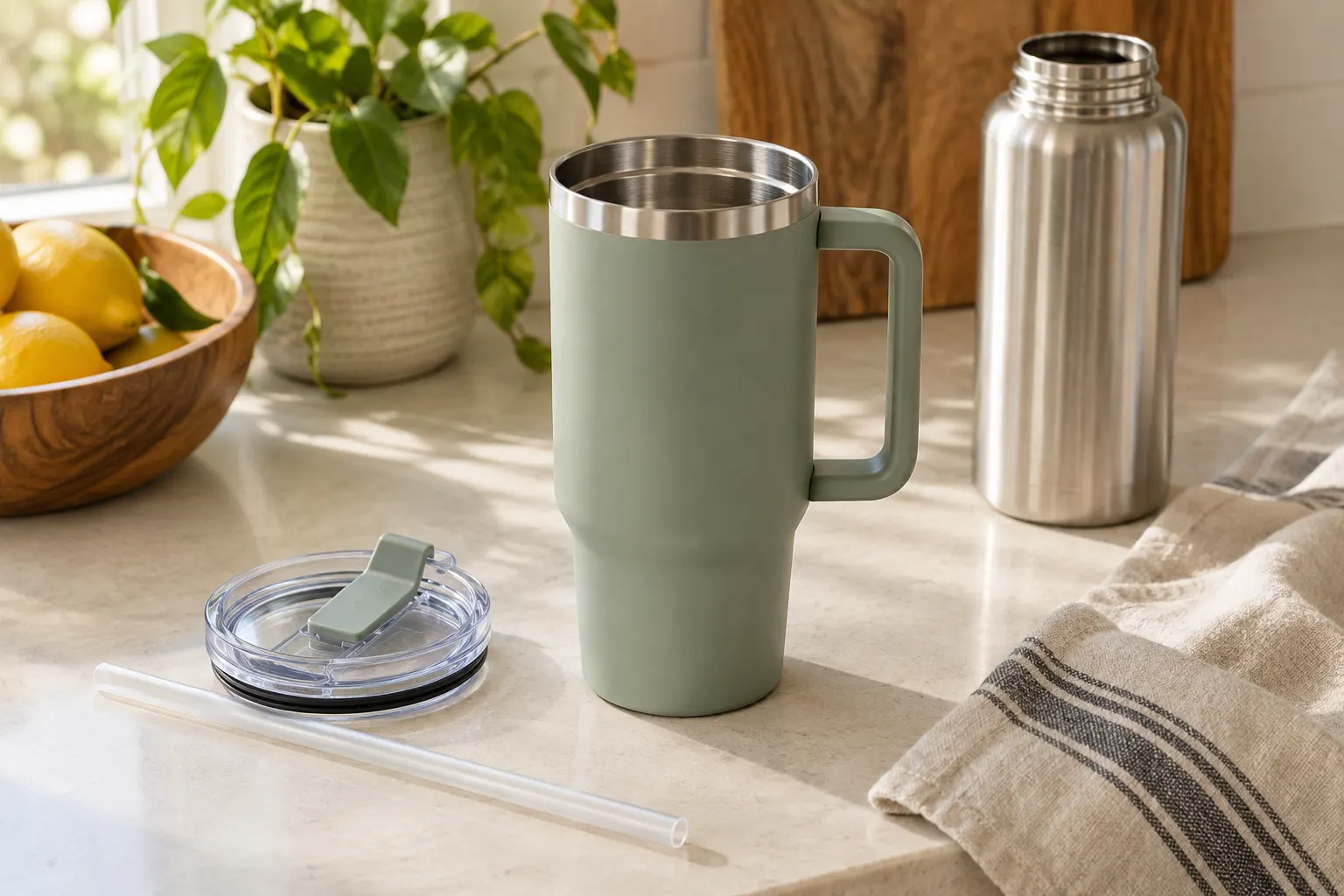
Key Takeaways
- The reviewed 40oz Black Traveler listing specifies an 18/8 steel body. The lid and straw need a separate material check.
- HydroJug’s help page identifies Tritan lids and straws; it describes the HydroStraw accessory as polypropylene. Do not treat those as interchangeable parts.
- BPA-free is a chemical claim. It is not a test result of zero polymer particles.
- The reviewed pages do not supply a Traveler-specific particle-release result. Generic cap or packaging studies cannot fill that gap.
- Model, finish, replacement parts and care instructions matter more than the colour or an insulation slogan.
What the 40oz Traveler listing actually says
We reviewed HydroJug’s Black 40oz Traveler listing on October 6, 2026. It names 18/8 stainless steel, a flip-top lid with a straw, and top-rack dishwasher use. A steel body is useful information: the main vessel differs from a plastic jug. But the liquid does not stay against that wall for its whole journey to your mouth.
Water can touch the straw, the lid passage and seals. Depending on how the tumbler is filled, carried or tilted, it can also contact the underside of the lid. The practical assessment therefore follows the whole path rather than stopping at the largest visible component. The word stainless on a product title cannot describe a part that the manufacturer separately calls plastic.
This page covers the standard Traveler question, with the reviewed 40oz listing as its reference. HydroJug also sells Sport, Everyday, Coffee and other products. A coating, accessory or temperature instruction for one line should not be copied onto another just because the logo is the same. Match the product name and replacement part when checking your own cup.
Trace the body, lid, straw and seal separately
| Part or pathway | Manufacturer information | What still needs checking |
|---|---|---|
| 40oz Traveler vessel | 18/8 stainless steel on the reviewed listing | This is a material declaration, not a water particle analysis |
| Lids and straws | General product help identifies BPA-free Tritan | Confirm the exact current lid and straw supplied with your unit |
| Seals | General help identifies food-grade silicone | Condition, correct assembly and model-specific replacements |
| HydroStraw accessory | Help page identifies BPA-free polypropylene | Do not assume this is the same component as every Traveler straw |
The component declarations above come from HydroJug’s product-information page. They are not laboratory observations made by us. We have not disassembled the reviewed unit or verified the resin grade from a private supplier document. If a replacement lid looks different, that is a reason to check its own listing rather than inherit the original assembly’s description.
An exterior handle or coating also differs from a drinking surface. The relevant question is whether the part normally touches the liquid, the mouth, or neither. That distinction keeps a material list from becoming a misleading count of everything visible in a photograph. It also explains why an exterior metal body and a polymer mouthpiece can coexist in the same assessment.
Does that mean the Traveler sheds microplastics?
It means the drinking path includes synthetic polymers. It does not supply the number of particles entering a drink. The reviewed HydroJug pages give material, performance and care claims; they do not publish a Traveler-specific particle count with an analytical size range, contamination controls and an aged-use protocol. We therefore do not invent one.
Sobhani and colleagues’ 2020 study demonstrated that opening and mechanically working plastic packaging can generate polymer particles. It included twist-opening plastic bottle caps. This establishes a mechanism worth studying; it does not test a HydroJug flip-straw assembly or provide a daily shedding rate for it.
The distinction is particularly important for reusable drinkware. A disposable bottle’s threaded cap, a flip-straw hinge and a drinking valve are different geometries. Their materials, loads and contact times can differ. Moving a published number from one mechanism to another may make a comparison look complete while removing the experiment that made the number meaningful.
A useful future test would identify the exact model and parts, include new and appropriately aged assemblies, measure relevant particles in the drink rather than merely inspect a dry component, and state the smallest sizes it could identify. It should also account for particles already present in the water. Until that information is available, material contact and measured release remain separate questions.
Why BPA-free does not mean plastic-free
Eastman, the resin manufacturer, describes Tritan as a copolyester plastic and says it is made without bisphenols including BPA and BPS. That is relevant to a bisphenol question. It cannot turn a Tritan straw into steel or establish how many physical fragments a finished lid releases through its entire life.
A particle analysis and a chemical-safety assessment can both be useful. They ask different questions, and neither should be used to pretend the other was performed. Read BPA-free as a bounded claim about BPA, then continue checking the material and intended use. Our Tritan guide explains the distinction between a bulk resin and a small particle made from it.
There is also no need to turn an uncertainty into a health diagnosis. Finding a polymer in a drinking path does not by itself show that ordinary use causes disease. The FDA’s food assessment does not find a demonstrated human-health risk at the particle levels currently detected in foods. That is broader food context, not a certification of this particular tumbler.
Two discrepancies to resolve before borrowing instructions
The reviewed listing is not perfectly consistent. Its specification fields call the insulation double-wall vacuum, while the description calls it triple-wall. It also gives hot and cold performance claims, while the general help pages discuss the Coffee Traveler separately. Those inconsistencies do not establish a defect or a particle problem. They do mean that a copied sales bullet is a weak substitute for model-specific operating instructions.
| Question | What the reviewed pages show | Practical response |
|---|---|---|
| Insulation construction | Double-wall in specifications; triple-wall in description | Do not infer liquid-contact materials from an insulation slogan |
| Hot beverages | Performance bullets and product-family help use different descriptions | Use the exact unit’s instructions; request clarification if they conflict |
| Dishwasher use | Top rack on the reviewed listing; hand washing recommended in general care | Follow the model and finish restrictions rather than a universal rule |
In particular, replacing a plastic straw with a metal one does not automatically make a cup or lid suitable for hot liquids. It changes one contact component. Temperature suitability also concerns the closure, pressure, handling and burn precautions. Choose a product expressly intended for the use you need instead of making that decision from a material swap alone.
How to clean and maintain the drinking path
HydroJug’s care page recommends hand washing with warm soapy water, cleaning straws with an appropriate brush, rinsing and drying with the lid off. It says most cups are dishwasher-safe but recommends hand washing for appearance, and specifies hand washing for glitter or 5D finishes. It also says not to freeze or microwave its products.
For a straw cup, the important cleaning task is not simply the large steel chamber. Check the straw passage, moving closure and the parts the maker permits you to remove. Clean and reassemble them as instructed. A good-looking outer cup does not verify that a narrow passage is clean, and detergent access is not the same as thorough drying.
Replace a damaged food-contact component with a compatible part rather than improvising an adhesive repair. Visible cracking, flaking or a distorted closure is a practical reason to stop using that part and ask the manufacturer. It is not a quantitative microplastic test. Cloudiness or staining alone also cannot identify a polymer or determine a release rate.
Should you switch to a different bottle?
If your intact Traveler is convenient and you can maintain its lid, the reviewed evidence does not establish a reason to discard it based on a claimed particle count. If your specific priority is avoiding plastic along the drinking path, a simpler steel vessel with a steel drinking rim can serve that preference. Inspect the cap’s underside and gasket as separate components rather than assuming the whole assembly is polymer-free.
The same method works for comparisons with Stanley, Owala, Yeti or Hydro Flask: compare the exact drinking interface, replacement parts, intended liquids and cleaning access. Our four-brand bottle comparison provides that wider context. It does not add a HydroJug-specific lab result that is absent here.
For a new purchase, write down the job first. One-handed sipping in a car, a leak-resistant bag bottle and a desk cup are different choices. A design that minimizes one material can be less convenient for another task. Consider steel bottle options or glass options using that task-based checklist, without treating the list as a clinical safety ranking.
The children’s Sport recall is a separate product issue
The CPSC’s December 4, 2025 notice concerns specified 14-ounce Children’s Sport Tumblers, whose handle rivets can detach and create a choking hazard. Its named product is not the 40oz Traveler reviewed here, and its issue is not a microplastic measurement. Owners of the specified children’s tumbler should check the official notice and follow its stop-use and replacement instructions. Do not turn a brand-level search result into a recall claim about every cup.
Use the App
Save the bottles and lids you actually use
The app organizes product and contact assessments over time. It does not count particles in your drink or turn a packaging score into a personal health measurement.
Explore drinkware assessmentsFrequently Asked Questions
Is HydroJug Traveler plastic-free?
Is the HydroJug Traveler straw Tritan or polypropylene?
Has HydroJug Traveler been measured for microplastic shedding?
Does BPA-free mean no microplastics?
Can I put a metal straw in it for hot coffee?
Was the 40oz Traveler in the children’s Sport recall?
Sources
- HydroJug (2026). Black 40oz Traveler listing (accessed October 6).
- HydroJug (2026). Product information and material declarations (accessed October 6).
- HydroJug (2026). Product care (accessed October 6).
- Eastman (2026). Tritan and Tritan Renew FAQs (accessed October 6).
- Sobhani Z, et al. (2020). Microplastics generated when opening plastic packaging. Scientific Reports.
- US Consumer Product Safety Commission (2025). HydroJug recalls specified 14-ounce Children’s Sport Tumblers.
- US Food and Drug Administration (2026). Microplastics and nanoplastics in foods (accessed October 6).
Your next product question
Start with your exact HydroJug Traveler and lid assembly.
Check the current model’s body, lid, straw and seals separately. A steel vessel does not disclose every contact component or establish a measured benefit.
Use the exact product name, model and label to check the information behind an assessment. A photo does not measure particles or personal health risk. The examples above are research subjects, not a verified app-coverage list.
Build a product-routine reading plan →Android · early access
Get the launch email the day Android opens.
One email. No spam. We send when the Android app is in the Play Store, and never again unless you opt in.
Related Research
Does Voss Water Have Microplastics? Glass vs Plastic Voss
No study has tested Voss. Three studies found glass-bottled water no cleaner than PET because of the caps, and Voss’s own US report lists US East and West sources alongside Norway. What that means for what you buy.
Read moreDo Plastic Bottle Caps Shed Microplastics? Opening Is the Friction Point
Yes. Direct studies show that opening and closing abrades the cap-neck system. See what changed after ten openings, why the size cutoff matters and when to retire a reused bottle.
Read moreJason Momoa's Mananalu Water: Refillables, Microplastics and the Fine Print
Jason Momoa's Mananalu now uses returnable glass and aluminum bottles. Review the refill model, microplastic claims and questions to ask about finished-water tests.
Read moreSam Leavitt Avoids Microplastics: LSU's Glass-Only Routine, Explained
ESPN says LSU QB Sam Leavitt chooses glass to avoid microplastics. See the original report, glass-versus-steel comparison and habits you can realistically borrow.
Read moreDoes Jaden Smith's JUST Water Have Microplastics? Inside the Carton
Jaden Smith's JUST Water carton contains plant-based plastic. Read the packaging breakdown, reported 2025 testing allegation and practical refill alternatives.
Read moreDoes Essentia Water Have Microplastics? No Brand Test Is Public
No public Essentia particle count was found. Its quality report documents purification and regulated contaminants, while the PET-1 bottle, cap and final filling path remain a separate question.
Read more