Microplastics in Tea Bags: Which Tea Bags Are Plastic and What to Buy Instead
Last reviewed: by the MicroPlastics Research Desk. Submit a correction or see our editorial standards.
Quick Answer
Got a different brand in the cupboard? Review its packaging inputs and Product Contact Signal, then compare a lower-contact option.
Scan my product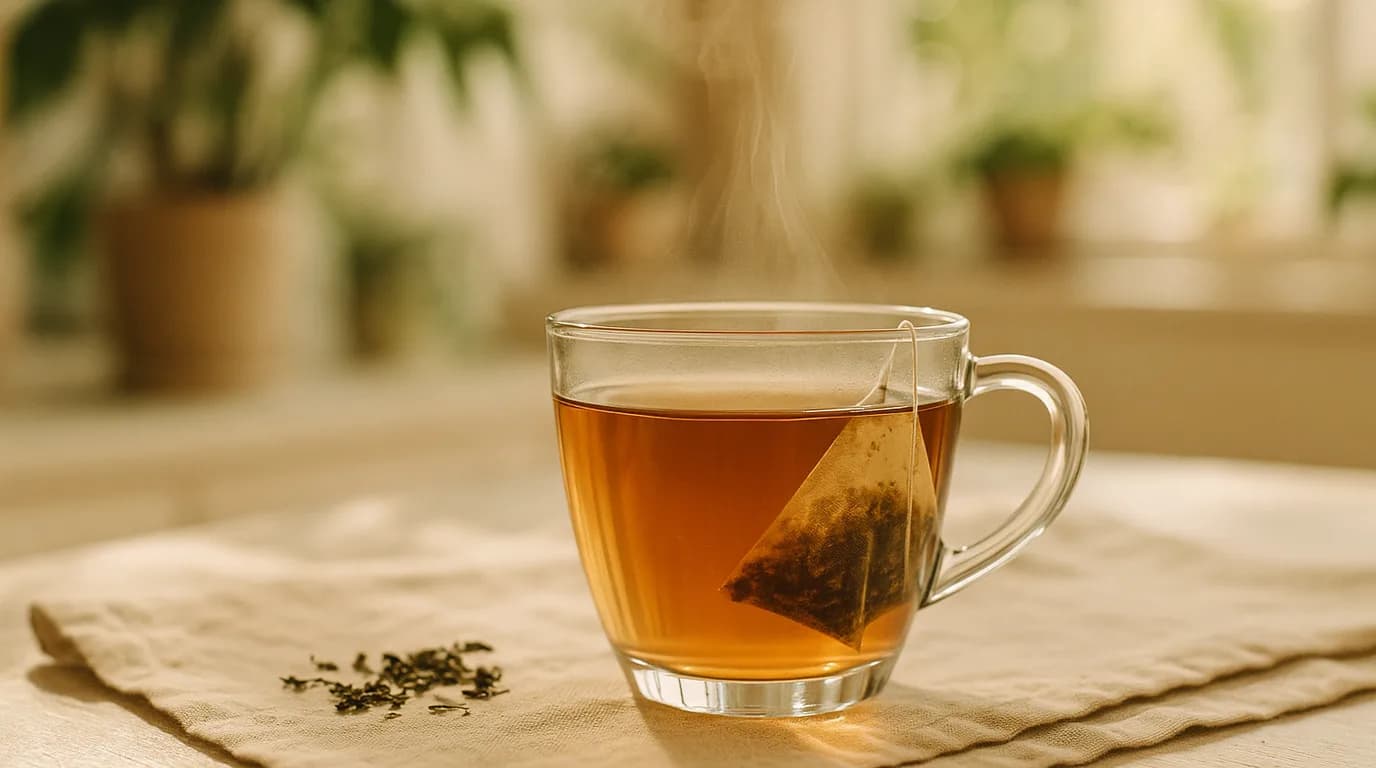
Most people don't realize they may be steeping plastic in their morning tea. Pyramid mesh bags are often nylon or PET. Even traditional paper bags frequently use a polypropylene sealant or heat-seal fibres. Hot water released billions of microplastic particles per cup from nylon and PET bags in a 2019 McGill study. German regulators later raised methodology concerns, but the polymer composition of those bags hasn't been disputed.
| Bag type | Typical material | Plastic risk | Verdict |
|---|---|---|---|
| Pyramid / silken mesh | Nylon-6 or PET | High, confirmed by 2019 McGill study | Avoid |
| Traditional paper bag (heat-sealed) | Paper + polypropylene seal | Moderate, seal is plastic; bag mostly paper | Acceptable; certified plastic-free preferred |
| Stapled paper bag (no seal) | Paper + cotton thread + staple | Low / none | Best paper option |
| Fold-and-tag (Lipton-style) | Often heat-sealed paper | Moderate | Check brand for “plastic-free” claim |
| PLA bioplastic mesh | Plant-derived bioplastic | Still polymer, releases particles | Better than nylon; not plastic-free |
| Loose leaf + infuser | Tea + stainless / glass infuser | None | Best option |
Key Takeaways
- Pyramid / mesh tea bags are usually nylon or PET, both shed at brewing temperature.
- Most traditional paper bags use a polypropylene heat-seal, even if the bag itself is paper.
- The 2019 McGill study found billions of particles per cup from nylon/PET pyramid bags.
- Germany's BfR critique focused on method limitations, not the fact that the bags are plastic.
- Loose leaf + stainless infuser is the cleanest brewing setup, and usually cheaper per cup.
- Brands that explicitly market “plastic-free tea bags”: Numi, Pukka, Clipper, Traditional Medicinals, Yogi (most lines), Tetley (UK plastic-free since 2021).
Why tea bags are a microplastic source
Three real mechanisms:
- Polymer mesh. Pyramid and silken bags use nylon-6 or polyethylene terephthalate (PET). Both polymers hydrolyze and shed at 95°C brewing temperature.
- Heat-seal on paper bags. Even traditional paper bags need to be sealed, and the most common method is a thin polypropylene melt seal. The paper portion isn't the issue; the seal is.
- Plastic outer packaging. Individual foil-wrap sachets are usually plastic-lined; the box overwrap is often PET film.
What the 2019 McGill study found, and what the BfR said
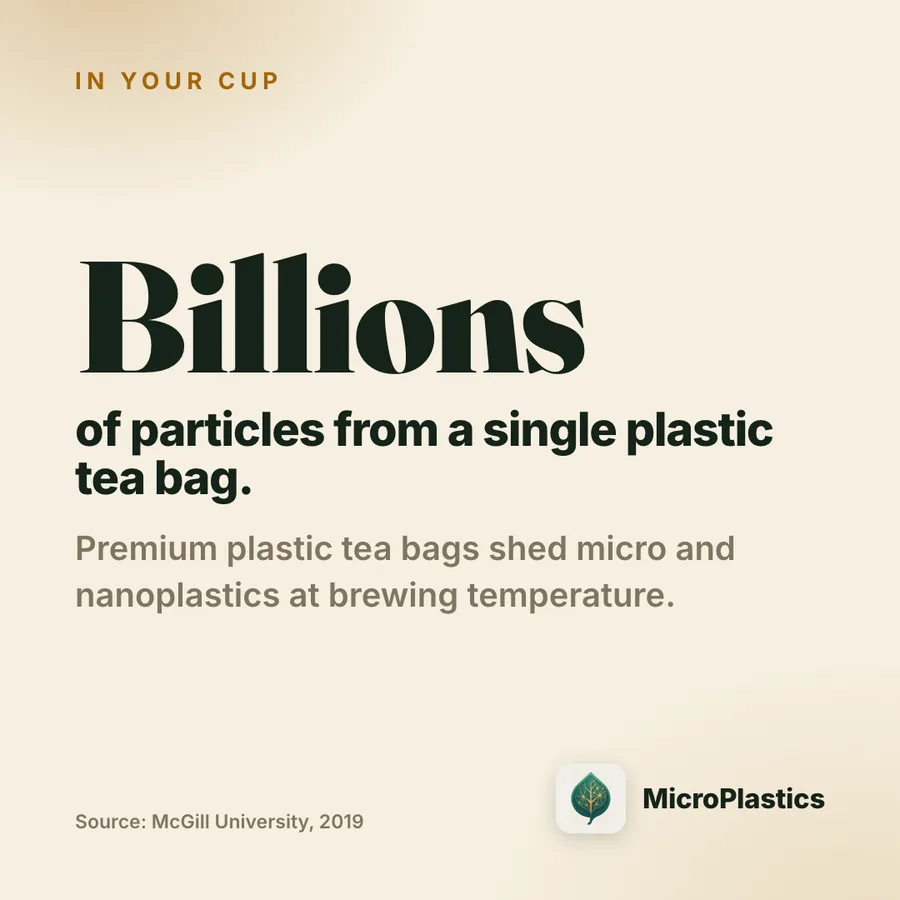
Hernandez et al. (Environmental Science & Technology, 2019) emptied four pyramid-mesh tea bags, washed them, then steeped the empty bags in 95°C water. They counted released particles using electron microscopy. The result: ~11.6 billion microplastic particles and ~3.1 billion nanoplastic particles per cup.
Germany's Federal Institute for Risk Assessment (BfR) later critiqued the methodology, arguing that the particle counting approach likely overestimated the true particle release. The BfR did not dispute that pyramid mesh bags are made of plastic, that they release particles, or that switching to loose-leaf tea reduces this exposure.
The honest takeaway: the precise number is contested. The existence of the exposure is not. If you brew nylon or PET tea bags daily, you are ingesting plastic particles. The amount is somewhere on a spectrum, and the spectrum starts above zero.
Brand-by-brand cheat sheet
| Brand | Bag material | Verdict |
|---|---|---|
| Numi | Plant-based, unbleached, no plastic | Plastic-free |
| Pukka | Plant-fibre stitched bag, no plastic | Plastic-free |
| Clipper | Unbleached paper, plant-based seal | Plastic-free |
| Traditional Medicinals | Paper with no plastic sealant | Plastic-free |
| Yogi (most lines) | Unbleached paper with starch seal | Plastic-free |
| Tetley (UK) | Plastic-free since 2021 | Plastic-free in UK |
| Lipton Pyramid | Polyethylene terephthalate (PET) mesh | Plastic, avoid |
| PG Tips (older) | Polypropylene seal (now claiming biodegradable) | Verify current packaging |
| Twinings (string & tag) | Heat-sealed paper (contains polypropylene | Mixed) verify line |
| Bigelow | Heat-sealed paper (typically polypropylene | Mixed) verify line |
| Tazo (mesh) | Nylon mesh | Plastic, avoid |
| TWG / Mariage Frères (pyramid) | Cotton, no plastic in many lines | Verify line, best premium options |
What to buy instead
- Loose-leaf tea + stainless infuser. The cleanest setup. OXO Brewing Basket (~$15), FORLIFE infuser (~$10), or a basic stainless tea ball ($5). Tea is usually fresher and cheaper per cup too.
- Paper-only certified tea bags. Numi, Pukka, Clipper, Traditional Medicinals, Yogi, Tetley (UK) all explicitly market plastic-free bags.
- Stapled paper bag (no heat-seal). Traditional stapled bags (some Salada and older Lipton lines) avoid the plastic seal issue, though they use a metal staple.
- Brew in a glass or ceramic teapot, not a plastic kettle. The boiling step matters less than the steeping vessel; both add up.
Why “plant-based” bags are not the fix
Several brands have moved from nylon to PLA(polylactic acid), a polymer made from corn starch or sugarcane, and market the result as plant-based, biodegradable or compostable. Those claims are all about end of life — specifically that the bag will break down in an industrial composting facility. They say nothing about what the bag does in your mug.
PLA is still a plastic in the sense that matters here: a synthetic polymer mesh sitting in near-boiling water, shedding particles under exactly the conditions that drive release. A compostable pyramid is a real environmental improvement and a marginal personal-exposure one. If you are reading this for exposure reasons, PLA is a step down from nylon rather than a solution.
What about plastic kettles?
Many electric kettles have plastic interiors, heating element housing, water line, lid mechanism. Hot water in contact with PP / PA / silicone parts can release particles. Glass or fully stainless kettles eliminate this exposure. See our microplastics in electric kettles guide.
What the MicroPlastics app checks
- Tea bag material when declared, paper-only, polypropylene seal, nylon mesh, PET mesh, PLA mesh.
- Brand and product line, “plastic-free” claims and certifications.
- Packaging, outer wrap, sachet liner, box materials.
- Brewing context you log, boiling water vs cooler brew vs cold brew.
- Linked published studies for each scan, including the McGill 2019 and BfR responses.
Use the App
Scan your tea before you brew it
Snap a photo of the box. The app pulls brand + bag type and gives a 0–100 risk score, plus loose-leaf or paper-only alternatives if your current brand contains plastic.
Scan tea packagingRelated reading: microplastics in electric kettles, microplastics in coffee, paper cups, 30 kitchen swaps.
Frequently Asked Questions
Are tea bags made of plastic?
How many microplastics are in a tea bag?
Which tea brands are plastic-free?
Is it safer to use loose-leaf tea?
Are PLA / bioplastic tea bags safer than nylon?
What about traditional Lipton or Bigelow paper bags?
Does steeping at lower temperature reduce particle release?
Should I throw out the tea bags I already bought?
Sources
- Hernandez LM, Xu EG, Larsson HCE, et al. (2019). Plastic Teabags Release Billions of Microparticles and Nanoparticles into Tea. Environmental Science & Technology.
- Bundesinstitut für Risikobewertung (BfR) (2019). Releases from teabags: Scientific evaluation of the Hernandez et al. study. BfR.
- Khan A, Jia Z (2023). Recent insights into uptake, toxicity, and molecular targets of microplastics and nanoplastics relevant to human health impacts. iScience.
- WHO (2022). Dietary and inhalation exposure to nano- and microplastic particles. World Health Organization.
- European Food Safety Authority (2016). Presence of microplastics and nanoplastics in food, with particular focus on seafood. EFSA Journal.
After install · scan this first
Open the camera and scan the tea bag you steeped this morning.
"Silken" pyramid bags release the most. Scan yours to know if you need to switch to paper or loose-leaf.
Android · early access
Get the launch email the day Android opens.
One email. No spam. We send when the Android app is in the Play Store, and never again unless you opt in.
Related Research
Microplastics in Coffee: What’s Really in Your Morning Cup?
What has actually been measured in a cup of coffee: about 16 microplastics per coffee-shop cup and 7 to 17 per capsule coffee, far below the viral numbers. It is the contact surface, not the bean. Brewing methods ranked.
Read moreMicroplastics in Seafood: Which Fish Are Safest to Eat?
A 2026 synthesis found effects in 95.2% of seafood specimens tested, yet seafood is still not your largest dietary source of particles. Which fish are lowest-contact.
Read moreMicroplastics in Salt: Should You Switch Brands?
Sea salt contains up to 600 microplastic particles per kilogram. Why that high concentration still adds up to a small share of your daily intake, and the cheapest swap.
Read moreMicroplastics in Fruits and Vegetables: How Produce Gets Contaminated
A 2026 Amsterdam study found fruit, vegetables and grains supply ~99.5% of daily microplastic particles, ahead of seafood. Why that is, and what it does and does not mean.
Read moreMicroplastics in Fast Food: What Recent Studies Found
Processed food consistently tests among the highest per gram. The cause is cumulative plastic contact across the chain, and the fix is at the hot final step.
Read moreMicroplastics in Milk and Dairy Products: A Complete Guide
Microplastics are in milk, cheese, yogurt and ice cream, but packaging and heat drive the exposure far more than the dairy itself. The lowest-contact formats, ranked.
Read more