Microplastics in Plastic Kettles: The 11.8 Million Particle Study
Last reviewed: by the MicroPlastics Research Desk. Submit a correction or see our editorial standards.
Quick Answer
Different container in your kitchen? Review its confirmed or estimated material and Product Contact Signal, then compare a lower-contact option.
Scan my product
Key Takeaways
- The Zhang et al. 2024 study quantified nanoplastic release from PP plastic kettles at unprecedented levels. 11.8M particles/mL on the first boil.
- Releases drop after first uses but particles remain detectable past 150 boils.
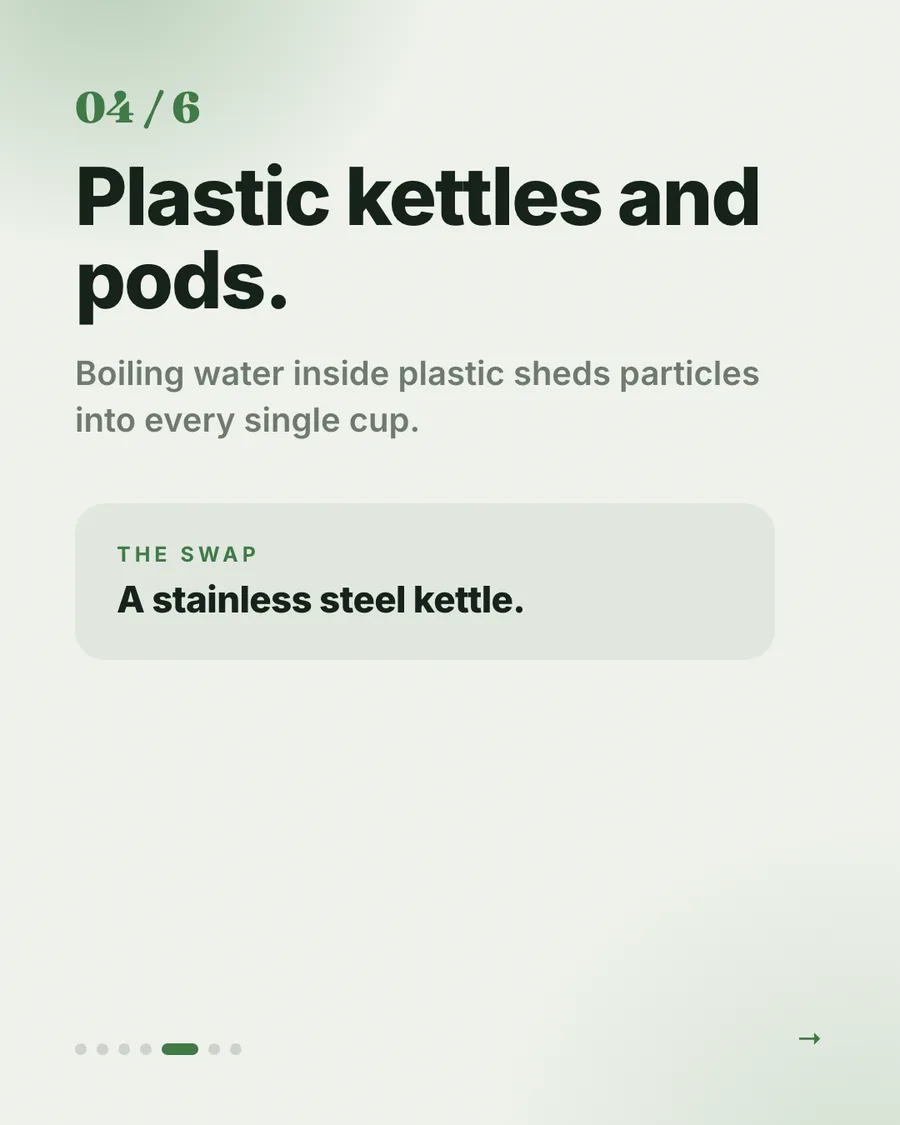
- The plastic interior of many “stainless steel exterior” kettles is the catch, check the water-contact surfaces, not the body.
- Temperatures of 90-100°C (typical kettle range) are above the threshold for accelerated polymer breakdown.
- Full stainless-steel-interior or borosilicate glass kettles eliminate this exposure entirely.
The 2024 study that made headlines
Researchers from the University of Newcastle (Australia) and Anhui Medical University (China) published in npj Emerging Contaminantsin 2024 the most detailed nanoplastic release measurements yet for electric kettles. Using a polypropylene plastic kettle filled with ultrapure water and boiled multiple times, they found:
- 11.8 million nanoplastic particles per mL on the first boil.
- ~3 billion particles in a typical 250 mL cup of tea or coffee from the first boil.
- Release dropped by the 10th boil but stabilised at lower (not zero) levels.
- Particles continued to be detected even after 150 boils.
- The majority of detected particles were nanoplastics (smaller than 1 µm), invisible to standard testing methods.
The “stainless exterior” trap
Many electric kettles look stainless steel on the outside but have a plastic water reservoir, plastic water gauge window, plastic lid insert, or plastic spout filter that contacts the boiling water. Common offenders: Hamilton Beach 1.7L stainless (plastic interior), Cuisinart cordless stainless models with plastic windows, KitchenAid electric kettles with PP water-gauge sleeves.
What to check before buying:
- Is the water reservoir fully stainless steel? Hold a magnet against the inside if you can.
- Is the water-level window plastic or glass? Many gauge windows are plastic.
- Is the lid interior plastic or steel? The lid is in steam contact constantly.
- Is the spout filter plastic or mesh metal?
Kettle types compared
| Kettle type | Microplastic release | Pros | Cons |
|---|---|---|---|
| Borosilicate glass + steel base (Hamilton Beach Glass, OXO Brew) | Effectively zero | Inert; visible water level; widely available | Heavier; breakable |
| Full stainless interior + steel lid (Cuisinart PerfecTemp, Stagg EKG) | Effectively zero | Durable; temperature presets | Can't see water level (varies) |
| Ceramic kettle (Yamazaki, Saki) | Zero | Inert; elegant | Heavy; expensive |
| Stovetop tea kettle (steel or cast iron) | Zero | No plastic at all; works in power outage | Slower; no auto-shutoff |
| “Stainless exterior” with plastic reservoir | Moderate | Marketed as stainless | Plastic interior defeats the purpose; check spec |
| Plastic (PP) kettle | 11.8M nanoparticles/mL first boil (2024 study) | Cheapest | Worst microplastic exposure of any common kitchen appliance |
Recommended truly plastic-free electric kettles (2025-2026)
- Cuisinart PerfecTemp CPK-17, full stainless interior, temperature presets, 1.7L. $120-150.
- Stagg EKG Electric Pour-Over, premium full-stainless gooseneck, programmable temperature. $195-225.
- Hamilton Beach Glass Kettle (40865), borosilicate glass + stainless base. $35-50.
- OXO Brew Adjustable Temperature, stainless interior + steel base; programmable. $90-120.
- Bonavita Variable Temperature, full stainless gooseneck. $90-120.
- Yamazaki Ceramic Kettle, pure ceramic; for traditional tea brewing. $50-80.
- Cast-iron stovetop kettle (Le Creuset, Staub), for those who don't need electric. $80-150.
If you keep your plastic kettle, do these things
- Boil and discard the first 5-10 fills before regular use to shed initial particle release.
- Descale monthly with vinegar, limescale buildup increases particle release.
- Don't reheat the same water repeatedly, fresh water each boil.
- Use the lowest temperature that suits your purpose (some kettles allow 80-90°C presets instead of 100°C).
- Replace your kettle every 2-3 years, older plastic degrades and sheds more.
See related: microplastics in coffee by brewing method, microplastics in tea bags, and best non-toxic cookware.
What the MicroPlastics app checks
- Material, stainless, glass, ceramic, cast iron, plastic (PE / PP / PS / PVC), silicone, wood.
- Visible condition, scratches, chips, warping, fade.
- Brand and product line, flags for non-stick / PFAS-treated items.
- Use-context flags you log, heat exposure, dishwasher cycles, contact with hot or fatty food.
- Cited published research behind the 0–100 risk score.
Use the App
Scan kitchen and household products before buying
Cookware, food storage, cutting boards, accessories. The app weighs material, condition, brand, and use-context to give a 0–100 risk score per item.
Scan household items in the appFrequently Asked Questions
Do electric kettles release microplastics?
What is the safest electric kettle to buy?
Is a glass electric kettle safer than stainless?
How often should I replace my electric kettle?
Does boiling water in a stainless kettle still release any microplastics?
Are Stagg EKG and Cuisinart PerfecTemp really plastic-free?
Sources
- Zhang Z, Jin Z, et al. (2025). Release of nanoplastic from polypropylene kettles. npj Emerging Contaminants.
- Hussain KA, Romanova S, Okur I, et al. (2023). Assessing the release of microplastics from plastic containers and reusable food pouches. Environmental Science & Technology.
- Sobhani Z, Lei Y, Tang Y, Wu L, Zhang X, Naidu R, et al. (2022). The influence of drinking water constituents on the level of microplastic release from plastic kettles. Science of the Total Environment.
- Yu Z, Wang J, Liu L, et al. (2024). Drinking boiled tap water reduces human intake of nanoplastics and microplastics. Environmental Science & Technology Letters.
Compare your kitchen contact pattern over time
The app turns saved scans into a modeled household contact pattern based on what you cooked in, stored in, and heated this month. The trend describes the assessed mix, not health or bodily exposure.
Download on the App Store- Free on iOS
- 3 free scans
- No sign-up
- Result in seconds
“Really cool to scan stuff around the kitchen and see what's actually in it. The swaps it suggests are realistic.” App Store review · 5.0★
Android · early access
Get the launch email the day Android opens.
One email. No spam. We send when the Android app is in the Play Store, and never again unless you opt in.
Related Research
Microplastics in Plastic Wrap (Cling Film): Is It Safe?
PVC and LDPE plastic wraps leach plasticisers and microplastics into food: especially hot, fatty, or acidic foods. Here is what to know and lower-plastic-contact alternatives.
Read moreMicroplastics in Pillows and Mattresses: What You Breathe All Night
You spend a third of your life on a mattress and pillow. Polyester, polyurethane foam, and flame retardants release microplastics and chemicals you inhale for 8+ hours nightly.
Read moreMicroplastics in Laundry & Dishwasher Pods: The PVA Problem
A 2021 Arizona State study found 77% of PVA plastic from laundry & dishwasher pods enters the environment intact. Liquid detergents are the lower-plastic-contact alternative.
Read moreMicrowaving Plastic Containers: What Happens in 5 Minutes
A 2023 study found microwaving plastic releases up to 4.22 million microplastic particles per cm² in 3 minutes. "Microwave-safe" does not mean particle-free.
Read morePlastic Cutting Boards and Microplastics: Switch to Wood?
A 2023 study estimated up to 50g of microplastic per person per year from polyethylene cutting boards. Wood and bamboo alternatives ranked.
Read moreBlack Plastic Kitchen Utensils: Should You Replace Them?
The viral 2024 study found brominated flame retardants in ~85% of black plastic kitchen items tested, apparently from recycled e-waste. The math correction explained, plus replacement priorities.
Read more