Best Non-Toxic Cookware 2026: Cast Iron, Steel, Ceramic, Enamel Ranked
Last reviewed: by the MicroPlastics Research Desk. Submit a correction or see our editorial standards.
Quick Answer
Different container in your kitchen? Review its confirmed or estimated material and Product Contact Signal, then compare a lower-contact option.
Scan my product
Contains affiliate links · we may earn a commission at no cost to you · full disclosure
Key Takeaways
- All PTFE / Teflon / “non-stick” pans shed coating particles, even “PFOA-free” modern versions. Avoid as primary cookware.
- Cast iron and stainless steel are the safest, most durable, and longest-lasting materials, both will outlive you.
- Enamel-coated cast iron (Le Creuset, Staub) gives non-stick-like ease for low-fat cooking without any plastic coating.
- Ceramic-coated pans vary widely: pure ceramic (Xtrema) is excellent; ceramic coatings on metal degrade in 1–3 years.
- Carbon steel is the professional kitchen workhorse, lighter than cast iron, gets a natural non-stick patina, no coatings.
Why non-stick is the elephant in the kitchen
Modern non-stick coatings are typically PTFE (polytetrafluoroethylene, often called Teflon). PFOA, a perfluorinated chemical used historically as a manufacturing aid, was phased out in the US in 2015 after EPA action. PFOA-free Teflon is generally considered safer in normal cooking, BUT:
- The PTFE coating itself still wears off and is ingested. A 2022 study from the University of Newcastle (Australia) found a single scratch in a non-stick pan can release ~9,100 microplastic particles per use, and small surface defects can release up to 2.3 million particles.
- Above ~260°C (500°F), PTFE begins to break down and release toxic fumes (polymer fume fever / “Teflon flu” in humans, fatal to pet birds).
- PFAS-related chemistry (the broader chemical family) remains under regulatory scrutiny worldwide.
Cookware materials ranked
| Rank | Material | Microplastic release | Chemical concerns | Best for |
|---|---|---|---|---|
| 1 | Cast iron (uncoated) | None | Adds iron (often beneficial) | Searing, baking, anything not highly acidic |
| 2 | Stainless steel (18/8 or 18/10) | None | None at consumer temperatures | Everyday sautéing, sauces, boiling |
| 3 | Carbon steel | None | Iron leaching like cast iron | Wok cooking, eggs, crepes |
| 4 | Enamel-coated cast iron | None | Some legacy lead concerns in vintage; modern products safe | Braises, stews, soups, acidic foods |
| 5 | 100% ceramic (Xtrema) | None | None, no metal contact either | Sensitive eaters; oven-to-table |
| 6 | Ceramic coating on metal | Low when new, increases as coating wears | Generally PFAS-free | Non-stick alternative for 1–3 years |
| 7 | Glass (Pyrex, Anchor Hocking) | None | None | Baking, casseroles |
| 8 | Copper (lined with stainless or tin) | None from lined; check liner | Bare copper not for acidic food | Premium sauce work |
| Avoid | PTFE / Teflon non-stick | High when scratched/aged (millions per scratch) | PFAS family; toxic fumes >260°C | Avoid as primary cookware |
| Avoid | Aluminium (unlined) | None | Aluminium leaches into acidic food | Avoid bare; anodized aluminium is acceptable |
Top picks by use case
Best overall: cast iron + stainless steel pair
The classic two-pan kitchen: a 10-inch Lodge cast iron($25–$30) for sears, eggs, and oven-to-table, plus a 10-inch All-Clad D3 stainless ($120–$180) for sauces, sauté, and boiling. Together these cover 90% of home cooking and will last decades.
Best non-stick alternative: enamel-coated cast iron
- Le Creuset Signature Round Dutch Oven 5.5 qt, heirloom-grade French enamel; lifetime warranty; $350–$450.
- Staub Round Cocotte, black-interior enamel, slightly more sear-friendly; $200–$350.
- Lodge Enameled Cast Iron Dutch Oven, budget alternative at $60–$100, very capable.
Best ceramic non-stick (when you really want non-stick)
- Caraway 10.5" Fry Pan, popular, ceramic-coated aluminium, PFAS-free; replace every 2–3 years as coating wears; $95.
- Our Place Always Pan 2.0, multi-use ceramic-coated; same replacement cycle; $145. We tested the Essentials range and scored it 8.7/10, see the full Our Place Essentials Pan Trio review.
- GreenPan Valencia Pro. Thermolon ceramic; well-tested; $75–$120.
- Xtrema Pure Ceramic, pure ceramic body (not coated metal); slow to heat but absolutely no metal or coating concerns; $80–$200.
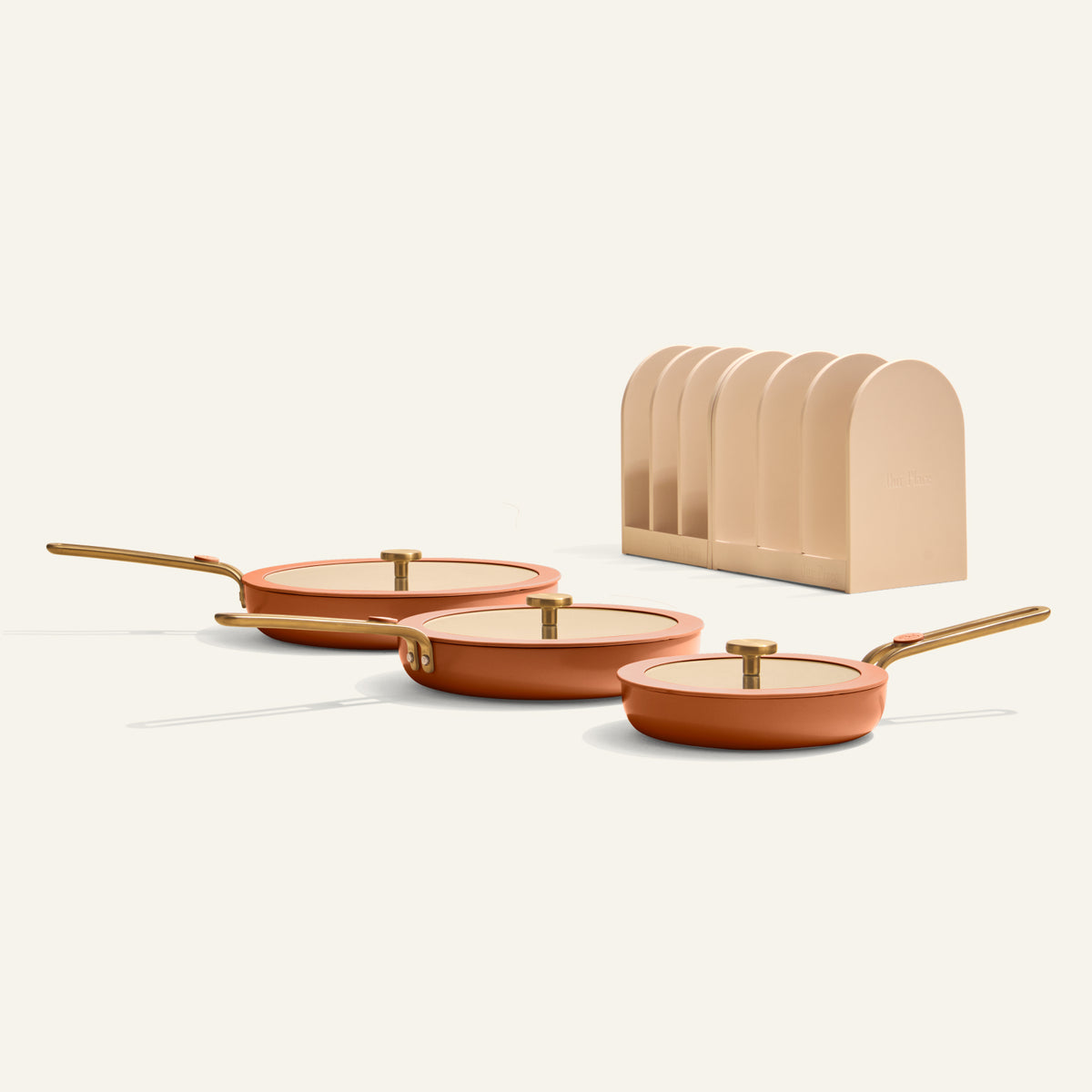
Our Place Essentials Pan Trio
8.7 / 10Our pick when you genuinely want nonstick. The Thermakind coating is sol-gel silica, not a fluoropolymer, so unlike PTFE there is no polymer present to shed as microplastic. Consumer Reports screened Our Place against 96 PFAS compounds in 2022 and found none.
The catch: like every ceramic nonstick, treat it as a 2–3 year consumable rather than lifetime cookware.
8 pieces (8″, 10″, 12″ + lids + storage) · $249.95 · 100-day trial, free returns
Best carbon steel
- Made In Carbon Steel. US-made, blue carbon steel, develops great patina; $99–$135.
- Matfer Bourgeat Black Steel, professional French standard; lighter than cast iron; $50–$95.
- de Buyer Mineral B, comes pre-seasoned with beeswax; $65–$120.
Best full-stainless complete set
- All-Clad D3 Stainless 10-piece, gold standard; lifetime warranty; $700–$900.
- Misen Stainless, direct-to-consumer alternative; great value; $300–$500 for 10 pieces.
- Tramontina Tri-Ply Clad, under-$300 7-piece set, often recommended by Cook's Illustrated.
What to avoid
- Any pan with a peeling, scratched, or visibly worn non-stick coating, replace immediately, do not continue using.
- Pre-2015 non-stick pans (PFOA era) if you still have them in the cupboard.
- Bare aluminium pans for acidic foods (tomato sauce, citrus).
- Bamboo melamine “eco” cookware, releases formaldehyde when heated.
- “Copper-coloured” non-stick pans (Copper Chef, Red Copper), these are PTFE coatings dyed copper, not actual copper cookware.
- Cookware with rubberised handles or silicone grips that touch hot food.
How long should your cookware last?
| Material | Typical lifespan | When to replace |
|---|---|---|
| Cast iron | Lifetime+ | Never, can be re-seasoned indefinitely |
| Stainless steel | 20+ years | When base warps or handle fails |
| Carbon steel | Lifetime | Never with proper seasoning |
| Enamel cast iron | 20+ years | If enamel chips inside cooking surface |
| 100% ceramic (Xtrema) | 10+ years | If cracked |
| Ceramic-coated metal | 1–3 years | When coating dulls or food sticks |
| PTFE non-stick | 1–2 years (recommended) | Immediately if scratched |
See related: reduce microplastics in your kitchen, microplastics in plastic containers, and best plastic-free food storage.
What the MicroPlastics app checks
- Material, stainless, glass, ceramic, cast iron, plastic (PE / PP / PS / PVC), silicone, wood.
- Visible condition, scratches, chips, warping, fade.
- Brand and product line, flags for non-stick / PFAS-treated items.
- Use-context flags you log, heat exposure, dishwasher cycles, contact with hot or fatty food.
- Cited published research behind the 0–100 risk score.
Use the App
Scan kitchen and household products before buying
Cookware, food storage, cutting boards, accessories. The app weighs material, condition, brand, and use-context to give a 0–100 risk score per item.
Scan household items in the appFrequently Asked Questions
What is the safest cookware material?
Is PFOA-free Teflon safe?
Is ceramic cookware microplastic-free?
What is the best cast iron pan?
Are Caraway pans safe?
Is stainless steel cookware safe for everyday cooking?
How often should I replace non-stick pans?
Sources
- Luo Y, Gibson CT, Chuah C, et al. (2022). Raman imaging of microplastics and nanoplastics generated by cutting PVC pipe. Environmental Pollution.
- US Environmental Protection Agency (2024). PFOA, PFOS and Other PFAS: drinking water and consumer products. EPA.
- European Food Safety Authority (2020). Risk to human health related to the presence of perfluoroalkyl substances in food. EFSA Journal.
- IARC Working Group (2017). Perfluorooctanoic acid (PFOA) - IARC Monograph 110. International Agency for Research on Cancer.
Compare your kitchen contact pattern over time
The app turns saved scans into a modeled household contact pattern based on what you cooked in, stored in, and heated this month. The trend describes the assessed mix, not health or bodily exposure.
Download on the App Store- Free on iOS
- 3 free scans
- No sign-up
- Result in seconds
“Really cool to scan stuff around the kitchen and see what's actually in it. The swaps it suggests are realistic.” App Store review · 5.0★
Android · early access
Get the launch email the day Android opens.
One email. No spam. We send when the Android app is in the Play Store, and never again unless you opt in.
Related Research
Plastic Recycling Numbers 1-7: Material and Contact Conditions
What plastic numbers 1–7 identify and how material, heat, wear, and use conditions differ. Ranked by modeled plastic contact, not chemical safety.
Read moreMicroplastics in Plastic Containers: Is Your Tupperware Leaching?
Microwaving plastic releases up to 4.22 million microplastic and 2.11 billion nanoplastic particles per cm2 in three minutes. The full numbers, and the lower-plastic-contact comparisons.
Read moreMicroplastics in Your Home: Hidden Sources and How to Eliminate Them
Room by room, ranked by what the measurements actually support: never microwave in plastic, filter the air, hard floors and natural fibres, ventilate the car.
Read moreAirborne Microplastics: The Invisible Pollution You Breathe Every Day
New 1-10 µm measurements put lung-penetrating intake near 68,000 particles a day, with car cabins over four times worse than homes. What to do about it.
Read moreMicroplastics in Plastic Kettles: The 11.8 Million Particle Study
A 2024 study found a new plastic electric kettle releases up to 11.8 million nanoplastic particles per mL on the first boil. lower-plastic-contact stainless and glass kettle picks.
Read moreMicroplastics in Plastic Wrap (Cling Film): Is It Safe?
PVC and LDPE plastic wraps leach plasticisers and microplastics into food: especially hot, fatty, or acidic foods. Here is what to know and lower-plastic-contact alternatives.
Read more