Microplastics scanner app
Scan any product for microplastic risk in 5 seconds
Tap the barcode. Snap the packaging. Get a 0–100 score backed by published research, plus a safer swap if the score is high. Works on food, drinks, cosmetics, cookware, baby gear, and household products.
5.0 on the App Store3 free scans, no account required
Quick answer
MicroPlastics is the only consumer barcode scanner app built specifically for microplastic and plasticiser risk. Other product-scanner apps (Yuka, Think Dirty, EWG Healthy Living) score for general additives or cosmetic safety, but none weigh packaging material, container condition, and microplastic-related chemicals (BPA, BPS, PFAS, phthalates) the way this one does. Scan a barcode and a packaging photo, get a 0–100 risk score with the cited research, and a safer alternative if the score is high. Free to start on iOS with 3 scans.
The comparison
How MicroPlastics compares to other scanner apps
Yuka, Think Dirty, and EWG Healthy Living are excellent for what they were built for. Here is what each one actually evaluates, and why MicroPlastics is the right tool for the plastics question.
| App | Built for | Microplastic scoring | Packaging analysis | BPA / PFAS / phthalates |
|---|---|---|---|---|
| MicroPlastics | Microplastic + plasticiser risk across food, drink, cosmetics, household | Yes: 0–100 score with cited research | Yes: photo-based condition scoring | Flagged as chemicals of concern |
| Yuka | Nutrition + additive safety for food & cosmetics | No: does not score plastics | No: barcode only | Partial: only chemicals in the ingredient list |
| Think Dirty | Cosmetic ingredient safety | No: flags polymers only as a single ingredient | No | Yes: ingredient-list focus |
| EWG Healthy Living | EWG database lookup for food + personal care | No: not scored separately | No | Yes: EWG database flagging |
All four apps are barcode-driven. Only MicroPlastics also uses a packaging photo, which is where most microplastic risk variation lives across copies of the same product.
How it works
Three steps. Five seconds per product.
Scan the barcode
Point your camera at any product barcode. The app pulls the brand, category, and declared packaging from the catalog instantly.
Snap the packaging
Take a quick photo of the actual container. The scoring model evaluates scratches, dents, fade, cap style, and condition, things barcode-only apps can't see.
Get a 0–100 score
See the risk score, the published studies that informed it, and a safer alternative if the product scores high. Save to your log to track exposure over time.
The photo matters
Why barcode-only apps miss half the story
Most food-rating apps just read the barcode and look up ingredients. For microplastics, the package is where most of the risk lives, and a barcode can't see condition.
Two bottles of the same brand water, one stored in a cool dark warehouse and one in a hot sunlit pallet, deliver very different particle loads when you open them. Two non-stick skillets, one new and one scratched after three years, are not the same risk.
The MicroPlastics app uses both the barcode and a photo. The barcode pulls brand, category, and packaging spec from the catalog. The photo lets the scoring model see scratches, dents, fade, cap style, and physical condition. Together they produce a 0–100 risk score with the cited published research available inside each scan.
Inside the app
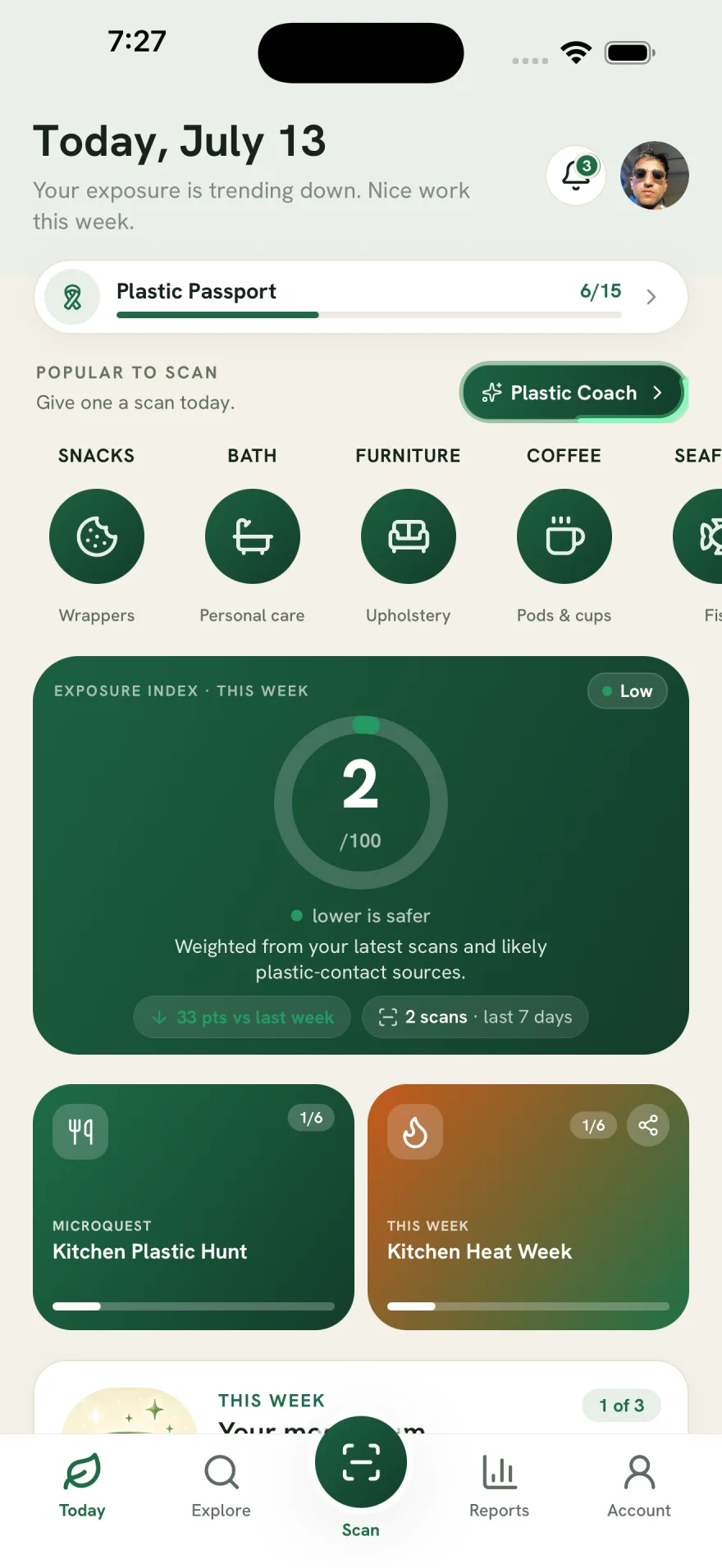
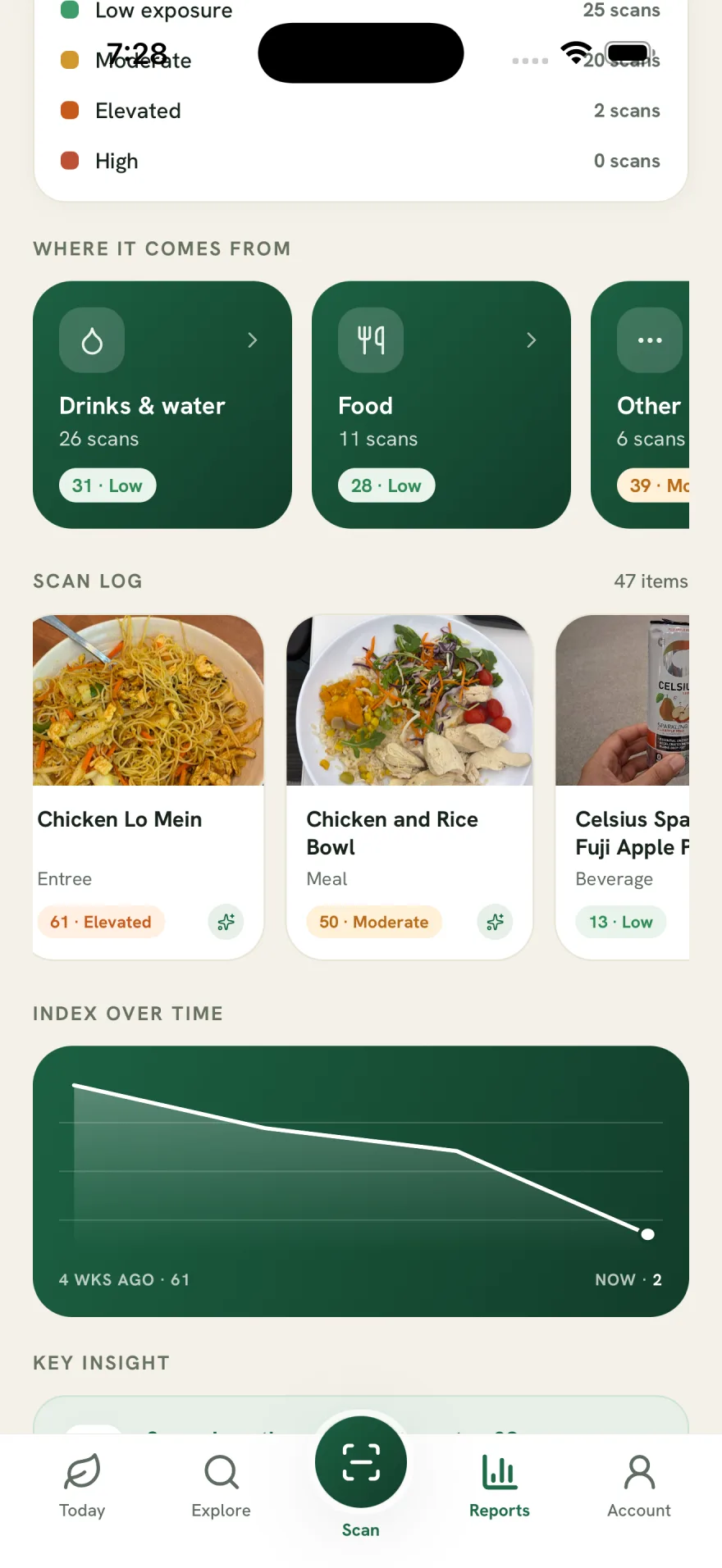
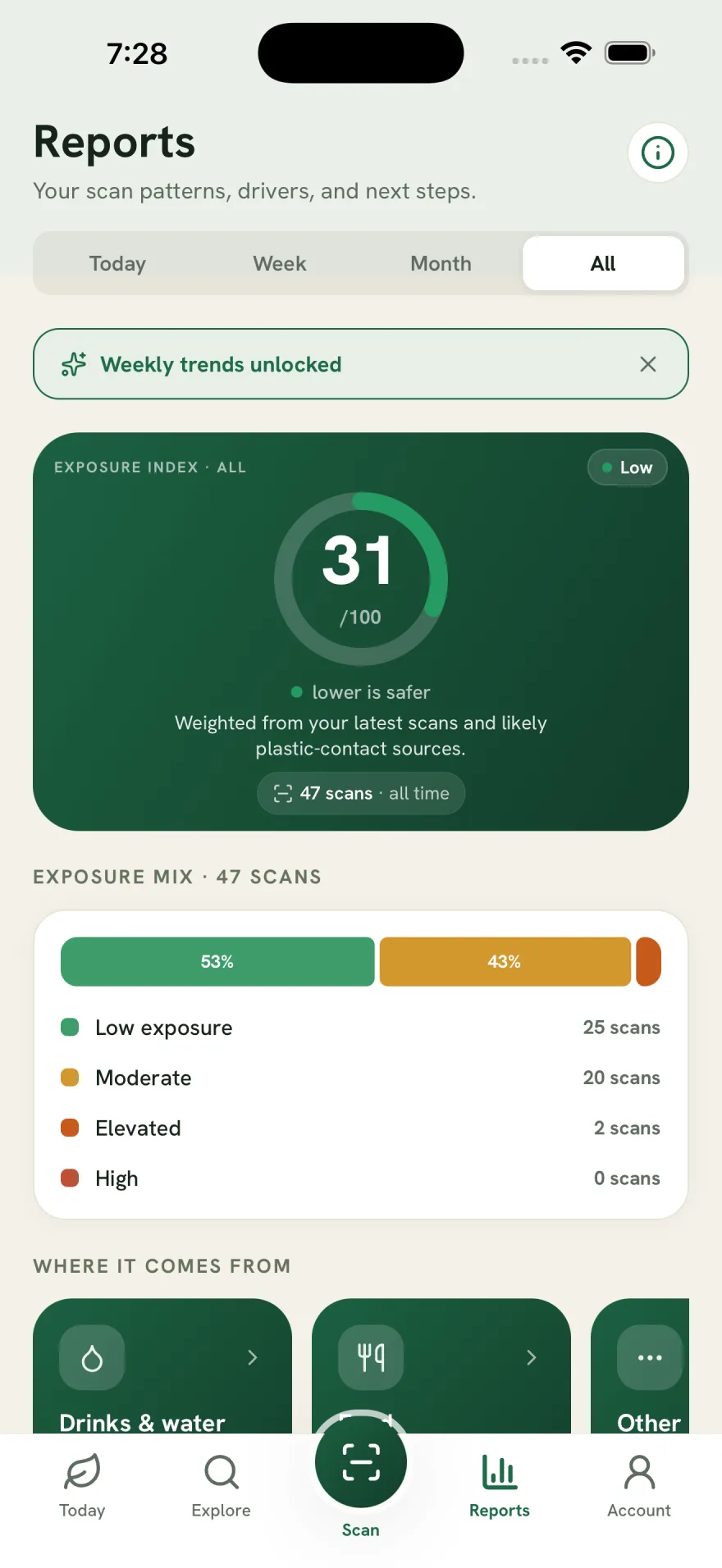
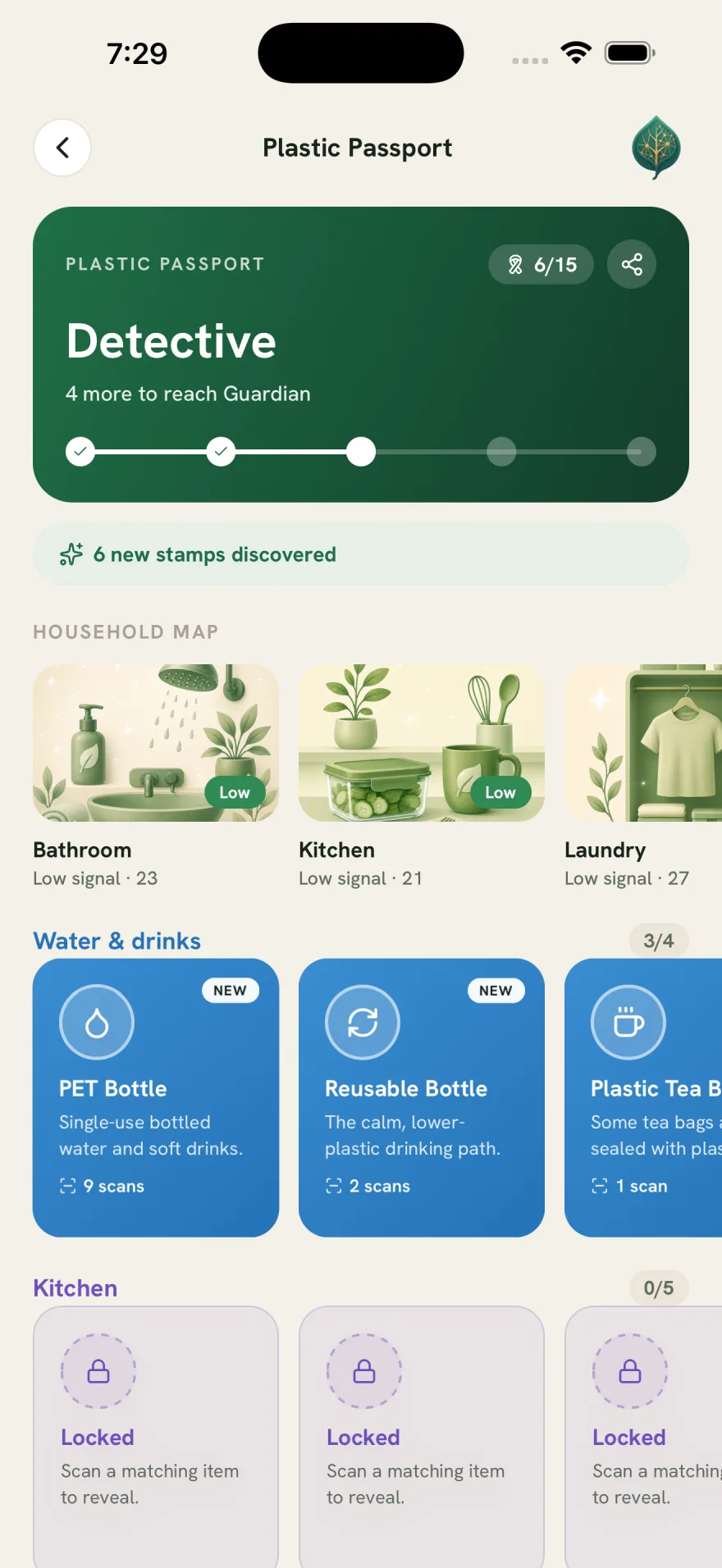
What it looks like
Clean, fast, no ads. The score on every product is a number plus the reasoning behind it.
Coverage
What you can scan
Anything with a barcode, and plenty without one. The camera has five modes (Auto, Barcode, Label, Ingredients, Material), you can type a product name when there is nothing to photograph, and the scoring model adapts to the category.
Bottled water & drinks
PET vs glass vs aluminum; brand, condition, storage history.
Packaged food
Canned, jarred, plastic-tubbed, frozen: material + heat history.
Coffee & tea
Cups, K-cups, tea bags: flag plastic-lined and nylon mesh.
Cosmetics & skincare
Ingredient-list parser for polyethylene, acrylates, PEG, fragrance.
Cookware & utensils
PTFE non-stick, black plastic, ceramic, stainless, cast iron.
Baby & kids products
Bottles, sippy cups, pouches, baby food, diapers.
Food storage
Tupperware, deli containers, plastic wrap, Ziploc, glass.
Personal care
Toothpaste, dental floss, deodorant, body wash, shampoo.
5.0 on the App Store
What people are saying
Real reviews from people using the app to make 5-second decisions at the shelf.
Simple & Powerful
“This app is honestly incredible. I had no idea how much microplastic exposure could be hiding in everyday food until I started using it. The scanner is super easy to use, fast, and makes checking products feel effortless. It's made me way more aware of what I'm buying and eating, and I genuinely feel like I'm making healthier choices because of it.”
Makes me feel way better about what I eat
“I kept seeing stuff about microplastics in food and had no idea what was safe anymore. This app lets you scan anything and it breaks it down for you instantly. I check everything now before I buy it. Honestly didn't think an app like this existed yet.”
Convenient App
“This app is clutch to have if you are concerned about having control over your health outcomes. One of my favorite alkaline waters was in the high range and will effect my choice to buy it again. This is a strong app: no glitches, and no incorrect data.”
I NEVER Knew!!!
“I had NO idea that our food and water contained so many harmful chemicals! Using this app has been an eye opener! I was plenty surprised that my Smucker’s Strawberry Preserve, in a glass jar, safely made the cut! I highly recommend!”
The evidence
Backed by peer-reviewed research
Every score is tied to published studies you can read yourself. No opaque AI claims, no wellness-influencer math.
Qian et al. 2024 (PNAS)
Bottled water averages ~240,000 plastic particles per liter, ~90% nanoplastics.
Marfella et al. 2024 (NEJM)
Microplastics in carotid plaque linked to 4.53× higher risk of heart attack or stroke.
Garcia et al. 2024 (Toxicological Sciences)
Microplastics detected in 100% of human placentas tested.
Li et al. 2020 (Nature Food)
~1.6 million microplastic particles per day from polypropylene baby bottles in formula context.
Hussain et al. 2023 (Environ. Sci. & Tech.)
Microwaving plastic containers releases up to 4.22M particles per cm² in 3 minutes.
Yadav et al. 2023 (Environ. Sci. & Tech.)
Plastic cutting boards shed up to 50g of microplastic per person per year into food.
Pricing
Start free
Three free scans to test the app on your own pantry. Premium when you're ready.
Free
$0
3 scans included
- Barcode + photo scanning
- 0–100 risk score with cited research
- Safer alternative suggestions
Premium annual
$49.99/yr
About $4.17/month, billed annually
- Unlimited scans
- Personal exposure tracking
- Saved product history
- Plasticiser flags (BPA, BPS, PFAS, phthalates)
Premium monthly
$7.99/mo
Cancel anytime
- Unlimited scans
- All premium features
- Best for short-term use
3-day free trial on Premium. Subscriptions auto-renew and are billed to your Apple ID; cancel anytime in App Store settings.
Common questions about the MicroPlastics scanner
Is there an app that scans products for microplastics?
How is the MicroPlastics app different from Yuka?
Does the app actually detect microplastics in the product?
Is the MicroPlastics app free?
What products can I scan with the MicroPlastics app?
How does the photo-based packaging analysis work?
Is the MicroPlastics app available on Android?
How accurate is the 0-100 risk score?
Can I cancel a Premium subscription?
What does the app include besides the scanner?
Does the app work offline?
Build your exposure baseline this week.
Start with 3 free scans of the products you use most: water, coffee, cookware, food storage, cosmetics. See the score, see the research, see the swap.
Download on iOSFree · 3 scans included · No credit card required
Related reading: how to check products before you buy, bottled water microplastics, 25 highest-risk foods, 30 kitchen swaps.