For brands

Certified on what's in it and what it's in

Every existing mark in this space assesses the formula. None assesses the container — which for most categories is the larger exposure route. Plastic-Checked assesses both, on two independent axes, against criteria published before you apply.

Indicatively from $199 for the first product, then $99 per product — against EWG's published $250 per product. Annual licence from $600.

Applying is free — no card, no payment

What the criteria rest on

103
flagged ingredients in our published ingredient database
15
packaging formats assessed in our packaging database
1,916
real ingredient lists already analysed across 62 brands

Pricing

A base fee covers assessing your first product, then each further product is charged at your tier's rate. On a pass, a separate annual licence covers use of the mark and scales with revenue and portfolio size — so an independent brand is not priced out of a mark that large incumbents can buy easily.

Deliberately cheaper than the incumbent

EWG VERIFIED publishes a $250 per-product evaluation fee. Ours is $75$99 per additional product, so at least 60% less per product in every tier, and the gap widens the more products you certify. We also assess packaging as well as ingredients, which that fee does not cover anywhere.

We are not taking payments yet

Nothing is charged when you apply. Fees are indicative, confirmed with you in writing before any assessment begins, and we take no payment through this site. Right now we are gathering applications, and we will contact you directly to agree scope and fees before anything begins.

Independent

Under $500k annual revenue

$199

one-off, to assess

+ $99 per extra product

+ $600/year

licence, if you pass

Licence covers up to 10 products

  • Both axes: ingredients and packaging
  • Mark usage on pack, site and listings
  • Listing in the certified directory
  • Written report, failures explained
  • One free re-assessment
Most common

Growing

$500k – $5M annual revenue

$399

one-off, to assess

+ $85 per extra product

+ $1,800/year

licence, if you pass

Licence covers up to 40 products

  • Everything in Independent
  • Per-product breakdown, not a range
  • Priority assessment queue
  • Free pre-submission screen
  • Annual re-assessment included

Established

$5M – $50M annual revenue

$699

one-off, to assess

+ $75 per extra product

+ $4,500/year

licence, if you pass

Licence covers up to 150 products

  • Everything in Growing
  • Portfolio-level reporting by product line
  • Named reviewer and a scheduled annual call
  • Reformulation guidance
  • Co-marketing assets

Enterprise

Over $50M annual revenue

Custom

Quoted per portfolio

Unlimited portfolio

  • Everything in Established
  • Multi-brand, multi-market portfolios
  • Supply-chain and co-man scope
  • Bespoke assessment schedule
  • Dedicated account contact

Figures above are indicative. No payment is taken on this site and nothing is charged when you apply.

Included at every tier

  • Assessment against criteria published in advance, not a private rubric
  • A result either way — a failed application gets the same written report
  • No effect on your product score in the app or on this site, ever

The mark

The claim is built into the badge

Plastic-Checked never means “green,” “non-toxic” or universally microplastic-free. It means the named product passed our published ingredient and packaging assessments. The artwork says that plainly instead of asking a shopper to infer it.

Verification rule

Every use must resolve to an active product record. No passed record, no mark.

Open the certified-product registry
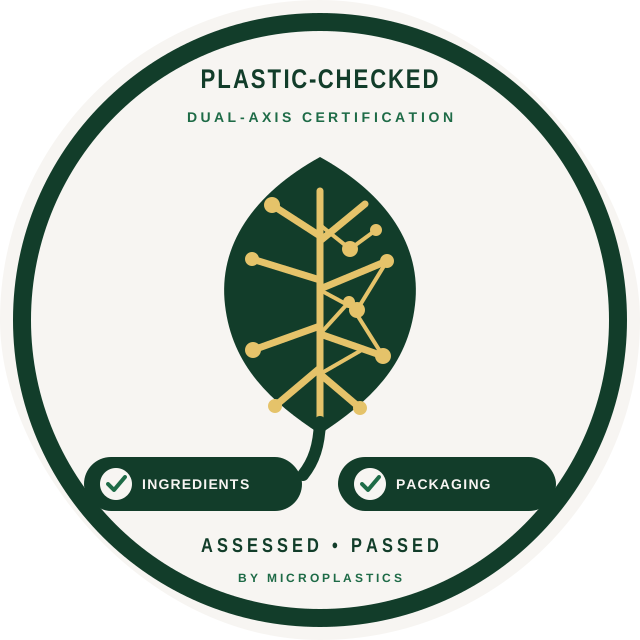
Plastic-Checked primary seal: ingredients and packaging assessed and passed

01 / Primary seal

Dual-Axis Seal

The front-of-pack mark. Both assessment axes are written into the seal, so the claim still makes sense when it is seen away from our website.

Use at 40 mm / 192 px or larger

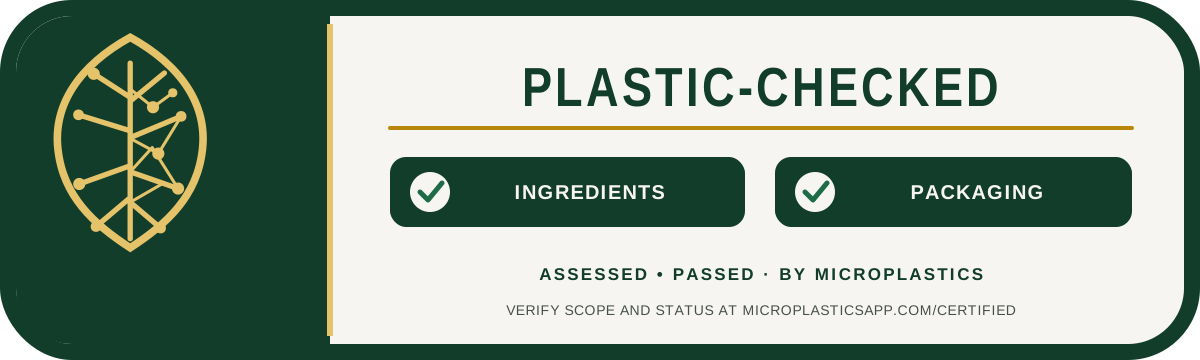
02 / Digital proof badge

Evidence Plaque

For product pages, retailer listings and press kits. It carries the verification destination and keeps the two passed axes readable.

Use at 420 px wide or larger

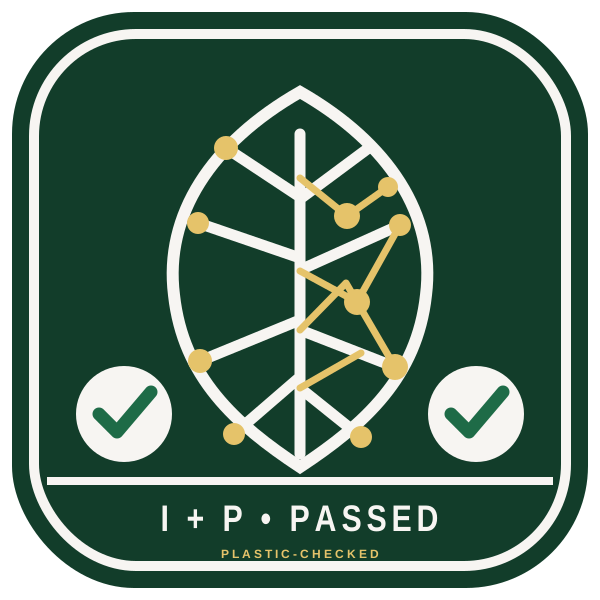
03 / Small-space stamp

Twin-Check Stamp

For a cap, carton corner or marketplace thumbnail. It is a recognition device, not a standalone claim, and must sit beside the full qualifier.

Use at 64 px or larger, with adjacent qualifier

What you actually get

Four deliverables, not a logo file and an invoice.

The mark, stating what passed

A badge for pack, site and listings that names which axes were assessed and passed. Collapsing two different claims into one badge is how certification stops being informative, so we do not.

A written assessment report

Every application gets one, pass or fail, naming the specific ingredients or formats behind any failure. A fail you can act on is worth more than a pass you cannot explain.

A listing in the certified directory

A public page on the site that shoppers and our app can link to, sitting alongside the databases the criteria come from.

A reformulation path

The criteria are public, so you can see exactly what would need to change before you apply — and one re-assessment is included once you have changed it.

The two axes

Assessed independently. A clean formula in a squeeze bottle is not the same product as a film-former in a glass jar, and a single badge that implied otherwise would be worthless.

01

Ingredient axis

Passes if: No solid synthetic polymer particles and no plastic film-formers in any product in scope.

  • Full INCI list screened against our 103-entry microplastic ingredient database
  • Includes film-formers, not only microbeads — film-formers are where most brands actually fail
  • Siloxanes assessed separately and not counted as microplastics, because they are not
  • Bio-based polymers such as PLA are not automatically exempt
See the ingredient criteria

02

Packaging axis

Passes if: Primary packaging does not place a polymer wall in sustained contact with the contents.

  • Container material and any internal liner, across 15 assessed formats
  • Closure and cap liner, which most schemes ignore entirely
  • Fat and acidity of the contents, since both increase migration
  • Expected storage conditions, including heat and light exposure
See the packaging criteria

Apply

Start an assessment

Ten minutes, and it costs nothing. We reply with your tier, the scope we would assess and a timeline — no payment is requested here, and nothing is published or licensed until an assessment is complete and passed.

Fees are on a sliding scale by revenue, so small brands are not priced out. This only sets your tier.

Product categories
What are you claiming?

These are your declarations, not our findings. Everything is verified against the published criteria before any mark is granted, and a brand can be certified on one axis without the other.

We use your details to assess the application and contact you about it. Applications are not published. See our privacy policy.

How it runs

  1. 01

    Apply

    Tell us the brand, the products in scope and where the ingredient lists live. Ten minutes.

  2. 02

    We assess

    Both axes, against the published criteria. Two to three weeks for most portfolios.

  3. 03

    You get the report

    Pass or fail, with the specific reasons and what would change the result.

  4. 04

    License the mark

    On a pass, the annual licence starts and your directory listing goes live.

How we keep this honest

A scheme that charges the brands it assesses has an obvious conflict of interest, and pretending otherwise would be worse than naming it. Our position, in full:

  • Criteria are published before assessment, so a pass is checkable rather than a matter of trust.
  • Fees are charged for the assessment, not the result. A failed application is not refunded.
  • Certification status never alters a product’s score in the app or on this site. Consumer scoring and this programme are separate, and paying us cannot improve a score.
  • We do not sell advertising, sponsored placement, or category exclusivity.
  • The databases the criteria come from are public, so anyone can audit a decision against them.

Questions

What does Plastic-Checked certification assess?
Two independent axes. The ingredient axis screens the full INCI list against our published microplastic ingredient database, including film-formers rather than only microbeads. The packaging axis assesses whether the container places a polymer wall in sustained contact with the contents, including the closure and cap liner. A brand can pass one axis without the other, and the mark states which.
How much does certification cost?
A base assessment fee starts at $199 and covers the first product, then each additional product is $75 to $99 depending on tier. For comparison, EWG VERIFIED publishes a $250 per-product evaluation fee, so this is at least 60% less per product — and it covers packaging as well as ingredients. If the products pass, an annual licence for the mark starts at $600, on a sliding scale set by revenue and portfolio size. Nothing is charged when you apply.
Does paying a fee influence the outcome?
No. The fee covers assessment work and licence administration and is charged whether the outcome is a pass or a fail — a failed application is not refunded. Criteria are published in advance so a pass is checkable rather than a matter of trust, and certification status never changes a product score in the app or on this site.
Do I pay when I apply?
No. Applying is free and no payment is taken on this site. The published fees are indicative: we review your application, then contact you directly to agree the scope and confirm fees in writing before any assessment begins. You can withdraw at any point before that.
How long does assessment take?
Most applications are assessed within two to three weeks of receiving complete ingredient and packaging information. Larger portfolios take longer. You will get a written report either way, including the specific ingredients or formats that caused any failure, so reformulation has something concrete to work from.

The criteria are simply our public databases: ingredients, packaging, brands already analysed and exposure habits. Read them before you apply — that is the point of publishing them.