Is "Microwave Safe" a Lie? What the Label Actually Means (2026)

Last reviewed: by the MicroPlastics Research Desk. Submit a correction or see our editorial standards.
Quick Answer
Different container in your kitchen? Review its confirmed or estimated material and Product Contact Signal, then compare a lower-contact option.
Scan my product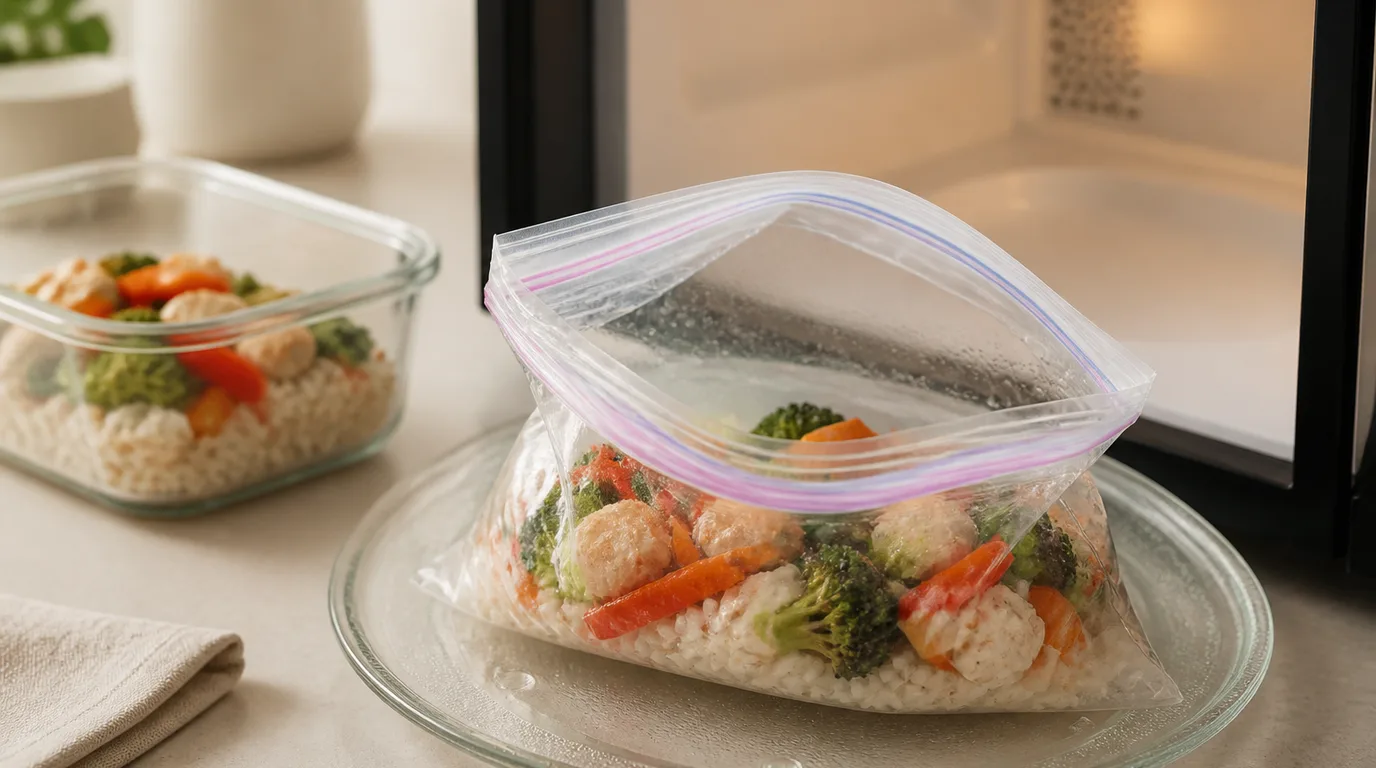
Key Takeaways
- There is no FDA “microwave safe” certification, symbol, or test. The wavy-lines icon you see on a lid is a manufacturer's mark, not a regulatory one, no agency issues it and no agency verifies it.
- What the law actually requires: food-contact plastics must be cleared under 21 CFR 174.5 and used within a declared condition of use (21 CFR 176.170(c), Table 2). Microwave reheating is Condition of Use H.
- That clearance is established by migration testing, the material sits against aqueous, acidic, and fatty food simulants at set temperatures, and dissolved chemical substances are quantified. Particles are never counted.
- So “microwave safe” is a melt-and-leach claim, not a shedding claim. It is true and it is meaningful, it just answers a different question from the one shoppers are asking in 2026.
- The temperature margin is thinner than the label implies. LDPE melts at 105–115°C; water boils at 100°C. A polyethylene bag in a microwave is running within roughly 5–15°C of its own melting point. Polypropylene (#5), which melts at 160–170°C, has genuinely more headroom, which is exactly why #5 is the plastic that usually carries the label.
- The research the label doesn't cover: Hussain et al. (2023) measured up to 4.22 million microplastic and 2.11 billion nanoplastic particles per square centimetre of container surface, into a food simulant, after 3 minutes at full power, and that is the worst-case top of a range that starts at 425 particles/cm². Every container tested was FDA-compliant.
- A published challenge argues the driver is heat, not microwave radiation (Sun et al. 2024), the microwave is just the fastest way to get plastic hot. That reframes the whole problem: the fix isn't avoiding a microwave, it's avoiding hot food in plastic.
What the label is (and isn't) by the numbers
- FDA microwave-safe certifications
- Zero
- No FDA regulation defines "microwave safe." There is no federal test, symbol, or approval for the phrase, it is an unregulated manufacturer claim
- 21 CFR 174.5, eCFR
- the FDA condition of use for microwave reheating
- Condition H
- "Frozen or refrigerated storage: ready-prepared foods intended to be reheated in container at time of use". Table 2, conditions of use A through J
- 21 CFR 176.170(c), eCFR
- the fatty-simulant microwave test condition
- 130°C / 266°F
- FDA-recommended migration protocols expose the material to a fatty simulant at 130°C for 15 minutes, and an aqueous simulant at 100°C for 15 minutes, then measure dissolved chemicals
- FDA food contact substances
- the melting range of LDPE
- 105–115°C
- Water boils at 100°C. A polyethylene bag in a microwave therefore operates within roughly 5–15°C of its own melting point. Polypropylene (#5) melts at 160–170°C, real headroom, which is why it carries the label
- Polymer thermal properties
- microplastics per cm², microwaved PP containers
- 425 – 4.22M
- The honest range. 4.22 million/cm² (plus 2.11 billion nanoplastics/cm²) is the worst-case top after 3 min at 1000 W into a food simulant, not a typical value, and not real food
- Hussain et al. 2023; Snekkevik et al. 2024
- particles, in any compliance test
- Not measured
- Migration testing quantifies dissolved chemical species. Micro- and nanoplastic particle counts appear nowhere in the protocol, which is why a compliant container can still shed
- EFSA literature review, 2025
The label is real. It just isn't a certification.
Start here, because everything else follows from it: no FDA regulation defines the phrase “microwave safe.” There is no microwave-safe test. There is no official microwave-safe symbol, the little dish-with-wavy-lines icon moulded into your lid is a manufacturer's mark, drawn by that manufacturer, verified by nobody. No agency issues it, no agency audits it, and no agency will take it away.
That sounds like an exposé. It isn't, quite. Because underneath the unregulated phrase there is a real regulatory regime, it just governs materials, not marketing claims. Under 21 CFR 174.5, any substance that touches food must be of “a purity suitable for its intended use” and used in amounts “not more than reasonably required”, a Good Manufacturing Practice standard. And under 21 CFR 176.170(c), food-contact polymers are cleared against a table of “conditions of use,” lettered A through J, that describe the temperature and duration the material is expected to face. The one that covers your leftovers is Condition of Use H: “frozen or refrigerated storage: ready-prepared foods intended to be reheated in container at time of use.”
So when a container says “microwave safe,” the defensible version of that claim is: this polymer is cleared for a condition of use that includes reheating, and it won't melt or warp while you do it. That is a genuine statement. It is also a much smaller one than the shopper standing in the aisle believes she is buying.
What the compliance test actually measures, and what it never looks at
Here is the mechanics of it. To establish that a polymer is fit for a condition of use, you run migration testing, also called extraction testing. You take the material, press it against food simulants, an aqueous simulant, an acidic one (typically 3% acetic acid), a fatty one, hold it at a set temperature for a set time, and then measure what came off. FDA's recommended protocols for microwave conditions are the fatty simulant at 130°C (266°F) for 15 minutes and the aqueous simulant at 100°C (212°F) for 15 minutes.
And what do you measure? Dissolved chemical species. Monomers, oligomers, additives, plasticisers, breakdown products, the things that go into solution and can be quantified by chromatography. The whole apparatus is built to answer one question: how much of this chemical ends up in the food?
That is a good question. It is not the question people are asking in 2026. Nowhere in that protocol does anyone count particles. Micro- and nanoplastics are not dissolved chemicals, they are solid fragments of the polymer itself, and a test designed to quantify dissolved species will not see them. So the honest summary of the regulatory position is this:
A container can be fully compliant, legally, chemically, genuinely, and still shed micro- and nanoplastics into your food, because particle release is simply not what the test looks for. The label isn't lying. It's answering a different question.
| What people think it means | What's actually tested | What is NOT tested |
|---|---|---|
| "The FDA approved this for microwaving" | The polymer is cleared as an indirect food additive (21 CFR 174.5) for a declared condition of use. Condition H covers reheating in the container | Nothing is "microwave certified." No FDA test, symbol, or approval exists for the phrase itself |
| "Nothing comes out of it into my food" | Dissolved chemical migration (monomers, additives, plasticisers) into aqueous, acidic, and fatty food simulants at set temperature and time | Micro- and nanoplastic particles. Solid polymer fragments are not dissolved species and are not quantified |
| "It can handle the heat" | Physical integrity: the container must not melt, warp, delaminate, or deform under the rated condition | How close to its melting point it is running. LDPE at 105–115°C sits ~5–15°C above boiling water |
| "It's safe for anything I microwave" | Performance against standardised simulants, water, 3% acetic acid, a fat surrogate | Real food. Sugary and fatty foods exceed 100°C substantially and create local hot spots the simulants do not reproduce |
| "Safe means safe over the container's lifetime" | The material as manufactured, in new condition | Ageing, scratching, dishwasher abrasion, or hundreds of heat cycles, all of which raise shedding from a surface that has already been roughened |
Is #5 plastic microwave safe? The recycling-code angle
Flip the container over and you'll find a number in a triangle. That number is a resin identification code, it tells you which polymer you're holding, and it is far more informative than the microwave-safe icon next to it.
#5 is polypropylene (PP), and it is the plastic that almost always carries the microwave-safe mark. There is a real materials reason for that: PP melts at 160–170°C. Water boils at 100°C. That's a 60–70°C margin, genuine thermal headroom, which is why yogurt pots, deli tubs, and most branded food-storage containers are made of it. If you're going to reheat in plastic at all, #5 is the one to reheat in. Our Tupperware and Rubbermaid breakdowns go through what each brand actually uses.
#6 is polystyrene (PS), and it is not the one. PS has a glass transition around 100°C, the temperature at which the polymer stops behaving like a rigid solid and goes rubbery. Boiling water is exactly that temperature. And when researchers put hot water through takeout containers, the polystyrene results were not close: expanded polystyrene foam released 2.82 × 10⁶ microplastics per litre against polypropylene's 1.90 × 10⁴, roughly 148 times more (Hu et al. 2023). If you do one thing after reading this article, get hot food out of foam takeout containers.
#4 is LDPE, sandwich bags, food wrap, produce bags. And this is where the label gets genuinely thin, which brings us to the argument at the centre of this article.
The temperature argument almost nobody makes
Put two numbers side by side and the whole “microwave safe” conversation changes shape.
LDPE (the polyethylene in a sandwich bag) melts at 105–115°C. Water boils at 100°C.
So a polyethylene bag in a microwave, holding food that is at or near boiling, is operating within roughly 5 to 15°C of its own melting point. Not its rated limit. Not a safety margin. Its melting point. And that's for watery food, sugary and fatty foods routinely exceed 100°C in a microwave and produce local hot spots well above it.
Read in that light, the manufacturers' own instructions stop looking like legal boilerplate and start looking like materials science. SC Johnson's guidance for Ziploc bags is that they can be microwaved only to defrost or reheat (not to cook in) with the zipper open at least an inch to vent steam, and with extra caution for foods high in sugar or fat. That is not a company being coy. That is a company describing the operating envelope of a polymer that is running very close to its physical limit. We take that apart properly in can you microwave Ziploc bags and do Ziploc bags release microplastics.
Notice what this does to the label. A material can be cleared for Condition of Use H, pass every migration test, never melt, and still be spending its working life a few degrees below the temperature at which its crystalline structure comes apart. Compliance and comfort are not the same thing.
What the particle research actually found
The study everyone half-remembers is Hussain et al., Environmental Science & Technology, 2023 (University of Nebraska–Lincoln). The researchers took two polypropylene baby-food containers and one polyethylene reusable pouch, all of them FDA-compliant, and microwaved them at full power, 1000 W, for three minutes.
The headline result, stated properly: up to 4.22 million microplastic particles and 2.11 billion nanoplastic particles per square centimetre of container surface, released into a food simulant (water or 3% acetic acid), not real food. And that figure is the worst-case top of a range whose floor is 425 particles per cm². You will see “4.22 million particles into your food” all over the internet with the unit, the simulant, and the range all quietly deleted. All three of those deletions matter, and we won't make them.
What the study does establish, and what genuinely matters, is the direction and the mechanism. Polypropylene and polyethylene released roughly 1,000 times more nanoplastics than microplastics, so the particle count is dominated by the fraction we can measure least well. The polyethylene pouch released more than the polypropylene containers, which lines up exactly with the melting-point argument above. Refrigeration and room-temperature storage over six months also released millions to billions of particles, heat is the accelerant, not the only route. And the modelled worst-case daily intake came out at 20.3 nanograms per kilogram per day for infants: a real number, a very small mass, and one the authors were careful not to attach a health claim to. Their own words on that: the health effects of consuming micro- and nanoplastics remain unclear.
The published challenge: it's the heat, not the microwave
Here is the part almost no article on this topic will tell you, and it is the most useful thing in this piece.
In 2024, Sun and colleagues published a formal Correspondence in the same journal, Environmental Science & Technology, challenging how the Hussain result was being read. They did not dispute that microwaving produced the highest release. Their argument was about why: the driver, they contend, is the high temperature the plastic reaches, not microwave radiation as such. The microwave is simply the fastest way to get a container hot. When they compared heating methods, the releases came out in the same order of magnitude. Their stated aim was to “alleviate unnecessary panic regarding the use of microwaves.” Hussain and colleagues published a rebuttal in the same issue; the exchange is live science, not settled.
The takeout-container data supports the heat interpretation independently. Hu et al. (2023) attributed microplastic release to “relaxations of the polymer chains in the rubbery state” plus “defects caused by processing techniques”, in plain terms: heat pushes the polymer past its glass transition into a rubbery state, and manufacturing flaws let go. That is a thermal mechanism. It has nothing to do with 2.45 GHz.
Which flips the practical advice. If it's heat, then swapping to a stovetop or an oven and keeping the same plastic container gains you nothing. And it means the microwave isn't the villain, hot food in plastic is. That includes the dishwasher, where the 70°C intensive cycle shed about 12× what a cold pre-wash did from PP lunch boxes. Same polymer, same physics, no microwave in sight.
What the regulators say right now
We owe you the other side of this, stated as strongly as its authors state it.
EFSA's 2025 literature review is the most thorough assessment that exists. Screening more than 1,700 publications and extracting data from 122, it concluded that release from food-contact materials does occur, but that it happens primarily through physical wear (abrasion, friction, cutting) rather than principally through heat; that measured release levels are very low; and that many published studies suffer from laboratory contamination and particle misidentification, meaning the literature may well overestimate release. Their bottom line is a statement of ignorance, and an honest one: “there is no sufficient basis at this stage to estimate MNP exposure from FCM during their uses.”
The FDA's stated position is in the same register: current scientific evidence does not demonstrate that the levels of microplastics or nanoplastics detected in foods pose a risk to human health.
Both of those are compatible with everything above. The mechanism is real and measurable. The dose is small. The health consequence is genuinely unknown, not proven harmless, not proven harmful. Anyone who tells you otherwise in either direction is ahead of the evidence.
Keep it in proportion: your chopping board probably beats your microwave
A cluster of articles that screams about microwaves while ignoring the rest of the kitchen isn't following its own evidence. So, plainly:
A single plastic cutting board sheds an estimated 7.4 to 50.7 grams of microplastic per year, grams, by mass, at 100 to 300 particles per millimetre of every cut, with polypropylene boards shedding 3–4× more than polyethylene ones. A damaged non-stick pan can release on the order of 2.3 million particles from broken sections of coating. Set against a microwaved container's modelled intake in the nanograms per kilogram per day, it is entirely plausible that cutting boards and worn non-stick pans dwarf microwaving as everyday kitchen sources, which is precisely what EFSA's “primarily via physical wear” finding predicts.
That's not a reason to microwave in plastic. It's a reason to spend your attention where it buys the most: replace the plastic cutting board first, retire the scratched pan second, and move hot food out of plastic third. The full ranked list lives in our microplastic-free kitchen swaps guide and the microplastics in food hub.
What to actually do with a “microwave safe” container
- Transfer, don't reheat in place. The most useful habit in this article, and it costs one plate. Tip leftovers onto a ceramic plate or into a glass bowl and microwave that. You have now removed heat-plus-plastic entirely, which, if Sun et al. are right that heat is the driver, removes the mechanism, not just the microwave.
- If you must reheat in plastic, use #5 (PP), never #6 (PS). PP has 60–70°C of headroom above boiling. Polystyrene hits its glass transition at roughly the temperature of the food you just put in it.
- Retire scratched, cloudy, and warped containers. An abraded polymer surface sheds more than a smooth one, and no compliance test covers a container that has been through 300 dishwasher cycles.
- Buy the vessel you can reheat in. Borosilicate glass with a silicone lid goes fridge → freezer → microwave → table with zero polymer contact on the food's main surface. Our Pyrex vs. Anchor Hocking comparison covers which glass actually survives thermal shock.
- Watch sugar and fat. Both push microwaved food well past 100°C and create hot spots the compliance simulants never reproduce. Tomato sauce and melted cheese are the worst-case cargo for any plastic vessel.
What the MicroPlastics app checks
- The actual polymer behind the label, the pack says “microwave safe,” the app tells you whether you're holding #5 polypropylene, #6 polystyrene, or LDPE film, because that's the fact that predicts shedding.
- The polymer's melting point and glass transition against the temperature of the job you're about to do, so “reheat soup” and “melt cheese on it” are scored as the different scenarios they are.
- Whether the manufacturer's own guidance is narrower than the icon suggests, defrost-and-reheat-only claims, vent instructions, and sugar/fat cautions that never make it onto the front of the box.
- A 0–100 microplastic risk score for the container, plus the cleanest same-format alternative (glass, stainless, or platinum silicone) matched to what you actually reheat in it.
Use the App
The label won't tell you the polymer. Scan the container and we will.
'Microwave safe' is a melt-and-leach claim, not a shedding claim, and it never tells you which plastic you're holding. Scan the container and the app identifies the resin, scores it against how you actually use it, and ranks the swaps that move your exposure most.
Scan a containerFrequently Asked Questions
Is "microwave safe" plastic really safe?
What does the microwave safe symbol actually mean?
Is plastic 5 (polypropylene) microwave safe?
Does microwave radiation itself create microplastics?
Should I stop microwaving plastic containers?
Sources
- US Food & Drug Administration (2026). 21 CFR 174.5: General provisions applicable to indirect food additives. Electronic Code of Federal Regulations.
- US Food & Drug Administration (2026). 21 CFR 176.170: Components of paper and paperboard in contact with aqueous and fatty foods (Table 2, Conditions of Use A–J). Electronic Code of Federal Regulations.
- US Food & Drug Administration (2024). Microplastics and Nanoplastics in Foods. FDA.
- Hussain KA, Romanova S, Okur I, et al. (2023). Assessing the Release of Microplastics and Nanoplastics from Plastic Containers and Reusable Food Pouches: Implications for Human Health. Environmental Science & Technology, 57(26), 9782–9792.
- Sun Y, Jiao X, Zhang N, Yan B, Fan D. (2024). Correspondence on "Assessing the Release of Microplastics and Nanoplastics from Plastic Containers and Reusable Food Pouches". Environmental Science & Technology, 58(20), 9013–9014.
- European Food Safety Authority (2025). Literature review on micro- and nanoplastic release from food contact materials during their use. EFSA Supporting Publications.
- Hu J-L, Duan Y, Zhong H-N, et al. (2023). Analysis of microplastics released from plastic take-out food containers based on thermal properties and morphology study. Food Additives & Contaminants: Part A, 40(2), 305–318.
- Snekkevik VK, Cole M, Gomiero A, et al. (2024). Beyond the food on your plate: Investigating sources of microplastic contamination in home kitchens. Heliyon.
- Sol D, Menéndez-Manjón A, et al. (2023). Contribution of household dishwashing to microplastic pollution. Environmental Science and Pollution Research, 30(15).
Compare your kitchen contact pattern over time
The app turns saved scans into a modeled household contact pattern based on what you cooked in, stored in, and heated this month. The trend describes the assessed mix, not health or bodily exposure.
Download on the App Store- Free on iOS
- 3 free scans
- No sign-up
- Result in seconds
“Really cool to scan stuff around the kitchen and see what's actually in it. The swaps it suggests are realistic.” App Store review · 5.0★
Android · early access
Get the launch email the day Android opens.
One email. No spam. We send when the Android app is in the Play Store, and never again unless you opt in.
Related Research
Are Vacuum Sealer Bags Safe? FoodSaver, Sous Vide & Freezing: What Releases Microplastics (2026)
Freezing in FoodSaver bags is near-zero risk: cold suppresses migration. Sous vide for hours at 130–165°F is the case worth understanding, and boiling is the one to skip. The full use-case risk ladder for vacuum-sealed food, plus the silicone and glass swaps that close the gap.
Read moreDo Air Fryers Release Microplastics? Nonstick Baskets, Liners & the Safe Setup (2026)
Mostly no: an intact PTFE basket is stable at air-fryer temperatures. But scratched coatings shed real microplastics (a single scratch ≈ 9,100 particles), and cheap coated-paper liners add fluorinated chemicals. Silicone vs parchment liners, ceramic and stainless baskets, and the safe setup.
Read moreAre Stanley Cups Non-Toxic? Inside the Stanley Quencher H2.0, IceFlow & AeroLight Microplastic Audit (2026)
A full audit of every Stanley line for microplastic and chemical risk in 2026: Quencher H2.0, IceFlow, AeroLight, ceramic. The 2024 lead controversy explained, plus straw, lid, paint, and dishwasher results.
Read moreIs Borosilicate Glass Safe? Lead, Heat & Pyrex Compared
Yes. Borosilicate is plastic-free at the contact surface and handles thermal shock better than soda-lime glass. Lead, leaching, modern Pyrex, breakage, lids, and the viral danger claims compared.
Read moreAre Ziploc Bags Safe? Microplastics, BPA & Heat
Ziploc bags are BPA-free, but heat changes the equation. Compare cold storage, freezing, hot food and microwave use, plus lower-contact swaps.
Read moreMicroplastics in Cooking Utensils: Spatulas, Cutting Boards, Spoons
Plastic and black nylon utensils, cutting boards, and blender jugs shed microplastics directly into food. Here is what to replace and what to use instead.
Read more