Are Ziploc Bags Safe? Microplastics, BPA & Heat

Last reviewed: by the MicroPlastics Research Desk. Submit a correction or see our editorial standards.
Quick answer

Check the containers in your kitchen
Scan what you heat and store food in to see what drives each score, and one swap worth making.


Free · 3 scans · iOS and Android
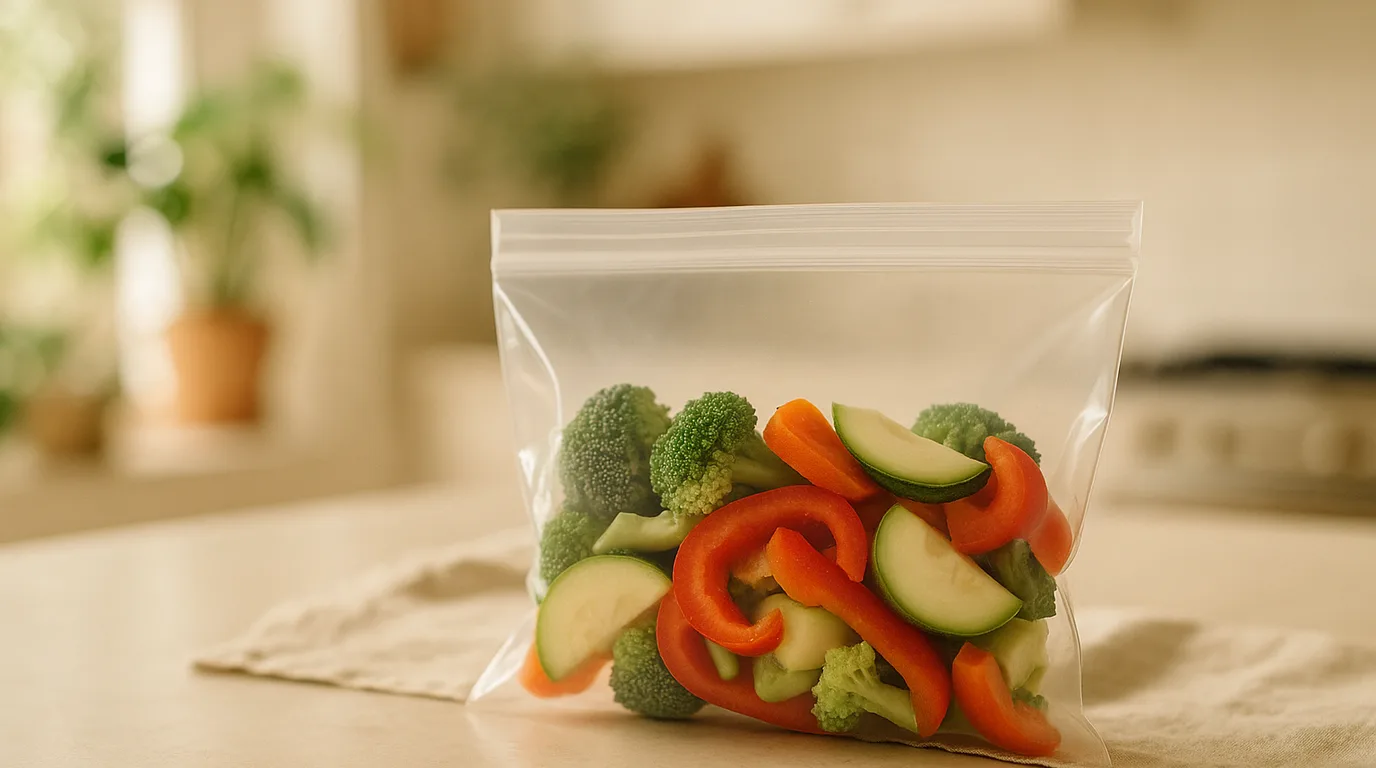
“Are Ziploc bags safe?” can mean several things. You might want to store a sandwich, freeze soup, put leftovers in a microwave or know whether a BPA-free claim rules out microplastics. Each question needs a different kind of evidence. A good materials disclosure does not supply a laboratory result, and a laboratory result does not replace a package instruction.
This review focuses on US sources checked October 6, 2026. It explains what we can document, what earlier versions overstated and how to make a practical decision with the information on your pack. It does not certify the contents of an individual bag or compare disease risk between food-storage brands.
What are Ziploc bags actually made of?
The US Sandwich Bags XL disclosure lists low-density polyethylene and linear low-density polyethylene, along with colorants. That is a specific disclosed product, not a complete bill of materials for every bag, slider, vacuum pouch or specialty format. Our earlier claim that all Ziploc zippers contain polyamide was not supported by the reviewed source.
Keep the film, closure and any added components as separate questions. If a disclosure describes the body but does not identify a slider, record the missing component rather than filling the gap from a different brand. A generic recycling code is also not a full formulation or a certificate of suitability for every food and temperature.
Documented product distinctions, without assigning a particle-release winner
- Format and source
- US Sandwich Bags XL
- What is documented
- The product disclosure lists LDPE, LLDPE and colorants.
- What that does not establish
- A complete formulation for every other bag or a particle count for this one
- Format and source
- Large Endurables pouch
- What is documented
- A platinum-silicone reusable pouch with its own use/care instructions.
- What that does not establish
- A release comparison against polyethylene bags or every silicone competitor
- Format and source
- Zip ’n Steam
- What is documented
- Specialized microwave cooking directions and precautions.
- What that does not establish
- Permission to copy the procedure onto an ordinary storage bag
- Format and source
- Compostable sandwich bag
- What is documented
- Commercial-composting conditions and a microwave-use restriction.
- What that does not establish
- Universal home compostability, a heating rating or a health advantage
A familiar logo can connect products that have different materials and purposes. Treat the full name and market as part of the evidence. If a retailer calls an item “Ziploc-style,” it is not necessarily an SC Johnson product; do not transfer the branded disclosure to a generic bag.
BPA-free and phthalate-free: useful claims with limits
The current US product materials statement says Ziploc Brand Bags and Endurables are not formulated with BPA or phthalates. Attribute that statement to the manufacturer. “Not formulated with” is not a published analysis of every trace substance in every lot.
Chemical ingredients and plastic particles are different questions. A declaration about BPA cannot, by itself, identify fragments, quantify exposure or establish a particle-free meal. It also should not be stretched into a statement about every possible additive, food type or use outside the directions.
Read claims at the level they actually describe. “BPA-free” addresses BPA; “microwaveable” has use conditions; “reusable” needs care and hygiene instructions. Combining those labels into an unrestricted safety verdict adds an inference that none of them establishes separately.
Key Takeaways
- The US Sandwich Bags XL disclosure is evidence for that product, not every bag component.
- Manufacturer BPA/phthalate declarations and measured particle release answer different questions.
- We cannot use a container study to supply a Ziploc-bag microwave count.
- Freezer thickness, silicone construction and compostability do not create a measured release ranking.
- Preserve food-safety practices when changing storage or heating vessels.
What the 2023 paper measured—and what we got wrong
Hussain et al. (2023) examined two polypropylene baby-food containers and a reusable polyethylene pouch with water and 3% acetic acid simulants. Its microwave experiments used the containers, not the pouch. Storage scenarios included accelerated laboratory testing, not a count from one household sandwich or a repeated freezer-bag trial.
We previously placed the paper’s headline microwave numbers next to broad claims about Ziploc bags. That made the article read as if the numbers measured the branded product and its common uses. They did not. We have removed that presentation, the quiz based on an unsupported universal multiplier and the cold-to-hot release ranking.
Use a research result only when the tested product, condition and measurement match the claim. If a study uses a food simulant, distinguish it from the actual meal. If it measures a particular size range, do not silently convert that result into a count of all particle sizes. If it models exposure or tests cells, do not present it as observed disease in people using a bag.
The FDA’s current assessment says evidence does not demonstrate health risk from detected food levels and identifies substantial measurement gaps. It also says evidence is insufficient to establish packaging migration into food and beverages. These are agency assessments, not a zero-release guarantee. We no longer claim the regulatory framework excludes particle concerns.
Laboratory research and regulatory assessment can have different scopes and standards of evidence. Presenting both is more useful than treating a dramatic count as a personal diagnosis or treating compliance as proof that every scientific question has been settled.
Cold storage, freezing and hot food: how to decide
We removed our previous seven-use safety ladder because it assigned confidence the cited sources did not provide. You can still make a useful decision: identify the product, confirm that your task is permitted and keep missing particle evidence separate from those instructions.
Everyday storage decisions: instructions to check and measurements still missing
- Your task
- Packing a sandwich or snack
- Practical next step
- Identify the exact bag; follow its intended food-storage use and keep perishable food appropriately cold
- Evidence boundary
- No validated single-digit particle count for your sandwich
- Your task
- Freezing a portion
- Practical next step
- Choose a freezer-intended product and check the current manufacturer guidance
- Evidence boundary
- Thickness and cycle count do not supply a particle dose or universal discard threshold
- Your task
- Cooling cooked leftovers
- Practical next step
- Divide into shallow containers and refrigerate promptly; choose suitable vessels rather than waiting for an invented bag-safe temperature
- Evidence boundary
- Avoiding hot-film contact must not prolong unsafe room-temperature storage
- Your task
- Microwaving or steaming
- Practical next step
- Use the product-specific microwave and closure guide
- Evidence boundary
- Heating permission is not a brand-specific particle measurement
- Your task
- Sous vide or boiling-water cooking
- Practical next step
- The US FAQ permits Endurables, not polyethylene Ziploc bags; use the exact product directions
- Evidence boundary
- A below-60°C workaround is not current manufacturer permission
Freezing a food and microwaving it later are two separate tasks. A bag selected for freezer storage does not automatically qualify for the next heating step. Plan a transfer to verified cookware if the label does not cover what you intend to do.
We cannot provide a universal number of freeze–thaw cycles after which a polyethylene bag releases a harmful amount. Check its condition and the product’s care directions, and do not use a ripped or leaking bag. The condition check is practical packaging assessment, not a home particle assay.
Food safety should guide cooling. USDA recommends prompt refrigeration of leftovers in shallow containers; hot food can go directly into the refrigerator. Refrigerate within two hours, or one hour above 90°F (32°C). We removed the advice to wait until food drops below 30°C before bagging because it was not a validated storage rule.
Can you wash and reuse Ziploc bags?
The current US gallon storage-bag page allows handwashing and air-drying for reuse, but advises against reuse after raw meat, fish, eggs or allergy-triggering foods. That is a hygiene restriction. It does not establish the particle release of a washed bag or the effect of every scrubbing method.
Specialty products can have different rules. Check the actual reuse and cleaning directions, rather than treating every disposable-looking bag as single-use or every zip-top pouch as indefinitely reusable. A single instruction about storage bags does not resolve the care requirements of a silicone pouch or steam bag.
Use prior contents as part of the decision. A bag previously used for an allergen does not become suitable for another person simply because it looks clean. Keep damaged packaging out of use and do not attempt to clean it by a heating method that its manufacturer does not permit.
Alternatives: change the contact surface, keep the task clear
A suitable microwave-safe glass or ceramic vessel can replace a flexible bag during reheating. A steel lunchbox may suit cold storage, but ordinary metal is not a default microwave alternative. Check covers, gaskets and utensils too; a nonplastic body does not describe the entire food-contact assembly.
Silicone is a separate material with product-specific care requirements. We have not established a head-to-head particle-release winner between Endurables, Stasher and all polyethylene storage bags. Choose it for documented suitability, convenience or a preference to reduce disposable film use—not an invented percentage reduction.
Our Stasher materials review and Pyrex Freshlock–Snapware comparison examine exact products and component instructions. Those reviews are useful when choosing a workflow; they do not certify a particle-free packed lunch.
Use the App
Review the exact bag and the job you use it for
Keep its product identity, disclosed components and storage or heating instructions together. A scan or modeled contact assessment cannot measure particle release, rank disease risk or override the package.
A useful record has four parts: the full product, the source of its material information, the permitted task and what remains unknown. That is enough to improve tomorrow’s storage and reheating routine without pretending that a household photograph is a laboratory test.
Frequently Asked Questions
Do Ziploc bags release microplastics?
Are Ziploc bags BPA-free?
Are all Ziploc bags made of LDPE?
Does the 2023 microwave study measure Ziploc bags?
Does freezing make a bag particle-free?
Can ordinary polyethylene Ziploc bags be used for sous vide?
Are glass or silicone alternatives proven to release fewer particles?
Can the app determine my bag’s exposure or safety?
Sources
- SC Johnson (Undated; reviewed October 6, 2026). What’s Inside: US Ziploc Brand Sandwich Bags XL material disclosure.
- Ziploc / SC Johnson (Undated; reviewed October 6, 2026). US gallon storage bag: reuse and food-contact instructions.
- Ziploc / SC Johnson (Undated; reviewed October 6, 2026). US gallon freezer bag: food-contact uses and precautions.
- Ziploc / SC Johnson (Undated; reviewed October 6, 2026). US FAQ: storage, sous vide and reuse instructions.
- Ziploc / SC Johnson (Undated; reviewed October 6, 2026). Zip ’n Steam: intended use, precautions and BPA/phthalate declaration.
- Ziploc / SC Johnson (Undated; reviewed October 6, 2026). Large Endurables silicone pouch: material and care instructions.
- Ziploc / SC Johnson (Undated; reviewed October 6, 2026). Compostable sandwich bags: disposal conditions and use restrictions.
- Hussain KA, et al. (2023). Assessing the Release of Microplastics and Nanoplastics from Plastic Containers and Reusable Food Pouches: Implications for Human Health. Environmental Science & Technology 57, 9782–9792; full text via NSF.
- FDA (Current page; reviewed October 6, 2026). Microplastics and Nanoplastics in Foods.
- USDA Food Safety and Inspection Service (Current page; reviewed October 6, 2026). Leftovers and Food Safety.
Your next product question
Start with the exact bag you use for storage, freezing or reheating.
Review disclosed film and closure materials separately from intended use. A materials record or modeled contact assessment is not a measured particle count, exposure or health-risk ranking.
Use the exact product name, model and label to check the information behind an assessment. A photo does not measure particles or personal health risk. The examples above are research subjects, not a verified app-coverage list.
Build a product-routine reading plan →Go deeper
Less-travelled research from our archive that follows directly from this page.
- Can You Microwave Ziploc Bags? The Rule for Each Bag TypeCheck the exact product, source conflicts and closure instructions before heating
- Are Stasher Bags Safe? Silicone, Heat and the Testing GapReview a specific silicone alternative and its care instructions
- Pyrex Freshlock vs Snapware: Glass, Lids and Microplastic QuestionsSeparate glass bodies from lid and seal instructions
Related Research
Microplastics in Cooking Utensils: Spatulas, Cutting Boards, Spoons
Plastic and black nylon utensils, cutting boards, and blender jugs shed microplastics directly into food. Here is what to replace and what to use instead.
Read moreMicroplastics in the Air at Home: HEPA, Carpets & Indoor Sources
Indoor air contains 3 to 15 times more microplastics than outdoor air. The biggest sources are synthetic carpets, clothing, and dust. Here is how to reduce them.
Read moreBest Plastic-Free Food Storage: Glass, Steel and Silicone Compared
Compare documented glass, steel and silicone storage by task, lids, seals, useful vessel count and care. Specific options without zero-particle promises.
Read moreBest Non-Toxic Cookware 2026: Cast Iron, Steel, Ceramic, Enamel Ranked
The best microplastic-free cookware for 2026. Cast iron vs stainless vs ceramic-coated vs enamel vs carbon steel: ranked by safety, durability, and price.
Read morePlastic Recycling Numbers 1-7: Material and Contact Conditions
What plastic numbers 1–7 identify and how material, heat, wear, and use conditions differ. Ranked by modeled plastic contact, not chemical safety.
Read moreMicroplastics in Plastic Containers: Is Your Tupperware Leaching?
Microwaving plastic releases up to 4.22 million microplastic and 2.11 billion nanoplastic particles per cm2 in three minutes. The full numbers, and the lower-plastic-contact comparisons.
Read more