Plastic Wrap vs Ziploc Bags: Microplastic Risk Compared (2026)

Last reviewed: by the MicroPlastics Research Desk. Submit a correction or see our editorial standards.
Quick Answer
Quick answer: Most home plastic wrap is LDPE (#4) or PVC (#3); Ziploc sandwich and freezer bags are LDPE. They're relatively stable for cold dry storage but shed and leach plasticisers when heated, stretched against oily or acidic food, or reused. PVC cling wrap (the kind that clings best) is the worst variant, it contains added phthalates and should never touch hot or fatty food.
Highest-risk situations: microwaving food covered with cling wrap, plastic wrap on hot leftovers, PVC cling on cheese / cured meat / oily salads, freezer bags reused multiple times, sandwich bags packed with hot food.
Best first swap: beeswax wraps (Bee's Wrap, Khala & Co) for bowls, cheese, and produce, and silicone bags (Stasher) for sandwich / freezer / sous-vide use. Both pay back vs disposable bags inside a couple of months.
Different container in your kitchen? Review its confirmed or estimated material and Product Contact Signal, then compare a lower-contact option.
Scan my product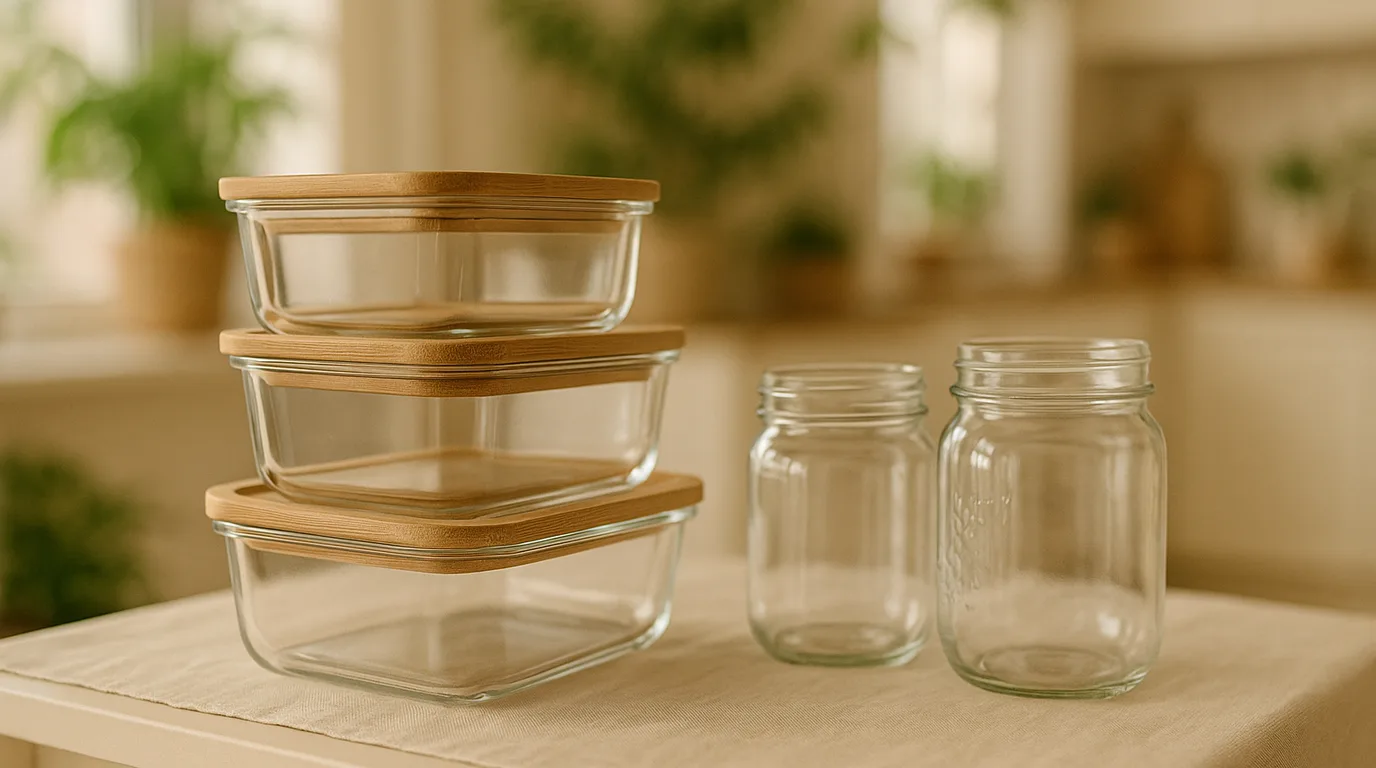
Plastic wrap and sandwich bags are everywhere because they disappear into everyday life. That's exactly why they matter. Risk is usually lowest when the plastic is cold, dry, and brief, and highest when it's heated, scratched, stretched, stuffed against fatty or acidic food, or reused beyond its intended life.
| Use case | Risk level | Why |
|---|---|---|
| Brief cold storage of dry food (sandwich at room temp for an hour) | Low | Cold + dry + short contact = minimal migration |
| Wrapping cheese or cold cuts in LDPE for a week | Medium | Fatty foods absorb plasticisers over time |
| Sandwich bags with greasy snacks (chips, nuts, fries) | Medium | Fat extracts plasticisers; bag friction also sheds |
| PVC cling wrap on hot, fatty, or acidic food | High | PVC contains phthalates; heat + fat = peak migration |
| Microwaving food covered with plastic wrap | High | Steam + heat + plastic = highest migration scenario |
| Reused freezer bags repeatedly | High | Scratches multiply particle release; old plastic sheds more |
| Ziploc / sandwich bag with hot leftovers (e.g., to-go soup) | High | Hot liquid + thin LDPE = particle and chemical release |
Key Takeaways
- Ziploc sandwich and freezer bags are LDPE (#4), relatively stable for cold dry use, less so for hot or oily contents.
- Most cling wrap sold at supermarkets has switched from PVC to LDPE for food contact, but PVC versions (often called “professional” or imported) still exist.
- PVC cling wrap contains added phthalate plasticisers that migrate especially into fatty food.
- Microwaving food covered with plastic wrap is the worst-case scenario for plasticiser migration.
- Reusing single-use bags is much worse than using them once, scratches multiply shedding.
- Beeswax wraps and silicone bags (Stasher) pay back vs Ziploc in 1-2 months for typical kitchens.
What the wrap is actually made of
| Product | Typical material | Concern |
|---|---|---|
| Glad / Reynolds household cling wrap (current US) | LDPE (#4), most are no longer PVC | Lower migration than PVC; still sheds with heat / fat |
| Generic / imported / restaurant-grade cling wrap | Often PVC (#3) with phthalate plasticisers | Higher migration; avoid for hot or fatty food |
| Ziploc sandwich bag | LDPE (#4) | Stable for cold; not for hot food; one-time use intended |
| Ziploc freezer bag | LDPE (#4), thicker | Stable for freezing; not for reheating in bag |
| Sandwich/snack bag (off-brand, dollar store) | Often LDPE; sometimes mixed PE | Lower quality control; check for unusual smell |
| Glad Press 'n Seal | LDPE with proprietary tack adhesive | Same as LDPE wrap plus added adhesive |
| Stretch / sealable produce film at supermarket | Often PVC | Fine for cold produce; transfer cheese / meat to non-PVC |
What actually drives migration and shedding
- Heat. The single biggest factor. Microwaving food covered with cling wrap, or putting hot food into a plastic bag, dramatically increases plasticiser migration and particle shedding.
- Fat / oil content. Plasticisers (especially phthalates in PVC) are lipophilic, they move into fatty foods more than watery ones. Cheese, cured meat, oily salad, and nut butter pull more out than lettuce or grapes.
- Acidity. Tomato, citrus, vinegar dressings, and pickled foods accelerate migration.
- Contact time. Hours vs days vs weeks of contact matter. A sandwich packed at 7 am and eaten at noon is in a different bracket than cheese stored in cling wrap for two weeks.
- Stretching and reuse. Stretched film exposes fresh polymer; scratched / reused bags shed multiplicatively more.
Safer alternatives by use case
| Use case | Swap | Price |
|---|---|---|
| Cover a bowl of leftovers in the fridge | Glass food storage with snap lid (Pyrex Simply Store) | $40-60 starter set |
| Cover a plate before microwaving | Second plate as a cover, or silicone microwave lid | $0-15 |
| Wrap cheese, half-onion, citrus, herbs | Beeswax wraps (Bee's Wrap, Khala & Co) | $15-25 for a set |
| Sandwich for school / work lunch | Stainless tiffin (LunchBots Trio) or silicone bag (Stasher) | $15-30 |
| Freezer storage for marinated meat | Glass freezer-safe container or Stasher freezer bag | $15-25 |
| Sous-vide cooking | Stasher silicone bag (heat-tolerant) or vacuum-sealed in food-grade plastic + cooler temperature | $15-20 |
| Produce storage in fridge | Organic cotton produce bags + glass containers | $10-20 |
| On-the-go snack pouch (kids) | Silicone snack bag (Stasher mini) | $10-15 |
When plastic bags are actually fine
You don't need to ban plastic wrap from your kitchen, you need to use it for what it's actually good at:
- Cold, dry, short contact, a sandwich, a slice of bread, packing dry cookies for a road trip.
- Wrapping non-fatty produce, celery, herbs, leftover broccoli for a day or two.
- Marinating in a glass dish with a plastic-wrap cover, fine if the food isn't hot, the dish is glass, and the wrap doesn't actually touch acidic marinade for days.
- Outer storage of glass-wrapped items, a freezer bag around glass containers prevents freezer burn without food contact.
When to definitely not use plastic wrap
- Microwaving anything covered with cling wrap. Use a plate or silicone lid.
- Wrapping hot leftovers, let them cool, then store in glass.
- Long-term storage of cheese, deli meat, or oily food in PVC cling. Beeswax wrap or glass.
- Marinating in plastic bags. Glass bowl + wrap as cover is fine; food sitting in plastic for hours is not.
- Reusing single-use sandwich bags. Buy reusable silicone instead.
- Sous-vide if you're cooking above ~70°C / 158°F in non-rated plastic. Stasher bags are sous-vide rated to 425°F (218°C) in oven, 250°F (121°C) in water bath.
What the MicroPlastics app checks
- Wrap or bag material. LDPE, PVC, multi-layer film, beeswax wrap, silicone, stainless, glass.
- Recycling number from the package (#3 PVC flagged for food contact concern).
- Brand and product line, most major US household brands have switched away from PVC; imports and generics often haven't.
- Use-context flags you log, microwave, hot food, oily/acidic contents, reuse, contact time.
- Cited published research on plasticiser migration and particle release.
Use the App
Scan your storage, wrap, bags, and containers
Plastic wrap, sandwich bags, freezer bags, takeout containers. Snap the box. The app weighs material + brand + your use context and suggests the right swap for each.
Scan storage products in the appRelated reading: microplastics in plastic wrap, best plastic-free food storage, microwaving plastic, 30 kitchen swaps, plastic containers.
Frequently Asked Questions
Is plastic wrap safe to use on food?
Are Ziploc bags safe?
Can I microwave food covered with plastic wrap?
Is beeswax wrap actually better?
Are Stasher silicone bags worth the price?
What about freezer storage in plastic?
Can I reuse Ziploc bags?
Is Glad Press 'n Seal safer than regular cling wrap?
Sources
- Hussain KA, Romanova S, Okur I, et al. (2023). Assessing the Release of Microplastics and Nanoplastics from Plastic Containers and Reusable Food Pouches. Environmental Science & Technology.
- Bandyopadhyay J, Sinha SK (2024). Migration of microplastics from plastic food contact materials. Journal of Food Engineering.
- European Food Safety Authority (2019). Update of the risk assessment of di-butylphthalate (DBP), butyl-benzyl-phthalate (BBP), bis(2-ethylhexyl)phthalate (DEHP), di-isononylphthalate (DINP) and di-isodecylphthalate (DIDP). EFSA Journal.
- US FDA (2024). Food Packaging: phthalates and substances in food contact applications. FDA.
- WHO (2022). Dietary and inhalation exposure to nano- and microplastic particles. World Health Organization.
Compare your kitchen contact pattern over time
The app turns saved scans into a modeled household contact pattern based on what you cooked in, stored in, and heated this month. The trend describes the assessed mix, not health or bodily exposure.
Download on the App Store- Free on iOS
- 3 free scans
- No sign-up
- Result in seconds
“Really cool to scan stuff around the kitchen and see what's actually in it. The swaps it suggests are realistic.” App Store review · 5.0★
Android · early access
Get the launch email the day Android opens.
One email. No spam. We send when the Android app is in the Play Store, and never again unless you opt in.
Related Research
Microplastics in Kitchen Sponges & Dish Brushes: lower-plastic-contact Picks
Most kitchen sponges are polyurethane foam + polyester abrasive: they shed microplastics with every scrub. Wood, cellulose, copper, and loofah alternatives ranked.
Read moreIs Silicone a Microplastic? Why It Is a Polymer But Not a Plastic
No, not by the standard definition: silicone’s backbone is silicon and oxygen, not the carbon chains that define plastics. But it is still a polymer, cheap filler-laden silicone can leach, and it degrades above its rated temperature. Where it genuinely wins.
Read moreIs Caraway Cookware Non-Toxic? What Its Own Filings Show
Caraway’s ceramic pans are PFAS-free, and the ad industry’s watchdog agreed. Its own documents also show an aluminium body, a one-year warranty that excludes coating wear, and cadmium in one cast iron colour’s exterior enamel.
Read moreAre Air Fryer Liners Safe? Paper, Silicone and Foil Checked
Paper liners are coated with silicone, wax or something unnamed, and a September 2026 study found new silicone liners release the most in their first uses. What each type is, what the fryer makers allow, and what to use instead.
Read moreTitanium Cutting Boards: A Best-Seller Is Half Plastic
A test kitchen found 2 of 3 “titanium” boards were stainless steel, and Amazon’s No. 2 cutting board is titled “Pure Titanium/PP”. What titanium avoids, what it costs your knives, and what to buy instead.
Read moreNon-Toxic Air Fryers: What Your Food Actually Sits On
We traced air-fryer baskets to the makers’ own documents. Glass fryers still use a coated plate, “stainless” usually means the outside, and SharkNinja lists PTFE for Ninja units made before August 2024.
Read more