Microwaving Plastic Containers: What Actually Happens in 5 Minutes
Last reviewed: by the MicroPlastics Research Desk. Submit a correction or see our editorial standards.
Quick Answer
Different container in your kitchen? Review its confirmed or estimated material and Product Contact Signal, then compare a lower-contact option.
Scan my product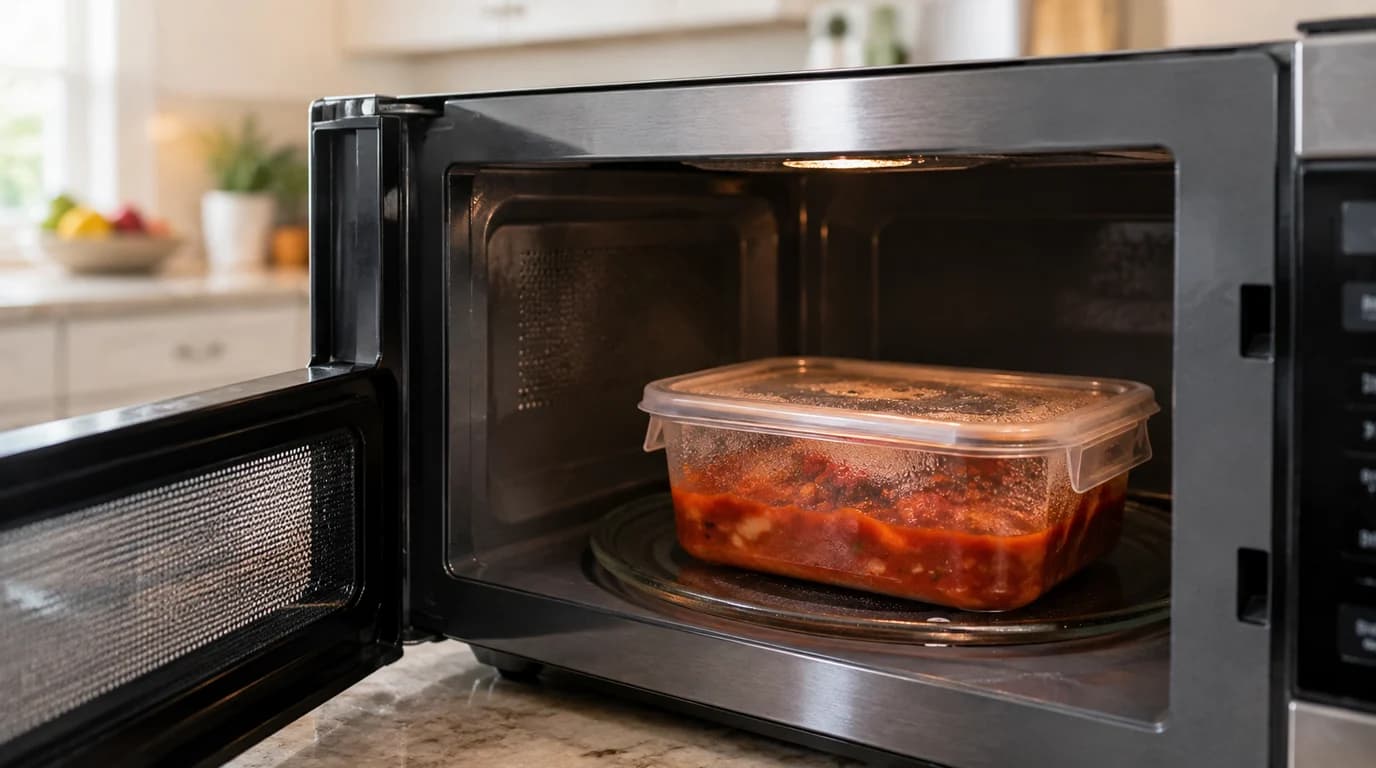
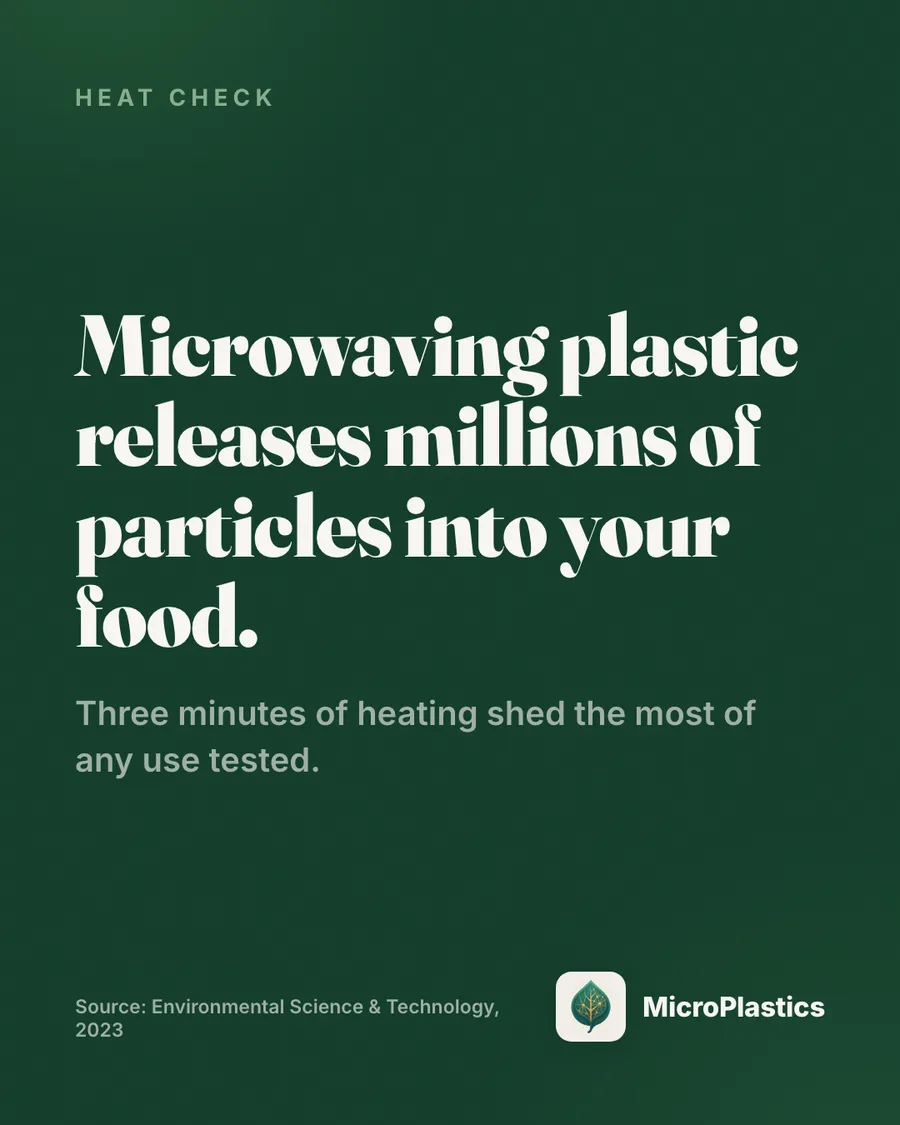
Microwave-safe means the container won't melt or warp under normal home use. It does not mean the container releases zero microplastic particles or zero plasticisers into your food. A 2023 University of Nebraska–Lincoln study found that 3 minutes of microwaving in plastic containers released up to 4.22 million microplastic particles and 2.11 billion nanoplastic particles per square centimeter of container surface into the food. That is one of the most acute microplastic-release events in a typical kitchen.
| Factor | Effect on release |
|---|---|
| Time in microwave | Longer = more release; ramps fast in first 3 minutes |
| Container material | PP and HDPE shed less than PVC and PS; glass / ceramic shed nothing |
| Food acidity | Tomato sauce, citrus, vinegar dressings = much more plasticiser migration |
| Food fat content | Fatty foods absorb more plastic-derived compounds |
| Container condition | Scratches, cracks, fade, warping all dramatically increase shedding |
| Container age | Older containers shed more, polymer breakdown is cumulative |
| Lid on or off | Lid trapping steam concentrates condensate and migration |
Key Takeaways
- 3 minutes of microwaving plastic can release up to 4.22 million microplastic particles per cm² of container (Hussain 2023).
- “Microwave-safe” means it won't melt at normal use temperatures, it does not mean zero particle release.
- Acidic + fatty + hot + plastic is the worst combination, exactly what microwave meals deliver.
- The fix is free: transfer to glass or ceramic. Pyrex, Anchor, and ceramic plates are universally safe.
- Older, scratched, or warped plastic releases multiplicatively more, toss damaged containers immediately.
- The microwave itself is fine, it's the plastic-food interface at high temperature that's the problem.
What the 2023 microwaving study actually found
Hussain et al. (Environmental Science & Technology, 2023) microwaved two common food-storage products, a baby food container and a reusable food pouch, and measured plastic particle release into the contents over 3 minutes at typical microwave settings.
- Up to 4.22 million microplastic particles per cm² of container surface area released in 3 minutes of microwaving.
- Up to 2.11 billion nanoplastic particles per cm² released over the same period.
- Refrigerated storage and room-temperature storage in the same containers also released particles, but at orders of magnitude lower rates than microwaving.
- The researchers used containers labeled food-safe and BPA-free.
For context: that's roughly the equivalent of a year's worth of baseline particle exposure in a single 3-minute reheat, depending on container size.
Why “microwave-safe” isn't a green light
The FDA does not test plastic for microplastic release, only for chemical migration above specific safety thresholds. A container labeled “microwave-safe” has passed the test that ensures:
- It won't melt or deform at typical microwave food temperatures.
- The specific plasticisers it's allowed to contain don't migrate above FDA limits under standard test conditions.
It has not been tested for:
- Microplastic particle release.
- Nanoplastic particle release.
- Migration with acidic, fatty, or unusual food contents.
- Behavior after the container has been scratched, cracked, faded, or repeatedly heated.
The worst-case microwave scenarios
| Scenario | Why it's bad | Fix |
|---|---|---|
| Microwave frozen meal in its plastic tray | Hot + acidic/fatty meal + thin plastic tray + steam | Transfer to glass or ceramic plate |
| Reheat takeout in the plastic clamshell | PS or PP clamshell + hot/acidic restaurant food + lid trapping steam | Transfer to ceramic plate; use plate as lid |
| Tomato sauce in scratched Tupperware | Acidity + scratches + heat = peak migration | Heat in saucepan; transfer to glass |
| Plastic-wrapped leftover in microwave | Cling wrap + hot food + steam = wrap meets food | Glass plate + paper towel as cover |
| Microwave plastic baby food pouch | Multi-layer plastic + heat + infant ingestion = compounded risk | Transfer to glass; warm in water bath if possible |
| Reheat oily curry in plastic deli container | Fat + heat + thin polymer = high migration | Transfer to glass or ceramic |
Safe reheating habits
- Buy a stack of glass food-storage containers. Pyrex Simply Store or Anchor Hocking starter sets run $35–60 and last decades.
- Transfer takeout / frozen meals to glass before reheating. The 30 seconds it takes is the cheapest microplastic reduction you'll ever buy.
- Use a plate as a cover instead of plastic wrap or the original lid.
- Skip plastic-pouch baby food warming. Pour into a small glass dish; warm in water bath or microwave.
- Toss scratched, warped, or stained plastic containers. They shed multiplicatively more.
- Use a stainless or glass coffee mug, not a plastic travel mug that's been microwaved hundreds of times.
What about “microwave-safe” PP or HDPE containers?
PP (#5) and HDPE (#2) are among the more stable food-contact plastics, they shed less than PS or PVC. But “less” is not “none.” In the 2023 study, even containers labeled microwave-safe and BPA-free released millions of particles per cm² in 3 minutes.
Rule of thumb: if you would prefer your food not contain plastic particles, transfer to glass or ceramic before reheating. It takes 30 seconds.
What the MicroPlastics app checks
- Container material. PET, HDPE, PP, PS, PVC, multi-layer, glass.
- Container condition from the photo, scratches, warping, dent, fade.
- Use-context flags you log, microwave history, dishwasher history, reuse count.
- Contents category (acidic, fatty, hot) that change migration.
- Cited research backing the 0–100 risk score.
Use the App
Scan the container before you reheat
Snap a photo of the takeout container, leftover bowl, or freezer tray. The app weighs material + condition + your contents and gives a 0–100 risk score with safer alternatives.
Scan before microwavingRelated reading: the 2026 test of food microwaved in its original plastic wrapper, microplastics in plastic containers, best plastic-free food storage, 30 kitchen swaps, recycling numbers explained.
Frequently Asked Questions
Is it safe to microwave plastic containers?
What does "microwave-safe" actually mean?
Which plastics are worst for microwaving?
Can I use plastic wrap in the microwave if it doesn't touch the food?
Is reheating in a takeout container okay if it's just once?
What about silicone for the microwave?
Should I throw out my plastic food storage?
What's the cheapest replacement for microwave reheating?
Sources
- Hussain KA, Romanova S, Okur I, et al. (2023). Assessing the Release of Microplastics and Nanoplastics from Plastic Containers and Reusable Food Pouches: Implications for Human Health. Environmental Science & Technology.
- US FDA (2024). Food Contact Substances FAQ: including "microwave-safe" labeling. FDA.
- Bandyopadhyay J, Sinha SK (2024). Migration of microplastics from plastic food contact materials. Journal of Food Engineering.
- WHO (2022). Dietary and inhalation exposure to nano- and microplastic particles. World Health Organization.
- European Food Safety Authority (2023). Risk assessment of food contact materials. EFSA.
Compare your kitchen contact pattern over time
The app turns saved scans into a modeled household contact pattern based on what you cooked in, stored in, and heated this month. The trend describes the assessed mix, not health or bodily exposure.
Download on the App Store- Free on iOS
- 3 free scans
- No sign-up
- Result in seconds
“Really cool to scan stuff around the kitchen and see what's actually in it. The swaps it suggests are realistic.” App Store review · 5.0★
Android · early access
Get the launch email the day Android opens.
One email. No spam. We send when the Android app is in the Play Store, and never again unless you opt in.
Related Research
Plastic Cutting Boards and Microplastics: Switch to Wood?
A 2023 study estimated up to 50g of microplastic per person per year from polyethylene cutting boards. Wood and bamboo alternatives ranked.
Read moreBlack Plastic Kitchen Utensils: Should You Replace Them?
The viral 2024 study found brominated flame retardants in ~85% of black plastic kitchen items tested, apparently from recycled e-waste. The math correction explained, plus replacement priorities.
Read morePlastic Wrap vs Ziploc Bags: Microplastic Risk Compared (2026)
PVC cling wrap, LDPE plastic wrap, and Ziploc bags compared head-to-head for microplastic release. Which is worst with hot food, fatty food, acidic food, and reuse: plus the lower-plastic-contact comparison for each use case.
Read moreMicroplastics in Kitchen Sponges & Dish Brushes: lower-plastic-contact Picks
Most kitchen sponges are polyurethane foam + polyester abrasive: they shed microplastics with every scrub. Wood, cellulose, copper, and loofah alternatives ranked.
Read moreIs Silicone a Microplastic? Why It Is a Polymer But Not a Plastic
No, not by the standard definition: silicone’s backbone is silicon and oxygen, not the carbon chains that define plastics. But it is still a polymer, cheap filler-laden silicone can leach, and it degrades above its rated temperature. Where it genuinely wins.
Read moreIs Caraway Cookware Non-Toxic? What Its Own Filings Show
Caraway’s ceramic pans are PFAS-free, and the ad industry’s watchdog agreed. Its own documents also show an aluminium body, a one-year warranty that excludes coating wear, and cadmium in one cast iron colour’s exterior enamel.
Read more