Plastic Cutting Boards and Microplastics: Should You Switch to Wood?
Last reviewed: by the MicroPlastics Research Desk. Submit a correction or see our editorial standards.
Quick Answer
Different container in your kitchen? Review its confirmed or estimated material and Product Contact Signal, then compare a lower-contact option.
Scan my product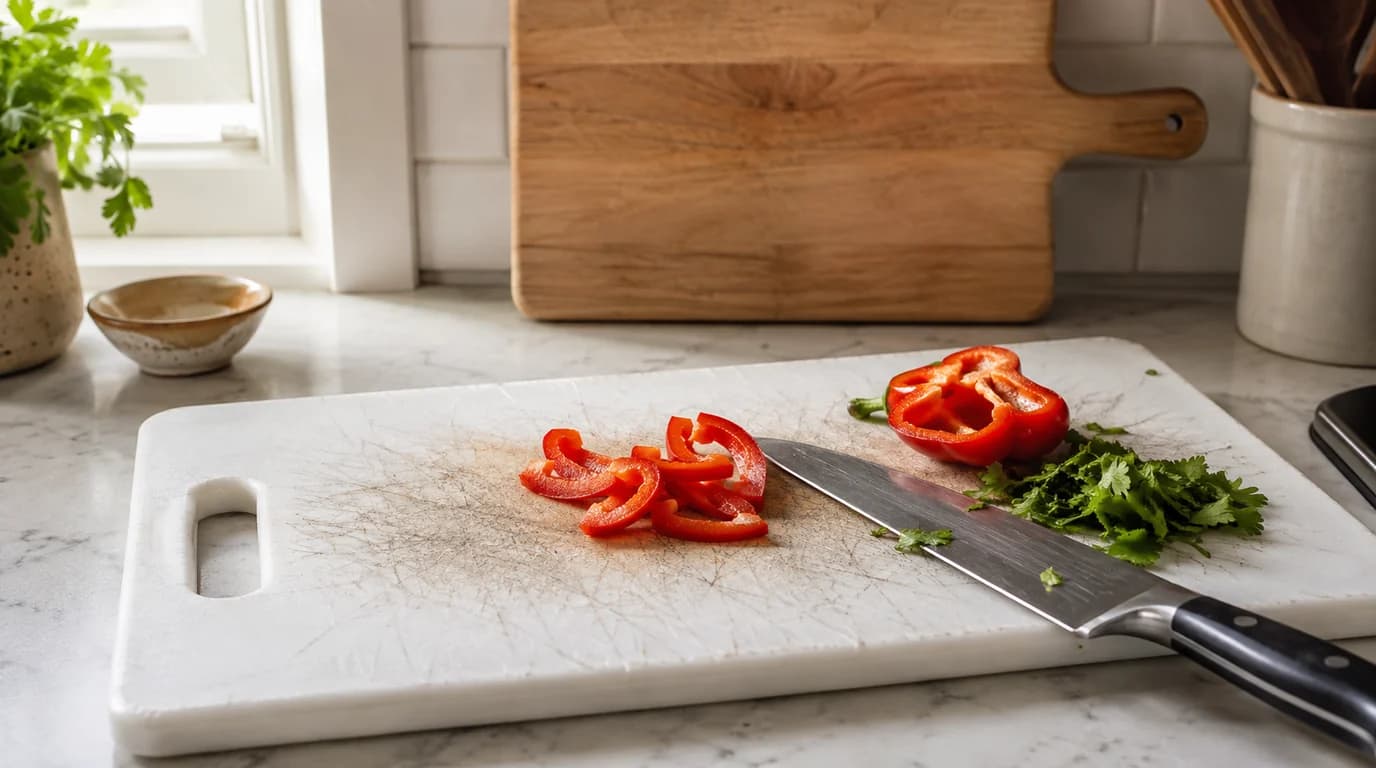
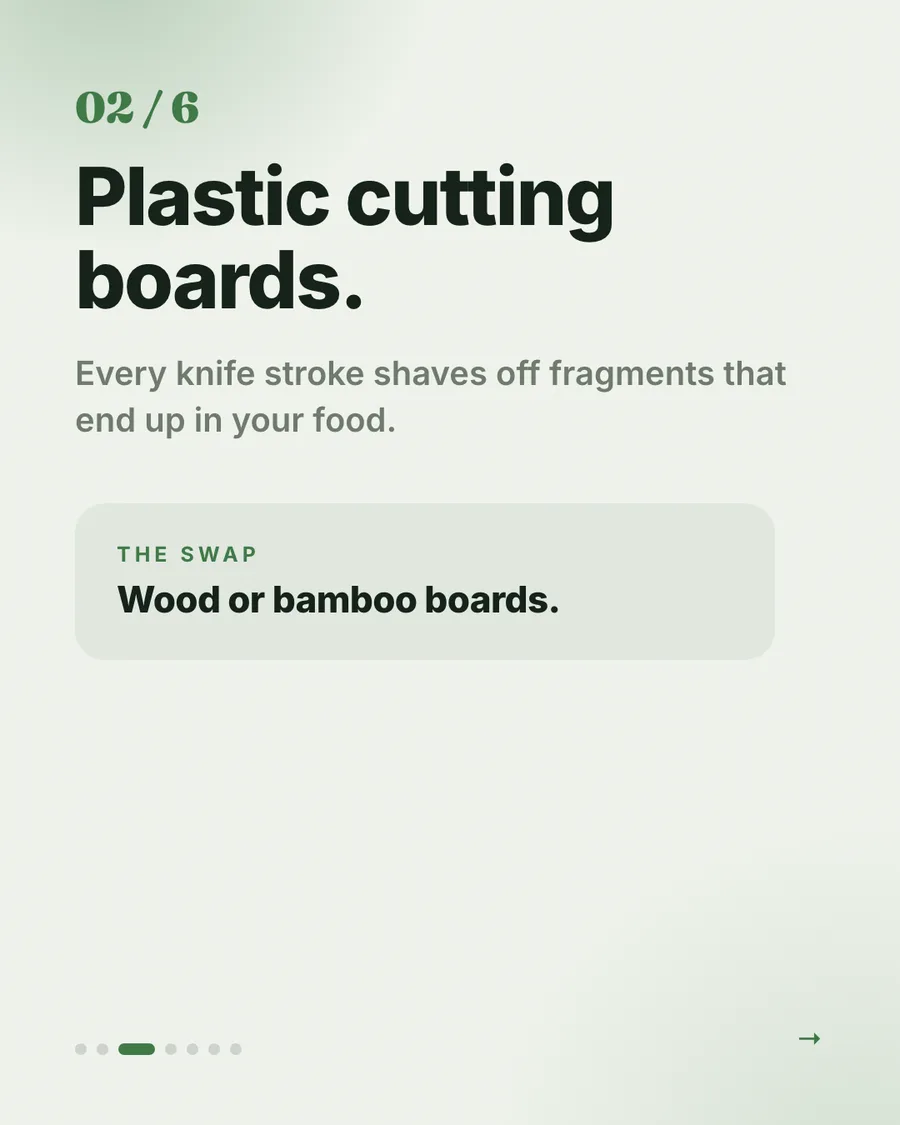
Every chop on a plastic cutting board shaves a tiny amount of plastic directly into your food. A 2023 study estimated that chopping on a polyethylene board could deposit 1.5 to 8 grams of plastic per year straight into the food a single household consumes. Wood and bamboo don't do this. Many old cooking myths claim wood is unhygienic, the evidence actually points the other way. If you have one swap to make in the kitchen this month, this is a strong candidate.
| Material | Microplastic risk | Hygiene | Knife wear | Verdict |
|---|---|---|---|---|
| Polyethylene (HDPE/LDPE) plastic | High, confirmed shedding into food | Dishwasher safe; scratches harbor bacteria | Low, friendly on edges | Replace for produce; consider for raw meat with caution |
| Polypropylene plastic | Lower than PE but still sheds | Dishwasher safe | Low | Better than PE; still not best |
| Wood (maple, walnut, teak) | None | Natural antimicrobial properties; hand wash + oil | Low; preserves knife edges | Best for produce and bread |
| Bamboo | None | Natural antimicrobials; hand wash | Medium, slightly harder than wood | Good budget alternative to hardwood |
| Glass | None | Dishwasher safe; sterile surface | High, dulls knives fast | Good as raw-meat prep; bad as daily board |
| Composite (paper / resin) | Low, resin-bonded fibre | Dishwasher safe; durable | Medium | Acceptable mid-range option (e.g., Epicurean) |
Key Takeaways
- Plastic cutting boards have been quantified as a microplastic source in the 2023 Yadav et al. study.
- Wood and bamboo do not shed plastic; both have natural antimicrobial properties.
- The “wood is unhygienic” myth is not supported by controlled food-safety studies.
- The fix is incremental: switch your produce / bread board first; keep a separate prep surface for raw meat.
- Composite (paper-resin) boards like Epicurean are a dishwasher-safe middle ground.
- Replace scratched, gouged, or warped plastic boards immediately, damage multiplies shedding.
What the 2023 study actually found
Yadav et al. (Environmental Science & Technology, 2023) measured plastic particle release from polyethylene and polypropylene cutting boards during chopping. The headline findings:
- Polyethylene boards released up to ~50 grams of microplastic per person per year in estimated household use.
- Polypropylene boards released less but still measurable amounts.
- Wood and bamboo boards released no plastic (they release plant cellulose, which the human gut already handles).
- Particle release scaled with cutting force and board age, scratched older boards shed more.
Importantly, this is a direct food-contamination pathway, the particles go from blade-on-board into the food on the board, which goes onto the plate.
Wood vs plastic hygiene, what science actually says
The common belief that plastic is more hygienic than wood for cutting comes from the dishwasher: plastic boards can be sanitized at high temperature, wood can't. But hygiene isn't just about dishwasher cycles.
- UC Davis researchers (Cliver lab) found that bacteria contaminating wood cutting boards die off within hours through wood's natural antimicrobial properties; bacteria on scratched plastic boards survive and grow.
- Wood is porous, it pulls bacteria below the surface where they die without nutrients.
- A new plastic board is at least as safe as wood. A scratched plastic board is worse than wood.
The practical implication: if you wash and dry wood properly, it is hygienically equivalent to or better than scratched plastic. For raw meat specifically, many cooks prefer dishwasher sanitation, keep a separate glass or stainless prep surface for raw meat.
Best replacement options ranked
| Pick | Material | Price | Note |
|---|---|---|---|
| John Boos Block Edge Grain | Hard maple | $80-200 | Heirloom-quality; lasts decades with oiling |
| Sonder LA Walnut Board | Black walnut | $120-250 | End-grain; gentle on knives; premium |
| Teakhaus Cutting Board | Sustainable teak | $50-100 | Water-resistant; cuts well; mid-range price |
| Greener Chef Bamboo Cutting Board | Organic bamboo | $20-40 | Budget option; harder on knives than wood |
| Epicurean Cutting Board | Paper-composite (Richlite) | $25-60 | Dishwasher safe; less particle release than plastic; durable |
| Notrax Sani-Tuff | Natural rubber | $60-120 | Restaurant-grade; gentle on knives; not for hot foods |
| OXO Good Grips Glass Board | Tempered glass | $20-30 | For raw meat prep only, dulls knives fast |
Caring for a wood cutting board
- Hand wash with hot soapy water after each use.
- Dry standing up, never lying flat or wet.
- Oil monthly with food-grade mineral oil or beeswax conditioner.
- Never put it in the dishwasher, it will warp and crack.
- For raw meat, use a separate glass or stainless prep surface if you want dishwasher sanitation.
- Sand out deep gouges with fine sandpaper if needed; re-oil.
What to do today
- Toss scratched, gouged, warped plastic boards. They shed multiplicatively.
- Buy one good wood or bamboo board for produce and bread ($30–80).
- Keep a small glass or stainless prep board for raw meat if dishwasher sanitation matters.
- Toss the plastic cutting board you've had for 5+ years, no matter what it looks like.
- Oil your wood board monthly, takes 30 seconds.
What the MicroPlastics app checks
- Cutting board material from the product or photo, plastic (HDPE / LDPE / PP), wood, bamboo, composite, glass.
- Visible condition signals, scratches, gouges, warping, stains.
- Brand and certifications when available. FSC for wood, USDA Organic for bamboo.
- Use-context flags you log, raw meat use, dishwasher cycles, age.
- Cited published research behind the 0–100 risk score, including Yadav 2023.
Use the App
Scan your kitchen tools, not just the food
Cutting boards, utensils, storage, the things that touch food shed plastic into it. Scan the boards you already own to see which to replace first.
Scan kitchen tools in the appRelated reading: microplastics in cooking utensils, best non-toxic cookware, 30 kitchen swaps, plastic containers.
Frequently Asked Questions
Do plastic cutting boards release microplastics into food?
Is wood or plastic safer for cutting boards?
Should I throw out my plastic cutting boards?
Is bamboo as good as wood?
Are composite (Epicurean-style) cutting boards safe?
How long does a wood cutting board last?
Can I use a wood board for raw chicken or fish?
What about glass cutting boards?
Sources
- Yadav H, Khan MRH, Quadir M, et al. (2023). Cutting Boards: An Overlooked Source of Microplastics in Human Food?. Environmental Science & Technology.
- Cliver DO (2006). Cutting boards in Salmonella cross-contamination. Journal of AOAC International.
- Ak NO, Cliver DO, Kaspar CW (1994). Cutting boards of plastic and wood contaminated experimentally with bacteria. Journal of Food Protection.
- Hussain KA, Romanova S, Okur I, et al. (2023). Microplastic release from food contact materials. Environmental Science & Technology.
- WHO (2022). Dietary and inhalation exposure to nano- and microplastic particles. World Health Organization.
Compare your kitchen contact pattern over time
The app turns saved scans into a modeled household contact pattern based on what you cooked in, stored in, and heated this month. The trend describes the assessed mix, not health or bodily exposure.
Download on the App Store- Free on iOS
- 3 free scans
- No sign-up
- Result in seconds
“Really cool to scan stuff around the kitchen and see what's actually in it. The swaps it suggests are realistic.” App Store review · 5.0★
Android · early access
Get the launch email the day Android opens.
One email. No spam. We send when the Android app is in the Play Store, and never again unless you opt in.
Related Research
Black Plastic Kitchen Utensils: Should You Replace Them?
The viral 2024 study found brominated flame retardants in ~85% of black plastic kitchen items tested, apparently from recycled e-waste. The math correction explained, plus replacement priorities.
Read morePlastic Wrap vs Ziploc Bags: Microplastic Risk Compared (2026)
PVC cling wrap, LDPE plastic wrap, and Ziploc bags compared head-to-head for microplastic release. Which is worst with hot food, fatty food, acidic food, and reuse: plus the lower-plastic-contact comparison for each use case.
Read moreMicroplastics in Kitchen Sponges & Dish Brushes: lower-plastic-contact Picks
Most kitchen sponges are polyurethane foam + polyester abrasive: they shed microplastics with every scrub. Wood, cellulose, copper, and loofah alternatives ranked.
Read moreIs Silicone a Microplastic? Why It Is a Polymer But Not a Plastic
No, not by the standard definition: silicone’s backbone is silicon and oxygen, not the carbon chains that define plastics. But it is still a polymer, cheap filler-laden silicone can leach, and it degrades above its rated temperature. Where it genuinely wins.
Read moreIs Caraway Cookware Non-Toxic? What Its Own Filings Show
Caraway’s ceramic pans are PFAS-free, and the ad industry’s watchdog agreed. Its own documents also show an aluminium body, a one-year warranty that excludes coating wear, and cadmium in one cast iron colour’s exterior enamel.
Read moreAre Air Fryer Liners Safe? Paper, Silicone and Foil Checked
Paper liners are coated with silicone, wax or something unnamed, and a September 2026 study found new silicone liners release the most in their first uses. What each type is, what the fryer makers allow, and what to use instead.
Read more