Back to Research

Can You Microwave Ziploc Bags? The Honest Answer (2026)

Last reviewed: by the MicroPlastics Research Desk. Submit a correction or see our editorial standards.

Quick Answer

Yes: but only for the narrow job SC Johnson actually rates them for: defrosting and reheating, with the zipper left open at least an inch to vent steam. Not cooking. Not boil-in-bag. And there's a second answer hiding behind the first: “microwave safe” means the bag won't melt and won't leach regulated chemicals above legal limits, it does not mean the bag sheds no plastic. No part of the FDA food-contact regime counts particles. Here's the number that reframes the whole question: Ziploc bags are polyethylene, which melts at 105–115°C. Water boils at 100°C. A Ziploc in the microwave is running within roughly 5–15°C of its own melting point. Read in that light, “defrost and reheat only, vent the zipper” isn't marketing caution. It's a materials-science necessity.

Got a different brand in the cupboard? Scan the label for its polymer, risk score, and a cleaner swap.

Scan my product
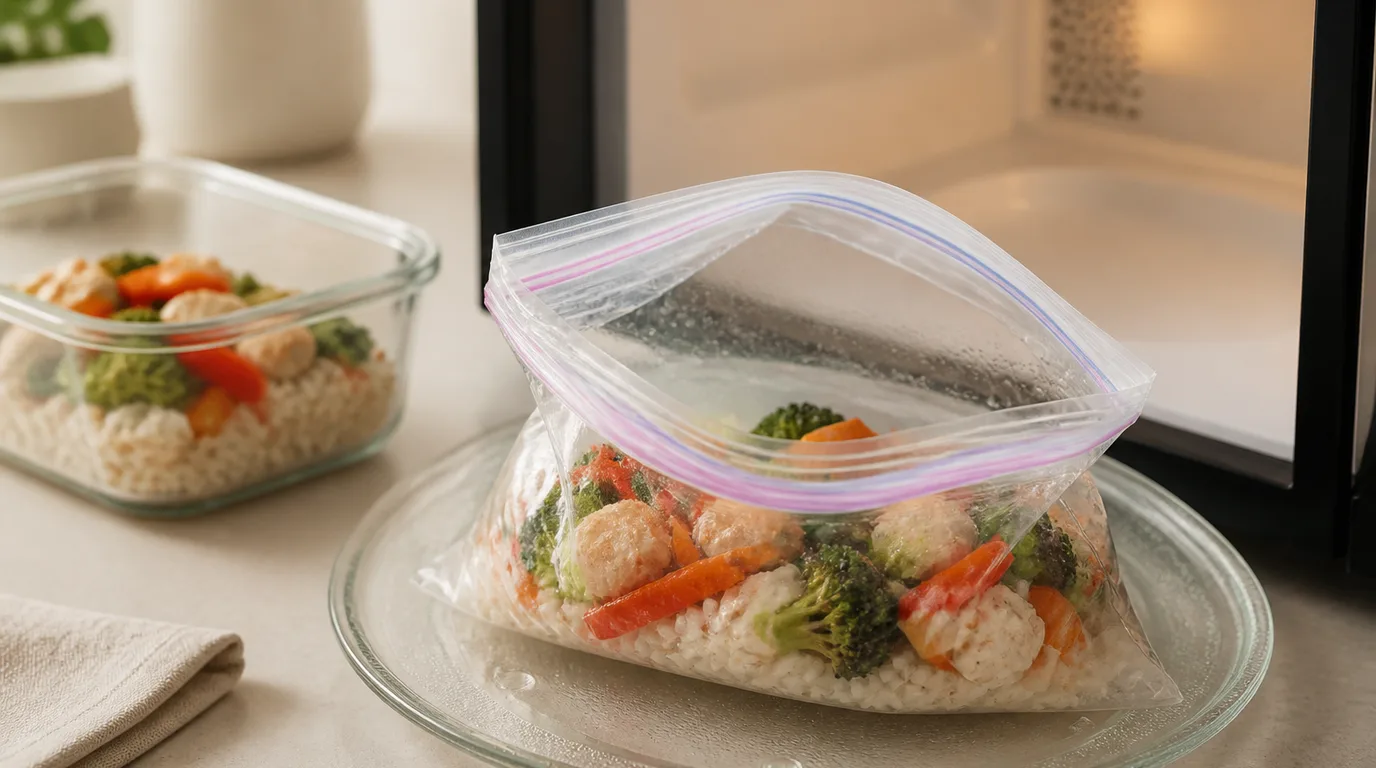
Can you microwave Ziploc bags, defrosting and reheating in a vented polyethylene bag, ranked by microplastic risk

Key Takeaways

  • SC Johnson's own instruction, verbatim: Ziploc bags “can be used in the microwave, but only to defrost or reheat food”, with the zipper “open at least one inch to vent any steam or heat.” That is a much narrower claim than most people hear.
  • The reason is physics, not liability. LDPE melts at 105–115°C; a microwave drives food to ~100°C. The bag has a margin of about 5–15°C. SC Johnson puts its bags' softening point at 230°F (110°C), the same razor-thin gap, in Fahrenheit.
  • Fatty and sugary foods are the trap. They routinely exceed 100°C locally in a microwave, hot spots in melted cheese, oil, or sugar syrup blow straight through polyethylene's melting range. SC Johnson explicitly cautions here, and it is the single most actionable warning in this article.
  • Freezer bags are not more microwave-safe. They're thicker polyethylene. Thickness buys mechanical margin (the bag is harder to puncture and holds its shape) but it does not change the polymer's melting point. The temperature limit is identical.
  • “Microwave safe” is not an FDA certification. Food-contact clearance tests dissolved chemical migration into food simulants, plus resistance to melting. Nothing in that testing counts plastic particles, so a fully compliant bag can still shed micro- and nanoplastics.
  • The best evidence says heat, not microwaving per se, drives release, the microwave is just the fastest way to get plastic hot. And EFSA's 2025 review of 122 studies concluded measured release levels are very low, with no sufficient basis yet to estimate real exposure. We'll say that plainly.

Ziploc in the microwave, the numbers that matter

LDPE melting range
105–115°CLDPE melting rangeWater boils at 100°C. A Ziploc bag in a microwave is operating within roughly 5–15°C of its own melting point, the tightest margin of any common kitchen plastic.
Ziploc's own stated softening point
230°FZiploc's own stated softening pointSC Johnson puts the softening point of its polyethylene bags at 230°F (110°C). That is the number the 'defrost and reheat only' rule is built on.
how far the zipper must stay open
1 inchhow far the zipper must stay openSC Johnson’s instruction is to microwave "only to defrost or reheat food," with the zipper open at least one inch to vent steam or heat.
microplastics per cm² from microwaved plastic
425 – 4.22Mmicroplastics per cm² from microwaved plasticThe full measured range across microwaved food-contact plastics in food simulants. 4.22 million/cm² is the worst-case top of that range, not a typical value.
what the challenge paper says drives release
Heat, not microwaveswhat the challenge paper says drives releaseA 2024 correspondence in Environ. Sci. Technol. argued release tracks the temperature reached, not microwave radiation itself, the microwave is simply the fastest way to make plastic hot.
particle tests inside the "microwave safe" regime
Zeroparticle tests inside the "microwave safe" regimeFood-contact clearance measures dissolved chemical migration into simulants and the ability to withstand heat without melting. No part of it counts plastic particles.

What SC Johnson actually says, and how narrow it is

Most articles on this question either say “never microwave a Ziploc” or shrug and say “it's labelled microwave safe.” Both skip the primary source. So here it is. Ziploc's own FAQ states that its brand bags “can be used in the microwave, but only to defrost or reheat food”, with the zipper “open at least one inch to vent any steam or heat,” and a specific caution “when reheating foods with a lot of sugar or fat.” SC Johnson's corporate site adds that Ziploc containers and microwaveable bags “meet FDA safety requirements for defrosting and reheating.”

Read that scoping carefully, because it is doing a lot of work. Defrost and reheat. Not cook. Not simmer. Not steam. Not boil-in-bag. The company is not claiming its bags are a cooking vessel, and the FDA clearance it points at is a clearance for reheating food in the container it was stored in, that is literally a defined condition of use in the regulations. The gap between what SC Johnson says and what consumers hear (“it says microwave safe, so I can nuke anything in it”) is where every melted-bag horror story lives.

The materials-science reason: a Ziploc runs 5–15°C from its melting point

Ziploc bags are polyethylene, low-density and linear low-density PE (recycling #4). Ziploc containers are polypropylene, a completely different polymer with a melting point of 160–170°C, which is why the containers get a far more relaxed set of instructions than the bags. The bags don't get that latitude, because polyethylene has one of the lowest melting points of any plastic in your kitchen:

Melting point vs. what a microwave actually does (2026)
MaterialMelting pointMargin over a 100°C microwave
LDPE. Ziploc bags105–115°C (221–239°F)About 5–15°C. Essentially none.
HDPE, milk jugs120–130°C20–30°C
PP. Ziploc containers, yogurt pots160–170°C60–70°C
Platinum silicone (Ziploc EndurablesRated to 425°F (218°C)Very large) built for the oven

This is the whole article in one line: a microwave drives water-based food toward 100°C, and a Ziploc bag melts at 105–115°C. The bag isn't sitting comfortably inside its rating; it is sitting a few degrees under the edge of a cliff. SC Johnson's own 230°F softening figure says the same thing in Fahrenheit: 230°F is 110°C, and boiling water is 212°F. Eighteen degrees Fahrenheit of headroom.

Once you see that number, the “vent the zipper an inch” instruction stops sounding like legal cover and starts sounding like engineering. A sealed bag traps steam, pressurises, and puts the seams under stress at precisely the temperature where the film is already softening. Venting keeps the bag at ambient pressure so the steam leaves instead of ballooning the seal. It is not a suggestion. It is the condition under which the rating holds.

The sugar and fat trap, the one warning that actually matters

Everything above assumes your food behaves like water and tops out near 100°C. Fatty and sugary foods don't. Oil and sugar syrups have higher boiling points and absorb microwave energy unevenly, so they develop local hot spots that comfortably exceed 100°C, think the molten cheese on a slice of leftover pizza, the oil pooling in a curry, the caramelised sugar in a reheated dessert. Those are the exact conditions that push polyethylene through its melting range rather than up to the edge of it.

This is why SC Johnson singles out sugar and fat by name. And it is why the practical rule is not “never microwave a Ziploc” but something sharper and more useful:

  • Lean, watery, cold-to-warm: defrosting a bag of frozen soup, thawing chicken, warming rice. Within the rating, with the zipper vented.
  • Fatty, cheesy, oily, sugary: pizza, curry, bacon, anything with melted cheese or a sauce that separates. Move it to a plate or a glass dish. This is the swap that matters most.
  • Anything you are actually cooking, not reheating: out of the bag entirely. Cooking is not what the bag is rated for.

And a detail that catches people out: the plastic doesn't have to visibly melt for the food to be affected. A bag can come out looking perfectly intact having spent two minutes above the temperature where polymer chains loosen and surface fragments detach. The visible failure mode (a hole, a warped seam) is the late symptom, not the threshold.

Are microwave-safe freezer Ziplocs bad for you?

This is one of the most-searched versions of the question, and it rests on a false intuition, that a freezer bag, being sturdier, must therefore tolerate more heat. It doesn't work that way. A Ziploc freezer bag is thicker polyethylene. It is the same polymer. Thickness buys you mechanical margin: the bag resists punctures, holds its shape when full, and survives handling. It buys you zero thermal margin, because the melting point is a property of the polymer, not of how much of it there is. A thick LDPE film and a thin LDPE film both start softening at the same temperature.

So: are they bad for you? The honest answer has two halves. Used as rated, vented, defrosting or reheating lean food, a freezer Ziploc is one of the lower-risk plastic-and-heat scenarios in a normal kitchen, and both the FDA and EFSA are explicit that current evidence does not establish a health risk at the levels actually measured. Used off-label, sealed, cooking, fatty food, long runs, you are operating a low-melting-point polymer past its design envelope, and release scales steeply with temperature. The bag isn't the villain. The use case is.

The freezer half of the equation, incidentally, is genuinely low-risk. Freezing does not take polyethylene anywhere near a phase change, a home freezer at −18°C is nowhere close to LDPE's glass transition. We cover the cold-storage side in detail in do Ziploc bags release microplastics, which answers the “does it shed” question; this article answers the “can I microwave it” question.

What “microwave safe” does not cover

Here is the part that no label will tell you. “Microwave safe” is not an FDA certification. There is no FDA test for the phrase, no symbol the agency issues, and no particle standard behind it. What exists is a materials-compliance regime: under 21 CFR 176.170, food-contact plastics are cleared against a table of conditions of use, and the one that covers microwave reheating is Condition H, “frozen or refrigerated storage: ready-prepared foods intended to be reheated in container at time of use.” Note the wording again: reheated. The regulation itself scopes the claim exactly the way SC Johnson does.

Testing under those conditions means chemical migration testing: the material is exposed to food simulants (aqueous, acidic, fatty) at set temperatures for set durations, and dissolved chemical substances are quantified against limits. Plus the practical requirement that the container survive the heat without melting or deforming. That is the entire test. No part of it counts plastic particles. A bag can be fully compliant, entirely legal, correctly labelled, and still shed micro- and nanoplastics, because particle release is simply not what the test looks for. We unpack the whole regime in what “microwave safe” actually means, which is the pillar this article sits under.

What the particle research actually found, and what it didn't

The flagship study is Hussain et al. (2023) in Environmental Science & Technology. Researchers at the University of Nebraska–Lincoln microwaved FDA-compliant polypropylene baby-food containers and a polyethylene reusable pouch (the closest thing in the literature to a Ziploc-style film) for three minutes at 1000 W. The widely-quoted figure is up to 4.22 million microplastic and 2.11 billion nanoplastic particles, and it needs three qualifiers that almost nobody carries:

  • It is per square centimetre of container surface, not per meal.
  • It went into a food simulant, water or 3% acetic acid, not real food.
  • It is the top of a range whose floor is 425 particles per cm². Household measurements span that entire four-orders-of-magnitude spread (Snekkevik et al. 2024). The 4.22 million is a worst-case bound, not a typical result.

Two findings from that paper genuinely matter for bag users, though. The polymers released roughly 1,000× more nanoplastics than microplastics (the smaller fraction is the bigger fraction) and the polyethylene pouch released more than the polypropylene containers did. Given Ziploc bags are PE and Ziploc containers are PP, that ordering is worth knowing. The authors themselves decline to claim harm, writing that “the health effects of consuming micro- and nanoplastics remain unclear.”

Then there's the part almost no article mentions. Sun et al. (2024) published a formal correspondence in the same journal challenging the framing. They don't dispute that microwaving produced the highest release. They argue the driver is the high temperature reached, not microwave radiation as such, different heating methods produced releases of comparable order of magnitude, and the microwave is simply the fastest route to a hot polymer. Their stated aim was to “alleviate unnecessary panic regarding the use of microwaves.” Hussain and colleagues published a rebuttal. The exchange is unresolved, and we think you should know it exists.

If Sun et al. are right, and their argument is consistent with the polymer physics in this article, then the actionable variable was never the appliance. It was the temperature. Which means venting a bag, avoiding fatty hot spots, and staying inside the defrost-and-reheat envelope aren't microwave-specific tricks. They're just heat management.

For balance, the authoritative counterweight: EFSA's 2025 literature review screened over 1,700 publications and extracted data from 122. Its conclusions were sober. Release from food-contact materials does occur, but primarily via physical wear, abrasion, friction, cutting, rather than principally heat. Measured release levels are very low. Many studies suffer from contamination and particle misidentification and may therefore overestimate release. And EFSA's bottom line: “there is no sufficient basis at this stage to estimate MNP exposure from FCM during their uses.” The FDA's stated position is aligned: current scientific evidence does not demonstrate that the levels of microplastics detected in foods pose a risk to human health. The mechanism is real. The dose, and what it does, is genuinely not settled.

On the lawsuits you may have read about

For completeness, because it still circulates: two class actions were filed against SC Johnson in 2025 over Ziploc microwave and freezer labelling, one in the US, one in Quebec. Both are over. The US case was dismissed in August 2025, and the Canadian case was withdrawn in September 2025, with plaintiff's counsel conceding that the documentation “did not substantiate these allegations.” No court adjudicated the underlying science either way, and there is no active case and no settlement to join. Nothing in this article rests on those filings, it rests on SC Johnson's own published instructions and the peer-reviewed literature, which are a better foundation anyway.

Every Ziploc use case ranked, with the safer swap for each

Ziploc bag use cases ranked by relative microplastic risk (2026)
Use caseMicroplastic riskWhySafer swap
Freezing (single freeze, fridge thaw)Near zeroCold locks the PE matrix; a home freezer is nowhere near a phase change for polyethyleneNone needed, this is what the bag is for. Glass if you want zero contact.
Fridge / cold storageVery lowNo heat, minimal migration; fat contact is the only modifierGlass with a silicone lid for oily or long-stored food
Defrosting, zipper vented an inchLowExplicitly within SC Johnson’s rating; food is coming up from frozen, not being driven to boilingOvernight fridge thaw, slower, and no heat at all
Reheating lean, watery food, ventedLow–moderateWithin the rating, but the film is running a few degrees under its melting point the whole timeTip it onto a plate or into a glass bowl. 5 seconds, removes the variable
Reheating fatty or sugary foodHighLocal hot spots exceed 100°C and push PE into and past its 105–115°C melting range. SC Johnson cautions against this by name.Glass or ceramic, always. This is the one swap to actually make.
Cooking in the bag (sealed, extended)HighOff-label. Sealed bags pressurise; sustained heat at the softening point is exactly the failure envelope.Cook in the pan or a glass dish; platinum silicone bags if you need the bag format
Boil-in-bag (immersed in 100°C water)HighestSustained contact at the bottom of the melting range, for the whole cook. Not a rated use in any sense.Ziploc Endurables (platinum silicone, rated to 425°F) or a pot

Same master variables as every other plastic-and-heat question we cover, temperature, time, fat, abrasion. See the parallel rankings for vacuum sealer bags, Tupperware and food containers, styrofoam takeout containers, and the microplastics in food hub. And if you routinely run plastic through the dishwasher, that's a separate heat-and-abrasion story worth reading.

What to do instead, matched to the job

  • Reheating anything → tip it out first. The cheapest intervention in this entire article costs five seconds and no money. Defrost in the bag if you like; move the food to a plate, ceramic bowl, or glass dish before you actually heat it through.
  • Bag format, but hot → platinum silicone. Ziploc's own Endurables line is platinum silicone and rated to 425°F, a margin of hundreds of degrees over a microwave, versus polyethylene's fifteen. Stasher and similar brands do the same job. If you want a bag you can heat, buy a bag that's built to be heated.
  • Meal-prep freezing → freeze in the bag, reheat in glass. The bag is genuinely good at the freezer job. Let it do that job, and hand the heating job to a material with headroom. Borosilicate glass with a silicone lid goes freezer → microwave → table.
  • Cool food before bagging it. Pouring 90°C soup straight into a Ziploc puts the film in the migration zone before it ever sees a microwave. Cool in the pot or a glass container, then transfer.
  • Ziploc containers ≠ Ziploc bags. The containers are polypropylene, melting at 160–170°C, with 60–70°C of headroom over a microwave. If you're going to reheat in Ziploc-branded plastic, the containers are a categorically different proposition from the bags. More options in our plastic-free food storage guide.

What the MicroPlastics app checks

  • Which Ziploc line you actually have, bags (polyethylene), containers (polypropylene), or Endurables (platinum silicone), read straight from the box barcode.
  • The manufacturer's rated temperature range for that exact product versus what you're about to do with it, flagging off-label uses like cooking or boil-in-bag.
  • A 0–100 microplastic risk score per use case, so “defrosting soup with the zipper vented” and “reheating cheesy pasta sealed shut” score as the very different scenarios they are.
  • Whether the food you're heating is in the high-fat / high-sugar category that pushes local temperatures past polyethylene's melting range.
  • The cleanest same-format alternative (silicone bags, glass with silicone lids, PP containers) matched to the job you actually need done.

Use the App

Scan the box and see what your Ziploc is actually rated for

Bags, containers, and Endurables are three different materials with three different temperature limits, and the box doesn't spell out the difference. Scan it and the app names the polymer, its melting point, the rated use, and the swap worth making.

Scan my food storage

Frequently Asked Questions

Are Ziploc bags microwave safe?

Yes, but only for a narrow job. SC Johnson states Ziploc bags "can be used in the microwave, but only to defrost or reheat food," with the zipper open at least one inch to vent steam. That is not a licence to cook in them. And "microwave safe" is not an FDA certification: food-contact clearance tests dissolved chemical migration into food simulants and resistance to melting. No part of that testing counts plastic particles, so a compliant bag can still shed micro- and nanoplastics.

Can you microwave freezer bags? Are Ziploc freezer bags microwave safe?

A freezer bag is thicker polyethylene, not a different or more heat-tolerant polymer. Thickness gives mechanical margin (puncture resistance, shape retention) but it does not raise the melting point one degree. LDPE melts at 105–115°C regardless of film thickness. The same rules apply: defrost and reheat only, zipper vented at least an inch, and keep fatty or sugary foods out of it.

Are microwave-safe freezer Ziplocs bad for you?

Used as rated (vented, defrosting or reheating lean food) they are one of the lower-risk plastic-and-heat scenarios in a kitchen, and both the FDA and EFSA state that current evidence does not establish a health risk at the levels actually measured. Used off-label (sealed, cooking, fatty food, sustained heat) you are running a low-melting-point polymer past its design envelope, and particle release scales steeply with temperature. The bag is not the problem; the use case is.

Will a Ziploc bag melt in the microwave?

It can. Ziploc bags are polyethylene, which melts at 105–115°C, and SC Johnson puts the softening point at 230°F (110°C). A microwave drives water-based food toward 100°C, so the bag is running within roughly 5–15°C of its melting point the entire time. Fatty and sugary foods develop local hot spots well above 100°C, which is exactly how bags fail. Sealing the bag makes it worse by trapping pressurised steam against a softening seam.

How long can you microwave a Ziploc bag?

SC Johnson gives no time limit, because time is the wrong variable, temperature is. The rule is the task, not the clock: defrosting and reheating only, with the zipper vented at least an inch. Use short bursts, stop as soon as the food is warmed through, and never keep heating a bag that has ballooned or gone slack. If food needs a long run to heat through, that is a signal to move it to a plate or glass dish, not to add another minute in the bag.

Can you cook in a Ziploc bag or use it for boil-in-bag?

No. SC Johnson rates its bags for defrosting and reheating, not cooking, and boil-in-bag means sustained contact with 100°C water (the bottom of polyethylene’s 105–115°C melting range) for the whole cook. It is off-label in every sense. If you want the bag format for hot cooking, use platinum-cured silicone: Ziploc’s own Endurables line is silicone rated to 425°F, versus roughly 230°F for the polyethylene bags.

Sources

  1. SC Johnson (Ziploc brand) (2026). Ziploc FAQ: microwave use, softening point, and materials. ziploc.com.
  2. Hussain KA, Romanova S, Okur I, et al. (2023). Assessing the Release of Microplastics and Nanoplastics from Plastic Containers and Reusable Food Pouches: Implications for Human Health. Environmental Science & Technology, 57(26), 9782–9792.
  3. Sun Y, Jiao X, Zhang N, Yan B, Fan D. (2024). Correspondence on "Assessing the Release of Microplastics and Nanoplastics from Plastic Containers and Reusable Food Pouches". Environmental Science & Technology, 58(20), 9013–9014.
  4. Snekkevik VK, Cole M, Gomiero A, et al. (2024). Beyond the food on your plate: Investigating sources of microplastic contamination in home kitchens. Heliyon.
  5. European Food Safety Authority (2025). Literature review on micro- and nanoplastic release from food contact materials during their use. EFSA Supporting Publications.
  6. US Food & Drug Administration (2025). 21 CFR 176.170: Components of paper and paperboard in contact with aqueous and fatty foods (Table 2, Conditions of Use). Code of Federal Regulations.
  7. US Food & Drug Administration (2025). Microplastics and Nanoplastics in Foods. FDA.

Audit your whole pantry, not just the 5 foods in this article

The app keeps a running scan history for every packaged food you own, every brand swap you make, and every reformulation a brand quietly pushes. The article is a snapshot. The app is the trend line.

Download on the App Store
  • Free on iOS
  • 3 free scans
  • No sign-up
  • Result in seconds

“Really cool to scan stuff around the kitchen and see what's actually in it. The swaps it suggests are realistic.” App Store review · 5.0★

Android · early access

Get the launch email the day Android opens.

One email. No spam. We send when the Android app is in the Play Store, and never again unless you opt in.

Related Research

Does Trident Gum Have Microplastics? Yes — It's in the Gum Base (2026)

Yes. Trident’s “gum base” is a synthetic petroleum-based plastic, and a 2025 UCLA study found chewing gum sheds 100–600 microplastic particles per gram of saliva. The honest catch: natural gum shed similar amounts.

Read more

Does Orbit Gum Have Microplastics? The Synthetic-Base Verdict (2026)

Yes. Orbit uses a synthetic petroleum-based gum base, and a 2025 UCLA study found chewing gum sheds 100–600 microplastic particles per gram. Sugar-free does not mean plastic-free, here is the honest verdict.

Read more

Does Simply Gum Have Microplastics? The Honest Chicle Verdict (2026)

Simply Gum uses a chicle (tree-sap) base with no synthetic plastic, a real ingredient upgrade over Trident or Orbit. But the 2025 UCLA study found natural gums shed microplastics at similar levels. The nuanced verdict.

Read more

Do Coffee Filters Have Microplastics? Paper vs Plastic vs Mesh (2026)

Paper coffee filters are mostly cellulose and low-risk, the real plastic contact is the dripper, the machine brew basket, and nylon mesh reusable filters steeping in hot water. The cleanest setup, ranked.

Read more

Microplastics in Coffee Creamer: It's the Packaging, Not the Cream (2026)

No study measures microplastics in creamer itself, the exposure is packaging. Single-serve cups (polystyrene) topped with hot coffee are the worst, PET bottles next. The cleaner swaps, ranked.

Read more

Do Keurig Coffee Makers Have Microplastics? The Honest Answer (2026)

Yes, but far less than the internet claims. A Keurig heats water through a polypropylene pod and its own plastic reservoir and tubing. The one study that measured capsule-brewed coffee found about ten microplastic particles per mug, not the billions spread online. The honest evidence, the machine vs the pod, and the swaps that actually cut it.

Read more