Best Stainless Steel Water Bottles 2026: Microplastic-Free Picks
Last reviewed: by the MicroPlastics Research Desk. Submit a correction or see our editorial standards.
Quick Answer
Holding a different bottle? Review its confirmed or estimated material and Product Contact Signal, then compare a lower-contact option.
Scan my product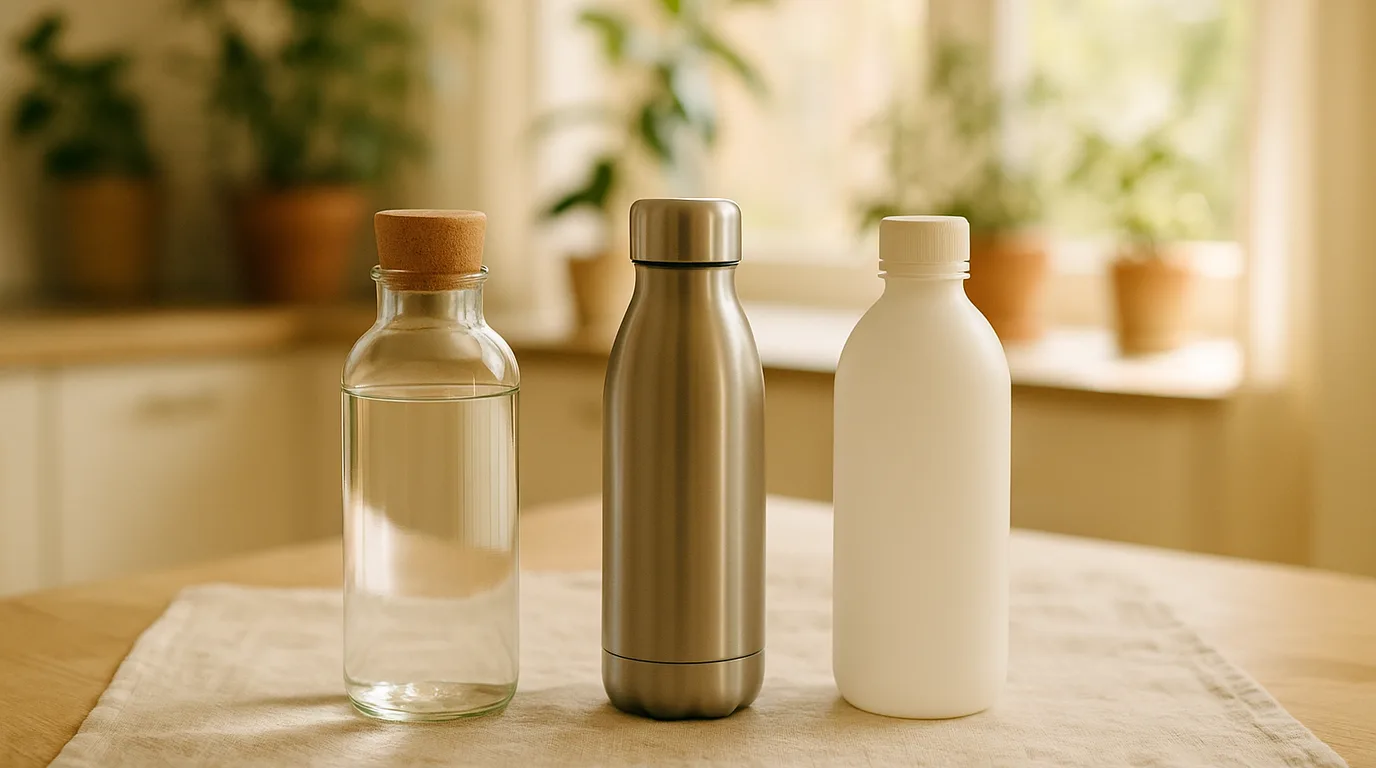
Key Takeaways
- Food-grade stainless steel (18/8 or 304) releases zero microplastics under any normal-use condition.
- The lid is the weak link, most bottles default to plastic chug caps. Look for stainless-steel cap options.
- Vacuum-insulated double-wall steel keeps cold drinks cold 24+ hours and hot drinks hot 6–12 hours.
- Avoid bottles with internal plastic liners, read product specs carefully; some “steel” bottles are actually plastic-lined.
- Stainless steel + paper-towel washing + occasional baking-soda soak prevents the metallic taste some users notice.
Why food-grade stainless steel is microplastic-free
Food-grade stainless steel (usually 18/8 (also called 304)) is an iron alloy with at least 18% chromium and 8% nickel. The chromium forms a thin passive oxide layer that resists oxidation, acid corrosion, and chemical leaching. Unlike plastic, the steel does not break down with heat, UV, time, or contact with acidic liquids at any consumer temperature.
The 2024 Columbia/Rutgers PNAS study that found 240,000 nanoplastic particles per litre of bottled water did not detect any equivalent particles in steel-bottled controls.
2026 ranked picks
| Pick | Brand / Model | Sizes | Lid options | Insulated? | Price |
|---|---|---|---|---|---|
| Best overall (pure) | Klean Kanteen Classic | Classic 18–27 oz (Wide / TKWide up to 64 oz) | Stainless loop cap available; standard sport cap is silicone+plastic | Single-wall (Classic) or double-wall (TKWide) | $20–$45 |
| Best insulated | Hydro Flask Wide Mouth | 12–64 oz | Flex Cap, Flex Chug, Flex Straw (plastic); Wide Mouth Stainless Steel Cap available | Yes | $35–$60 |
| Best design / ethics | MiiR Wide Mouth | 16–32 oz (plus 64 oz) | Leak-proof lid; MiiR does not publish its material | Yes | $30–$45 |
| Best daily UX | Owala FreeSip 24 oz | 24–40 oz (Kids 16 oz) | Plastic flip + straw (one of the few weak points) | Yes | $28–$35 |
| Best big-format | Stanley Quencher H2.0 40 oz | 14–64 oz | Plastic flip + straw | Yes | $35–$55 |
| Best premium insulation | Zojirushi Stainless Mug SM-VA | 20–24 oz | Plastic flip-lid you drink from; nonstick-coated interior | Yes | $35–$55 |
| Best for travel | Yeti Rambler 18 oz | 12–46 oz | Chug cap, MagSlider, TripleHaul (all have plastic in mouth-contact zone) | Yes | $30–$50 |
| Best lightweight | Takeya Actives 22 oz | 14–64 oz | Spout lid (plastic); convertible chug cap | Yes | $25–$35 |
| Best budget | Thermos King 16 oz | 16 oz–2 L | Plastic twist-and-pour stopper; serving-cup lid on the 40 oz | Yes | $20–$30 |
The lid is the catch
Almost every modern stainless bottle ships with a plastic lid, often a silicone-and-polypropylene blend designed for leak-proofing, drinking ease, or straw integration. The plastic component is what your mouth contacts when you drink, which means even a steel-bodied bottle still introduces some plastic at the point of consumption.
Practical rules:
- If pure microplastic avoidance is the priority, choose a Klean Kanteen Classic with the Steel Loop Cap or a Hydro Flask Wide Mouth with the Stainless Steel Cap: both keep the part you drink from metal.
- If convenience matters and you accept some plastic at the lip, the MiiR and Hydro Flask Flex Cap have minimal plastic in the actual drinking path.
- Straws and flip-cap mechanisms (Owala, Stanley) have the most plastic-mouth contact; you can replace some with stainless or silicone aftermarket straws.
What to check before buying
- “Food-grade 18/8 or 304 stainless steel” on the spec sheet. Avoid cheap unbranded bottles that may use lower-grade steel.
- No internal plastic liner. Some “steel” bottles have a plastic interior. Read the construction description carefully.
- Compatible steel-only lid available? Almost every major brand sells an alternative metal lid. The Klean Kanteen all-stainless loop cap is the most widely-available.
- Vacuum-insulated double-wall if you want hot or cold retention, slightly more expensive but the temperature retention is significant.
- Powder-coat vs paint exterior. Powder coat is more durable; some cheap paints can chip and contaminate.
Care tips
- Follow the maker's washing advice: Hydro Flask and Klean Kanteen say their bottles are dishwasher safe, while MiiR and Owala recommend hand-washing the body.
- Monthly baking-soda soak removes any taste buildup.
- Vinegar rinse for hard-water deposits in insulated bottles.
- Don't store with the lid sealed when wet, encourages mold in rubber gaskets.
Glass or stainless?
Both eliminate microplastics from the body of the bottle. Glass is chemically purest (zero metallic taste, transparent), stainless is unbreakable and better insulated. Most people end up with both, a glass bottle for the office desk and a stainless bottle for travel, the gym, and the car.
See the companion guide on best glass water bottles and microplastics in bottled water.
What the MicroPlastics app checks
- Bottled drink material. PET, HDPE, glass, aluminum, multi-layer carton.
- Container condition signals from the photo, dents, scratches, label wear.
- Brand, product category, and SKU variant.
- Use-context flags you log, heat exposure, reuse, storage time.
- Linked published research behind the 0–100 risk score.
Use the App
Scan bottled drinks and water products before you buy
Tap the barcode and snap a photo. The MicroPlastics app weighs packaging material + brand + container condition and gives a 0–100 risk score with a safer alternative.
Scan water products in the appFrequently Asked Questions
Are stainless steel water bottles really microplastic-free?
What is the best stainless steel water bottle for 2026?
Does Hydro Flask have plastic in it?
Is stainless steel safer than glass for water?
Are cheap stainless steel water bottles safe?
Why does my stainless steel bottle taste metallic?
Can stainless steel water bottles hold hot drinks safely?
Sources
- Qian N, Gao X, Lang X, et al. (2024). Rapid single-particle chemical imaging of nanoplastics by SRS microscopy. PNAS.
- US Food and Drug Administration (2024). CFR Title 21: Indirect Food Additives: Adhesives and Components of Coatings. US FDA.
- NSF International (2024). NSF/ANSI 51 - Food equipment materials. NSF.
- European Food Safety Authority (2018). Chromium in food: scientific opinion on the risks to public health. EFSA Journal.
After install · scan this first
Open the camera and scan a stainless bottle you're considering.
The interior coating (and the lid) is where most stainless bottles leak microplastics. Scan it before you buy.
Android · early access
Get the launch email the day Android opens.
One email. No spam. We send when the Android app is in the Play Store, and never again unless you opt in.
Related Research
Best Glass Water Bottles for 2026: Ranked for Microplastic Safety
Glass water bottles eliminate microplastic leaching entirely. Here are the best borosilicate and soda-lime glass bottles for 2026, ranked by safety, durability, and price.
Read moreInternational Report: Microplastics in Drinking Water (2026)
The 2026 international report on microplastics in drinking water: WHO, PNAS, EPA findings, regions with highest contamination, and what it means for you.
Read moreWhich Country Has the Most Microplastics in Tap Water? (2026 Global Ranking)
Tap-water microplastic levels range from <1 to 1,500+ particles per litre worldwide. The 2026 country-by-country ranking with WHO baseline, regional studies, and what drives the gap between the lowest-contact and dirtiest taps.
Read moreBottled Water Microplastics: What to Drink Instead
A 2024 PNAS study counted ~240,000 plastic particles per liter in bottled water: 90% nanoplastics. Why bottles shed, what raises risk, and what to drink instead.
Read moreMicroplastics in Tap Water: Is Your Drinking Water Safe?
94% of US tap water samples contain microplastics. What actually removes them, why the boiling trick only works in hard water, and which filter certification to look for.
Read moreTap Water vs Bottled Water: Which Has More Microplastics?
Bottled water averages ~240,000 particles/L; unfiltered tap is far lower; filtered tap is the lowest-contact everyday option. Full comparison plus filter picks.
Read more