Best Glass Water Bottles for 2026: Ranked for Microplastic Safety
Last reviewed: by the MicroPlastics Research Desk. Submit a correction or see our editorial standards.
Quick Answer
Holding a different bottle? Review its confirmed or estimated material and Product Contact Signal, then compare a lower-contact option.
Scan my product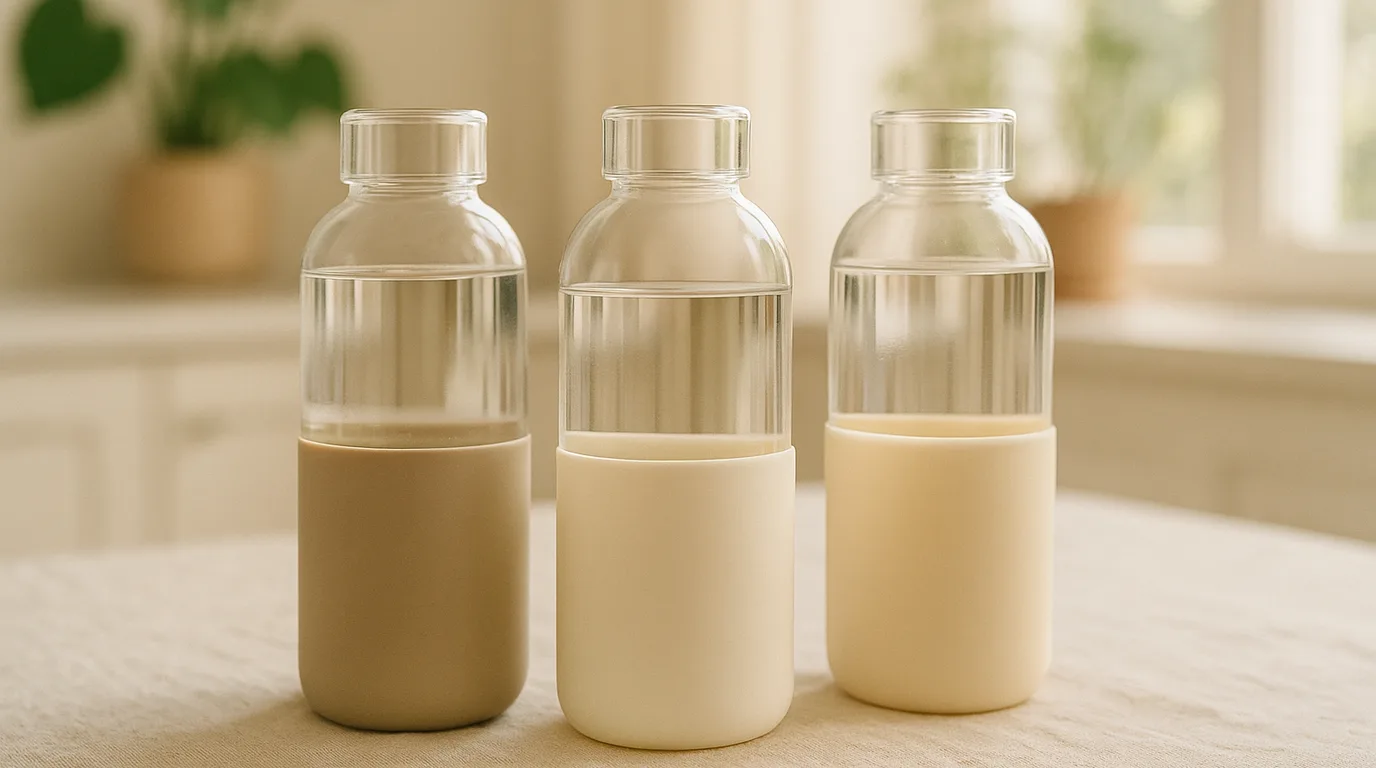
Key Takeaways
- Glass releases zero microplastics under any normal-use condition, heat, UV, time, acidity, none of them affect it.
- Borosilicate glass (the lab-glass kind; US Pyrex since 1998 is soda-lime) handles thermal shock far better than soda-lime. Best for hot/cold transitions.
- Soda-lime glass is more affordable and still inert. Slightly more fragile to temperature shifts.
- The lid is the weak link, many “glass” bottles have plastic lids that contact your mouth. Choose steel, silicone, or bamboo lids.
- A protective silicone sleeve dramatically reduces breakage risk without compromising the water's contact surface.
Why glass beats every plastic bottle
The 2024 Columbia/Rutgers PNAS study found bottled water in PET plastic averaged 240,000 nanoplastic particles per litre. By contrast, glass bottles produce no measurable microplastic releaseunder any tested condition. Glass does not break down chemically when in contact with water, doesn't leach with heat (within its tolerance range), and isn't affected by UV.
Borosilicate vs soda-lime: which glass should you choose?
Most consumer water bottles use one of two glass types:
- Borosilicate glass (lab glassware, Purifyou, Soma): contains boron oxide. Resists thermal shock up to ~165°C temperature differential, harder to crack with hot/cold transitions, slightly more expensive.
- Soda-lime glass (typical drinking glasses, Lifefactory, bkr): contains sodium oxide. More common, cheaper, slightly heavier. Less thermal-shock resistant, don't pour boiling water into a cold soda-lime bottle.
Both are equally safe for microplastic exposure (zero). Borosilicate is the better choice if you frequently fill with hot or icy liquids; soda-lime is fine for room-temperature and cold drinks.
How we picked the best glass water bottles
We ranked glass water bottles on the factors that actually determine microplastic exposure and daily usability — not brand hype. Every pick was assessed on four things: glass type (borosilicate for thermal-shock resistance vs soda-lime for value), the lid and mouthpiece material (the one part that still touches your mouth — we favour steel, silicone, or bamboo over plastic sip-spouts), breakage protection (a removable silicone sleeve), and real-world fit (size, weight, wide-mouth cleaning, price). Our pick for the best glass water bottle overall is the Purifyou 22 oz — borosilicate glass, a protective silicone sleeve, and a cap with a stainless-steel insert so little plastic touches the water — with brand-by-brand alternatives for protection, size range, hot drinks and babies below.
Our 2026 picks
| Pick | Brand / Model | Glass type | Lid material | Sizes | Price |
|---|---|---|---|---|---|
| Best overall | Purifyou 22 oz | Borosilicate | Cap with stainless-steel insert; silicone sleeve | 12–40 oz | $25–$40 |
| Best with sleeve | bkr 500 ml / 1L | Soda-lime | Polypropylene cap, silicone gasket | 250 ml–1 L | $35–$55 |
| Best size range | Lifefactory 22 oz | Soda-lime (no boiling water, no freezer) | Polypropylene cap; silicone sleeve | 12–22 oz | $22–$30 |
| Best for hot drinks | Soma 17 oz | Borosilicate | Bamboo and recycled-plastic lid | 17 oz | $30 |
| Best for babies | Lifefactory 9 oz baby bottle | Borosilicate | Polypropylene cap or sippy cap | 9 oz | $15–$22 |
| Best big-format | Purifyou 40 oz | Borosilicate | Silicone + stainless | 40 oz | $35–$45 |
What to look for (and avoid)
Look for
- Borosilicate glass if you ever fill with hot tea, hot lemon water, or ice water from very cold to room temperature.
- A removable silicone sleeve for protection.
- Lid materials: stainless steel, silicone, or bamboo, not BPA-free plastic if you can avoid it.
- Wide-mouth opening for easy cleaning and ice.
- BPA-free, BPS-free, phthalate-free labelling on any plastic components.
Avoid
- Cheap glass bottles without thermal-shock rating.
- Bottles with plastic mouthpieces or plastic sip-spouts, that's where you actually drink from.
- “Glass-lined” products, these are often plastic with a glass coating that can chip.
- Decorative paint or printing inside the bottle (rare, but check).
- Vintage/antique bottles (potential lead in older glass).
Glass vs stainless steel, which should you pick?
Both eliminate microplastics. Glass lets you see the water (a nice psychological reinforcement for hydration tracking) and never imparts a metallic taste. Stainless steel is unbreakable, lighter, and better at keeping temperature with vacuum insulation. Most people end up owning one of each: a glass bottle for the desk and a stainless steel for travel/gym.
See our companion guide on best stainless steel water bottles and microplastics in bottled water.
Filling from the tap? Pair a glass bottle with a certified filter — see how AquaTru, Clearly Filtered, and Berkey compare for microplastics. Still buying bottled? Check whether Fiji, Aquafina, or Dasani have microplastics.
What the MicroPlastics app checks
- Bottled drink material. PET, HDPE, glass, aluminum, multi-layer carton.
- Container condition signals from the photo, dents, scratches, label wear.
- Brand, product category, and SKU variant.
- Use-context flags you log, heat exposure, reuse, storage time.
- Linked published research behind the 0–100 risk score.
Use the App
Scan bottled drinks and water products before you buy
Tap the barcode and snap a photo. The MicroPlastics app weighs packaging material + brand + container condition and gives a 0–100 risk score with a safer alternative.
Scan water products in the appFrequently Asked Questions
Are glass water bottles really microplastic-free?
What is the difference between borosilicate and soda-lime glass?
What is the best glass water bottle brand?
Can you put hot drinks in glass water bottles?
Are glass water bottles safe if they break?
Do glass water bottles keep water cold?
Sources
- Qian N, Gao X, Lang X, et al. (2024). Rapid single-particle chemical imaging of nanoplastics by SRS microscopy. PNAS.
- European Food Safety Authority (2022). Scientific opinion on Bisphenol A and its alternatives in food contact materials. EFSA.
- World Health Organization (2019). Microplastics in drinking-water. WHO.
- NSF International (2024). Standards for food contact materials. NSF.
After install · scan this first
Open the camera and scan a glass bottle you're considering.
Glass + silicone sleeve combos score differently from plain glass. Scan yours before you commit to a swap.
Android · early access
Get the launch email the day Android opens.
One email. No spam. We send when the Android app is in the Play Store, and never again unless you opt in.
Go deeper
Less-travelled research from our archive that follows directly from this page.
Related Research
International Report: Microplastics in Drinking Water (2026)
The 2026 international report on microplastics in drinking water: WHO, PNAS, EPA findings, regions with highest contamination, and what it means for you.
Read moreWhich Country Has the Most Microplastics in Tap Water? (2026 Global Ranking)
Tap-water microplastic levels range from <1 to 1,500+ particles per litre worldwide. The 2026 country-by-country ranking with WHO baseline, regional studies, and what drives the gap between the lowest-contact and dirtiest taps.
Read moreBottled Water Microplastics: What to Drink Instead
A 2024 PNAS study counted ~240,000 plastic particles per liter in bottled water: 90% nanoplastics. Why bottles shed, what raises risk, and what to drink instead.
Read moreMicroplastics in Tap Water: Is Your Drinking Water Safe?
94% of US tap water samples contain microplastics. What actually removes them, why the boiling trick only works in hard water, and which filter certification to look for.
Read moreTap Water vs Bottled Water: Which Has More Microplastics?
Bottled water averages ~240,000 particles/L; unfiltered tap is far lower; filtered tap is the lowest-contact everyday option. Full comparison plus filter picks.
Read moreMicroplastics in Sparkling Water: LaCroix, Bubly & Spindrift Ranked (2026)
Cans beat plastic bottles, and carbonation is why the gap is wider than for still water. CO2 pressure and agitation raise shedding from PET. LaCroix, Bubly, Spindrift, Waterloo, Topo Chico and Perrier ranked, plus the can-liner trade-off.
Read more