Does Clearly Filtered Remove Microplastics? Pitcher Verdict (2026)

Last reviewed: by the MicroPlastics Research Desk. Submit a correction or see our editorial standards.
Quick Answer
Holding a different bottle? Review its confirmed or estimated material and Product Contact Signal, then compare a lower-contact option.
Scan my product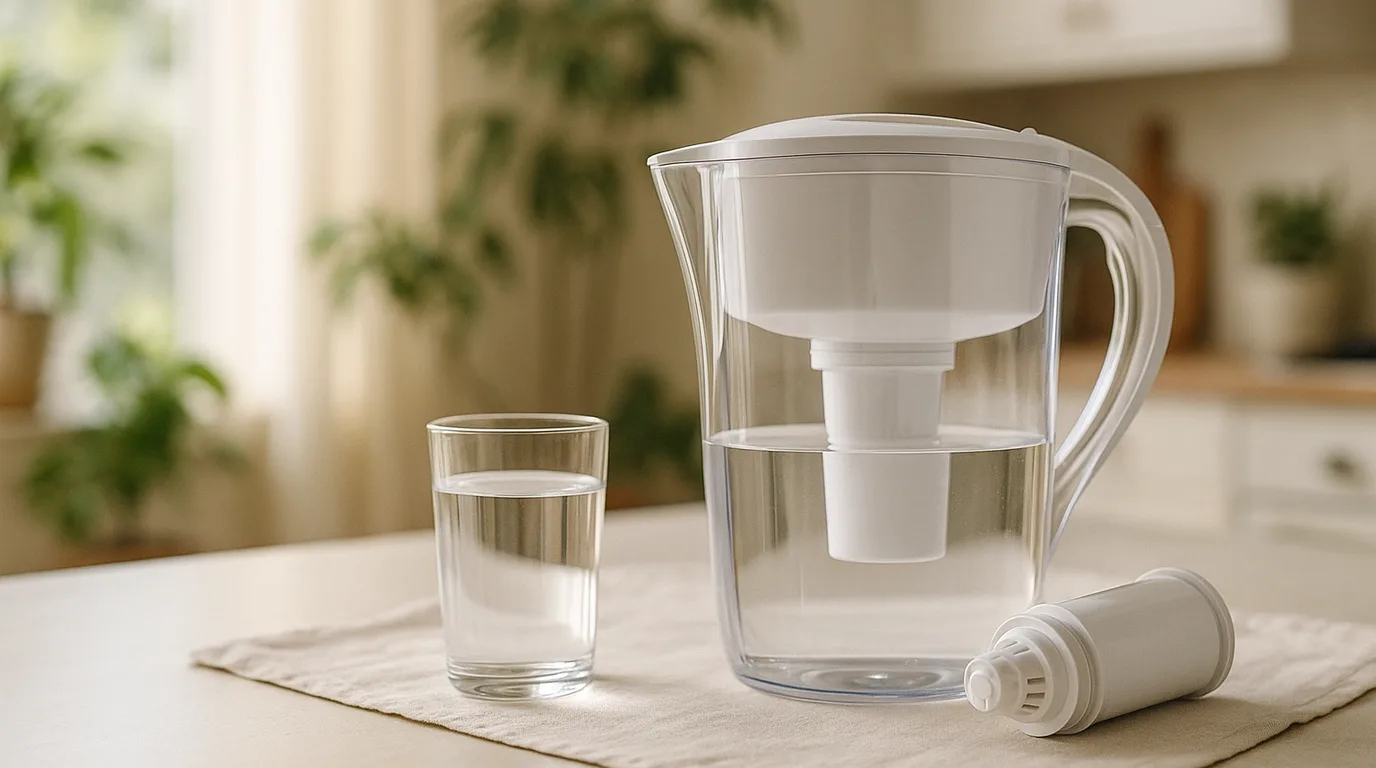
Key Takeaways
- Clearly Filtered's Affinity three-stage pitcher is independently tested to remove 99.9%+ of microplastics plus PFAS, lead and pharmaceuticals.
- It is certified only to NSF/ANSI 42 and 372, not to NSF/ANSI 401, the one standard with a microplastics claim.
- Unlike reverse osmosis, it keeps beneficial minerals (calcium, magnesium), so the water isn't “flat” and needs no remineralizing.
- It's a fridge pitcher: no plumbing, no power, no counter space, the easiest serious-filter format to live with.
- Trade-offs: slower gravity flow, smaller capacity, and higher filter cost than a basic Brita, in exchange for far better removal.
- Want faster throughput or fluoride-free water for the whole household? Compare with AquaTru reverse osmosis.
Clearly Filtered & microplastics — the facts
- microplastic removal (independent lab)
- 99.9%+
- third-party tested, not just manufacturer-claimed
- Clearly Filtered performance data
- certifications held
- NSF 42, 372
- not certified to NSF/ANSI 401, the standard with a microplastics claim
- NSF listing
- unlike reverse osmosis
- Keeps minerals
- calcium and magnesium stay in — no flat taste, no remineralizing
- Affinity filtration design
- no plumbing or power
- Pitcher
- lives in the fridge; the easiest serious filter to adopt
- Clearly Filtered product design
Does Clearly Filtered remove microplastics?
Yes — and it is one of the few pitchers that can back the claim with independent testing. Clearly Filtered uses a proprietary three-stage “Affinity” filtration media rather than the single carbon block in a basic pitcher. The company publishes third-party laboratory results showing greater than 99.9% removal of microplastics, part of a tested list of 365+ contaminants that also includes PFAS, lead, and pharmaceutical residues.
Clearly Filtered says the testing was done by an independent lab (QFT, now IAPMO New Jersey) that is capable of testing to NSF/ANSI protocols; it does not say which standard each test followed. NSF/ANSI 401 is the standard with a microplastics claim. The caveat: Clearly Filtered is not certified to it. Its NSF certifications cover chlorine taste and odour (NSF 42) and lead-free materials (NSF 372); the microplastic figure comes from a testing lab. Three pitchers do carry a certified NSF 401 microplastic claim: PUR PLUS, the Brita Elite cartridge and the LifeStraw Home glass pitcher. Clearly Filtered reports a higher figure than any of them, but as a lab result rather than a certified one. Against a standard Brita, which makes no microplastic claim at all, it is well ahead either way.
Why keeping minerals matters
The big functional difference between Clearly Filtered and a reverse-osmosis system like AquaTru is what stays in the water. RO strips almost everything, including beneficial minerals, which is why RO water can taste flat and why many owners remineralize. Clearly Filtered's media is designed to pull out contaminants while leaving calcium and magnesium behind. For a lot of people that is the deciding factor: comparable microplastic removal, better-tasting water, and nothing to add back.
The trade-offs
Clearly Filtered is a pitcher, and pitchers have limits. The dense media that makes it effective also makes it slower to filter — gravity takes its time. Capacity is a pitcher's worth, so a large household refills often. And the replacement filters cost more than a Brita's, though they last longer and do far more. None of that changes the microplastic verdict — it is about whether a fridge pitcher fits your volume needs.
Clearly Filtered vs the alternatives
| Filter | Format | Evidence of removal | Keeps minerals? | Best for |
|---|---|---|---|---|
| Clearly Filtered | Fridge pitcher | Brand-commissioned independent lab tests; certified to NSF 42, 372 only | Yes | No-install, keeps minerals |
| AquaTru | Countertop RO | Certified NSF/ANSI 401 for microplastics (96.48%), plus 42, 53, 58, 372 (IAPMO) | No (remineralize) | Certified microplastics plus lead, fluoride, arsenic |
| Berkey | Gravity system | Not tested for microplastics, per Berkey; uncertified | Yes | Off-grid / emergency |
| Brita Standard | Pitcher | NSF 42/53 (not 401) | Yes | Taste only, weak on microplastics |
For the full breakdown see Berkey vs Brita vs AquaTru vs Clearly Filtered and the best water filters for microplastics guide. Curious how the gravity option holds up? Read the Berkey verdict.
Use the App
Filtered at home — now check everywhere else
Clearly Filtered covers your pitcher water. Scan bottled drinks, to-go cups, and food packaging with the MicroPlastics app to catch the exposure a pitcher can't reach.
Get the MicroPlastics appFrequently Asked Questions
Is Clearly Filtered NSF certified for microplastics?
Does Clearly Filtered remove minerals from water?
Is Clearly Filtered better than Brita for microplastics?
Clearly Filtered or AquaTru for microplastics?
Sources
- NSF International (2024). NSF/ANSI 401: Emerging contaminants / incidental compounds. NSF.
- Qian N, et al. (2024). Rapid single-particle chemical imaging of nanoplastics by SRS microscopy. PNAS.
- World Health Organization (2022). Dietary and inhalation exposure to nano- and microplastic particles. WHO.
Track every water source you actually drink
Save bottled brands, filtered tap sources, and travel-water situations to compare a modeled packaging-contact pattern over time. It is not a personal exposure profile.
Download on the App Store- Free on iOS
- 3 free scans
- No sign-up
- Result in seconds
“Really cool to scan stuff around the kitchen and see what's actually in it. The swaps it suggests are realistic.” App Store review · 5.0★
Android · early access
Get the launch email the day Android opens.
One email. No spam. We send when the Android app is in the Play Store, and never again unless you opt in.
Related Research
Does Hydro Flask Have Microplastics? The Lid Is the Only Catch (2026)
Hydro Flask lists an 18/8 stainless-steel body, removing a polymer body from the contact pathway. Compare lid, straw, gasket, condition, and use; this is not a product test or zero-particle guarantee.
Read moreDoes Yeti Have Microplastics? The Rambler & MagSlider Verdict (2026)
Yeti lists an 18/8 stainless-steel Rambler body, removing a polymer body from the contact pathway. Compare the MagSlider or straw lid, gasket, condition, and use; this is not a product test or zero-particle guarantee.
Read moreTritan Plastic: What It Actually Is, Whether It's Safe in Hot Water, and What Really Sheds
Tritan is Eastman’s copolyester of DMT, CHDM and TMCD — no bisphenol anywhere in it, a glass transition near 120 °C, and FDA clearance to 100 °C. The estrogenic-activity claims were found false under the Lanham Act in 2014. And when researchers counted particles from reusable bottles, the source was the screw cap: 131 per litre after one opening, 242 after eleven.
Read moreDoes Cirkul Have Microplastics? Bottle, Sip Cartridges & Flavor System Audit (2026)
The standard Cirkul bottle is Tritan: BPA-free, but still a plastic: and every sip passes through a disposable plastic flavor cartridge. The full materials audit: Tritan’s contested safety record, the cartridge valve, dishwasher heat cycles, the stainless line, and how Cirkul compares to Owala and Stanley.
Read moreIs Bottled Water Left in a Hot Car Safe? Hours vs Days
Unopened bottle or whole case? Compare a few hours, 2 days and longer in a hot car, what heat does to PET, and when replacing the water is sensible.
Read moreBest Owala Water Bottles for Microplastics: FreeSip, Twist, Tumbler Compared (2026)
Owala FreeSip, FreeSip Sway, Twist, Big Gulp, Color Shift, Kids Owala: every Owala line ranked for stainless grade, Tritan lid plastic, and microplastic exposure per sip. The lowest-contact Owala SKU and the lowest-contact non-Owala alternative if you want less plastic.
Read more