Ember Mug 2 vs Mug 3: Coating and Microplastic Questions

Last reviewed: by the MicroPlastics Research Desk. Submit a correction or see our editorial standards.
Quick answer
Save kitchen products and compare their contact assessments in the app.
Scan my product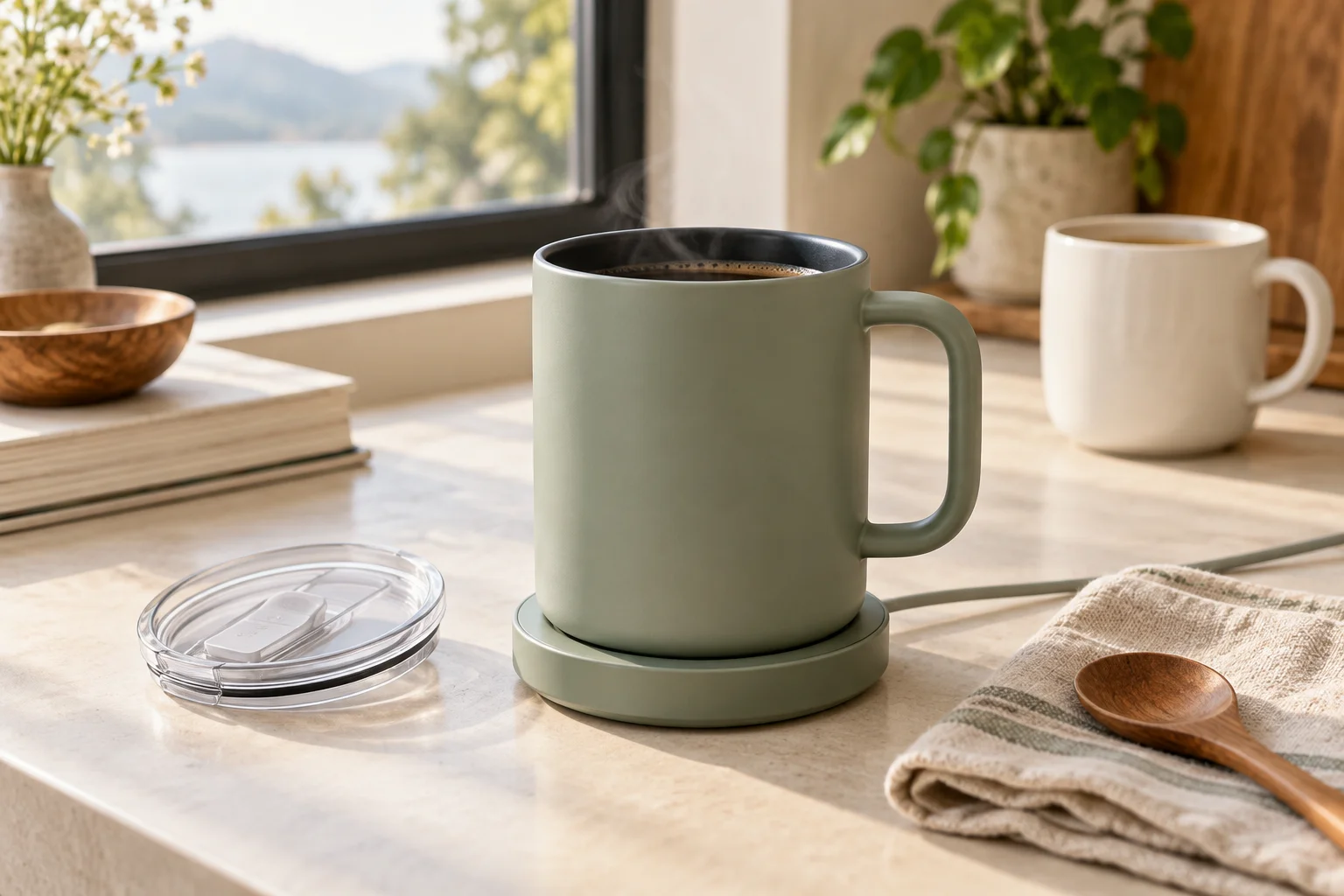
Key Takeaways
- A ceramic-coated steel mug is a different construction from a solid ceramic cup or bare steel vessel.
- The reviewed Mug 3 listing still declares a ceramic-coated interior. New cleaning permission does not mean the coating disappeared.
- Mug 3’s care guide specifies the top rack and a low-temperature dishwasher cycle, with an exception for customized or branded mugs.
- Coating composition, chemical migration and particle release are separate questions; one reassuring label cannot answer all three.
- An old product URL can now display a newer generation. Verify the product name, not just the address.
First, identify the Ember generation
A search for an Ember mug can now return advice written for different generations. As of October 6, 2026, Ember sells Mug 3 and explicitly distinguishes it from the original Mug and Mug 2 in its cleaning guidance. That distinction has a practical consequence: the newer model has restricted dishwasher permission, while the earlier mugs do not.
Ember’s identification guide recommends checking the row of small indicator lights below the main light on Mug 3. Its guide also discusses base colours and charging rings, but notes exceptions among Mug 2 colours. A black base by itself is therefore not enough to identify the generation. Check your order record or ask support if the visual checks disagree.
The product page we reviewed is the Black 14oz Mug 3 variant at the link below. The legacy Mug 2 URL now displays Mug 3 content. That is why a saved address, an old search snippet or a retailer’s title should not be used alone to decide which instructions apply to the mug on your desk.
| Model | What the sources establish | Cleaning distinction |
|---|---|---|
| Original Mug and Mug 2 | Manufacturer material FAQ describes coated stainless steel | Hand-wash only under the earlier-model care guidance |
| Mug 3, reviewed Black 14oz variant | Current product listing declares a ceramic-coated steel interior | Top rack, low-temperature cycle; customized/branded mugs excluded |
This comparison does not cover every Ember Cup, Tumbler, Travel Mug or third-party accessory. Those names identify different products. A care rule for a handled Mug 3 does not grant the same permission to another heated drinking vessel, even when both use a charging coaster.
What does your coffee actually touch?
Ember’s material FAQ describes stainless steel with a ceramic-reinforced coating. The current 14oz Mug 3 listing separately identifies a ceramic-coated interior. These descriptions establish that the beverage-facing surface is coated; this is not simply a bare steel mug with electronics underneath it.
Ceramic-reinforced is not a complete chemical recipe. The reviewed material FAQ does not specify every coating constituent, its binder or a particle-release protocol. We therefore do not identify the entire coating as PTFE, epoxy or a particular plastic. We also do not infer that every component is inorganic and permanently non-shedding from the word ceramic.
An exterior finish is another surface with a different contact pattern. A metallic-looking edition does not, by appearance alone, prove an uncoated beverage interior. If avoiding a particular substance is a buying requirement, ask for the declaration for the exact interior coating and edition. Colour, price and the word premium are not substitutes for that declaration.
Using a lid changes the contact path again. Mug 3 includes a sliding lid, but the reviewed listing does not give a complete resin-by-part declaration for that accessory. Include the lid and seal in your questions when you use them. A glass or steel vessel label cannot describe every surface in an assembled drinking system; our Contigo AUTOSEAL guide explains that distinction for another mug format.
Does the coating contain plastic, PTFE or PFAS?
The documents reviewed here are not enough to confirm a complete formulation or a tested absence of all PFAS. That is a disclosure limit, not evidence that a particular substance is present. “Ceramic-reinforced” does not identify a specific fluoropolymer, and an unspecified binder should not be filled in with a guess from a discussion forum.
Likewise, a PFAS-free claim would need a defined scope. A composition statement, a targeted chemical panel and a total-fluorine measurement provide different information. Before using a test as proof, check the tested part, substances covered, detection limits and date. Even a well-defined chemical result would not automatically answer a question about all physical particles released during use.
Search results can also mix unrelated products sold under similar names. A coating declaration for cookware is not a declaration for an electronic coffee mug. Follow the product identity and the manufacturer’s domain all the way to the source. Do not transfer a saucepan’s test report to this mug because the page also contains the word Ember.
What does the manufacturer’s food-grade wording mean?
The material FAQ uses food-grade wording and refers to FDA. We report that as the manufacturer’s description, rather than as our verification of a complete approval file. The FDA explains food-contact authorization in terms of substances, intended uses and conditions, including the relevant specifications and limits. A general food-contact statement is not a finished-mug particle count.
If you want to examine that claim in detail, ask which authorization or regulation covers the coating’s constituents and intended hot-beverage contact. Ask whether a migration report applies to the current finished surface and how the sample was conditioned. Such documentation is more informative than treating the words food grade as a universal promise about every possible kind of damage or wear.
The distinction works both ways. A coating whose composition is not fully public should not automatically be called toxic. The FDA’s microplastic guidance describes significant research gaps and says current evidence does not demonstrate a human-health risk from detected levels in food. That broad statement does not certify this mug, and this article does not calculate a personal risk from using one.
Mug 3: dishwasher permission has conditions
The current Mug 3 care guide specifies the top rack and a low-temperature cycle; bottom-rack, high-temperature and sanitize cycles are outside that advice. It also permits top-rack washing of the sliding lid. Customized or branded mugs are excluded from dishwasher use. The charging coaster must stay out of the dishwasher and must not be immersed.
For hand washing, use warm water and mild soap without long soaks. Avoid metal utensils, abrasives, microwaves and external heat sources; dry the charging contacts before charging. Read the complete model-specific guide.
These instructions describe how Ember allows the product to be cared for. They do not demonstrate a lower release rate than Mug 2. A dishwasher-compatible design is a useful maintenance change, but comparing particle release requires measurements under defined conditions. It is not sound to label the newer mug microplastic-free simply because washing it is more convenient.
Mug and Mug 2: keep the older care routine
The earlier-model maintenance page requires hand washing with warm soapy water and a soft sponge. It recommends a wooden or silicone spoon because metal can damage the coating, and says to dry the mug completely before charging. Dishwasher permission for Mug 3 does not revise that earlier-model restriction.
An older Ember care article also warns against abrasive cleaning and describes coating chipping. It includes a broad warning against immersion, while other product documentation describes water resistance. Treat a water-resistance rating and permission for a particular cleaning routine as separate facts. Use the supplied instructions and the current guide for your generation rather than assuming either unrestricted soaking or dishwasher suitability.
The goal is to clean the intended surface without turning cleaning into a wear experiment. A stain is not proof of a polymer particle count. If you cannot remove residue using the permitted routine, ask support about the correct next step; do not increase abrasion until the surface looks bare.
What if the interior is chipped, bubbling or peeling?
Pause use of a visibly damaged drinking surface and ask Ember to assess it. Keep the model details and photographs of the affected area. This is a practical precaution for a surface that no longer looks intact, not a diagnosis of poisoning or a claim that every mug will develop the same defect.
Do not strip or sand the interior coating to create a homemade bare-metal mug. That changes the designed contact surface, can create debris and does not establish that the modified product meets its intended use conditions. A repair demonstrated online is not a materials assessment of your own mug.
Customer reports can help identify questions to ask, but cannot establish a failure rate without knowing how many comparable mugs were used and under what conditions. Photographs also cannot determine whether a detached fragment is polymer, mineral, a mixture or something else. That requires material analysis. We do not turn individual complaints into an average exposure estimate.
Do we know the microplastics per Ember coffee?
No Ember-specific release count is provided in the documents reviewed for this guide. We have not commissioned a coating or beverage test. Results from plastic-lined disposable cups, nonstick pans or another heated mug cannot supply that missing value, because the materials, temperatures and mechanical stresses differ.
A useful study would identify the mug and coating version, compare the beverage before and after use, include blanks for laboratory contamination and state the particle-size range it can detect. It would distinguish mineral fragments from polymer particles and include realistic washing and stirring conditions. A new-versus-aged comparison would be particularly useful when the question concerns coating wear.
Until such evidence is available, long warm contact is a condition to document, not a number to multiply by a generic plastic shedding rate. Nor does a temperature setting measure chemical migration. The mug’s thermostat answers a temperature-control question; it does not identify what is in the beverage.
How to choose without an unsupported safety ranking
| Your priority | What to check |
|---|---|
| Keep an existing Ember working | Correct generation, intact surface and permitted cleaning routine |
| Dishwasher convenience | Mug 3’s restricted cycle instructions and customized-mug exception |
| Avoid an unspecified interior coating | A documented alternative contact surface, with its own heat and handling limits |
| Prove lower particle exposure | A controlled comparison of the actual finished products; marketing labels are insufficient |
If a working, intact Ember solves a temperature-control need, this review does not establish that you must replace it. If you prefer a simpler contact surface, make that objective explicit when comparing alternatives. A conventional ceramic cup, glass vessel and bare steel mug have different handling requirements; none should be promised to remove every possible particle from the drink.
See our glass profile and steel profile for those material limits. For disposable cups, use the separate coffee-cup guide. Keeping each source tied to the product it actually studied is more useful than declaring one material universally best.
Use the App
Save the materials and parts you want to compare
Keep product assessments together and review their evidence. The app does not test a mug coating or count particles in your coffee.
Explore product assessmentsFrequently Asked Questions
Does an Ember Mug release microplastics?
Is Ember Mug 3 dishwasher safe?
Can Ember Mug 2 go in the dishwasher now?
Does the stainless-steel edition have a bare steel interior?
Sources
- Ember (2026). Black 14oz Mug 3, variant 47905282162873 (accessed October 6).
- Ember (2026). Mug material FAQ: ceramic-reinforced coating (accessed October 6).
- Ember (2026). Which Ember Mug do I have? (accessed October 6).
- Ember (2026). Cleaning and caring for Mug 3 (accessed October 6).
- Ember (2026). Earlier Mug care and maintenance (accessed October 6).
- Ember (2026). How to care for your Ember Mug: earlier general care article (accessed October 6).
- US Food and Drug Administration (2026). How FDA regulates food-contact substances (accessed October 6).
- US Food and Drug Administration (2026). Microplastics and nanoplastics in foods (accessed October 6).
Your next product question
Start with your exact Ember Mug and food-contact surface.
Check the model-specific surface and care documentation, including any lid. Temperature control and the outer body do not establish a particle count for the drink.
Use the exact product name, model and label to check the information behind an assessment. A photo does not measure particles or personal health risk. The examples above are research subjects, not a verified app-coverage list.
Build a product-routine reading plan →Android · early access
Get the launch email the day Android opens.
One email. No spam. We send when the Android app is in the Play Store, and never again unless you opt in.
Related Research
Are Stasher Bags Safe? Silicone, Heat and the Testing Gap
Stasher bags use platinum silicone, not polyethylene film. What the manufacturer allows, what silicone migration studies actually measured, and when glass makes a simpler reheating choice.
Read moreIs Caraway Cookware Non-Toxic? What Its Own Filings Show
Caraway’s ceramic pans are PFAS-free, and the ad industry’s watchdog agreed. Its own documents also show an aluminium body, a one-year warranty that excludes coating wear, and cadmium in one cast iron colour’s exterior enamel.
Read moreAre Air Fryer Liners Safe? Paper, Silicone and Foil Checked
Paper liners are coated with silicone, wax or something unnamed, and a September 2026 study found new silicone liners release the most in their first uses. What each type is, what the fryer makers allow, and what to use instead.
Read moreTitanium Cutting Boards: A Best-Seller Is Half Plastic
A test kitchen found 2 of 3 “titanium” boards were stainless steel, and Amazon’s No. 2 cutting board is titled “Pure Titanium/PP”. What titanium avoids, what it costs your knives, and what to buy instead.
Read moreNon-Toxic Air Fryers: What Your Food Actually Sits On
We traced air-fryer baskets to the makers’ own documents. Glass fryers still use a coated plate, “stainless” usually means the outside, and SharkNinja lists PTFE for Ninja units made before August 2024.
Read moreIs HexClad Non-Toxic? It Depends on When You Bought It
HexClad’s own FAQ said “Our nonstick coating contains PTFE” until 2024; it now says every pan uses PTFE-free TerraBond ceramic. What the $2.5 million settlement changed and what to do with an older pan.
Read more