Are Stasher Bags Safe? Silicone, Heat and the Testing Gap

Last reviewed: by the MicroPlastics Research Desk. Submit a correction or see our editorial standards.
Quick answer
Save kitchen products and compare their contact assessments in the app.
Scan my product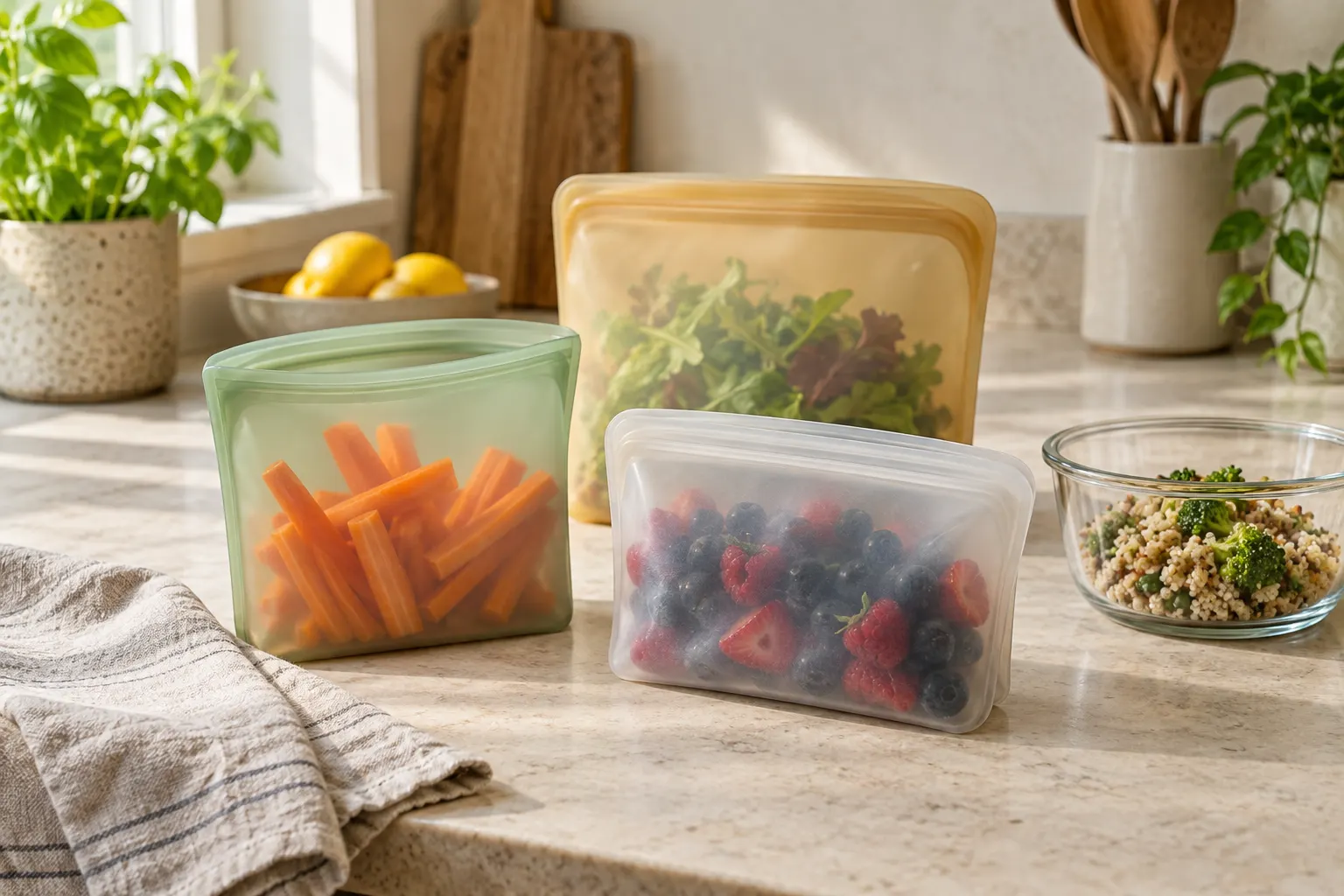
Key Takeaways
- The reviewed Sandwich Bag is declared food-grade platinum silicone. It is not the polyethylene film used in disposable sandwich bags.
- An allowed oven temperature is a use limit, not a finding that migration is zero at every lower temperature.
- Silicone migration studies often measure siloxane molecules. Those results are not counts of microplastic particles.
- Venting and preserving the seal matter. A damaged bag should leave food service, even if it still holds a sandwich.
- Glass is a practical reheating alternative; an intact silicone bag remains useful for snacks, freezer portions and carrying food.
What are Stasher bags actually made of?
The Sandwich Bag listing identifies food-grade platinum silicone. Its seal is part of the flexible bag rather than a separate zipper track. The brand also declares no BPA, BPS, lead, latex or phthalates. Those are manufacturer statements about the reviewed product; they do not establish the composition of every reusable bag sold online under a similar description.
Silicone is a synthetic polymer with a silicon–oxygen backbone and organic side groups. Calling it rubber-like can help describe the feel, but does not turn it into a natural material. Platinum describes the curing system. It does not mean that the finished bag is made of platinum, that every conceivable residual compound has been measured, or that the bag is medically protective.
This distinction matters when comparing Stasher with disposable Ziploc bags. A study of polyethylene film does not tell us the particle release from silicone. The products have different materials, structures and intended lifetimes. Comparing the brand names without comparing those details produces a confident answer to the wrong question.
What does the safety testing establish?
Stasher says it sends finished products for third-party testing and follows food-contact requirements in multiple markets. That is relevant, but the reviewed product page does not publish a complete laboratory report with a particle-size cutoff, aged-bag conditions, blank correction and a particles-per-serving result. We therefore cannot convert its compliance statement into a measured shedding rate.
A useful question for any maker is: Which finished product was tested, under which food simulant, for how long and at what temperature? Ask whether the report concerns total migration, named chemicals, mechanical durability or polymer particles. Each can be a worthwhile test. None automatically answers all the others. A pass against one defined limit also differs from a claim that nothing leaves the material.
| Claim or test | What it helps establish | What it does not establish |
|---|---|---|
| BPA-free declaration | A statement about a named chemical | No polymer, no other migrants or zero particles |
| Platinum-cured silicone | The declared material and curing route | A product-specific lifetime migration result |
| Food-contact migration test | Performance under the tested conditions and limits | Every food, temperature or damaged condition |
| Particle-release analysis | Particles detected within the method’s size and identification limits | All smaller particles or a personal health outcome |
We reviewed the public material and care information on October 6, 2026. We did not buy bags, perform a laboratory test or verify a private report. This is a source-based assessment of intended use and evidence limits. It is also why there is no invented Stasher score in particles per litre or particles per meal.
Does silicone release microplastics or chemicals?
The most useful answer separates physical fragments from chemical migration. A small solid polymer fragment and a dissolved siloxane molecule are different measurements. The label “not ordinary plastic” cannot settle either one. Definitions also differ between scientific methods and regulation; a silicon–oxygen backbone alone does not justify a universal exemption from every microplastic definition. Our silicone evidence guide explains that distinction.
In a 2025 Health Canada-led study, researchers examined 25 silicone bakeware products and measured cyclic siloxanes migrating into an oily food simulant and into air during baking at 177°C for one hour. Migration depended on factors including the product and contact conditions, and declined with repeated baking. These were chemical measurements from bakeware, not a Stasher bag particle test.
A 2022 study of four silicone cupcake moulds found that manufacturing and post-curing affected volatile compounds and migration results. It supports asking about finished-product quality. It cannot tell us that an unnamed cheap bag is dangerous, that every premium bag releases nothing, or that an owner should put any silicone item through an improvised home heat treatment.
These studies make high-temperature, fatty-food contact a reasonable area for careful product-specific testing. They do not demonstrate that ordinary cold storage in a Stasher bag causes disease. The FDA’s current food guidance says available evidence does not demonstrate a human-health risk from microplastics and nanoplastics at the levels detected in foods. Uncertainty is a reason to describe the evidence accurately, not to manufacture a precise personal risk.
Can you microwave or bake in a Stasher bag?
Stasher’s FAQ permits microwave, freezer and oven use up to 425°F / 218°C. It says to leave the seal partly open during cooking and use a baking sheet in the oven. That is the manufacturer’s intended-use instruction, rather than an independent finding of zero migration. The limit is specific to these products; do not apply it to an unknown silicone pouch or an attached accessory.
Our preference for routine microwave reheating is a microwave-safe glass bowl or dish, with an appropriate vented cover. That removes the flexible polymer from the main food-contact surface without adding a complicated routine. It also lets you stir the food and check temperature more easily. Follow the glass maker’s thermal-shock instructions and remember that glass can become hot and break; material simplicity is not permission to ignore handling safety.
If a silicone bag is the practical option, read its own instructions rather than guessing from the brand category. Do not improvise a sealed cooking method. The distinction is especially useful for soup, sauce and oily leftovers: storage, reheating and prolonged cooking are separate use cases even when the same bag can perform all three.
Stasher, disposable bags or glass: which fits the job?
| Job | Practical choice | Reason and tradeoff |
|---|---|---|
| Portable snacks and packed lunches | An intact reusable silicone bag | Flexible and reusable; inspect and clean the seal |
| Freezer portions in a tight space | Silicone or another freezer-rated container | Choose a size you will use; allow for expansion as instructed |
| Routine microwave reheating | Microwave-safe glass | Food can sit against glass; handle heat and thermal shock carefully |
| Leak-sensitive travel | A container with a verified closure | Leak resistance and hygiene matter alongside material |
| Avoiding polymer contact at the main food surface | Glass or uncoated food-storage steel | Check lids and seals separately; steel generally cannot go in a microwave |
There is no need to replace an entire kitchen to follow this approach. Start with the repetitive job you actually do: yesterday’s pasta reheated for lunch, fruit carried to work, or portions frozen for a busy week. Change that one contact surface if it fits your budget and routine. The benefit we can describe is the changed material contact, not a promised reduction in the plastic inside your body.
For a broader storage comparison, see Pyrex versus Anchor Hocking. If your question is specifically about heating disposable bags, use the separate Ziploc microwave guide. Keeping those decisions separate is more useful than treating every product called a bag as interchangeable.
How to clean a bag and decide when to replace it
The brand’s care instructions allow dishwasher cleaning or washing by hand. Clean the corners and seal, leave it open to dry, and avoid turning it inside out: Stasher says that can damage the seal. A clean exterior does not tell you whether food remains in a fold, so inspect the parts you cannot see at first glance.
Retire a bag from food use if it tears, develops a damaged closure, or has material visibly flaking or crumbling. An odour or colour stain alone does not measure chemical migration, and a lack of smell does not prove zero migration. If a surface change persists after following the maker’s care instructions, ask the manufacturer rather than trying aggressive solvents, scraping or an unapproved bake-out.
The common pinch or twist test is not a substitute for formulation analysis. Whitening does not tell you which ingredient is present or whether the product passes food-contact testing. For a buying decision, documentation, traceability and suitable care instructions provide firmer information than a social-media purity trick.
What the MicroPlastics app checks
- Declared packaging and food-contact material, where the product can be identified.
- The storage or heat-use context you record and the research associated with that category.
- A modeled contact assessment, not a laboratory particle count or a diagnosis.
Use the App
Keep a record of the storage products you use
The article explains the material choice. The app helps you save product assessments and compare your recorded contact pattern over time; it does not measure particles in your food or body.
Explore the appFrequently Asked Questions
Are Stasher bags plastic?
Do Stasher bags release microplastics?
Are Stasher bags microwave-safe?
Can Stasher bags go in the oven?
Are Stasher bags safer than Ziploc?
Does a white streak prove that silicone is unsafe?
Sources
- Stasher (2026). Sandwich Bag: material and product declarations (accessed October 6). Manufacturer information.
- Stasher (2026). Frequently asked questions (accessed October 6). Manufacturer instructions.
- Stasher (2026). Care and cleaning (accessed October 6). Manufacturer instructions.
- Health Canada research team (2025). Silicone bakeware as a source of human exposure to cyclic siloxanes via inhalation and baked food consumption. Journal of Hazardous Materials.
- University of Zaragoza research team (2022). Analysis of potential migration compounds from silicone molds for food contact by SPME-GC-MS. Food and Chemical Toxicology.
- European Commission (2023). Regulation (EU) 2023/2055: synthetic polymer microparticles. EUR-Lex.
- US Food and Drug Administration (2026). Microplastics and nanoplastics in foods (accessed October 6).
Your next product question
Start with your exact Stasher bag and intended use.
Keep the material disclosure and permitted use together. Silicone construction and a care instruction are not a whole-product particle-clearance result.
Use the exact product name, model and label to check the information behind an assessment. A photo does not measure particles or personal health risk. The examples above are research subjects, not a verified app-coverage list.
Build a product-routine reading plan →Android · early access
Get the launch email the day Android opens.
One email. No spam. We send when the Android app is in the Play Store, and never again unless you opt in.
Related Research
Is Caraway Cookware Non-Toxic? What Its Own Filings Show
Caraway’s ceramic pans are PFAS-free, and the ad industry’s watchdog agreed. Its own documents also show an aluminium body, a one-year warranty that excludes coating wear, and cadmium in one cast iron colour’s exterior enamel.
Read moreAre Air Fryer Liners Safe? Paper, Silicone and Foil Checked
Paper liners are coated with silicone, wax or something unnamed, and a September 2026 study found new silicone liners release the most in their first uses. What each type is, what the fryer makers allow, and what to use instead.
Read moreTitanium Cutting Boards: A Best-Seller Is Half Plastic
A test kitchen found 2 of 3 “titanium” boards were stainless steel, and Amazon’s No. 2 cutting board is titled “Pure Titanium/PP”. What titanium avoids, what it costs your knives, and what to buy instead.
Read moreNon-Toxic Air Fryers: What Your Food Actually Sits On
We traced air-fryer baskets to the makers’ own documents. Glass fryers still use a coated plate, “stainless” usually means the outside, and SharkNinja lists PTFE for Ninja units made before August 2024.
Read moreIs HexClad Non-Toxic? It Depends on When You Bought It
HexClad’s own FAQ said “Our nonstick coating contains PTFE” until 2024; it now says every pan uses PTFE-free TerraBond ceramic. What the $2.5 million settlement changed and what to do with an older pan.
Read moreIs Ceramic Cookware Safe? “Ceramic” Means Four Different Things
Ceramic nonstick is PFAS-free but held together by a silicone matrix, enamel is safe until it chips, solid ceramic has trace lead, and lead-glazed clay is the real risk. The evidence for each type.
Read more