Are Air Fryer Liners Safe? Paper, Silicone and Foil Checked

Last reviewed: by the MicroPlastics Research Desk. Submit a correction or see our editorial standards.
Quick Answer
Different container in your kitchen? Review its confirmed or estimated material and Product Contact Signal, then compare a lower-contact option.
Scan my product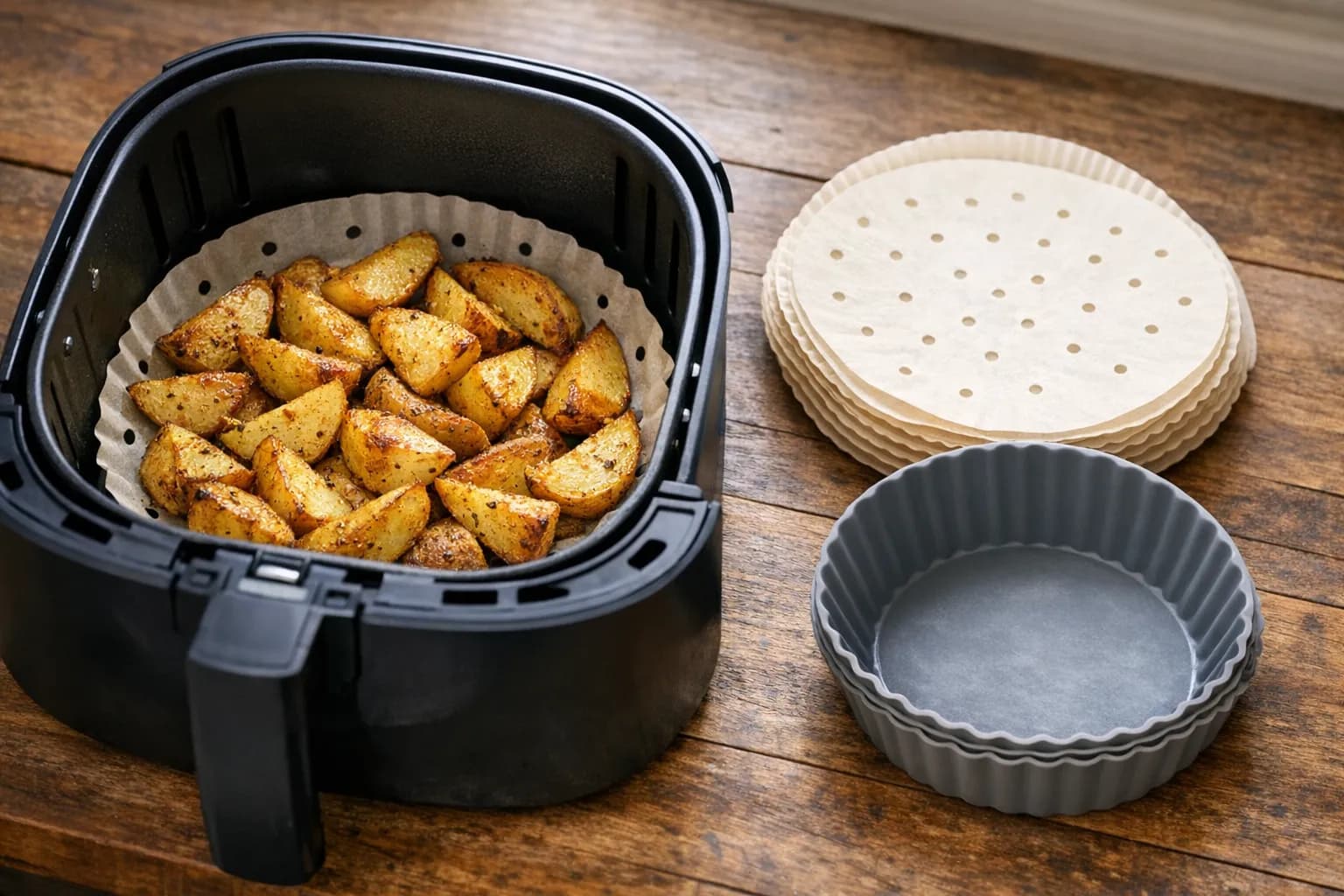
Key Takeaways
- Paper liners aren’t all the same. Katbite says silicone, Smartake says wax, and Reynolds names no coating.
- PFAS: no liner has been tested, but the FDA says PFAS grease-proofers are no longer sold for US food-contact paper.
- Silicone is worst when new. A September 2026 study found limits exceeded at 175 °C, and levels below the criteria by the third use.
- The fire risk is real. Cosori, Philips, Instant and Reynolds all warn about paper or foil reaching the element.
- Temperature limits are low: 400 °F for Reynolds and Smartake, and 428–450 °F for Katbite. Many fryers go higher.
- The cleanest option is no liner: a stainless rack or basket, or an uncoated fryer.
Air fryer liners: what the evidence says
- silicone air-fryer liners chemically tested
- 10 moulds
- 128 substances identified; limits exceeded at 175 °C, below criteria by the third use
- Jaén et al. 2026, Polymers
- published PFAS tests of an air fryer liner
- 0
- parchment rolls have been tested; liners have not
- our search, 23 Sep 2026
- Reynolds liner heat limit, “on fryer setting only”
- 400°F
- many air fryers can be set higher
- Reynolds Kitchens
- volatile limit for silicone in German guidance
- 0.5%
- every mould in the 2026 study exceeded it
- BfR Recommendation XV
What are air fryer liners made of?
There are three kinds, and they raise different questions. We read what the makers of the best-known ones say on their own pages and listings:
| Liner | What the maker says it is | Heat limit |
|---|---|---|
| Reynolds Kitchens Air Fryer Liners | Paper, “home compostable”; the coating is not named | 400°F, “on fryer setting only” |
| Katbite disposable liners | “3× food-grade silicone coating” (brand site); “double silicone coating” (Amazon) | 450°F (brand site); 428°F (Amazon) |
| Smartake disposable liners | “Applied food-grade wax on both sides” | 400°F |
| Reusable silicone liners and moulds | “Food-grade silicone”; curing method rarely stated | Typically 428–450°F |
| Aluminium foil | Aluminium | Not the limit; airflow and fire are |
Retrieved 23 September 2026. Cosori sells branded liners, but its page lists no material or temperature.
So “paper liners are silicone-coated” is true for some brands, not all. If You Care, which makes parchment but not air fryer liners, says its paper has “a fine misting of food safe and non-toxic silicone”. The one wax-coated liner we found is rated lower, at 400 °F, than the silicone-coated ones. When a box names no coating, you can’t tell which you have.
Do paper air fryer liners have PFAS?
Probably not, but no one has checked an air fryer liner directly. Grease-resistant paper used to be treated with PFAS, the “forever chemicals”. In a 2017 study of US fast-food packaging, 46% of food-contact papers had detectable fluorine. In February 2024 the FDA announced that PFAS grease-proofing substances “are no longer being sold by manufacturers into the U.S. market” for food-contact paper, and in January 2025 it declared the related authorisations no longer effective.
The closest thing to a test is parchment. Mamavation, a consumer blog that publishes its lab reports, had parchment rolls and sheets tested for total fluorine in 2021. If You Care and Katbite parchment were non-detect. Reynolds measured 14 ppm and Kirkland 12 ppm, low levels that don’t show whether PFAS was deliberately added. Those were baking papers, not liners. For more, see does parchment paper have plastic?
If PFAS is your main worry, choose a brand that states its coating and publishes a PFAS result, or skip paper altogether.
Are silicone air fryer liners safe?
They are the only liner with product-specific research, and it came out this month. Researchers at the University of Panama and the University of Zaragoza bought ten silicone moulds sold for air fryers in Panama and published a full chemical analysis in Polymers on 3 September 2026. They identified 128 substances, including siloxanes and substances nobody added on purpose.
| Test | Result |
|---|---|
| Dry-food simulant (Tenax), 175 °C for 1 hour | Dibutyl phthalate (DBP), a plasticiser, exceeded its 0.3 mg/kg limit, reaching about 37 mg/kg. Cyclic siloxanes (D4–D10) exceeded 60 mg/kg in all ten samples. |
| Water and acidic simulants, 100 °C for 4 hours, three runs | DBP stayed below EU limits. Most substances fell from the first to the third run, though DBP rose in some samples. |
| Volatiles released at 200 °C | All ten exceeded the 0.5% guideline; two came close to 2%. |
| After the third use | “Concentrations … remained below the regulatory and toxicological criteria considered.” |
So the headline results come from the harshest test, on brand-new moulds. The finding that holds up in every test: new silicone releases the most, and it drops with use and heat. German guidance says silicone for food use should release no more than 0.5% volatiles, and heat treatment (“tempering”) after moulding lowers them. None of the ten moulds met that limit, which suggests, though the study didn’t test this, that they hadn’t been fully tempered. The authors also note that the labels were no guide to which moulds performed worst.
Older studies agree. In 2010, German researchers found untempered silicone moulds with 1.1% volatiles released considerably more than tempered ones, with up to 177 mg/kg migrating into a meat loaf. A 2012 follow-up used moulds up to about 1,700 times, and siloxane migration fell below the detection limit with no new siloxanes forming. A 2026 Chinese study of 30 silicone food-contact items flagged total cyclic siloxanes above a proposed action limit for children in most samples.
Is silicone a microplastic?
Silicone is a synthetic polymer, but it isn’t a carbon-chain plastic like polyethylene, and the research on it is about chemicals leaching out, not particles breaking off. We found no study measuring silicone particles shed from a food-contact item into food. A 2023 study found a kitchen silicone sealant releasing micro- and nanoplastics, but that’s a different product. See is silicone a microplastic? The practical concern with liners is siloxanes and additives, not particles.
Do air fryer makers allow liners?
They disagree, and the reason is fire and airflow, not chemistry. The fan that makes an air fryer work can lift loose paper into the heating element.
| Maker | What the manual or FAQ says |
|---|---|
| Ninja (AF150 FAQ) | “It is safe to use parchment paper and aluminum foil in the basket.” The Foodi Grill FAQ says not to use parchment. |
| Cosori (TurboBlaze manual) | “Never put baking or parchment paper into the air fryer without food on top. Air circulation can cause paper to lift and touch heating coils.” |
| Philips | Doesn’t recommend baking paper or foil; they “could be sucked into the heating element and start to burn”, and they block airflow. |
| Instant (Vortex Slim) | “DO NOT cover the air frying basket or any part of the appliance with foil. This will cause the oven to overheat.” |
| Reynolds (liner maker) | “Warm up your air fryer without the liner” and “never allow the liner to directly contact a heating element.” |
Check your own manual before using any liner, and never run one in an empty basket, including during preheating. Also check the liner’s heat limit against your fryer. Reynolds and Smartake stop at 400 °F, and many fryers go higher.
Use the App
Is your air fryer setup the problem, or the liner?
Scan your air fryer and the liners you use. The app checks the basket coating for your model, what the liner says it’s made of, and the heat limit you should stay under, and suggests a lower-plastic swap.
Scan my air fryerDo air fryer liners protect a nonstick basket?
That’s a common reason to buy them, but we couldn’t find any maker or study that says so. A liner keeps food off the basket, so it may reduce scrubbing, and scrubbing is what wears nonstick. That is plausible, not measured. Many baskets are PTFE-coated, and some older models were PTFE even when newer ones of the same name aren’t. Our non-toxic air fryer audit traces basket coatings model by model from the makers’ own filings. If your basket is uncoated stainless, a liner adds material without solving anything.
Are foil liners better than paper?
Foil avoids coatings and PFAS entirely, but it’s the liner makers are most cautious about. Instant says not to cover the basket with foil at all because it causes overheating, Philips advises against it, and Cosori allows foil in the basket but not over the crisper plate. If you use foil, keep it under the food, don’t cover the holes, and don’t let it reach the element.
What’s the safest way to line an air fryer?
- Use no liner if you can. A stainless steel rack or a quick wash of the basket avoids the question. It’s the only option with nothing to test.
- If you use paper, pick a brand that names its coating, prefer silicone over wax for higher heat, and stay under its temperature limit. Put food on it before the fan starts.
- If you use silicone, break it in. Wash it, then heat it empty in the oven before its first use with food. That is when it releases the most.
- Replace silicone that’s cracked, tacky or still smells after washing, rather than keep cooking in it.
- If the basket is the worry, fix the basket. A liner doesn’t turn a worn PTFE basket into a safe one. See do air fryers release microplastics?
What the MicroPlastics app checks
- What your air fryer’s basket is coated with, by model and build date where the maker discloses it.
- What a liner says it’s made of: silicone, wax, or nothing stated.
- The heat limits of your liner against your fryer’s settings.
- A lower-plastic setup, from steel racks to uncoated baskets.
Frequently Asked Questions
Are air fryer liners safe?
Are silicone air fryer liners toxic?
Do paper air fryer liners contain PFAS?
Are parchment air fryer liners coated with silicone?
Can air fryer liners catch fire?
What can I use instead of air fryer liners?
Sources
- Jaén J, Castillo C, Arjona L, Vera P, Canellas E, Nerín C, et al. (2026). Chemical characterization and migration profile of silicone molds for air fryers. Polymers 18(17):2162.
- Helling R, Kutschbach K, Simat TJ (2010). Migration behaviour of silicone moulds in contact with different foodstuffs. Food Additives & Contaminants Part A 27(3):396–405.
- Helling R, Seifried P, Fritzsche D, Simat TJ (2012). Characterisation and migration properties of silicone materials during typical long-term commercial and household use applications: a combined case study. Food Additives & Contaminants Part A 29(9):1489–1500.
- Chen Y, Li H, Huang H, Shentu X (2026). Migration of 35 siloxanes from silicone food contact materials in China and their potential exposure assessment. Foods 15(8):1387.
- German Federal Institute for Risk Assessment (BfR) (2023). Recommendation XV: Silicones (0.5% volatile organic matter; must not test positive for peroxides). BfR.
- US Food and Drug Administration (2025). Authorized uses of PFAS in food contact applications (grease-proofing agents no longer sold, Feb 2024; FCNs no longer effective, Jan 2025). FDA.
- Schaider LA, Balan SA, Blum A, et al. (2017). Fluorinated compounds in U.S. fast food packaging. Environmental Science & Technology Letters 4(3):105–111.
- Mamavation (2024). Safest non-toxic parchment paper without PFAS (total fluorine lab results, testing 2021; consumer blog). Mamavation.
- Reynolds Kitchens (2026). Air Fryer Liners: “Heat Safe up to 400°F on fryer setting only” (retrieved 23 September 2026). Reynolds Consumer Products.
- Reynolds Kitchens (2026). How to use air fryer liners (retrieved 23 September 2026). Reynolds Consumer Products.
- Katbite (2026). Heavy-duty disposable air fryer liners: “3× food-grade silicone coating”, 450°F (retrieved 23 September 2026). katbite.com.
- If You Care (2026). FAQs: parchment has “a fine misting of food safe and non-toxic silicone” (retrieved 23 September 2026). ifyoucare.com.
- SharkNinja (2026). Ninja Air Fryer Max XL (AF150) FAQs (retrieved 23 September 2026). SharkNinja.
- Philips (2026). Can I use baking paper or tin foil in my Philips Airfryer? (retrieved 23 September 2026). Philips.
- Fang C, Luo Y, Naidu R (2023). Raman imaging for the analysis of silicone microplastics and nanoplastics released from a kitchen sealant. Frontiers in Chemistry 11:1165523.
Compare your kitchen contact pattern over time
The app turns saved scans into a modeled household contact pattern based on what you cooked in, stored in, and heated this month. The trend describes the assessed mix, not health or bodily exposure.
Download on the App Store- Free on iOS
- 3 free scans
- No sign-up
- Result in seconds
“Really cool to scan stuff around the kitchen and see what's actually in it. The swaps it suggests are realistic.” App Store review · 5.0★
Android · early access
Get the launch email the day Android opens.
One email. No spam. We send when the Android app is in the Play Store, and never again unless you opt in.
Related Research
Titanium Cutting Boards: A Best-Seller Is Half Plastic
A test kitchen found 2 of 3 “titanium” boards were stainless steel, and Amazon’s No. 2 cutting board is titled “Pure Titanium/PP”. What titanium avoids, what it costs your knives, and what to buy instead.
Read moreNon-Toxic Air Fryers: What Your Food Actually Sits On
We traced air-fryer baskets to the makers’ own documents. Glass fryers still use a coated plate, “stainless” usually means the outside, and SharkNinja lists PTFE for Ninja units made before August 2024.
Read moreIs HexClad Non-Toxic? It Depends on When You Bought It
HexClad’s own FAQ said “Our nonstick coating contains PTFE” until 2024; it now says every pan uses PTFE-free TerraBond ceramic. What the $2.5 million settlement changed and what to do with an older pan.
Read moreIs Ceramic Cookware Safe? “Ceramic” Means Four Different Things
Ceramic nonstick is PFAS-free but held together by a silicone matrix, enamel is safe until it chips, solid ceramic has trace lead, and lead-glazed clay is the real risk. The evidence for each type.
Read moreNon-Toxic Rice Cookers: What the Makers’ Own Chemical Filings Say
Zojirushi lists PTFE or PFA for its rice cookers, “platinum” included, and a “ceramic” Tiger lists PFAS. Uncoated stainless pots start near $55, and rinsing rice matters more than either.
Read moreKourtney Kardashian's Poosh Kitchen Swaps: A Microplastics Check
Kourtney Kardashian's Poosh recommends plastic-free kitchen swaps. Compare glass, steel, lids, silicone and bamboo labels before changing your food storage.
Read more