Are Silicone Baking Mats Safe? Mats vs Parchment for Baking

Last reviewed: by the MicroPlastics Research Desk. Submit a correction or see our editorial standards.
Quick answer

Check the brand in your cupboard
Scan the label to see its packaging, what drives its contact score, and a lower-plastic swap.


Free · 3 scans · iOS and Android
Key Takeaways
- Siloxanes, not microplastics, are the measured issue. Studies count small silicone molecules that migrate; none we found counted particles from a mat.
- Release falls with use. Several studies found migration and emissions dropped after the first bakes, and better post-cured silicone released less.
- Fat drives migration. Meat loaf pulled far more siloxanes from silicone moulds than milk-based bakes did.
- Respect the heat rating. Silpat lists 428°F for its half-size mat; Reynolds rates parchment to 425°F. Neither goes under a broiler.
- Retire a damaged mat. Cuts, tears or exposed fiberglass mean it is done. A tacky surface or a rancid smell are also replacement signs.
- Bare metal is the zero-liner option for roasting and fatty foods; parchment is the disposable option; wax paper is not an oven liner.
What the baking-liner evidence measured
- silicone bakeware items tested for cyclic siloxanes
- 25 products
- 60-minute bakes at 177°C; migration into food simulant and indoor air; declined with reuse
- Zhu et al., J Hazard Mater 2025
- highest siloxane migration into cake vs meat loaf
- 21 vs 177 mg/kg
- silicone baking moulds; 60 mg/kg is the overall migration limit used for plastics
- Helling et al. 2009; 2010
- proposed acceptable migration for the D3–D13 sum
- 13 mg/kg
- BfR presentation to an EFSA network, 2022; not a legal limit
- BfR (Merkel), 2022
- stated limits: Silpat half-size mat / Reynolds parchment
- 428°F / 425°F
- maker pages; model pages differ, so check yours
- Silpat; Reynolds
Are silicone baking mats safe to use?
For ordinary baking, used as directed, they are a reasonable choice, and they replace a lot of disposable paper. “Safe” needs a qualifier, though, because the material does give something off. Silicone rubber is a network of silicon-oxygen chains, and manufacturing leaves behind small unbound rings called cyclic siloxanes (D4, D5, D6 and larger). Heat and fat draw them out. That is what every study below measured: molecules moving into food, simulants or kitchen air.
It is not a particle count. We found no study measuring microplastic or silicone particles shed from a baking mat during baking. Whether silicone fragments count as microplastics at all depends on the definition, which our silicone explainer covers. For a baking-liner decision, the useful questions are how much siloxane migrates, under what conditions, and how to keep it low.
What is a Silpat made of?
Silpat’s own product pages list the material as silicone and fiberglass. A mat of this type is a woven glass-fiber mesh, which keeps it flat and stops it stretching, sealed inside food-grade silicone on both sides. On the half-size mat page Silpat gives a range of -40°F to 428°F (-40°C to 220°C) and lists FDA and NSF; another of its model pages lists a higher top temperature, so read the page or box for the mat you own. Silpat’s use-and-care page says not to use knives, scrapers, brushes or cutters on the mat, not to cut on it, and not to use a cut or torn mat, and its FAQ warns that cutting could let fiberglass particles end up in food. It also says to keep the mat away from direct heat such as a grill, stovetop, flame or oven element. (We could read Silpat’s pages only through search results on November 8, 2026, because its site refused a direct connection; check the live pages before relying on a detail.)
Many cheaper mats copy the same construction and print heat ratings on the packaging. A rating is a maker’s durability statement. It is not a migration test result, and neither is “food grade” or “BPA-free”.
Is a silicone mat the same as a nonstick coating?
No. Nonstick pans are usually coated with PTFE, a fluoropolymer. A silicone mat is silicone rubber over glass fiber, and Silpat lists no other materials. That means a mat on a bare aluminum sheet keeps fluoropolymer out of your cookies entirely, which some bakers want. It also means mat chemistry and nonstick chemistry are different questions with different studies, so evidence about scratched PTFE pans does not transfer to mats, and the siloxane results below do not transfer to nonstick pans.
Do silicone mats leach chemicals at baking temperatures?
Yes, in measurable amounts that vary a lot by product, food and age of the item. Most of the evidence comes from silicone moulds and bakeware rather than flat mats, but the material and the temperatures are the same.
Siloxane migration studies relevant to baking liners
- Study
- Zhu et al. 2025 (Health Canada)
- What was tested
- 25 silicone bakeware products, 60-minute bakes at 177°C (350°F)
- Finding
- Siloxanes migrated into a food simulant and into indoor air; both fell with repeated use; heavier rings (D7–D16) made up most food intake
- Limit
- Simulant, single bake temperature; Canadian market
- Study
- Helling et al. 2009
- What was tested
- 37 silicone baking moulds; cakes and simulants
- Finding
- Cyclic siloxanes in every mould; cake migration up to 21 mg/kg, below the 60 mg/kg overall limit used for plastics
- Limit
- Moulds, not mats; migration fell only slightly over 10 bakes
- Study
- Helling et al. 2010
- What was tested
- Moulds with meat loaf and milk-based foods
- Finding
- Meat loaf up to 177 mg/kg; milk-based foods under 2.4 mg/kg; poorly post-cured moulds released much more
- Limit
- Moulds absorbed fat, up to 8 g per kg of silicone
- Study
- Zhang et al. 2012 (US FDA)
- What was tested
- Silicone bakeware content; baking-sheet plaques in milk at 40°C for 6 h
- Finding
- Bakeware held siloxanes up to 7,030 µg/g; none detected in milk or formula from the sheet plaques
- Limit
- Low temperature; not a baking test
- Study
- Liu et al. 2021
- What was tested
- Moulds baked at 175°C, microwaved and frozen
- Finding
- 18 silicone oligomers identified; prior baking reduced later migration
- Limit
- Starting volatiles were above the German guidance value
Three patterns run through the results. First, fat matters: in Helling’s tests, a meat loaf pulled up to 177 mg/kg of siloxanes from a commercial mould, while milk-based bakes stayed under 2.4 mg/kg. Second, new items release the most. The Health Canada team saw emissions and migration decline with repeated use, and Liu and colleagues found earlier baking reduced later migration. Third, manufacturing quality shows up in the numbers. Germany’s BfR uses the share of volatile material lost in a 4-hour bake at 200°C as a quality check. In a 2022 BfR presentation, samples that lost less than 0.1% showed no migration above 50 µg/kg by their third use, and Helling found moulds with 1.1% volatiles migrated considerably more than properly post-cured ones.
What these molecules do in people is less settled. The same BfR presentation proposed an acceptable migration of 13 mg/kg of food for the combined D3 to D13 rings, noted that there are no toxicity data for D7 and above, and concluded that no exposure assessment was possible with current data. Treat that as an open question, not a verdict either way.
Silicone mat vs parchment vs wax paper vs bare pan
Baking-sheet liner decision
- Liner
- Silicone baking mat
- What it is
- Silicone over woven fiberglass
- Heat limit
- Maker rating, e.g. 428°F (Silpat half-size)
- Best for
- Cookies, macarons, sticky candy, kneading
- Avoid for
- Broiler, roasting above the rating, fatty roasts, anything you cut on the sheet
- Liner
- Parchment paper
- What it is
- Paper with a silicone coating
- Heat limit
- Up to 425°F (Reynolds)
- Best for
- Cookies, sheet-pan dinners near 400°F, cakes, en papillote
- Avoid for
- Broiler, toaster ovens, open flame
- Liner
- Wax paper
- What it is
- Paper coated with paraffin wax
- Heat limit
- Not for direct oven heat
- Best for
- Rolling dough, wrapping, catching sprinkles
- Avoid for
- Any exposed use in a hot oven
- Liner
- Freezer paper
- What it is
- Paper with a moisture-proof coating
- Heat limit
- Not oven safe
- Best for
- Freezing
- Avoid for
- Ovens and microwaves
- Liner
- Greased bare metal pan
- What it is
- Aluminum or steel with butter or oil
- Heat limit
- No liner limit
- Best for
- Roasting, high heat, fatty foods, bread
- Avoid for
- Very delicate or sugary bakes that weld to metal
- Liner
- Aluminum foil
- What it is
- Aluminum
- Heat limit
- No coating limit
- Best for
- Roasting, easy cleanup
- Avoid for
- Sticky bakes unless greased
The paper rows come from Reynolds, which describes its parchment as having a “food-safe silicone coating” good to 425°F and its wax paper as coated with paraffin. Reynolds says wax paper should not be exposed directly to oven heat, and allows it as a pan liner only when batter completely covers it. Its parchment page adds: never let it touch an open flame, and don’t use it with a broiling unit or in a toaster oven. Freezer paper is not oven safe at all. The parchment guide explains why its silicone coating is not the same as a plastic film.
Which liner for which holiday bake?
Cookie season is mostly low-fat, moderate-heat baking, which is where a mat does best. The decision changes as the menu does.
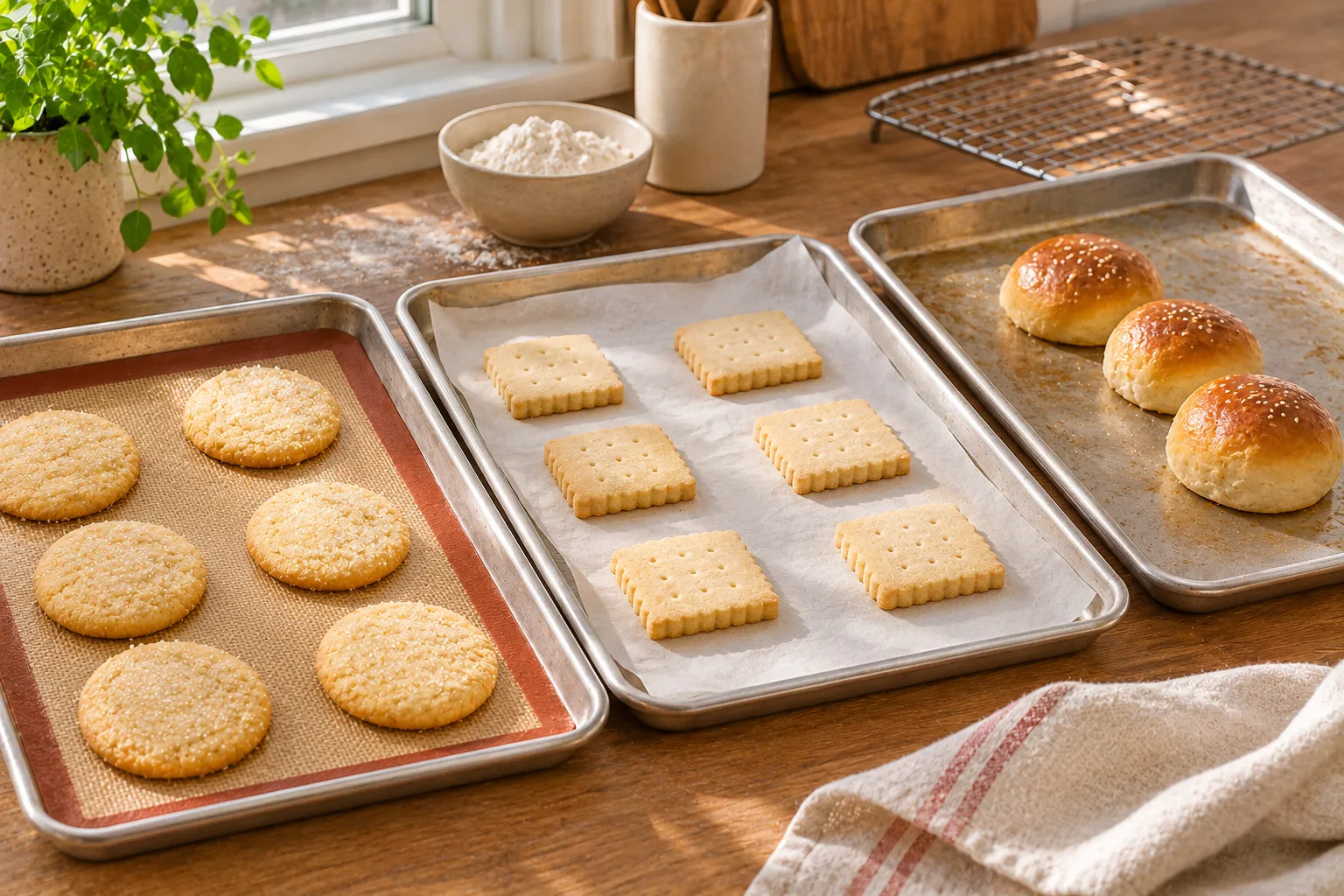
- Drop cookies, shortbread and sugar cookies (325 to 375°F): a mat or parchment. Both give even bottoms; a mat spreads cookies slightly less on some recipes.
- Meringues, macarons and tuiles: a mat is the classic choice because they peel off cleanly.
- Brittle, toffee and caramel corn: a mat works if the candy is poured after cooking in a pot; the sugar is hot but the mat is not under a flame. Lift the slab off before breaking it with anything sharp.
- Blind-baking pie crust: parchment filled with weights. A mat is the wrong shape, and the weights can dent it.
- Roasted nuts and granola: parchment or a bare pan, especially if the oven runs above 400°F.
- Sheet-pan dinners, bacon and roast vegetables at 425 to 450°F: a greased bare pan or foil. This is fatty, high-heat cooking, the combination that drew the most migration in the mould studies.
- Breads and rolls: a lightly floured or greased pan, or parchment if the dough is very wet.
What about silicone cupcake liners and molds?
Most of the migration evidence above actually comes from moulds, so it applies to them directly. Moulds have two drawbacks a flat mat does not. They hold batter in deep contact on all sides, and many are thin, colorful, low-cost items whose post-curing you can’t judge. Helling found poorly post-cured moulds released considerably more. If you use them, run new ones through a few washes and bakes with the hood on, keep them for cakes rather than meat loaf or savory fatty bakes, and retire any that stay tacky. Paper cupcake liners in a metal tin, or a greased metal loaf pan, avoid the question. Our silicone guide covers the Zaragoza cupcake mould study in more detail.
Is parchment paper safer than a silicone mat?
Not clearly. Both put a silicone surface against your food. Parchment’s coating is thin and is used once; a mat is thicker and is used hundreds of times. A brand-new mat is likely at its highest release, and an old, well-washed mat lower, based on the reuse studies above. Nobody has published a head-to-head comparison of siloxane migration from parchment and a mat under the same bake, so we can’t rank them on chemistry.
The practical differences are clearer. Their heat limits are almost the same (425°F for Reynolds parchment, 428°F for the Silpat half-size mat). Parchment tears and goes in the trash. A mat saves waste and gives even browning on cookies but needs careful washing and replacing when damaged. If you bake every week in cookie season, a mat makes sense. If you bake twice a year, parchment is fine.
Do parchment and baking papers contain PFAS?
Parchment’s release surface usually comes from silicone, not fluorochemicals. PFAS were historically used as grease-proofing agents on some food papers, a separate function. The FDA reports that PFAS grease-proofing substances for paper are no longer being sold by manufacturers into the US food-contact market as of early 2024. That covers new US supply. It does not tell you what an older box or an imported paper contains, and most boxes don’t say. If PFAS is your concern, choose parchment that names its silicone coating, or use a mat or a bare pan. Our PFAS explainer covers the wider picture.
Use the App
Check your baking drawer before cookie season
Scan a baking mat, parchment box or pan. The app records the declared material and heat rating, flags liners that don’t belong in a hot oven, and saves a reminder to check your mat for wear.
When should you replace a silicone baking mat?
- Any cut, tear or nick. Silpat says not to use a cut or torn mat. Once the fiberglass mesh is exposed, glass fibers can reach food.
- Frayed or flaking edges where you can see white fibers or the mesh pattern.
- A sticky, tacky or chalky surface that no longer releases cookies cleanly after a proper wash.
- A persistent rancid or greasy smell. Silicone absorbs fat: Helling measured up to 8 g of fat per kg in moulds. Old fat can go rancid in the mat.
- Heat damage such as browning, bubbling or warping from use near an element or above the rating.
How to use a silicone mat with less migration
- Stay under the rating. Most cookies bake at 325 to 375°F, well inside a 428°F limit. Roasting vegetables at 450°F is not; use a bare pan.
- Keep it for low-fat, sugary bakes. Cookies, meringues and candy suit a mat. Bacon, chicken thighs and roast potatoes suit greased metal.
- Ventilate during the first bakes. The reuse studies show new silicone releases the most, including into kitchen air, so run the hood on a new mat’s first few uses. This is our inference from those studies, not a maker instruction.
- Never cut on it, and lift bars or brownies off before slicing.
- Wash gently. Silpat recommends a soft sponge and neutral detergent and says hand washing prolongs its life. A baking soda paste helps with greasy film.
- Store flat or loosely rolled, away from knives in a drawer.
If you’re replacing sheet pans too, uncoated aluminum or stainless sheets avoid a nonstick coating under the liner. The non-toxic cookware guide covers pans, and for the air fryer version of this question see are air fryer liners safe. Silicone spatulas raise the same heat-rating questions, covered in our spatula guide.
What the evidence does not establish
- A particle count from any baking mat. Every result here measures molecules migrating, not shed particles.
- A result for your brand. No study we found named Silpat or any other mat brand; results varied widely between products.
- A ranking of parchment against mats for siloxane migration under identical conditions.
- A health effect from home baking. BfR said no exposure assessment was possible with current data, and toxicity data are missing for larger siloxane rings. A 2026 study of other silicone food items found most exceeded a strict child action value in a fatty simulant, which is a reason for care, not proof of harm.
What the MicroPlastics app checks
- The declared material of a scanned mat, liner or pan, such as silicone with fiberglass, silicone-coated paper, paraffin-coated paper, aluminum or stainless steel.
- The maker’s stated temperature limit where product information gives it.
- Wear signs to watch for and a bare-pan or parchment alternative for high-heat jobs.
- Product information only: the app does not measure siloxanes or particles released by your bakeware.
Frequently Asked Questions
Are silicone baking mats toxic?
Do silicone baking mats release microplastics?
Is parchment paper safer than a silicone mat?
What temperature can a Silpat go to?
Do you need to grease a silicone baking mat?
When should I throw away a silicone baking mat?
Can you use wax paper instead of parchment in the oven?
Sources
- Silpat (Maison Demarle) (2026). Silpat half-size baking mat: silicone and fiberglass, -40°F to 428°F (read via search results, November 8, 2026). us.silpat.com.
- Silpat (Maison Demarle) (2026). Use and care for Silpat products (read via search results, November 8, 2026). us.silpat.com.
- Zhu J, Wawrzynczak A, Niu J, Chan WY, et al. (2025). Silicone bakeware as a source of human exposure to cyclic siloxanes via inhalation and baked food consumption. Journal of Hazardous Materials 497:139591.
- Helling R, Mieth A, Altmann S, Simat TJ (2009). Determination of the overall migration from silicone baking moulds into simulants and food using 1H-NMR techniques. Food Additives & Contaminants Part A 26(3):395–407.
- Helling R, Kutschbach K, Simat TJ (2010). Migration behaviour of silicone moulds in contact with different foodstuffs. Food Additives & Contaminants Part A 27(3):396–405.
- Zhang K, Wong JW, Begley TH, Hayward DG, Limm W (2012). Determination of siloxanes in silicone products and potential migration to milk, formula and liquid simulants. Food Additives & Contaminants Part A 29(8):1311–1321.
- Liu YQ, Wrona M, Su QZ, et al. (2021). Influence of cooking conditions on the migration of silicone oligomers from silicone rubber baking molds to food simulants. Food Chemistry 347:128964.
- Merkel S, German Federal Institute for Risk Assessment (BfR) (2022). BfR activities on silicone (presentation to the 8th meeting of the EFSA FIP Network on Food Contact Materials). EFSA.
- Chen Y, Li H, Huang H, Shentu X (2026). Migration of 35 siloxanes from silicone food contact materials in China and their potential exposure assessment. Foods 15(8):1387.
- Reynolds Kitchens (2026). Aluminum foil and cooking papers guide (retrieved November 8, 2026). reynoldsbrands.com.
- Reynolds Kitchens (2026). Parchment paper rolls: 425°F limit and use warnings (retrieved November 8, 2026). reynoldsbrands.com.
- US Food and Drug Administration (2026). Authorized uses of PFAS in food contact applications (retrieved November 8, 2026). FDA.
Your next product question
Start with the baking mat, parchment box or sheet pan you use most for holiday baking.
Record the declared material and temperature limit, and check the mat for cuts or exposed fiberglass. A material check does not measure siloxanes or particles your bakeware releases.
Use the exact product name, model and label to check the information behind an assessment. A photo does not measure particles or personal health risk. The examples above are research subjects, not a verified app-coverage list.
Read the silicone evidence →Go deeper
Less-travelled research from our archive that follows directly from this page.
Related Research
Thanksgiving Dinner Plastic Swaps: What to Change, What to Keep
A whole-meal plan for Thanksgiving: swap the nylon oven bag, plastic carving board and microwave reheating in plastic; keep foil pans and an intact nonstick pan; brining bags and paper plates are low priority.
Read moreAre Takeout Soup Containers Safe? Plastic, Foam and Paper
Winter soup arrives in polypropylene deli tubs, foam cups or plastic-lined paper. What hot-water and microwave studies tested, how close they are to real soup, and the transfer-and-reheat routine that avoids the hottest contact.
Read moreMicroplastics in Sugar: What the Studies Found, and One That Was Retracted
Sugar studies report anywhere from 75 suspected particles per kilogram to about 300 per gram, depending on how small the lab looked. We compare the 2026 Greek and Italian studies, explain the retracted Bangladesh paper, and cover white vs brown vs raw and packaging.
Read moreAluminum Foil vs Plastic Wrap: Which to Use for Each Job
Foil, cling film, beeswax wraps, parchment, silicone lids or glass? A task-by-task guide for the fridge, freezer, microwave and oven, with what EFSA, the BfR and lab tests found on aluminum and plasticizer migration.
Read moreIs Fellow Aiden Plastic-Free? What Fellow Says It’s Made Of
No. Fellow lists Aiden’s materials as plastic, stainless steel and silicone and names the plastic as PPO, without saying which parts. Compared with Moccamaster, Ratio, Caraway, Breville and OXO by what touches hot water.
Read moreDoes a Moka Pot Have Microplastics? The Gasket, the Valve and the Aluminum Question
Stovetop moka pots are metal apart from the gasket. We trace Bialetti Moka Express, Brikka and Venus, Alessi 9090 and an electric model, and explain the aluminum study: at most 4% of the EU weekly limit.
Read more