Aluminum Foil vs Plastic Wrap: Which to Use for Each Job

Last reviewed: by the MicroPlastics Research Desk. Submit a correction or see our editorial standards.
Quick answer

Check the brand in your cupboard
Scan the label to see its packaging, what drives its contact score, and a lower-plastic swap.


Free · 3 scans · iOS and Android
Key Takeaways
- Match the cover to the job, not to a general sense of which material is “safer.” Each fails in a different place.
- Foil plus acid or salt plus time or heat is the combination that moves aluminum into food. Put parchment between tomato dishes and foil.
- Most US household cling film is polyethylene. Reynolds and Glad both say so; Glad says its wraps contain no PVC or plasticizers.
- PVC film plus fatty food is where plasticizer migration has been measured, even in the fridge.
- In the microwave: no foil, no film touching food, and a plate or vented glass lid is simplest.
- Glass with a lid handles fridge, freezer and reheating, as long as the plastic lid comes off before heating.
The numbers behind the advice
- body weight per week: EFSA tolerable intake for aluminum
- 1 mg/kg
- all dietary sources combined, including foil, pans and additives
- EFSA 2008
- of that weekly limit most people already get from food
- ~50%
- average for adolescents and adults, before foil or cosmetics
- BfR aluminium FAQ
- aluminum in fish baked in foil with lemon and salt
- up to 42 mg/kg
- 180°C (356°F) for 1 hour; the same foods in Pyrex were below detection
- Fermo et al., IJERPH 2020
- Reynolds wrap microwave rule: gap above food, maximum time
- 1 inch, 3 min
- reheating only, one corner vented, never cooking
- Reynolds Brands
Is aluminum foil or plastic wrap better? The short version by task
The question usually comes up with a specific bowl in your hand. So here is the answer by job, using maker instructions and agency guidance rather than a single ranking.
| Job | Best choice | Fine | Avoid |
|---|---|---|---|
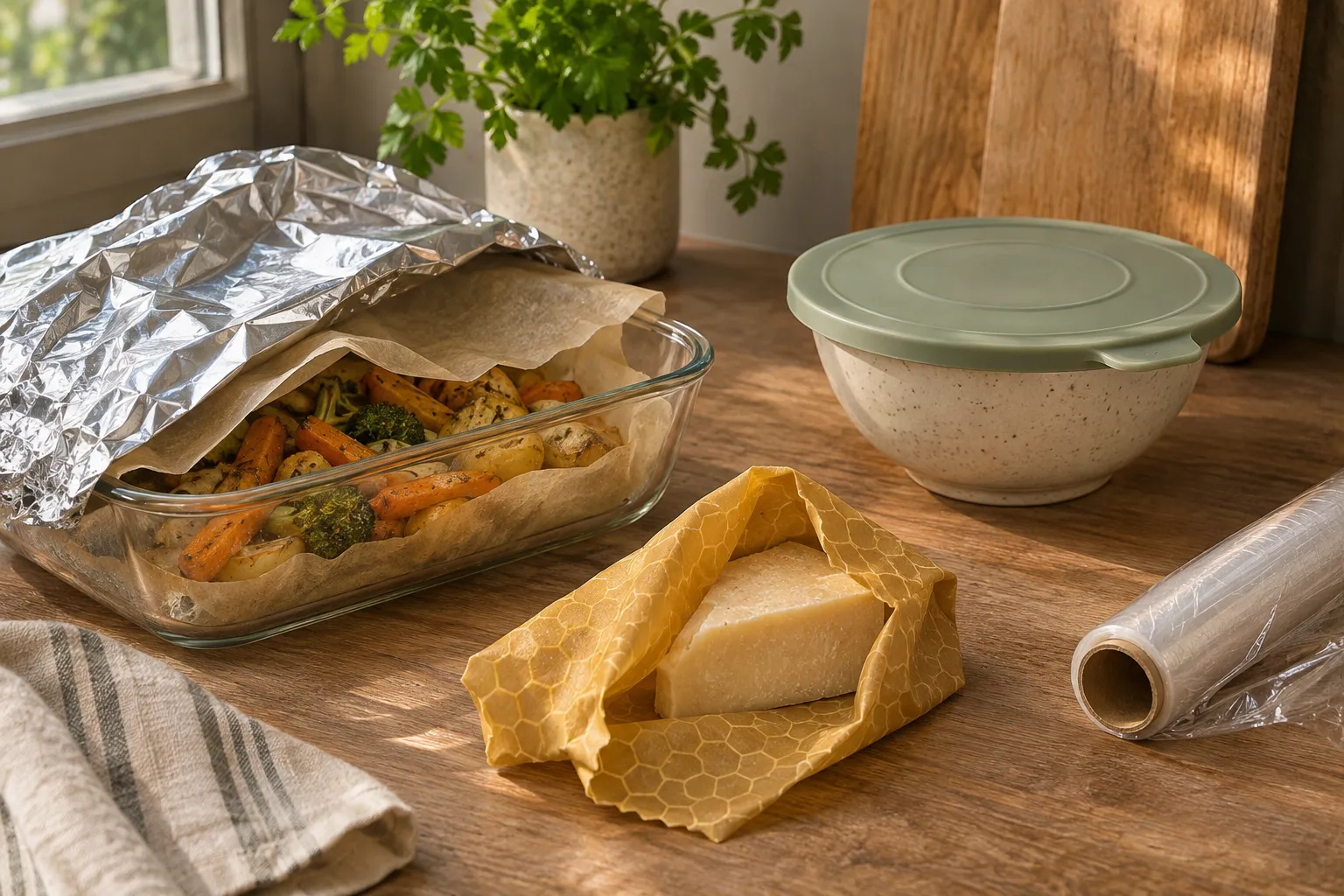
| Covering leftovers in the fridge | Glass or steel container with lid; plate over a bowl | PE cling film; foil for neutral food; silicone lid | Foil on tomato, citrus or brined dishes |
| Wrapping cheese | Beeswax wrap or parchment, then a container | PE cling film for short storage | PVC film, especially on hard, fatty cheese for days |
| Raw meat or fish | Lidded glass or steel container | PE film or foil, cold, on a plate | Beeswax wraps (maker excludes them) |
| Freezing | Freezer-rated glass or steel container | Foil or PE film for dry foods; freezer paper | Thin wrap alone for long storage (freezer burn) |
| Reheating in the microwave | Glass or ceramic dish under a plate or vented glass lid | Parchment or a microwave-rated silicone lid | Foil; film touching food; plastic lids not rated for heat |
| Roasting or baking in the oven | Lidded ovenware, or parchment | Foil tent over dry or neutral food | Cling film, wax paper, freezer paper; foil on acidic or salty dishes |
| Grilling | Stainless steel or ceramic grill tray | Foil tray; season after cooking | Marinating in foil on the grill |
| Storing tomato sauce, lasagna, pickles | Glass with lid | Parchment under foil | Bare foil touching the food |
The rest of this guide explains why each row reads the way it does. If you only want the container side, our plastic-free food storage guide compares glass and steel sets.
Does aluminum foil leach into food?
Yes, and how much depends on four things: acid, salt, heat and time. Aluminum foil grows a thin oxide layer that protects it in ordinary use. Acids and salts break that layer down, and heat and long contact speed it up.
Germany’s Federal Institute for Risk Assessment (BfR) is blunt about it: aluminum foils are not suitable or intended for storing, heating or keeping warm acidic or salty foods. Its examples are cut apples, tomatoes, rhubarb, salted herring, marinated fish and cheese. The BfR also cites a Council of Europe guide value of 5 mg of aluminum released per kilogram of food for metal food-contact items. That value is a recommendation, not a binding EU limit.
The best home-style test we found is Fermo and colleagues (2020). They baked about 100 g of beef, chicken and fish at 180°C (356°F) for an hour, either in a Pyrex dish or wrapped in foil, with and without oil, salt and lemon. In Pyrex, aluminum stayed below the detection limit. Foil-baked samples reached up to 42 mg/kg (seasoned fish), 40 mg/kg (seasoned chicken) and 40 mg/kg (unseasoned beef). Under the microscope, foil that had touched food was pitted with holes about a tenth of a millimeter across. The authors call the study preliminary: one foil brand, one temperature, few repeats.
Catering is a second warning. A 2017 BfR project found aluminum moving from uncoated menu trays into sauerkraut juice, apple sauce and sieved tomatoes, notably when the food was kept warm, and even after two hours. That is why the BfR recommends coated trays, or trays made of other materials, for hot holding.
How much aluminum is too much?
The European Food Safety Authority set a tolerable weekly intake of 1 mg of aluminum per kilogram of body weight in 2008. It chose a weekly figure because aluminum builds up in the body. For a 70 kg adult that is 70 mg a week. EFSA estimated adults’ average dietary intake at 0.2 to 1.5 mg/kg per week, so some people already sit near the line from food alone. The BfR says most adolescents and adults take in about half the weekly figure from ordinary food, and that adding foil, cosmetics and medicines can push some people over it. The WHO and FAO committee JECFA uses a higher provisional value of 2 mg/kg per week.
In plain terms: one foil-baked dinner is not a crisis, but foil on acidic food every day is an avoidable extra load on top of what you already eat. EFSA found the highest exposures per kilogram of body weight in children and young people, so they have the least headroom. The same reasoning applies to aluminum cookware, covered for coffee in our moka pot guide.
Is plastic wrap PVC or polyethylene?
Most cling film sold for US home kitchens is now polyethylene. Reynolds lists its plastic wrap as PE, and Glad says its products are made from polyethylene, contain no PVC and contain no plasticizers.
PVC film still exists, and it behaves differently. PVC is rigid on its own, so cling grades are softened with plasticizers, often an adipate called DEHA. Those molecules are not chemically bound and can move into fatty food. In a study by Goulas and colleagues (2000), PVC film containing 28.3% DEHA was wrapped around Kefalotyri, Edam and Feta and held at 5°C (41°F). After 240 hours, migration into the two harder cheeses exceeded the EU overall migration limit for plastics, and the plasticizer had penetrated up to 3.6 mm into the Edam. EU food-contact plastics rules, Regulation 10/2011, set that overall limit and specific limits for individual substances.
If your box says PVC or polyvinyl chloride, or gives no material at all, keep it away from cheese, meat, butter and anything warm. The full chemistry, including the microplastics angle, is in microplastics in plastic wrap, and named products are compared in what Ziploc bags are made of.
On particles specifically: we did not find a study in the sources we reviewed that counted microplastics shed by household cling film under ordinary home use. Polyethylene film is still plastic touching your food, and heat and fat are the conditions that raise migration from plastics in general, so the same two rules apply.
Can you put foil or plastic wrap in the microwave?
Foil: no. The FDA says metal pans and aluminum foil generally should not be used in a microwave oven, because microwaves reflect off metal, food heats unevenly and the oven can be damaged. Reynolds adds that foil can spark and start a fire.
Plastic wrap: only within the maker’s limits. Reynolds says its PE wrap is for reheating, not cooking: cover a microwave-safe dish, leave at least one inch between wrap and food, turn back a corner to vent, and heat for no more than three minutes. It warns that fatty or sugary foods can get hot enough to melt the wrap, and that wrap touching food during heating should not be used. Those limits leave little room for a dense lasagna or a fatty stew. A dinner plate inverted over a bowl does the same job with no film at all.
For what the “microwave-safe” label does and doesn’t promise, read what microwave-safe actually means.
Use the App
Not sure what your wrap or container is made of?
Scan the box or the container. The app reports the declared material, whether the maker allows microwave, oven or freezer use, and saves the glass or steel swap for the jobs where it matters.
Are beeswax wraps, parchment and silicone lids better?
Each one is good at a narrower set of jobs than its marketing suggests.
| Option | Good for | Limits |
|---|---|---|
| Beeswax wrap (cotton, beeswax, plant oil, tree resin) | Bread, cheese, cut produce, covering a bowl | Bee’s Wrap excludes raw meat and fish, hot food, microwave, oven and hot water; lasts up to about a year |
| Parchment paper (silicone-coated) | Oven lining, a barrier between food and foil, loose microwave cover | Reynolds rates its parchment to 425°F; never under a broiler or in a toaster oven |
| Wax paper | Wrapping sandwiches, separating layers cold | Not for direct oven heat |
| Silicone stretch or suction lids | Reusable bowl and can covers in the fridge | Silicone releases small siloxane molecules in migration tests; follow the maker’s heat rating |
| Glass container with lid | Fridge, freezer, microwave and oven (body only) | Most lids are plastic; take the lid off before heating |
| Stainless steel container | Cold storage, lunches, acidic leftovers | No microwave; check the seal material |
Bee’s Wrap asks for cool-water hand washing with mild soap and says heat softens the wax. Parchment is paper with a silicone coating rather than a plastic film; our parchment guide separates it from wax and freezer paper, which do carry wax or plastic coatings. Silicone lids are convenient, but silicone is not inert: in Chen et al. 2026, 30 silicone food-contact items held at 70°C for two hours released siloxanes in widely varying amounts. That was a test of molecules, not particles, and lids were not among the items. Our silicone explainer covers the definitions.
A practical routine for wrapping and storing food
- Default to a container. A glass or steel box with a lid replaces most wrap jobs in the fridge and removes the material question for acidic and salty leftovers.
- Use foil for dry heat and neutral food. Tenting a roast chicken, wrapping baked potatoes, covering a tray of plain vegetables. Season after cooking when grilling, as the BfR suggests.
- Put parchment between acid and foil. Lasagna, tomato braises, citrus fish and anything in brine: a sheet of parchment against the food, foil on top if you need the seal.
- Keep cling film cold. Read the box. If it is polyethylene, use it for short-term covering of cold food. If it is PVC or unlabeled, keep it off fatty food entirely.
- Reheat in glass under a plate. No foil, no film touching food, no plastic lid unless the maker rates it for microwave use.
- Wrap cheese in wax or paper, not film. Beeswax wrap or parchment, then a container, keeps it from drying out without a plasticized film against a fatty surface.
What the MicroPlastics app checks
- The declared material of a scanned wrap, bag, lid or container, such as polyethylene, PVC, silicone, glass or aluminum.
- The maker’s stated microwave, oven, freezer and dishwasher permissions where product information gives them.
- Which part touches food, so a glass dish with a plastic lid is not treated as all glass.
- Product information only: the app does not measure aluminum, plasticizers or particles in your food.
Frequently Asked Questions
Is aluminum foil safer than plastic wrap?
Can you put aluminum foil in the microwave?
Does aluminum foil leach into food when cooking?
Is it safe to cover tomato dishes with foil?
Is cling film made of PVC?
Are beeswax wraps safe for meat?
Sources
- European Food Safety Authority (2008). EFSA advises on the safety of aluminium in food (tolerable weekly intake 1 mg/kg bw). EFSA.
- German Federal Institute for Risk Assessment (BfR) (2020). FAQs about aluminium in food and products intended for consumers. BfR.
- German Federal Institute for Risk Assessment (BfR) (2017). BfR research: proof of the transfer of aluminium from menu trays to food (Opinion No. 007/2017). BfR.
- Fermo P, Soddu G, Miani A, Comite V (2020). Quantification of the aluminum content leached into foods baked using aluminum foil. International Journal of Environmental Research and Public Health 17(22):8357.
- Goulas AE, Anifantaki KI, Kolioulis DG, Kontominas MG (2000). Migration of di-(2-ethylhexyl)adipate plasticizer from food-grade polyvinyl chloride film into hard and soft cheeses. Journal of Dairy Science 83(8):1712–1718.
- European Commission (2011). Commission Regulation (EU) No 10/2011 on plastic materials and articles intended to come into contact with food. EUR-Lex.
- US Food and Drug Administration (2026). Microwave ovens (retrieved November 8, 2026). FDA.
- Reynolds Brands (2026). Aluminum foil and cooking papers guide (retrieved November 8, 2026). reynoldsbrands.com.
- Reynolds Brands (2026). Plastic wrap: PE material and microwave reheating directions (retrieved November 8, 2026). reynoldsbrands.com.
- Glad (2026). FAQ: polyethylene, no PVC, no plasticizers (retrieved November 8, 2026). glad.com.
- Bee’s Wrap (2026). FAQ: materials, uses and care (retrieved November 8, 2026). beeswrap.com.
- Chen Y, Li H, Huang H, Shentu X (2026). Migration of 35 siloxanes from silicone food contact materials in China and their potential exposure assessment. Foods 15(8):1387.
Your next product question
Start with your cling film box, foil roll or leftover container.
Record the declared material and the maker's microwave, oven and freezer permissions, then match each cover to the job. A material check does not measure aluminum, plasticizers or particles in your food.
Use the exact product name, model and label to check the information behind an assessment. A photo does not measure particles or personal health risk. The examples above are research subjects, not a verified app-coverage list.
Compare plastic-free storage containers →Related Research
Is Fellow Aiden Plastic-Free? What Fellow Says It’s Made Of
No. Fellow lists Aiden’s materials as plastic, stainless steel and silicone and names the plastic as PPO, without saying which parts. Compared with Moccamaster, Ratio, Caraway, Breville and OXO by what touches hot water.
Read moreDoes a Moka Pot Have Microplastics? The Gasket, the Valve and the Aluminum Question
Stovetop moka pots are metal apart from the gasket. We trace Bialetti Moka Express, Brikka and Venus, Alessi 9090 and an electric model, and explain the aluminum study: at most 4% of the EU weekly limit.
Read moreDoes a French Press Have Microplastics? Every Part, Model by Model
Traces the beaker, lid, frame and filter stack of the Bodum Chambord, Brazil and Caffettiera, ESPRO P3/P7 and Frieling. Shows which presses keep plastic out of the coffee, and why diterpenes are a separate issue.
Read moreDoes Extra Gum Have Microplastics? What Its “Gum Base” Can Contain
Extra lists “gum base” but not its polymers. What 21 CFR 172.615 allows, what Mars Wrigley discloses, and what the peer-reviewed 2025 saliva study found for gum in general, plus 5, Doublemint and what to chew instead.
Read moreReusable Nespresso Capsules: Steel, Silicone and Microplastic Questions
Compare selected SealPod, WayCap and Bluecup declarations, brewing closures and model restrictions. Reusable construction does not establish particle-free coffee.
Read moreChemex and Microplastics: Glass, Filters and the Full Brewing Path
Trace manual glass carafes, exact filter formats, the required Funnex gasket and the separate Ottomatic water path. Material declarations do not certify particles per brew.
Read more