Reusable Nespresso Capsules: Steel, Silicone and Microplastic Questions

Last reviewed: by the MicroPlastics Research Desk. Submit a correction or see our editorial standards.
Quick answer
Got a different brand in the cupboard? Review its packaging inputs and Product Contact Signal, then compare a lower-contact option.
Scan my product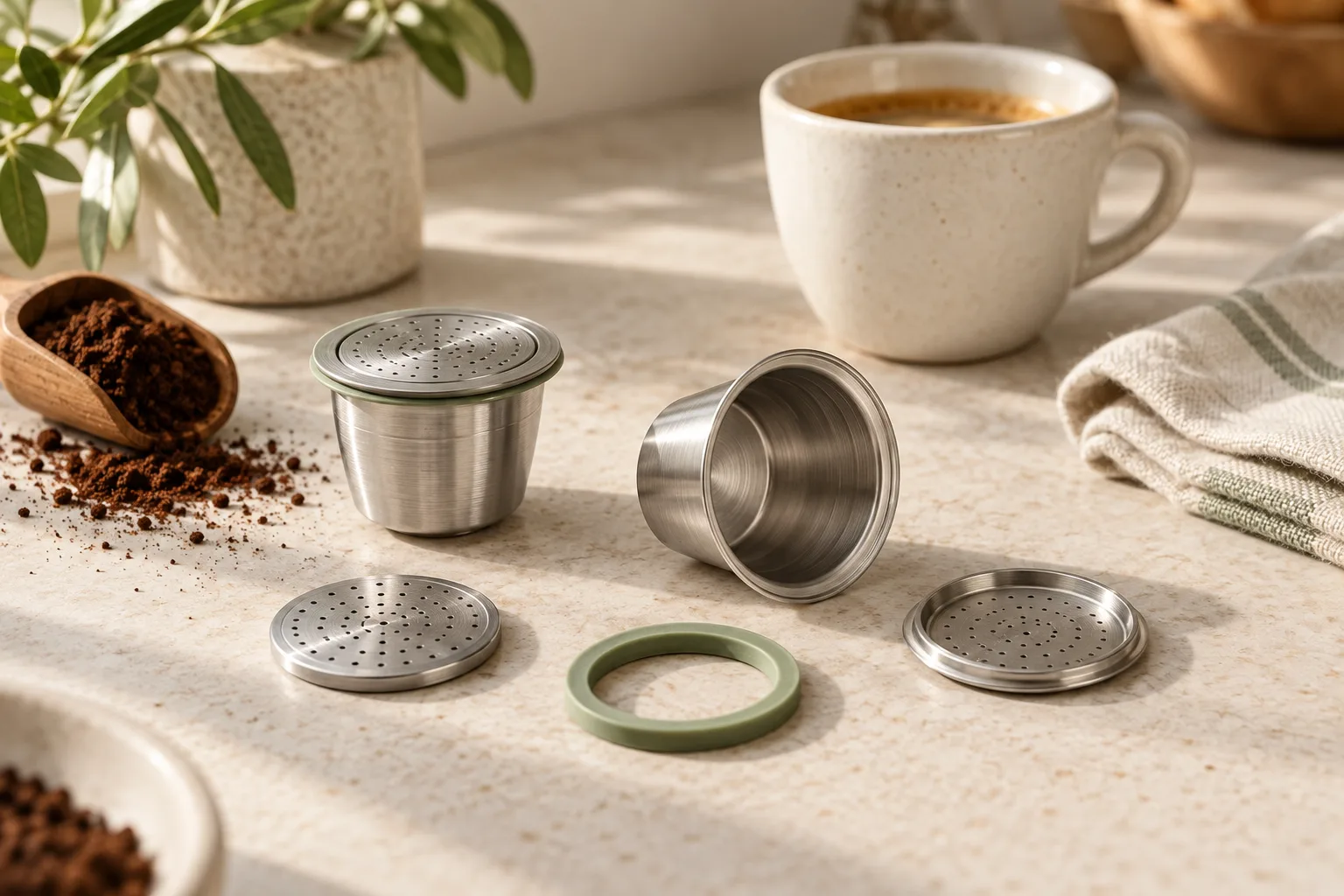
Key Takeaways
- “Reusable” describes a use pattern, not one material or a microplastic test.
- Original Line compatibility does not establish Vertuo compatibility; confirm the exact machine and capsule version.
- A storage cover and a brewing seal serve different roles. Follow the complete assembly instructions.
- BPA-free, food-grade and an absence of glue answer different questions from particle release.
- Keep required seals and filters in place. A parts inventory is not permission to modify the appliance.
Start with the machine, then identify the entire capsule
A reader considering a refillable pod usually has two practical questions: will it work in the machine already on the counter, and what will hot water contact? Those questions need exact product information. A stainless exterior or a reusable label does not answer them by itself. Record the machine model and the capsule name before comparing options.
This guide reviews selected Original Line products and their current manufacturer documentation on October 6, 2026. It does not cover every marketplace capsule, historical revision, regional bundle or Vertuo refill system. The sources establish declared construction and specified compatibility; we have not purchased, dismantled or laboratory-tested these products.
Identify the pod body, brewing lid or filter, seals, and any separate storage cover. Then follow the path beyond the pod through the machine and into the cup. Replacing one component changes that component; it does not document the material of an internal hose or quantify the particles in the finished drink. Our coffee evidence guide explains why those contributions need separate measurements.
What the selected manufacturers actually disclose
| Product / family | Declared parts | Keep this distinction |
|---|---|---|
| SealPod Original Line | Stainless pod; FAQ identifies silicone O-ring and separate Fresh Cover | Choose the correct brewing closure; a storage cover is a different part |
| WayCap Basic Kit / EZ listing | Stainless capsule and four interchangeable tops; general FAQ describes silicone gaskets | Confirm the complete current kit and gasket placement |
| WayCap POP Basic Kit | Stainless body with food-grade silicone cap | A different closure from the Basic Kit; not an all-metal assembly |
| Bluecup Original Line | BPA-free plastic capsule; mechanically crimped foil closure | Reusable does not mean stainless or polymer-free |
The SealPod listing declares the body as stainless steel. The WayCap Basic Kit listing describes a stainless capsule with four interchangeable tops; its general FAQ identifies food-grade silicone gaskets. That FAQ is broader than an exact current kit inventory, so confirm the parts supplied with the version you order.
The POP listing explicitly adds a silicone cap and includes two caps in the kit. Do not transfer a broad brand-level “no plastic” slogan to this different closure. Bluecup explicitly declares a BPA-free plastic body and a foil closure crimped without glue. Its reviewed homepage does not identify the body’s resin; neither its colour nor BPA claim supplies that missing identification.
These are useful differences for a material preference. They do not establish which assembled system releases the fewest particles. The exact steel grade, full seal formulation, every coating and the contact of each edge or joint are not comprehensively disclosed by these short listings.
A brewing lid, an O-ring and a storage cover are different parts
The SealPod FAQ distinguishes silicone Fresh Covers used for prefilling and storage from the O-ring around the pod. It discusses aluminium and paper sticker closures and acknowledges residual adhesive. The reviewed information does not disclose the complete adhesive formulation or measure its transfer into coffee.
Inventory parts by their actual role rather than counting everything in the box as an immersed surface. Equally, do not omit a seal simply because the main body is metal. Removing a gasket or substituting a home-made lid can change fit and operation. Use the complete manufacturer instructions for the exact capsule and appliance instead.
A reusable metal top can reduce the need to buy single-use lids, while a foil-lid design has a different replenishment routine. That is an ownership difference, not a demonstrated exposure reduction. Paper, foil and silicone closures cannot be ranked for particle output from their names alone. A coffee-ground strainer also needs its own evidence before being described as a microplastic-removal filter.
Compatibility has exceptions that a brand name can hide
| Capsule family | Reviewed compatibility statement |
|---|---|
| SealPod Original Line listing | Original Line; explicitly excludes C100 |
| WayCap Original guidance | Lists selected Original models; some older Essenza models may not fully fit |
| Bluecup | Homepage says every Original; FAQ adds after-October-2010 and black-holder restrictions |
| Vertuo | A separate system; no fit is established by these Original product declarations |
SealPod’s selected listing excludes the C100. WayCap’s compatibility page lists Original machines including Pixie, Inissia, Citiz and Creatista, with a caveat for some older Essenza models. A short product title saying “Nespresso compatible” should not erase those restrictions.
Bluecup’s homepage and FAQ differ in scope: the former says every Original Line machine; the latter specifies machines manufactured after October 2010 with a black plastic capsule-holder sleeve rather than aluminium. Ask for a version-specific answer when a broad statement and a detailed restriction disagree. This review does not resolve that discrepancy for every model.
Fit is a separate property from material. A capsule that is mostly steel but does not fit is not a useful substitute. Do not force a part into an appliance, defeat a recognition system or remove functional seals to follow a materials preference. If a seller’s answer remains uncertain, a clear return policy and written model confirmation are more useful than a universal compatibility promise.
What would establish a microplastic advantage?
The reviewed product documents do not provide a matched polymer-particle comparison between these reusable pods and disposable capsules. A material declaration cannot supply particles per cup, a nanoplastic count, or the percentage reduction achieved by switching. An absent result in these sources is not a claim that no relevant research exists anywhere.
A useful experiment would identify the exact capsule, closure and appliance; use matched water and coffee; include appropriate blanks; identify polymers and sizes; and state the brew and reuse conditions. It would need to distinguish contamination already in the ingredients from contributions introduced by the pod, machine and serving cup. Testing only a separate material under another temperature or cleaning routine would answer a narrower question.
A matched comparison should also describe the particle-size detection range. Counts from different methods can vary because they observe different sizes, not because one coffee setup is proportionally more hazardous. Chemical migration is a different endpoint from polymer fragments. Neither a BPA declaration nor a metal-migration result can be substituted for particle identification.
The Nespresso US FAQ states that its capsules contain no BPA or other bisphenols. That is the manufacturer’s chemical declaration. It does not settle reusable-versus-disposable particle release, provide every current liner formulation or document the entire appliance water path. It also does not support a claim that switching pods produces a particular health benefit.
Refilling adds a care routine, not a universal lifetime
Before choosing a reusable capsule, check whether the supplied manual describes filling, the correct filter or lid, cooling before handling, cleaning and replacement parts. The effort is part of the buying decision. A design that suits someone making one espresso may be inconvenient for someone preparing several drinks in succession.
Use the cleaning permissions for the actual parts. Do not assume a steel body makes every attached seal dishwasher-safe, or transfer a plastic pod’s care permission to another product. Do not abrasively scrape a seal or improvise a high-temperature treatment to pursue an unmeasured particle benefit. Seek replacement advice for damaged parts or poor fit.
Appliance maintenance remains model-specific. Nespresso’s US FAQ gives a three-month descaling interval in its Vertuo Next support section; that is not a universal interval for the Original machines discussed here. Reusable-capsule instructions cannot replace the appliance’s own manual. This review makes no blanket claim that third-party capsules preserve or void every warranty; check the relevant terms for your market and machine.
Compare the ownership decision with a simple manual brew
If the requirement is a steel capsule body in an existing compatible machine, confirm the selected refillable assembly and accept its seal and care requirements. If the requirement is to inspect more of the hot-water path directly, a manual brewer may offer a different design to assess. That is a construction comparison, not proof of a lower dose or healthier cup.
The Chemex guide follows a glass vessel, paper and added accessories; the V60 guide distinguishes specific cones and holders. A kettle, receiving cup and travel lid still belong to those setups. Our brewing-method comparison uses the same complete-path questions.
For cost, use the actual capsule, recurring lids or seals, coffee and shipping prices relevant to your purchase. For waste, separate reused bodies from disposable closures and follow local disposal rules. A manufacturer’s savings or sustainability slogan is not a life-cycle assessment and should not become a measured microplastic claim.
A decision you can check before ordering
Write down four items: machine model, capsule version, all required parts and the source for compatibility. Then identify the material preference the assembly actually satisfies. Keep unresolved formulation and particle questions visible. Request documentation for a disputed detail instead of filling the gap with a generic “safe” or “zero plastic” verdict.
You can choose a reusable system for coffee choice, convenience or a documented body material without claiming a measured exposure benefit. If your existing equipment works and its instructions are followed, the evidence reviewed here does not establish a health reason that requires immediate replacement. What this comparison supports is a more accurate buying question and a clearer inventory of the setup you actually use.
Frequently Asked Questions
Are reusable Nespresso capsules plastic-free?
Do steel reusable capsules eliminate microplastics?
Will an Original Line reusable capsule fit Vertuo?
Does BPA-free mean a reusable pod releases no particles?
Can I remove silicone parts to make the pod all-metal?
Sources
- SealPod (2026). Original Line stainless capsule listing and C100 exclusion; accessed October 6.
- SealPod (2026). FAQ: storage cover, O-ring and closure distinctions; accessed October 6.
- WayCap (2026). Basic Kit: stainless capsule and interchangeable tops; accessed October 6.
- WayCap (2026). POP Basic Kit: silicone cap declaration; accessed October 6.
- WayCap (2026). General FAQ: silicone gaskets; confirm the exact kit; accessed October 6.
- WayCap (2026). Original machine compatibility and older Essenza limitation; accessed October 6.
- Bluecup (2026). Plastic body and mechanically crimped closure declarations; accessed October 6.
- Bluecup (2026). FAQ: machine-date and holder restrictions; accessed October 6.
- Nespresso (2026). US FAQ: bisphenol declaration and model-specific support; accessed October 6.
Your next product question
Start with your exact reusable capsule and compatible brewer.
Find the capsule’s exact body, lid, seal and compatibility documentation. Reuse or a metal body does not establish zero release or approve it for another brewer.
Use the exact product name, model and label to check the information behind an assessment. A photo does not measure particles or personal health risk. The examples above are research subjects, not a verified app-coverage list.
Build a product-routine reading plan →Android · early access
Get the launch email the day Android opens.
One email. No spam. We send when the Android app is in the Play Store, and never again unless you opt in.
Related Research
Chemex and Microplastics: Glass, Filters and the Full Brewing Path
Trace manual glass carafes, exact filter formats, the required Funnex gasket and the separate Ottomatic water path. Material declarations do not certify particles per brew.
Read moreHario V60: Plastic, Glass, Ceramic and Steel Compared
Compare classic plastic, current Tritan NEO, glass holders, porcelain and coated versus bare steel. Exact materials and care are documented; a V60 particle count is not.
Read moreContigo AUTOSEAL: Steel Body, Lid Care and Testing Limits
Check two adult West Loop mugs, the lid disclosure gap, model-specific cleaning and conflicting body-care documents. BPA-free and spill resistance do not supply a particle count.
Read moreAre Oven Bags Safe for Turkey? The Question Isn’t Microplastics
Reynolds oven bags are FDA-compliant nylon, and USDA prefers them to paper bags. But hot nylon releases oligomers into fatty food, and a July 2026 study found heated nylon-bag leachate toxic to water fleas while PET bags were not.
Read moreDo Plastic-Wrapped Candies Contain Microplastics? 20 of 20 Did
A 2026 study detected microplastics in all 20 plastic-wrapped candies tested. The average was 6.73 particles per gram—but brands were blinded and the wrapper was not the only possible source.
Read moreCan You Microwave Food in Its Plastic Wrapper? New 2026 Evidence
A 2026 study detected PE micro- and nanoplastics from microwaved onigiri wrappers and lined cartons. See what appeared within 1–3 minutes, what the cell test cannot prove and when to transfer food.
Read more