Hario V60: Plastic, Glass, Ceramic and Steel Compared

Last reviewed: by the MicroPlastics Research Desk. Submit a correction or see our editorial standards.
Quick answer
Got a different brand in the cupboard? Review its packaging inputs and Product Contact Signal, then compare a lower-contact option.
Scan my product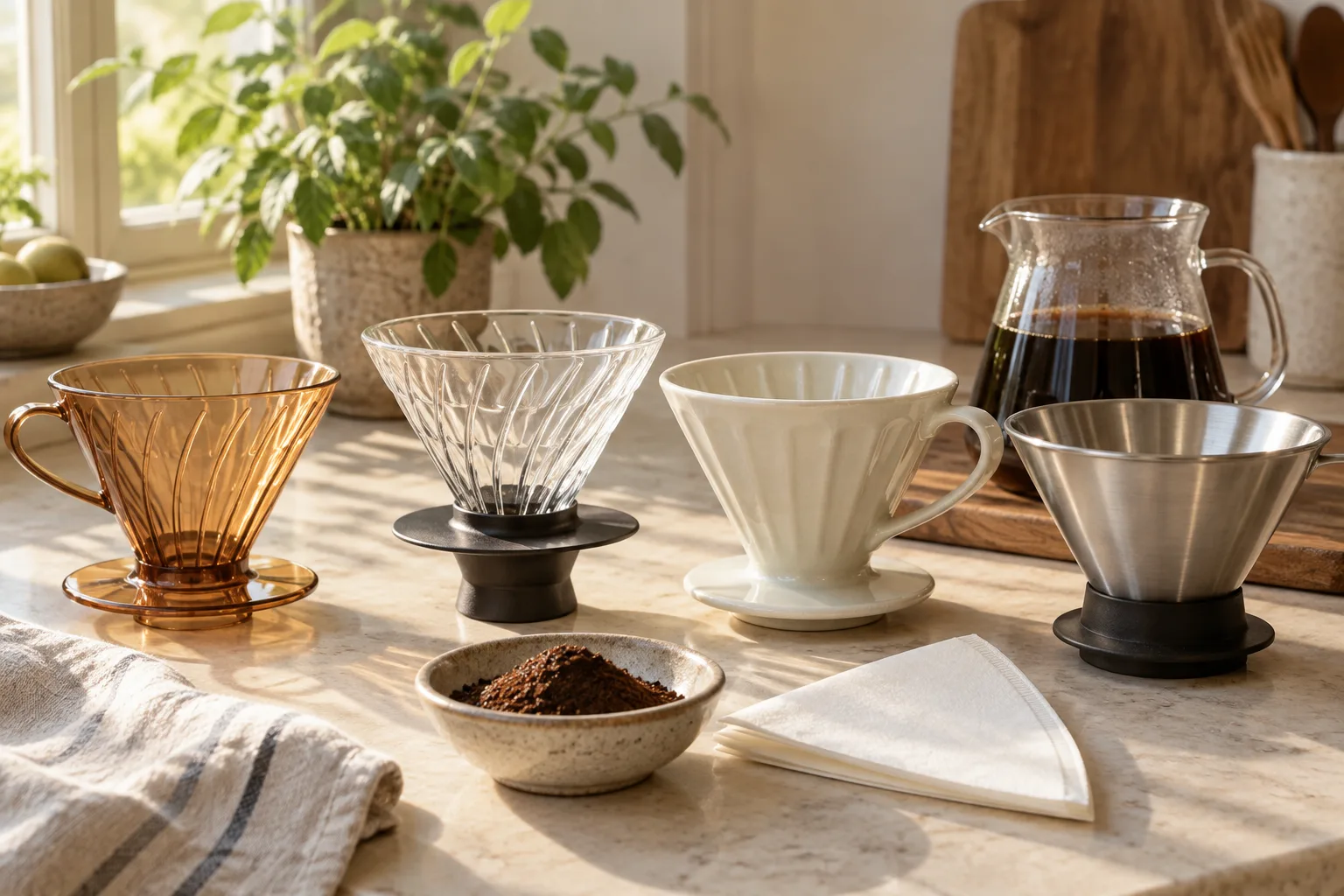
Key Takeaways
- The classic plastic V60 and V60 NEO have different declared resins. Clear appearance cannot identify the polymer.
- A glass cone with a polypropylene holder is a mixed-material product; the holder’s presence and its contact with the drink are separate questions.
- The silver metal listing declares no coating. The matte-black version declares powder coating and different cleaning permission.
- A paper coffee filter is not documented here as a validated barrier to every microplastic or nanoplastic.
- Cup, baby-bottle and kettle studies cannot supply an unmeasured V60 release rate.
Start with the model, not the word V60
If you want to reduce plastic in a pour-over setup, the first useful question is what your particular cone is made from. V60 describes a product family. It does not mean every cone is glass, every transparent cone uses the same resin or every metal-looking version has the same finish. A retailer’s broad category label can hide the very distinction you are trying to check.
We reviewed the manufacturer listings below on October 6, 2026. They establish declared materials and selected care permissions, not an independent test of each finished product. The model numbers help you compare the listing with your box, receipt or replacement part. When they disagree, ask Hario to identify your version before applying another model’s instructions.
| Reviewed version | Cone / body declaration | Other distinction |
|---|---|---|
| Classic transparent 01 listing | Acrylonitrile-styrene resin | Listing separates the clear material; do not infer every colour’s resin |
| New transparent colours, including VD-02-AB | Acrylonitrile-styrene resin | Selected 01/02 product codes listed separately |
| NEO, including VDN-02-T | PCT resin (Tritan) | Silicone-rubber base |
| VDGR-01-B / VDGR-02-B glass oval base | Heatproof borosilicate glass | Polypropylene holder |
| VDGR-01-OV / VDGR-02-OV olive wood | Heatproof borosilicate glass | Olive wood and silicone-rubber holder |
| Ceramic 02 new colours, including VDC-02TQ | Porcelain | A glazed ceramic product, not a plastic cone painted white |
| VDMR-02-HSV / VDMR-02-MB metal | Steel; silver uncoated, black powder-coated | Silicone-rubber holder; cleaning differs by finish |
This table does not cover every historical release, regional SKU, Switch, Mugen or accessory. It also does not assign a dose to the material names. A product can have a clear material declaration and still lack a published particle-release comparison under the way you brew and clean it.
Plastic V60: classic resin and NEO are different
The classic 01 listing identifies the clear dripper as acrylonitrile-styrene resin. Its product-number line mixes 01 codes with a 02 white code, so confirm the selected version rather than assuming that every field applies identically to every variant. The new-colour listing also declares acrylonitrile-styrene resin and provides separate codes for its transparent colours.
The NEO listing has the different resin and base shown in the table. Applying an old classic V60 material statement to every newer transparent Hario product would be wrong. These documents describe construction; none of the reviewed listings supplies a particle-release count for the finished cone.
A plastic’s name does not let us calculate how much it releases in a few minutes of brewing. The finished shape, surface condition, water, cleaning history and measurement method matter. Our Tritan evidence guide separates material evidence from results on specific tested products; it does not certify a NEO dripper.
Choosing a different cone can remove that plastic cone from the brewing setup. That is a concrete change in construction. It is not, on its own, a measured reduction of a particular number of particles or proof that the previous cone caused harm. We do not manufacture a percentage reduction by borrowing a polypropylene baby-bottle result.
Glass V60: identify the holder and the contact path
The oval-base glass listing distinguishes the body from its holder. A plastic support somewhere in an assembly does not automatically mean the normal stream of coffee passes across it. Conversely, a glass cone does not make the entire assembly plastic-free. Treat the parts list and the drink-contact path as separate checks.
Keep the geometry in mind: where does water sit, where does filtered coffee exit and what touches it on the way into the server? Check your actual assembly, including spills, overfilling and any added stand or lid. This is a contact-path assessment, not a laboratory confirmation that a support part contributes zero particles under every possible use.
The olive-wood version has the additional silicone component listed above. Wood in a title therefore does not remove every polymer from the product. Silicone should not be silently counted as glass; it is a separate material with its own care questions. See our silicone guide for the distinction between material identity, chemical migration and fragments.
Do not remove a required holder or improvise an unstable stand merely to make the parts list shorter. A secure cone and server matter when handling hot water. Check the intended assembly and support fit. If eliminating a holder material is a purchase requirement, choose a documented design that meets it rather than modifying another design without guidance.
Ceramic and steel: different surfaces, different limits
Hario’s ceramic 02 new-colour listing declares porcelain. That is a different cone construction from the plastic versions. The appearance or craft description is not a complete glaze-analysis report, however. This guide does not infer an independently tested absence of every metal from every colour, and it does not characterize an intact glazed surface as plastic simply because its full formulation is not listed.
The metal listing distinguishes the two finishes shown above. It does not fully map the black coating to every beverage-facing area. If bare contact steel is your requirement, the silver version’s declaration is the relevant one to check, rather than assuming every steel colour has an identical surface.
Glass can break, ceramic can chip and a metal part can become hot. These handling differences remain important when comparing construction. Metal-ion migration is also a different outcome from polymer fragments. Neither “not a plastic cone” nor a lower polymer count in a parts list means a finished drink contains nothing else that could be measured.
Our glass and steel profiles explain these material limits. They are not finished-V60 certifications. The choice should fit how you use and maintain the brewer, rather than relying on an unsupported universal safety order of glass, ceramic, steel and plastic.
A paper filter is not proof of zero contact or zero particles
A filter holds the grounds, but the wet filter and dripper operate together. We do not assume that paper creates a sealed barrier between every drop and the cone. Hario’s V60 instructions describe fitting the paper into the cone and rinsing it before brewing. That is a brewing routine, not a certification that all small polymer particles are captured.
To claim a removal percentage, a test would need to specify particle sizes, materials, starting concentration, flow and the exact filter. A coffee filter’s ordinary use does not provide those data. Paper and reusable mesh also change the brewing process, so a preference for either should not be presented as a measured microplastic advantage without an appropriate comparison.
Check the rest of the path too: kettle interior, spout, server, serving lid and mug. A nonplastic cone does not identify all those parts, and incoming water may already contain particles. Our coffee overview explains why adding results from unrelated equipment studies cannot yield a reliable total for your morning cup.
Why disposable-cup studies do not measure a V60
The 2022 NIST publication measured nanoparticles from selected nylon products and polyethylene-lined hot-beverage cups. Those results concern the tested products, contact conditions and analytical approach. A lined disposable cup is neither an acrylonitrile-styrene V60 nor a Tritan NEO; its result cannot be relabeled as particles released by a reusable cone.
We found no V60-specific release measurement in the manufacturer documents reviewed for this article, and we have not commissioned one. That statement describes this source review; it is not proof that no study could exist anywhere. It also does not mean absence of evidence establishes zero release or a harmful dose.
A useful comparison would identify exact models, measure incoming water and brewed output, include contamination blanks and report the sizes and polymers detected. It would distinguish new from normally aged surfaces and keep brewing and cleaning conditions comparable. Without those controls, a ranking can confuse equipment contributions with background contamination or differences in what the instrument can see.
Care permissions belong to the exact version
| Version | Documented distinction |
|---|---|
| Glass oval-base VDGR listing | Hot-water and dishwasher permission; no microwave, oven or open flame |
| NEO listing | Dishwasher-safe statement; follow the complete model instructions |
| Metal silver versus matte black | Silver dishwasher permission; matte version excluded; no microwave, oven, induction or open flame |
| Wood-holder glass, other ceramic/plastic versions | Do not transfer permission from another holder, finish or model |
Heatproof glass is not permission to apply every kind of heat, and dishwasher permission is not a particle-release result. We could not retrieve every linked manufacturer manual during this review, so we report explicit listing permissions and direct you to the instructions supplied with your product for the complete routine. We do not invent a single maximum temperature for the whole V60 family.
If a cone is cracked, chipped or visibly deteriorating, pause use and ask about an appropriate replacement. Staining alone is not a polymer analysis, and a photograph cannot quantify what reached a drink. Avoid sanding a finish or escalating to improvised abrasive cleaning to turn one construction into another.
Do not apply this comparison to every Switch
A Switch adds an immersion mechanism, so it needs a separate component check. For example, the Alpha ceramic Switch listing declares a ceramic dripper, silicone base, PCT-resin trigger and steel ball. A ceramic body does not fully describe that assembly. It is a different model from a basic porcelain V60 and from other glass Switch versions.
If you are buying now, write down the requirement you actually want to meet: a nonplastic cone, an uncoated steel surface, a particular holder material or a specific cleaning routine. Confirm it against the exact listing. Keeping an intact brewer is also an option; the evidence here does not establish a health benefit that requires replacing every plastic V60.
Use the App
Keep the whole coffee contact path together
Save products and review declared parts, use conditions and evidence limits. The app does not count particles in a V60 brew.
Explore product assessmentsFrequently Asked Questions
Does a plastic Hario V60 release microplastics?
Is every transparent V60 made from the same plastic?
Is the glass V60 completely plastic-free?
Does paper filter out all microplastics and nanoplastics?
Which V60 material is safest?
Sources
- Hario USA (2026). Classic V60 Plastic Coffee Dripper 01: selected clear material (accessed October 6).
- Hario USA (2026). V60 Plastic Coffee Dripper, new colours (accessed October 6).
- Hario USA (2026). V60 NEO: body and base (accessed October 6).
- Hario USA (2026). V60 Glass Coffee Dripper, oval base (accessed October 6).
- Hario USA (2026). V60 Glass Coffee Dripper, olive wood (accessed October 6).
- Hario USA (2026). V60 Ceramic Coffee Dripper 02, new colours (accessed October 6).
- Hario USA (2026). V60 Metal Coffee Dripper 02: finish and care (accessed October 6).
- Hario (2026). V60 series and basic brewing instructions (accessed October 6).
- Hario USA (2026). Alpha ceramic Switch: separate assembly (accessed October 6).
- Zangmeister, Radney, Benkstein and Kalanyan (2022). Common single-use consumer plastic products release sub-100 nm nanoparticles: cup and nylon evidence, not V60 testing.
Your next product question
Start with your exact Hario V60 dripper and filter.
Keep the dripper, filter and server identities separate. A material version or photograph is not a measurement of particles in the brewed coffee.
Use the exact product name, model and label to check the information behind an assessment. A photo does not measure particles or personal health risk. The examples above are research subjects, not a verified app-coverage list.
Build a product-routine reading plan →Android · early access
Get the launch email the day Android opens.
One email. No spam. We send when the Android app is in the Play Store, and never again unless you opt in.
Related Research
Contigo AUTOSEAL: Steel Body, Lid Care and Testing Limits
Check two adult West Loop mugs, the lid disclosure gap, model-specific cleaning and conflicting body-care documents. BPA-free and spill resistance do not supply a particle count.
Read moreAre Oven Bags Safe for Turkey? The Question Isn’t Microplastics
Reynolds oven bags are FDA-compliant nylon, and USDA prefers them to paper bags. But hot nylon releases oligomers into fatty food, and a July 2026 study found heated nylon-bag leachate toxic to water fleas while PET bags were not.
Read moreDo Plastic-Wrapped Candies Contain Microplastics? 20 of 20 Did
A 2026 study detected microplastics in all 20 plastic-wrapped candies tested. The average was 6.73 particles per gram—but brands were blinded and the wrapper was not the only possible source.
Read moreCan You Microwave Food in Its Plastic Wrapper? New 2026 Evidence
A 2026 study detected PE micro- and nanoplastics from microwaved onigiri wrappers and lined cartons. See what appeared within 1–3 minutes, what the cell test cannot prove and when to transfer food.
Read moreDo Plastic Salt Grinders Shed Microplastics? A 2026 Test Says Yes
Yes. Three plastic grinder heads released an estimated 1,091 to 15,743 particles per 50 g of salt. The polymers matched the mechanisms; ceramic or steel burrs are the direct swap.
Read moreAre Compostable Coffee Cups Plastic? PLA Is Still a Polymer Lining
Many compostable paper cups use PLA plastic lining. A new study found about 12× higher released particle mass than PE cups, while earlier nanoplastic counts found the opposite—why both results can be true.
Read more