Do Plastic-Wrapped Candies Contain Microplastics? 20 of 20 Did

Last reviewed: by the MicroPlastics Research Desk. Submit a correction or see our editorial standards.
Quick Answer
Got a different brand in the cupboard? Review its packaging inputs and Product Contact Signal, then compare a lower-contact option.
Scan my product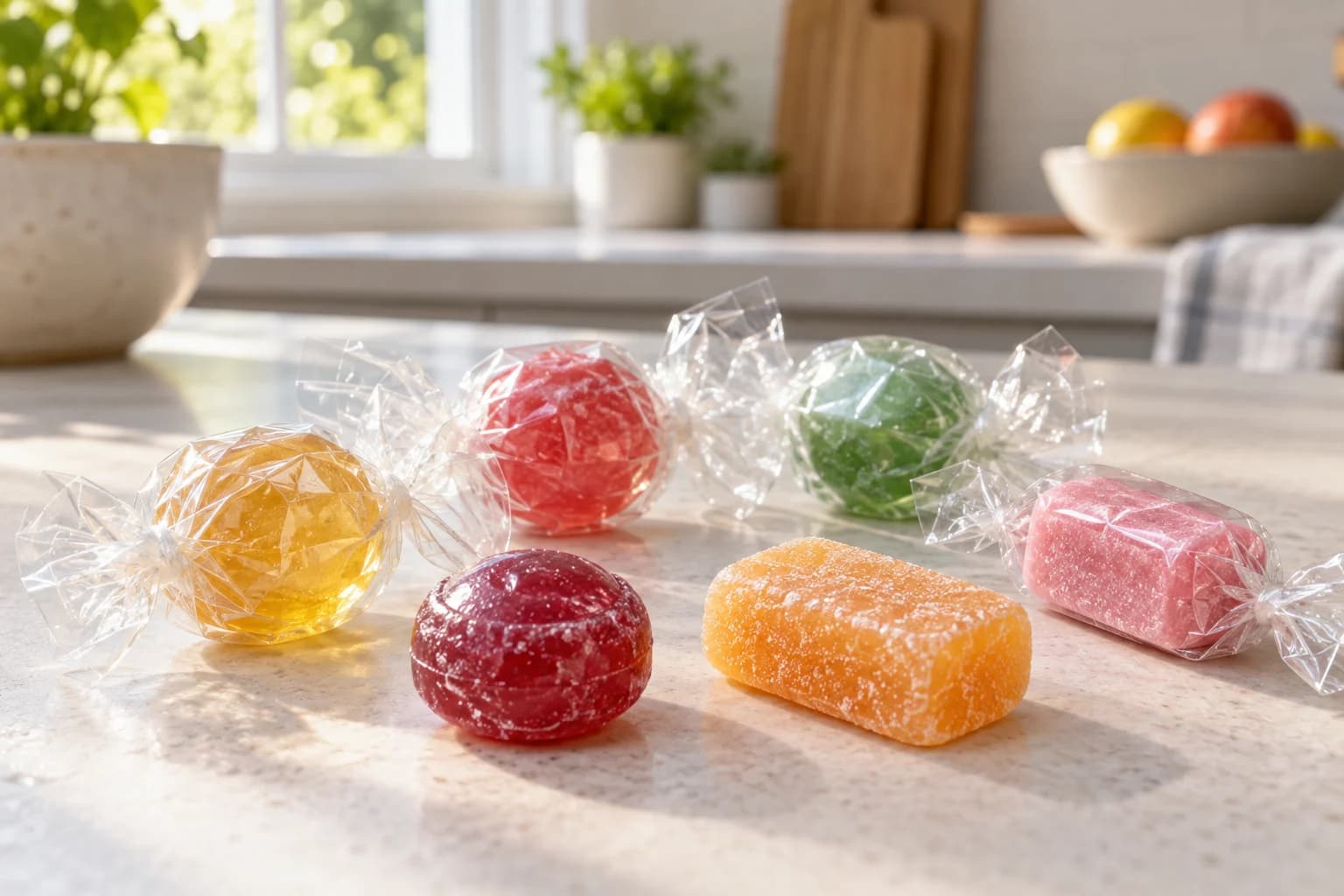
Key Takeaways
- Microplastics were detected in 20 of 20 plastic-wrapped candy samples.
- The average concentration was 6.73 ± 3.73 particles per gram, with substantial variation.
- Fibers dominated (70.13%), and most measured particles were 200–500 µm.
- PET was the leading identified polymer, but matching one common packaging polymer does not prove the wrapper caused every particle.
- No brands were disclosed, so the paper cannot support a “best” or “worst” candy ranking.
- Practical move: reduce repeated individually wrapped treats rather than panicking over a single piece.
Inside the first 20-sample candy survey
- samples contained microplastics
- 20 of 20
- branded plastic-wrapped candies sourced across 20 Asian and African countries
- Adjama & Dave 2026
What exactly did the candy study test?
Researchers collected 20 branded plastic-wrapped candy products—one from each of 20 countries across Asia and Africa—and purchased each sample in triplicate. Brand and manufacturer names were intentionally withheld. The packaging layers were characterized with ATR-FTIR, while particles recovered from the candy were examined by microscopy and spectroscopy.
Every sample contained detected microplastics, but the amounts varied. The overall average was 6.73 ± 3.73 particles per gram. Three coded products reached 15.55 ± 0.93, 13.31 ± 0.81 and 12.10 ± 2.51 particles per gram. Without the brand key, those product codes cannot guide a shopping list.
Were the wrappers definitely the source?
Not every particle. PET made up 38.21% of the identified polymers and is widely used in food packaging, so wrapper contact is a plausible source. But candy begins with ingredients such as sugar, flavorings and syrups, then passes through mixers, belts, moulds, cooling air and packing equipment. Fibers can also settle from the surrounding environment.
The study measured the finished candy and characterized its packaging; it did not manufacture identical candy with and without a plastic wrapper under controlled conditions. That means it establishes occurrence and points to plausible sources, but it cannot assign a percentage of the contamination to the wrapper itself.
| Question | What the evidence supports |
|---|---|
| Were particles found? | Yes, in all 20 coded products tested |
| How much? | 6.73 ±3.73 particles/g on average; individual products varied |
| What shape? | 70.13% fibers; most measured particles were 200–500 µm |
| What polymer? | PET led at 38.21%, followed by a mix of other polymers |
| Which brand was worst? | Unknown; brand names were intentionally not disclosed |
| Did the wrapper cause all of it? | Not proven; ingredients, processing, air and packaging are all possible sources |
| Does this amount cause disease? | Not tested; the study measured occurrence and modeled exposure |
Why were fibers more common than fragments?
Fibers represented 70.13% of detected particles. That shape is common in food studies and can enter from textiles, airborne fallout, cleaning materials and industrial environments as well as packaging. White and transparent particles dominated, which makes visual source attribution especially unreliable.
Size matters too. About 62.23% of particles fell between 200 and 500 µm. A study with a much lower detection cutoff could find many more small particles; a study that begins above 500 µm could find fewer. “Particles per gram” only becomes comparable when recovery, blanks, polymer confirmation and the size window are comparable.
What does the child-exposure estimate mean?
The authors combined the measured candy concentrations with consumption and body-weight assumptions. Their modeled averages were 23.04 ± 0.93 particles per kilogram of body weight per day for boys and 24.61 ± 0.99 for girls across the assessed early-childhood groups.
That is a scenario calculation, not particles counted inside children and not a medical threshold. Change the candy intake, body weight, product or analytical cutoff and the estimate changes. It is most useful as a reminder that frequency matters: an individually wrapped treat eaten every day is a different pattern from one eaten occasionally.
Use the App
Scan the candy and its contact layer
Capture the exact product, wrapper format, ingredient list and how often it is eaten. The app separates what the package discloses from what the 20-sample study can—and cannot—say about your brand.
Scan my candyAre paper, foil or boxed candies better?
The 2026 study did not compare package formats, so it cannot prove a paper box or foil wrap contains fewer particles. Many wrappers that look like paper or foil are laminated with plastic for sealing and moisture control. “Plastic-free” should come from the packaging specification, not the color or feel of the outside.
A useful hierarchy is more modest: fewer individually wrapped pieces means fewer direct-contact films and less packaging waste. Unwrapped candy from an open bulk bin removes the factory wrapper but adds handling and airborne exposure, so it is not automatically particle-free. For children, choking, allergy, dental and sugar considerations remain much more established than any brand-specific microplastic risk.
Five practical choices before Halloween and party season
- Change frequency before chasing a perfect wrapper. Keep candy occasional rather than trying to identify a zero-particle product that has not been demonstrated.
- Choose fewer individually wrapped pieces. A larger shared package can reduce the number of direct-contact films, where hygiene and allergies allow.
- Do not heat candy in its wrapper. Remove plastic before melting or baking; use glass, ceramic or stainless cookware.
- Discard damaged or sticky packaging. Visible delamination, flaking ink or wrapper pieces stuck to the food are clear quality failures.
- Scan the exact package. The study withheld brands, so a product-level label and format check is more honest than a viral “worst candy” list.
Should parents be worried?
The finding deserves attention because the products are designed for frequent direct contact and are widely eaten by children. It does not show that the measured concentrations cause harm. The FDA says current evidence does not demonstrate that micro- and nanoplastic levels detected in food pose a human-health risk, and it notes that measurement methods are not yet standardized. EFSA says exposure and health-effect knowledge remains limited.
The proportionate response is neither “ignore it” nor “ban every sweet tonight.” Use this as one more reason to reduce a low-nutrition, heavily packaged daily habit. That choice has established benefits independent of how microplastic science develops.
Continue the September 2026 food-contact series with the new evidence on microwaving food in its original plastic wrapper and direct abrasion from plastic salt-grinder heads. For adjacent pantry context, see what “gum base” can contain and the most-studied food sources.
What the MicroPlastics app checks
- The exact candy, country, wrapper type and any disclosed material code.
- Direct-contact film versus outer multipack packaging.
- Heat exposure, wrapper damage and how often the product is eaten.
- A lower-packaging alternative without fabricating a brand-level particle count.
Frequently Asked Questions
Does candy contain microplastics?
Which candy brands had the most microplastics?
Do candy wrappers cause microplastics?
Is unwrapped candy microplastic-free?
Should children stop eating candy because of microplastics?
Sources
- Adjama I, Dave H (2026). Quantitative and qualitative assessment of microplastics contamination in plastic-wrapped candies and estimation of dietary exposure in early childhood. Science of the Total Environment.
- Udovicki B, Andjelkovic M, Cirkovic-Velickovic T, Rajkovic A (2022). Microplastics in food: scoping review on health effects, occurrence, and human exposure. Springer Nature.
- European Food Safety Authority (2026). Microplastics and nanoplastics in food. EFSA.
- US Food and Drug Administration (2026). Microplastics and Nanoplastics in Foods. FDA.
Audit your whole pantry, not just the 5 foods in this article
The app keeps a running scan history for every packaged food you own, every brand swap you make, and every reformulation a brand quietly pushes. The article is a snapshot. The app is the trend line.
Download on the App Store- Free on iOS
- 3 free scans
- No sign-up
- Result in seconds
“Really cool to scan stuff around the kitchen and see what's actually in it. The swaps it suggests are realistic.” App Store review · 5.0★
Android · early access
Get the launch email the day Android opens.
One email. No spam. We send when the Android app is in the Play Store, and never again unless you opt in.
Related Research
Can You Microwave Food in Its Plastic Wrapper? New 2026 Evidence
A 2026 study detected PE micro- and nanoplastics from microwaved onigiri wrappers and lined cartons. See what appeared within 1–3 minutes, what the cell test cannot prove and when to transfer food.
Read moreDo Plastic Salt Grinders Shed Microplastics? A 2026 Test Says Yes
Yes. Three plastic grinder heads released an estimated 1,091 to 15,743 particles per 50 g of salt. The polymers matched the mechanisms; ceramic or steel burrs are the direct swap.
Read moreAre Compostable Coffee Cups Plastic? PLA Is Still a Polymer Lining
Many compostable paper cups use PLA plastic lining. A new study found about 12× higher released particle mass than PE cups, while earlier nanoplastic counts found the opposite—why both results can be true.
Read moreAre Nylon Cooking Utensils Plastic? Yes—Heat Is the Real Test
Nylon is polyamide plastic. Studies from 2016–2026 measured oligomers and aromatic amines rather than one universal particle count; heat, contact time and visible damage decide the practical response.
Read moreDoes Parchment Paper Have Plastic? Silicone Is the Key Detail
Most parchment is cellulose paper coated with cured silicone, not polyethylene film. The direct shedding evidence is limited, and plastic-coated freezer paper is a different product entirely.
Read moreThe Steel Ball Changes What a Plastic Shaker Bottle Releases
The first direct shaker-bottle study tested polypropylene, polycarbonate and Tritan. Every bottle shed; the steel ball increased abrasion; and the annual estimate is simultaneously 74,000–146,000 particles and only 42–72 micrograms of mass.
Read more