Can You Microwave Food in Its Plastic Wrapper? New 2026 Evidence

Last reviewed: by the MicroPlastics Research Desk. Submit a correction or see our editorial standards.
Quick Answer
Got a different brand in the cupboard? Review its packaging inputs and Product Contact Signal, then compare a lower-contact option.
Scan my product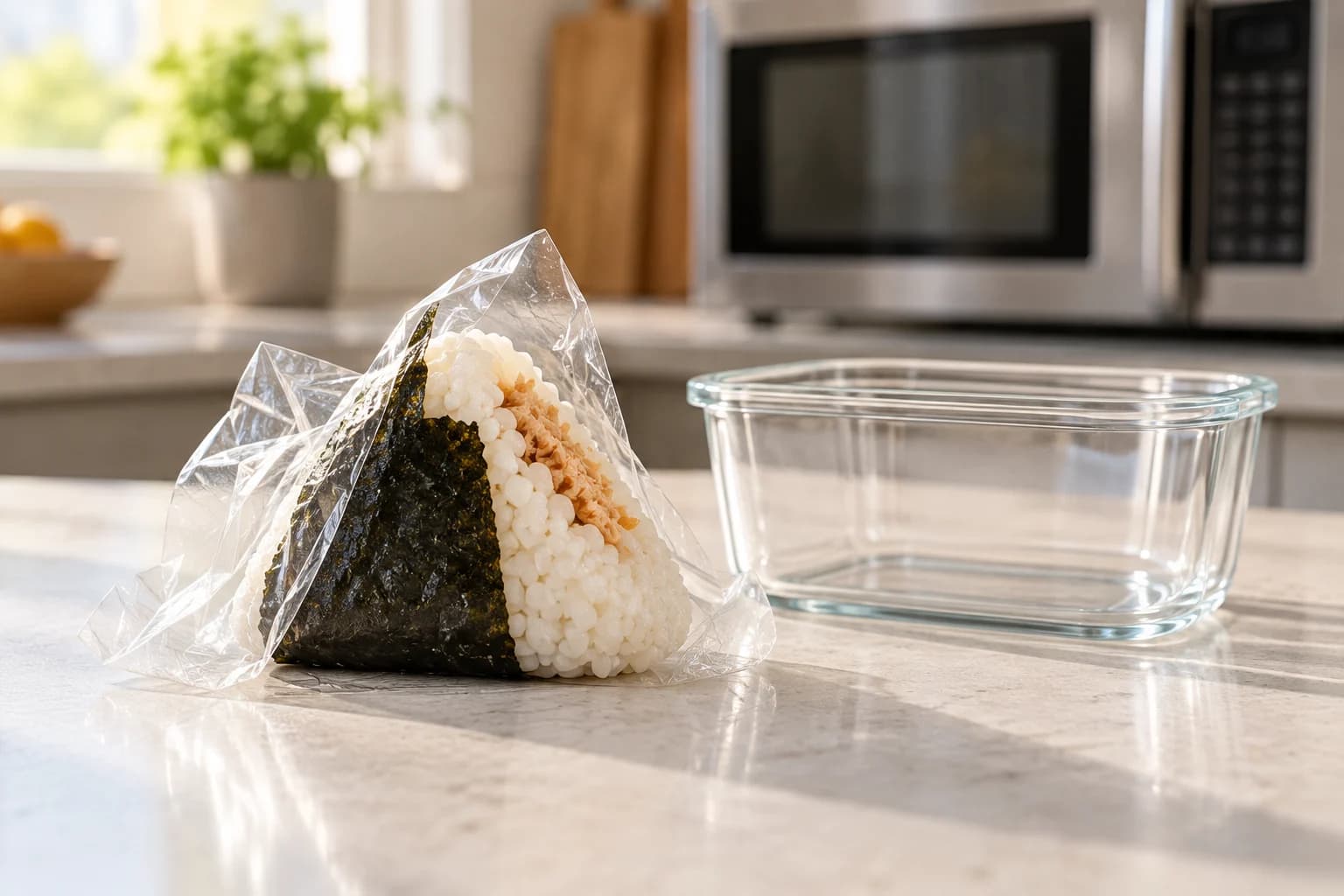
Key Takeaways
- “Microwave-safe” addresses intended use; it does not certify zero micro- or nanoplastic release.
- The 2026 study tested onigiri wrappers, porridge cartons and milk cartons containing polyethylene.
- Nanoplastics in the 40–240 nm range appeared after 1–3 minutes of microwave heating.
- Longer heating increased PE release and reduced the average measured microplastic size.
- A rat-cell result is an early hazard signal, not proof of disease or a real-world human dose.
- Best default: transfer food to uncovered or loosely covered glass or ceramic before reheating.
What the new microwave-packaging study reported
- until nanoplastics appeared
- 1–3 min
- dynamic light scattering detected particles during microwave heating
- Lin et al. 2026
- average microplastic size decreased
- 3.88 → 3.18 µm
- as heating duration increased; values are mean ±0.28 and ±0.23 µm
- Lin et al. 2026
- PE residues from the onigiri wrapper
- 1,443.78 µg/mL
- after five minutes in this experiment; ±5.28 µg/mL
- Lin et al. 2026
What counts as a plastic food wrapper?
Flexible packaging is rarely “just a bag.” It may combine polyethylene for sealing, PET for strength, nylon for puncture resistance, inks, adhesives and a thin metal layer. A paper-looking carton can also use polyethylene on its food-contact surface. The outside appearance cannot tell you what the hot food touches.
The new experiment focused on PE residues from three ordinary package formats: a plastic wrapper around onigiri, a porridge carton and a milk carton. It did not test every frozen-meal film, steam pouch or brand. Its central finding is narrower and useful: heat duration changed release from the tested food-contact layers.
What happened during microwave heating?
PE release increased as microwave time increased. Nile Red fluorescence measurements found the average microplastic size moved from 3.88 ± 0.28 µm to 3.18 ± 0.23 µm with prolonged heating. Dynamic light scattering detected smaller, 40–240 nm particles within one to three minutes.
Surface-enhanced Raman spectroscopy reported 1,443.78 ± 5.28 µg/mL of PE residues from the onigiri wrapper after five minutes. That is a mass-concentration endpoint for one tested package, not a particle count and not an estimate of what every person swallows. It should not be compared directly with studies reporting particles per litre unless the size range and analytical method also match.
| Package situation | What to do | Why |
|---|---|---|
| No microwave directions | Remove food; use glass or ceramic | The package has not stated that it is designed for microwave heat |
| Peel-back film on a rigid tray | Prefer transfer; otherwise follow the venting directions exactly | The film, tray and steam are one engineered cooking system |
| Microwave steam pouch | Follow the exact package directions or choose a non-pouch product | Opening early can change cooking and food-safety performance |
| Metallic or foil-lined wrapper | Never microwave unless the manufacturer explicitly instructs it | Metal can arc and damage the oven |
| Leftovers in cling film or a storage bag | Move to glass or ceramic; cover with a plate | Storage packaging is not automatically a cooking vessel |
Is “microwave-safe” the same as particle-free?
No. A microwave-use claim means the item is intended to withstand specified conditions and comply with applicable food-contact requirements. It does not mean a regulator counted every micro- and nanoplastic particle released under every time, temperature and food condition.
This distinction also explains why two statements can coexist: a package may be legally sold for its intended microwave use, while a sensitive research method detects polymer residues during that use. For the full label breakdown, see what “microwave safe” actually means.
What did the cell test show—and not show?
The researchers exposed Clone 9 normal rat liver cells to residues from the packaging experiments. Cell viability decreased and oxidative stress increased. That is a laboratory hazard signal worth following. It is not a clinical trial, a human exposure study or proof that microwaving one wrapped rice ball damages a person's liver.
Dose, digestion, particle recovery, tissue exposure and repeated real-world use all sit between a cell dish and a health outcome. The FDA currently says evidence does not demonstrate that micro- and nanoplastic levels found in foods pose a human-health risk. EFSA says the exposure and effect evidence remains limited and is working toward a fuller assessment.
Use the App
Check the package before the timer starts
Scan the heating directions, food-contact material, film, tray and planned cook time. The app flags when a storage package is being used as cookware and suggests a lower-contact transfer.
Scan my food packageHow to reheat with less plastic contact
- Read the complete instructions first. “Remove outer wrapper,” “pierce film” and “cook in pouch” are different directions.
- Transfer when the package is not essential to cooking. Use an intact glass or unglazed-contact-safe ceramic dish.
- Cover without cling film. A microwave-safe plate or vented glass lid controls splatter without resting film on hot food.
- Do not improvise with takeout or storage packaging. A container that held cold food is not automatically rated for cooking.
- Do not undercook for the sake of the package. If safe preparation depends on the original system, follow the directions or choose a product designed for transfer.
For common formats, compare our investigations of Ziploc bags, microwave popcorn bags and microwave containers.
The same September 2026 contact-point series also tests two non-microwave pathways: direct abrasion from plastic salt-grinder heads and the occurrence survey of 20 plastic-wrapped candies.
Does the new study prove packaging is the biggest source?
No. Food can acquire particles from air, water, ingredients and processing equipment before it reaches the wrapper. The experiment demonstrates that the tested packaging can add PE during microwave use; it does not apportion a typical person's total diet across every source.
An EFSA review of food-contact materials found evidence for particle release but also widespread methodological weaknesses and insufficient data for a reliable exposure estimate. That is why the practical recommendation is proportionate: make the easy transfer, keep eating safely, and do not turn one analytical endpoint into a diagnosis.
What the MicroPlastics app checks
- Whether the package is for storage, reheating or cooking.
- The film, pouch, tray, lining and any metallic layer—not only the outer box.
- Time, temperature, fat content and whether hot food touches the packaging.
- A food-safe alternative that preserves required cooking instructions.
Frequently Asked Questions
Can you microwave food in a plastic wrapper?
Do microwave-safe wrappers release microplastics?
How quickly can nanoplastics appear?
Is it safer to cover food with a paper towel?
Does microwaving plastic cause cancer?
Sources
- Lin P-Y, Hsieh S-L, Wu I-H, Hsieh Y-C, Hsieh S (2026). Invisible plastic release from overlooked usage practices in microwaved food packaging. Food Chemistry.
- European Food Safety Authority (2025). Literature review on micro- and nanoplastic release from food contact materials during their use. EFSA Supporting Publications.
- US Food and Drug Administration (2026). Microplastics and Nanoplastics in Foods. FDA.
- US Food and Drug Administration (2024). Microwave Ovens. FDA.
Audit your whole pantry, not just the 5 foods in this article
The app keeps a running scan history for every packaged food you own, every brand swap you make, and every reformulation a brand quietly pushes. The article is a snapshot. The app is the trend line.
Download on the App Store- Free on iOS
- 3 free scans
- No sign-up
- Result in seconds
“Really cool to scan stuff around the kitchen and see what's actually in it. The swaps it suggests are realistic.” App Store review · 5.0★
Android · early access
Get the launch email the day Android opens.
One email. No spam. We send when the Android app is in the Play Store, and never again unless you opt in.
Related Research
Do Plastic Salt Grinders Shed Microplastics? A 2026 Test Says Yes
Yes. Three plastic grinder heads released an estimated 1,091 to 15,743 particles per 50 g of salt. The polymers matched the mechanisms; ceramic or steel burrs are the direct swap.
Read moreAre Compostable Coffee Cups Plastic? PLA Is Still a Polymer Lining
Many compostable paper cups use PLA plastic lining. A new study found about 12× higher released particle mass than PE cups, while earlier nanoplastic counts found the opposite—why both results can be true.
Read moreAre Nylon Cooking Utensils Plastic? Yes—Heat Is the Real Test
Nylon is polyamide plastic. Studies from 2016–2026 measured oligomers and aromatic amines rather than one universal particle count; heat, contact time and visible damage decide the practical response.
Read moreDoes Parchment Paper Have Plastic? Silicone Is the Key Detail
Most parchment is cellulose paper coated with cured silicone, not polyethylene film. The direct shedding evidence is limited, and plastic-coated freezer paper is a different product entirely.
Read moreThe Steel Ball Changes What a Plastic Shaker Bottle Releases
The first direct shaker-bottle study tested polypropylene, polycarbonate and Tritan. Every bottle shed; the steel ball increased abrasion; and the annual estimate is simultaneously 74,000–146,000 particles and only 42–72 micrograms of mass.
Read moreThe Cup Noodle Study Everyone Cites Never Counted the Particles
Instant noodle containers have one government safety assessment — Hong Kong, 2009 — and it cleared them on chemistry: styrene, heavy metals and total migration all inside the limits. It never counted particles, and nobody has since. Meanwhile the one fix that halves release in disposable cups, rinsing before use, is impossible when the food is already in the cup.
Read more