The Steel Ball Changes What a Plastic Shaker Bottle Releases
Last reviewed: by the MicroPlastics Research Desk. Submit a correction or see our editorial standards.
Quick Answer
Got a different brand in the cupboard? Review its packaging inputs and Product Contact Signal, then compare a lower-contact option.
Scan my product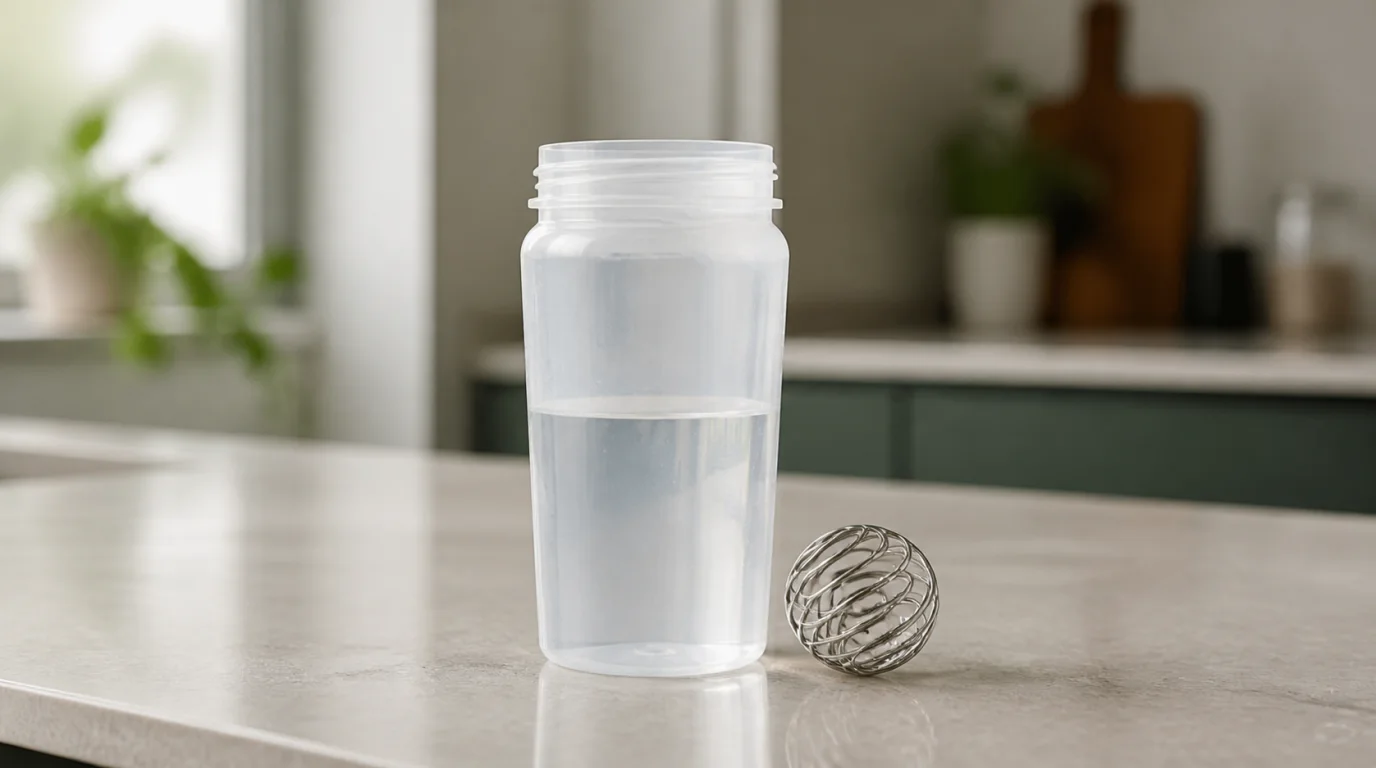
Key Takeaways
- This is the first direct shaker-bottle study. It tested the bottle and steel ball together, rather than borrowing figures from kettles, cups or food containers.
- All three plastics shed. Polypropylene, polycarbonate and Tritan released particles under the tested conditions.
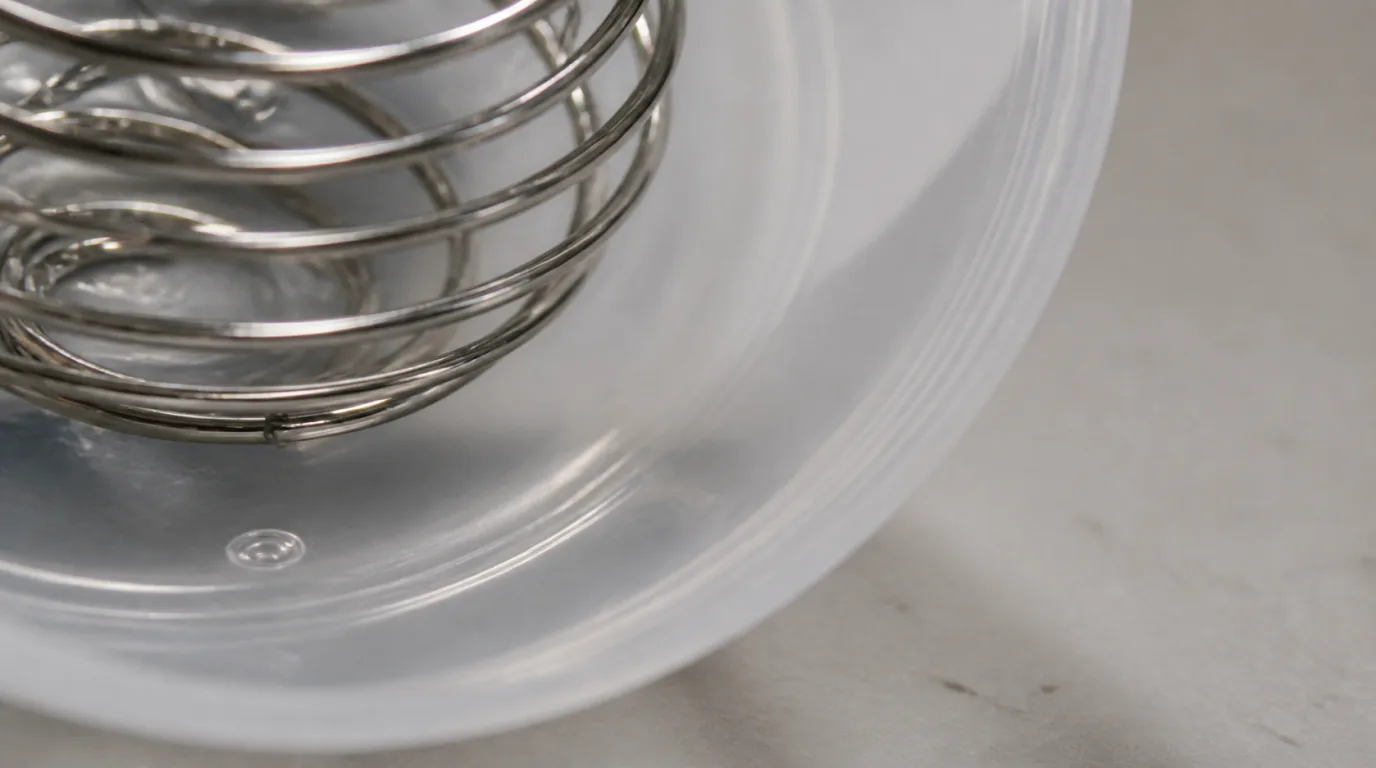
- The ball made release worse. Contact between steel and the bottle wall produced localized abrasion.
- Counts and mass tell different stories. The authors estimated 74,000–146,000 particles ingested annually, but 42–72 µg of plastic mass released per bottle annually.
- Use mattered. Release generally increased as bottles continued to age under repeated shaking.
- Polycarbonate showed chemical change as well as wear. Spectroscopy indicated surface etching and bond scission.
- No health outcome was measured. The paper cannot tell us whether this exposure causes harm.
What the 2026 study actually measured
- plastic families tested
- 3
- polypropylene, polycarbonate and Tritan copolyester under controlled and user-relevant shaking
- Yang et al., 2026
- particles estimated to reach a user each year
- 74k–146k
- an exposure estimate based on the study protocol, not a measured health effect
- Yang et al., 2026
- estimated annual plastic mass released per bottle
- 42–72 µg
- why particle count should always be read alongside mass
- Yang et al., 2026
- particles estimated to enter the environment annually
- 550–1,090m
- primarily through washing and disposal of bottle contents
- Yang et al., 2026
The answer changed in July 2026
Until this paper appeared, advice about shaker bottles rested on a plausible mechanism: put a steel ball inside a plastic cylinder, shake it hard every day, and the harder material should abrade the softer one. Our older guide to microplastics in protein powder described that mechanism, but no study had measured the object itself. Yang and colleagues changed that by testing reusable shakers as they are actually used.
What the researchers did
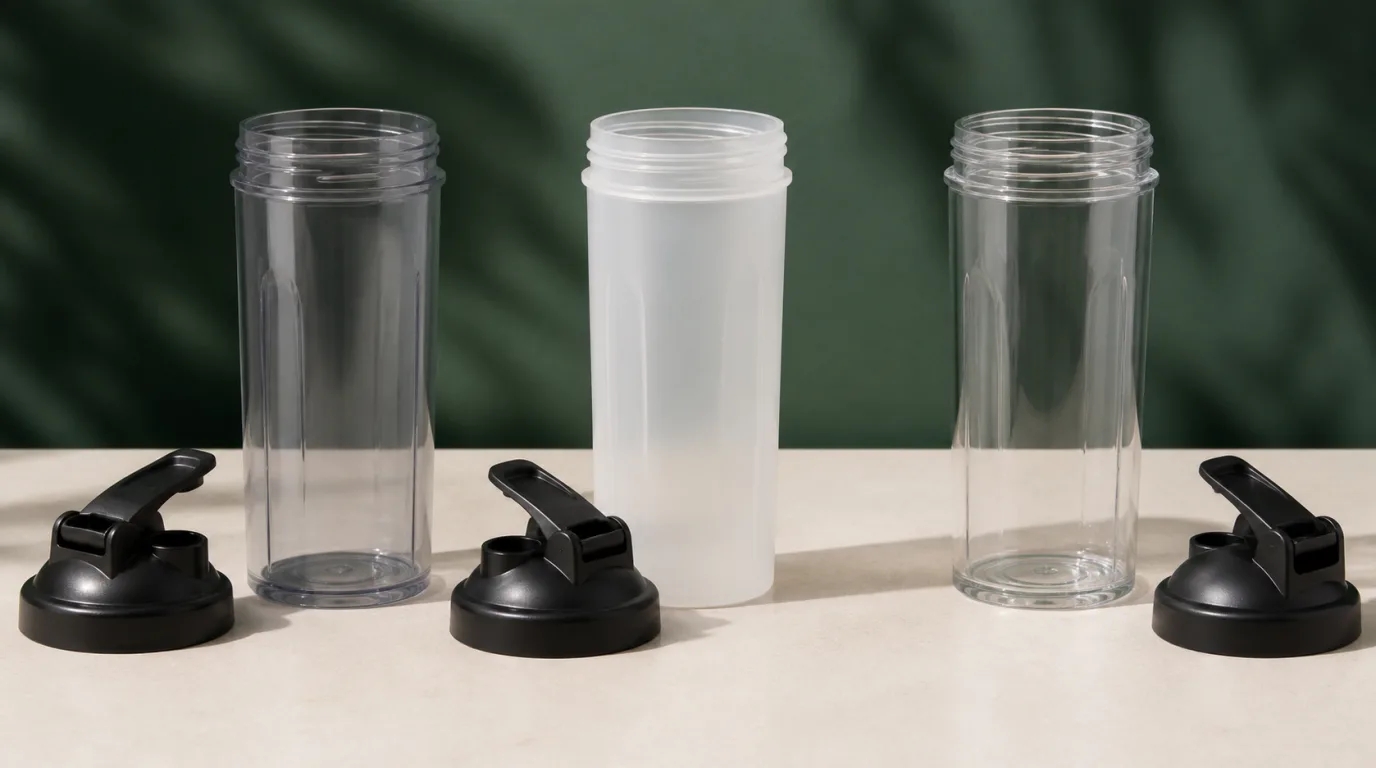
The team compared bottles made from polypropylene, polycarbonate and Tritan, then separated baseline shedding from ball-assisted abrasion. Bottles were shaken under controlled and user-relevant protocols, with and without a stainless-steel mixing ball, and across stages of continued use. Optical photothermal infrared microspectroscopy was used to identify the released polymers and examine chemical changes.
Every bottle released measurable particles without the ball. The authors interpret that baseline as pre-existing manufacturing residue and ordinary surface shedding. Adding the ball markedly increased release at the places where steel contacted plastic. Continued use generally increased the amount released rather than polishing the surface into stability.
The big number and the small number are both true
The headline-friendly estimate is 74,000–146,000 particles per year reaching a user. The equally important estimate is 42–72 micrograms per bottle per year. A microgram is one-millionth of a gram. Reporting the count without the mass makes the result sound larger than it physically is; reporting only the mass hides how many small fragments were measured.
Neither number is a disease threshold. The experiment did not follow people, measure inflammation or compare outcomes between plastic and steel-bottle users. It establishes a route of exposure and identifies the mixing ball as a controllable driver.
Why polycarbonate stood out
Polycarbonate showed more than simple scraping. The researchers found surface etching and changes consistent with chemical bond scission—a mechanochemical process in which repeated physical force changes the polymer itself. That does not mean one shake “breaks down” a bottle. It means long-term mechanical aging can be chemical as well as cosmetic.
Tritan is a copolyester rather than polycarbonate, and polypropylene is a different polymer again. The paper found polymer-specific behavior, which is why a universal “plastic shaker” number should not be applied to every bottle, every shaking routine or every year of use.
What to do without turning a microgram finding into a crisis
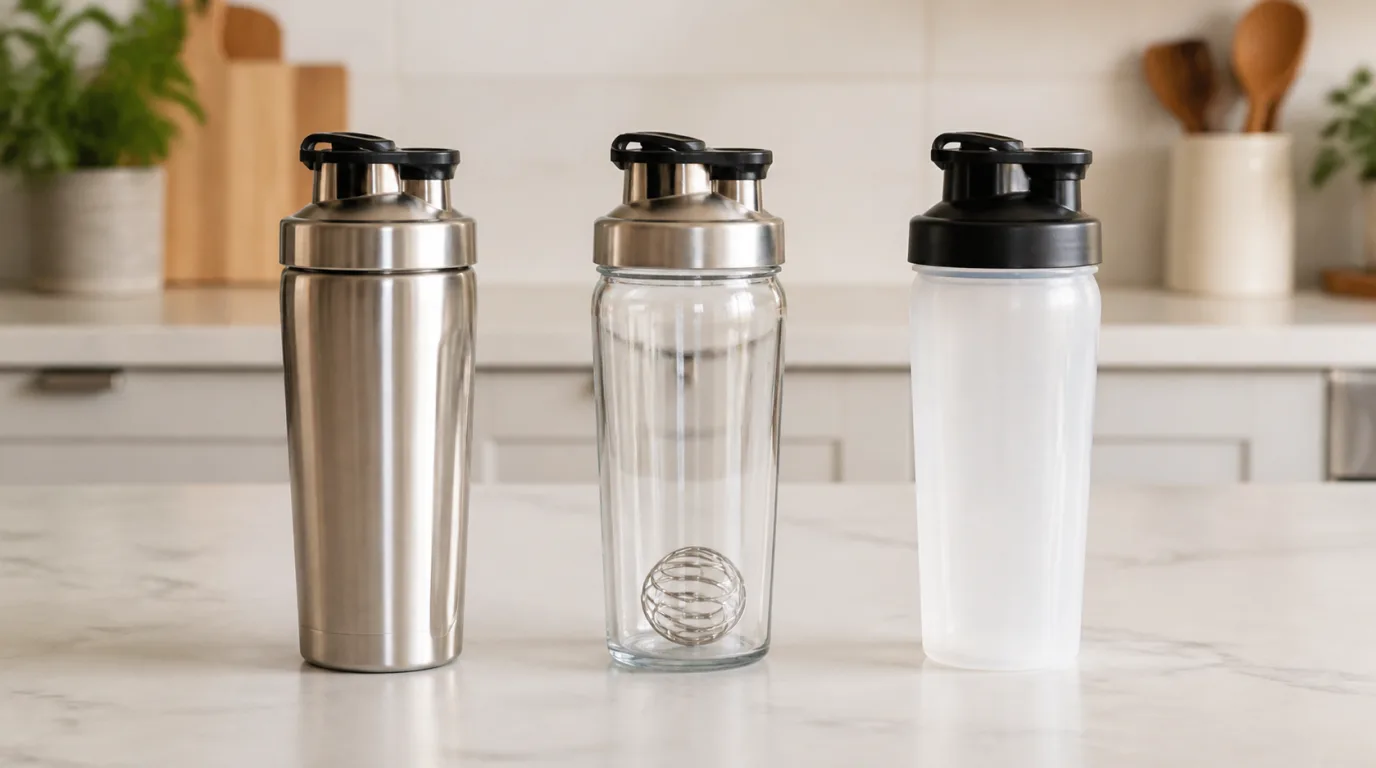
- Remove the steel ball. A whisk insert fixed in the lid or ordinary stirring avoids the measured steel-on-plastic abrasion.
- Retire visibly scored bottles. Continued use generally increased release in the experiment.
- Use stainless steel or glass if you shake daily. This removes the plastic wall from the ball-contact mechanism.
- Do not add heat. The study addressed mechanical shaking; hot dishwashing adds a separate aging stress.
- Keep the result in scale. The annual mass estimate is tens of micrograms, and no health outcome was tested.
Use the App
Check the whole protein-shake setup
Scan the powder tub, sachet, bottle and mixing accessories with MicroPlastics. The container, heat, wear and contact pattern often matter more than the marketing on the powder.
Check my shaker setupFrequently Asked Questions
Do protein shaker bottles shed microplastics?
Does the metal mixing ball make it worse?
How many particles does a shaker bottle release?
Is Tritan safer than polypropylene or polycarbonate?
Should I throw away my plastic shaker?
Did the study prove shaker bottles are harmful?
Sources
- Yang C, Wang Q, Ma C, Ji R, Su Y, Xing B (2026). Polymer-specific abrasion and aging govern microplastic release from reusable plastic shaker bottles. Journal of Hazardous Materials 515:143125.
- Geueke B, et al. (2025). Food contact articles as source of micro- and nanoplastics: a systematic evidence map. npj Science of Food.
Audit your whole pantry, not just the 5 foods in this article
The app keeps a running scan history for every packaged food you own, every brand swap you make, and every reformulation a brand quietly pushes. The article is a snapshot. The app is the trend line.
Download on the App Store- Free on iOS
- 3 free scans
- No sign-up
- Result in seconds
“Really cool to scan stuff around the kitchen and see what's actually in it. The swaps it suggests are realistic.” App Store review · 5.0★
Android · early access
Get the launch email the day Android opens.
One email. No spam. We send when the Android app is in the Play Store, and never again unless you opt in.
Related Research
The Cup Noodle Study Everyone Cites Never Counted the Particles
Instant noodle containers have one government safety assessment — Hong Kong, 2009 — and it cleared them on chemistry: styrene, heavy metals and total migration all inside the limits. It never counted particles, and nobody has since. Meanwhile the one fix that halves release in disposable cups, rinsing before use, is impossible when the food is already in the cup.
Read moreThe Slow Cooker Liner Is Not a Sandwich Bag
Liners are nylon rated to 400 °F, not polyethylene — the film is nowhere near its limit in a crock. But nylon 6 is made from caprolactam and nylon 66 is not, the manufacturer says only “a blend of nylon”, and that omission decides which migration question applies to dinner.
Read moreThe PFAS Left Microwave Popcorn Bags. The Plastic Film Did Not.
US manufacturers stopped selling grease-proofing PFAS for food packaging in February 2024, so the warning most articles still repeat is out of date — and the study everyone quotes runs on data from 2003–2014. But every bag still holds a metallized PET susceptor film that reaches about 450°F against the food.
Read morePFAS in Cooking Oil: When the Plastic Doesn't Come From the Bottle
A third-party test found PTFE — a fluoropolymer, and therefore a PFAS — suspended in an olive oil whose squeeze bottle is not made of PTFE. That mismatch points upstream at processing equipment rather than packaging. Plus the regulatory science on why fat extracts more from plastic than any other food.
Read moreDoes the AeroPress Leach Microplastics? Every Model Checked
The Original chamber is polypropylene and you brew near-boiling water in it, which is the exact combination we warn about. The saving grace is contact time: about a minute, not all day. Every model by material from AeroPress own documentation, plus the two versions with no plastic in the water path at all.
Read moreProtein Shakes Ranked by Microplastic and Phthalate Risk (2026)
Only one ready-to-drink shake has ever been publicly tested, and it failed badly. Every major brand ranked on container format, processing route and what the company actually discloses — plus why almost nobody in this aisle will tell you what the bottle is made of.
Read more