Protein Shakes Ranked by Microplastic and Phthalate Risk (2026)

Last reviewed: by the MicroPlastics Research Desk. Submit a correction or see our editorial standards.
Quick Answer
Got a different brand in the cupboard? Review its packaging inputs and Product Contact Signal, then compare a lower-contact option.
Scan my product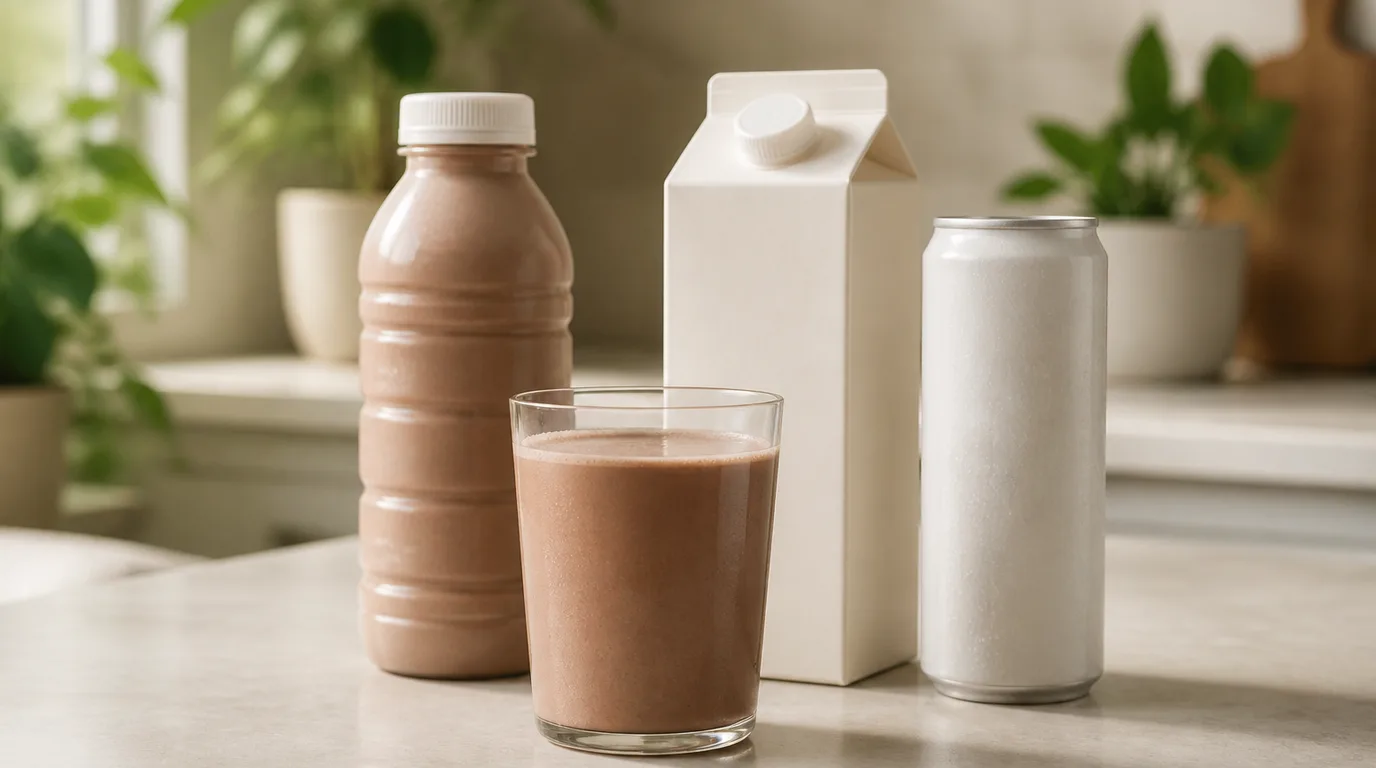
Key Takeaways
- Consumer Reports found plasticizers in 84 of 85 foods tested. This is a category problem, not one bad brand.
- Fairlife Core Power Chocolate is the only RTD shake with published numbers, and CR's own two documents give two different figures for it — 20,452 and 24,928 ng per serving.
- Phthalates are not microplastics. They are plasticizer chemicals that leach out of plastic. Both come from packaging; only one has been measured here.
- Packaging format is the one lever you control: steel can > carton > HDPE/PET bottle for a liquid stored warm and shaken.
- Ultrafiltered shakes pass milk through polymer membranes under pressure. High-protein claims and polymer contact travel together.
- Premier Protein and Muscle Milk publish no packaging material and no test data at all — so their rank here reflects format, not a clean bill of health.
- Nobody has published a particle count for any protein shake. Any site quoting one made it up.
What has actually been measured
- foods tested by Consumer Reports
- 85
- 67 grocery items and 18 fast foods, two to three samples each
- Consumer Reports, Jan 2024
- contained plasticizers
- 84 of 85
- only one product in the whole survey came back at zero
- Consumer Reports
- per serving, Fairlife Core Power Chocolate
- 24,928 ng
- the figure in CR’s February 2024 letter to fairlife; CR’s article table lists 20,452
- Consumer Reports letter to fairlife
- published particle counts for any RTD shake
- 0
- phthalates have been measured; microplastic particles have not
- MicroPlastics Research Desk review, Aug 2026
Start with the distinction everyone gets wrong
Search “protein shake microplastics” and you will find a lot of pages citing the Consumer Reports Fairlife result as if it were a microplastic measurement. It was not. CR measured phthalates — plasticizer chemicals that migrate out of plastic into food. Microplastics are solid particles of the plastic itself.
They are different things with the same root cause, which is why the distinction keeps collapsing in coverage. Both arrive from plastic in contact with your food. But only one of them has ever been measured in a protein shake, and it is not the one in the search query. We think the honest framing is: the phthalate result is a proxy signal. A product carrying that much plasticizer had a lot of plastic contact somewhere in its life. That tells you something real about the process even though it is not a particle count.
How we ranked, given that the data barely exists
A ranking is only worth reading if you know what produced it. We scored every shake on three things that are checkable rather than on numbers nobody has generated:
- Container format. A steel can with an epoxy or acrylic liner, a multi-layer carton, and an HDPE or PET bottle behave differently under heat, time and agitation. A bottle is the only one of the three where the polymer wall is the container.
- Processing route. Ultrafiltered milk protein is pushed through polymer membranes under pressure. That is an extra plastic contact step that a simple whey-and-water shake does not have.
- Disclosure. Whether the brand states, on its own site, what the container is made of. Almost none do, and we score that honestly rather than assuming the worst or the best.
What we did not do is assign each product a particle count. Several sites will show you one. Those numbers do not come from a laboratory, because no laboratory has published one for this category.
The ranking
| # | Product | Container | Why it ranks here |
|---|---|---|---|
| 1 | Powder + your own shaker | You choose | Lowest risk in the category by construction. No liquid stored for months against a polymer wall. Use a steel or glass shaker and the packaging question mostly disappears. |
| 2 | Premier Protein shakes (carton) | Tetra-style carton; material not disclosed | Carton laminate keeps the liquid off a thick polymer wall, though every carton has a thin inner polyethylene layer. No test data exists. Not disclosed by the brand. |
| 3 | Premier Protein sodas | Steel can; liner not disclosed | Steel is the best barrier here, but the can liner is a real and separate question — see our canned-food work. |
| 4 | Orgain, OWYN and similar carton shakes | Carton; material not disclosed | Same format logic as Premier. Plant protein skips dairy ultrafiltration, which removes one polymer contact step. |
| 5 | Muscle Milk / Muscle Milk Pro (11oz, 14oz) | Not disclosed | Cytosport publishes neither container material nor any test data on its own site. Ranked mid on format uncertainty, not on evidence of a problem. |
| 6 | SlimFast Creamy Chocolate | Plastic bottle | Measured by Consumer Reports at 16,916 ng plasticizer per serving — the second-highest shake in the survey. |
| 7 | Fairlife Core Power Chocolate | Plastic bottle | The only shake CR wrote to a manufacturer about. Ultrafiltered, and sold in a plastic bottle. Both risk factors in one product. |
Two honest caveats about that table. Rank 5 is not a compliment and rank 2 is not a clearance. Premier ranks above Muscle Milk because a carton is a better format than an unknown, not because Premier has been tested and passed. And Fairlife sits at the bottom because it is the one product with published numbers — which is partly a penalty for having been measured at all. If every brand here were tested tomorrow, this order could change.
Why ultrafiltration matters
The high-protein dairy shakes that dominate this category get their protein numbers through ultrafiltration: milk is forced through a semi-permeable membrane that holds protein back and lets water and lactose through. Those membranes are typically polymer.
This is the part that gets missed when people blame the bottle. A shake's plastic contact starts well before it is filled. The marketing promise on the front of the bottle — more protein, less sugar, lactose-free — is delivered by a process that involves pressurised contact with a polymer surface. That does not make ultrafiltered milk dangerous. It does mean the bottle is not the whole story, and it is why a plant-protein carton shake ranks above a dairy bottle shake on our scoring even before you get to the container.
The disclosure problem
We checked every brand on this page against its own website in August 2026. Here is what that exercise turned up: not one ready-to-drink protein brand states what its container is made of. Not the resin code, not the liner chemistry, not the carton laminate structure.
Compare that with how other categories behave. AeroPress names the polymer for every model it sells. CeraVe and Cetaphil publish complete ingredient lists you can audit line by line. The protein aisle publishes grams of protein and nothing about the vessel those grams arrive in.
That silence is the finding. When a brand does not disclose, the correct conclusion is not “it must be fine” and not “it must be bad” — it is that you cannot tell, and they have decided you do not need to.
Use the App
Check the shake in your fridge
Scan the bottle, carton or can with MicroPlastics to see the polymer, a 0–100 risk score, and a lower-exposure swap in the same format.
Get the MicroPlastics appWhat to actually do
- Switch format before you switch brand. Moving from a plastic bottle to a carton or a can does more than moving between two bottled brands.
- Powder is the real answer if you drink these daily. A tub plus a steel shaker removes months of liquid-against-polymer storage entirely. It is also cheaper per gram.
- Do not leave shakes in a hot car. Release scales with time and temperature together — the same rule that governs a water bottle left in a hot car.
- Occasional use is not worth anxiety. CR found plasticizers in 84 of 85 foods. A shake three times a week is not the thing to fix first.
- Ask the brand. Every one of these companies has a contact form. Packaging material is a fair question and the answers are currently missing.
Brand-level detail: does Fairlife have microplastics, does Premier Protein have microplastics, and does Muscle Milk have microplastics. For powders see microplastics in protein powder, and for the can-liner question, are cans lined with plastic.
Frequently Asked Questions
Which protein shake has the least microplastics?
Does Fairlife Core Power really have the most microplastics?
Are phthalates the same as microplastics?
Is Premier Protein safer than Fairlife?
Should I switch to protein powder instead?
Sources
- Consumer Reports (2024). The Plastic Chemicals Hiding in Your Food (85 foods tested for 10 phthalates, 3 replacement plasticizers and 3 bisphenols). Consumer Reports.
- Ronholm, B. (Consumer Reports) (2024). Letter to fairlife, LLC regarding plasticizer levels in Core Power High Protein Chocolate Milk Shake (24,928 ng per serving). Consumer Reports Advocacy.
- Premier Nutrition Company, LLC (2026). Premier Protein product range (packaging material not stated on brand site; checked August 2026). premierprotein.com.
- Cytosport, Inc. (2026). Muscle Milk ready-to-drink shake range (packaging material not stated on brand site; checked August 2026). musclemilk.com.
- European Food Safety Authority (2025). Microplastics and nanoplastics in food (release driven primarily by heat, wear and contact time). EFSA.
After install · scan this first
Open the camera and scan the shake in your fridge.
Not one brand in this category publishes what its container is made of. Scanning the pack is currently the only way to find out what yours is.
Android · early access
Get the launch email the day Android opens.
One email. No spam. We send when the Android app is in the Play Store, and never again unless you opt in.
Related Research
Does Premier Protein Have Microplastics? What the Carton Actually Tells You
Never tested, and Premier does not state its packaging material — so any number you see is invented. What an aseptic carton is really made of, why it beats the plastic bottle Fairlife was flagged for, and the free switch hiding inside the range.
Read moreDoes Muscle Milk Have Microplastics? What Cytosport Won't Tell You
We went looking for a bottle material and an ingredient list and found neither, which makes this the least transparent product we have audited in any category. What the plastic-bottle format implies, why the 11oz is marginally worse than the 14oz, and the better option inside the same brand.
Read moreIs a Moccamaster Plastic-Free? Every Part That Touches Your Coffee (2026)
No, and no drip brewer is. But the Moccamaster puts its plastic where it matters least: the reservoir holds cold water and heating happens in a copper element, not a plastic tank. Component by component through the water path, what Technivorm confirms, the polymer it will not disclose, and how it compares with a Keurig.
Read moreFruit and Vegetables Are the Biggest Microplastic Source in Your Diet (2026)
A University of Amsterdam review of 193 studies found fruit, vegetables and grains account for roughly 99.5% of the microplastic particles people swallow, ahead of seafood and bottled water. Why that is about how often you eat them rather than how dirty they are, why it is not a reason to eat less produce, and the buried finding: intake estimates span more than ten orders of magnitude.
Read moreCan Food Help Clear Microplastics? Kimchi, Fiber & the Evidence (2026)
A kimchi bacterium (Leuconostoc mesenteroides CBA3656) bound 57% of nanoplastics and doubled plastic excretion in mice. What that means for your plate, what fiber does, and the honest limit: food may block absorption, not clear what's already stored.
Read moreDo Energy Drinks Have Microplastics? Prime, Celsius, Red Bull & Monster Ranked (2026)
No brand tests its drink, so packaging decides it. Canned energy drinks (Celsius, Red Bull, Monster) shift the question to the liner; Prime Hydration's plastic bottle is the real shedder. The honest 2026 ranking and the lowest-plastic pick.
Read more