Are Compostable Coffee Cups Plastic? PLA Is Still a Polymer Lining
Last reviewed: by the MicroPlastics Research Desk. Submit a correction or see our editorial standards.
Quick answer

Check the brand in your cupboard
Scan the label to see its packaging, what drives its contact score, and a lower-plastic swap.


Free · 3 scans · iOS and Android
Key Takeaways
- PLA is a plastic polymer, even when its feedstock is corn or sugar and the finished item is certified compostable.
- Paper cups need a liquid barrier; common liners include PE and PLA.
- A 2026 study reported roughly 12× higher released particle mass from PLA-lined cups than PE-lined cups under its test conditions.
- Particle count and particle mass are different endpoints: more small particles can weigh less than fewer large ones.
- A compostability claim applies only under defined disposal conditions and says nothing by itself about hot-drink particle release.
- Best repeat-use option: an uncoated ceramic, glass or stainless-steel mug.
Why the cup-study headlines look contradictory
- higher released particle mass
- ~12×
- PLA-lined versus PE-lined cups in the 2026 ACS study
- Shi et al. 2026
- nanoparticles counted from PLA
- 4.3M/mL
- compared with about 2.7 million/mL from PE in the same 2026 experiments
- University of Queensland / ACS study
- more nanoparticles from LDPE
- up to 26×
- LDPE-coated versus PLA-coated paper cups in a different 2024 study
- Son et al. 2024
- LDPE release increased
- >80°C
- temperature threshold highlighted in the 2024 nanoplastic experiment
- Son et al. 2024
What makes a paper cup waterproof?
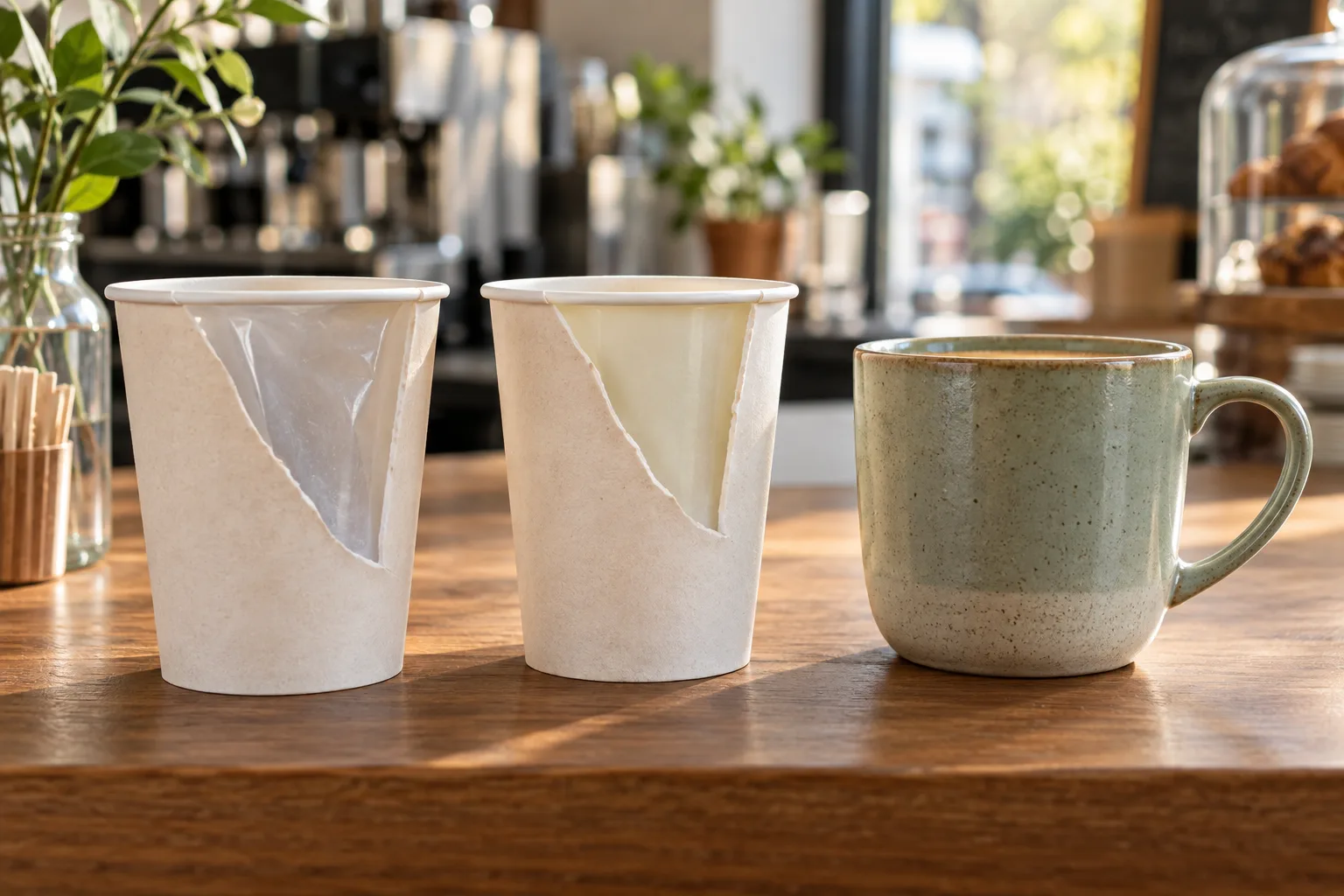
Plain paper absorbs hot liquid and loses strength. Manufacturers therefore add a thin barrier to the inside wall. Conventional cups commonly use polyethylene. Cups marketed as compostable may replace that layer with PLA or another compostable polymer. The outside can look and feel like fibre while the drink still touches plastic film.
Some newer cups use water-based dispersion coatings or other barrier systems, but “paper cup” alone does not identify the contact layer. Ask for the cup specification or certification instead of judging the brown colour, leaf pattern or “eco” copy.
Is PLA actually plastic?
Yes. PLA is polylactic acid, a thermoplastic polyester. It can be made from biologically derived sugars rather than fossil feedstock, and suitable products can meet industrial-composting standards. Those characteristics may change climate and waste trade-offs; they do not turn the lining into cellulose.
The European Commission warns that “biobased,” “biodegradable” and “compostable” describe different properties and can mislead when treated as synonyms. Industrially compostable packaging generally needs collection and controlled facility conditions. A cup abandoned outdoors or sent to the wrong waste stream is not guaranteed to disappear harmlessly.
| Label | What it means | What it does not prove |
|---|---|---|
| Paper cup | The structural wall is primarily paperboard | That the drink-contact barrier is plastic-free |
| Bio-based | Some or all feedstock came from biological resources | Biodegradation or low particle release |
| Biodegradable | Material can biologically break down under stated conditions | Home compostability or instant breakdown |
| Compostable | Meets a specified composting standard under defined conditions | Plastic-free use or zero microplastics |
| PLA-lined | The barrier uses a thermoplastic polyester | That every PLA cup behaves identically |
What did the new 2026 cup study find?
Shi and colleagues tested single-use paper cups lined with polyethylene and PLA. Both released micro- and nanoscale plastic material into hot water. The researchers reported approximately 4.3 million nanoparticles per millilitre from PLA-lined cups and 2.7 million per millilitre from PE-lined cups. On estimated total particle mass, PLA was about twelve times higher in their experiments.
That is a strong reason not to equate “compostable” with “no plastic exposure.” It is not proof that every PLA cup on the market releases twelve times more than every PE cup. Lining thickness, manufacturing quality, drink temperature, contact time, agitation and analytical recovery all affect the result.
Why did an earlier study find the opposite?
Son and colleagues studied nanoplastics from LDPE- and PLA-coated paper cups and reported up to 26-fold more nanoparticles from LDPE cups, with a maximum of 1.9 × 10⁷ particles per cup. LDPE release increased above 80°C and with physical agitation. The authors also found coating thickness mattered: thicker contact layers released far fewer particles.
The studies are not interchangeable scorecards. One headline emphasizes estimated released mass, another a count within a particular nanoscale window. A cloud of very small particles can produce a large count but little mass. A smaller count of larger fragments can weigh more. Before declaring a winning polymer, compare the size range, unit, cup construction and exposure protocol.
| Factor | Why it changes the result |
|---|---|
| Count versus mass | Millions of tiny particles may weigh less than fewer larger fragments |
| Lower size cutoff | A method that sees further into the nanoscale counts particles another method misses |
| Lining thickness | Thin and uneven films can fragment differently from thicker coatings |
| Temperature | Heat changes polymer expansion and the film-paper interface |
| Agitation and time | Movement and longer contact add mechanical opportunity for release |
| Cup manufacturer | PLA and PE are material families; additives and processing vary |
Use the App
Check what the drink actually touches
Scan the cup label, lining claim, lid, drink temperature and contact time. The app distinguishes paper structure from the inner polymer barrier instead of treating every brown cup as plastic-free.
Are compostable cups safer than regular paper cups?
The particle evidence does not support one universal winner. The 2026 experiment raises a clear concern for the tested PLA cups; the 2024 experiment found the opposite ranking for nanoparticles under different conditions. Neither study measured disease outcomes in coffee drinkers.
“Safer” can also mix unrelated questions: hot-drink migration, greenhouse emissions, litter persistence, industrial composting access and recyclability. A material may perform better on one dimension and worse on another. For personal recurring contact, reuse is the cleaner comparison because it removes hundreds of disposable linings rather than trying to identify the least-shedding one.
What should you use instead?
- Drink in. Ask for an uncoated ceramic or glass cup when the café offers one.
- Bring a durable mug. Stainless steel, ceramic or glass removes the disposable liner; inspect any lid and gasket separately.
- Remove the plastic lid when practical. The lid is another hot-contact surface and was not always included in cup studies.
- Do not extend contact unnecessarily. Avoid leaving a hot drink sitting in a disposable cup for hours.
- Dispose according to the actual certification. “Compostable” usually does not mean backyard compost or ordinary paper recycling.
See the broader evidence in our coffee-cup guide, Starbucks packaging audit and brewing-method comparison.
What the MicroPlastics app checks
- The drink-contact lining—not just the paperboard exterior.
- PLA, PE and other stated barrier materials.
- Hot-drink temperature, contact time, lid and repeat frequency.
- Reusable alternatives while keeping environmental and exposure claims separate.
Frequently Asked Questions
Are compostable coffee cups plastic-free?
Is PLA a microplastic?
Do PLA cups release more microplastics than PE cups?
Can a compostable cup go in a home compost bin?
What is the lowest-contact coffee cup?
Sources
- Shi K, Okoffo ED, et al. (2026). Release of Nanoplastic and Microplastic from Polyethylene and Polylactic Acid Lined Single Use Paper Cups. ACS Food Science & Technology.
- Son JW, Nam Y, Kim C (2024). Nanoplastics from disposable paper cups and microwavable food containers. Journal of Hazardous Materials.
- Kim H, Kim D, et al. (2023). High levels of microparticles release from biodegradable polylactic acid paper cups compared with polyethylene-lined cups. Chemical Engineering Journal.
- European Commission (2022). EU policy framework on biobased, biodegradable and compostable plastics. Directorate-General for Environment.
- Weinstein JE, Crocker BK, Gray AD (2020). Degradation of bio-based and biodegradable plastics in a salt marsh habitat: Another potential source of microplastics in coastal waters. Marine Pollution Bulletin.
Compare what your food and drink touch
Save products, review declared materials and compare modeled contact inputs. Scans do not measure particles in food or beverages.
- iOS and Android
- Current terms in each store
“Really cool to scan stuff around the kitchen and see what's actually in it. The swaps it suggests are realistic.” App Store review · 5.0★
Related Research
Are Nylon Cooking Utensils Plastic? Yes—Heat Is the Real Test
Nylon is polyamide plastic. Studies from 2016–2026 measured oligomers and aromatic amines rather than one universal particle count; heat, contact time and visible damage decide the practical response.
Read moreDoes Parchment Paper Have Plastic? Silicone Is the Key Detail
Most parchment is cellulose paper coated with cured silicone, not polyethylene film. The direct shedding evidence is limited, and plastic-coated freezer paper is a different product entirely.
Read moreThe Steel Ball Changes What a Plastic Shaker Bottle Releases
The first direct shaker-bottle study tested polypropylene, polycarbonate and Tritan. Every bottle shed; the steel ball increased abrasion; and the annual estimate is simultaneously 74,000–146,000 particles and only 42–72 micrograms of mass.
Read moreThe Cup Noodle Study Everyone Cites Never Counted the Particles
Instant noodle containers have one government safety assessment — Hong Kong, 2009 — and it cleared them on chemistry: styrene, heavy metals and total migration all inside the limits. It never counted particles, and nobody has since. Meanwhile the one fix that halves release in disposable cups, rinsing before use, is impossible when the food is already in the cup.
Read moreThe Slow Cooker Liner Is Not a Sandwich Bag
Liners are nylon rated to 400 °F, not polyethylene — the film is nowhere near its limit in a crock. But nylon 6 is made from caprolactam and nylon 66 is not, the manufacturer says only “a blend of nylon”, and that omission decides which migration question applies to dinner.
Read moreThe PFAS Left Microwave Popcorn Bags. The Plastic Film Did Not.
US manufacturers stopped selling grease-proofing PFAS for food packaging in February 2024, so the warning most articles still repeat is out of date — and the study everyone quotes runs on data from 2003–2014. But every bag still holds a metallized PET susceptor film that reaches about 450°F against the food.
Read more