Are Nylon Cooking Utensils Plastic? Yes—Heat Is the Real Test
Last reviewed: by the MicroPlastics Research Desk. Submit a correction or see our editorial standards.
Quick answer

Check the brand in your cupboard
Scan the label to see its packaging, what drives its contact score, and a lower-plastic swap.


Free · 3 scans · iOS and Android
Key Takeaways
- Nylon, polyamide and PA all describe plastic. PA6 and PA66 are common kitchenware materials.
- Migration of small molecules is not the same endpoint as microplastic particle shedding; report them separately.
- BfR found 10 of 33 items exceeded its 5 mg/kg cyclic-oligomer group value in 2016/2017 testing.
- A real-food study later found migration below 5 mg/kg in sunflower oil, beans, soup and milk, while simulants overestimated it.
- A 2026 survey detected six targeted aromatic amines in at least one utensil, but concentrations were low and none were detected after the third test.
- Best practical rule: brief hot contact, no pan-resting, and immediate retirement when melted, chipped or fuzzy.
Nylon utensil evidence at a glance
- items exceeded 5 mg/kg
- 10 of 33
- cyclic PA oligomer group migration in BfR’s 2016/2017 test set
- BfR Opinion 036/2019
- temperature singled out by BfR
- >70°C
- keep hot-food contact as brief as possible, especially above this point
- BfR Opinion 036/2019
- PA utensils in a migration study
- 23
- PA6, PA66 and PA6/66 tools tested in water, ethanol and olive-oil simulants
- Abe et al. 2016
- utensils in a 2026 amine survey
- 55
- 40 were polyamide; detected concentrations were low under the tested conditions
- Kiralan et al. 2026
Is nylon a plastic?
Yes. Nylon is the familiar name for a family of synthetic polyamides. PA6 is produced from caprolactam; PA66 is produced from adipic acid and hexamethylenediamine. Manufacturers use these materials because they can be moulded, resist grease and tolerate more heat than many lower-cost plastics.
Heat resistance changes how the plastic performs; it does not change the fact that it is plastic. A utensil may be labelled “nylon,” “polyamide,” “PA,” “PA6” or “PA66.” A generic “BPA-free” claim answers a different chemical question and does not identify the polymer or measure what migrates during cooking.
What do studies find migrating from nylon utensils?
Abe and colleagues analysed 23 utensils made from PA6, PA66 and their copolymer. They isolated eight cyclic monomers and oligomers and measured migration into water, 20% ethanol and olive oil. Under most conditions, total migration was 0.66–100 µg/cm². High-temperature ethanol produced much higher PA66 results because the simulant swelled the material.
That extreme simulant is useful for challenging a material but should not be reported as if it were ordinary soup. A 2021 method tested migration into real sunflower oil, cooked beans, soup and whole milk and found results below the specified 5 mg/kg value; its food simulants exceeded the limit and overestimated real-food migration. Together, the studies show why the food, time, temperature and test system belong beside every number.
| Evidence | Measured endpoint | Useful finding | Do not turn it into |
|---|---|---|---|
| Abe et al. 2016 | PA monomers and cyclic oligomers | Migration varied by polymer and simulant | A microplastic particle count |
| BfR 2019 | Cyclic PA oligomer group migration | 10/33 items exceeded 5 mg/kg; brief hot contact advised | A claim that every utensil exceeds the value |
| Canellas et al. 2021 | Oligomers in real foods and simulants | Real foods stayed below 5 mg/kg; simulants could overestimate | Proof that all PA tools are inert |
| Kiralan et al. 2026 | 20 targeted primary aromatic amines | Six detected in at least one sample; low concentrations; none after third test | A universal brand or country ranking |
| Visible wear | Melt, chips, roughness or fuzzing | The contact surface is physically degrading | Identification of particle count or chemistry |
Do nylon cooking utensils shed microplastics?
They can generate plastic fragments when the surface is cut, abraded, melted or chipped. What the published utensil literature does not provide is one validated “particles per stir” number across brands, ages and cooking conditions. Most of the strongest measurements are migration chemistry, not fragment counting.
That distinction is not a loophole. Monomers and oligomers are small molecules made from a limited number of building units; microplastics are solid polymer-containing particles with physical boundaries. Both can be relevant to food contact, but combining them into one dramatic count makes the science less useful.
Are black nylon utensils worse?
Color alone cannot identify polymer, recycled content or additive history. Some research on black plastic consumer products found flame retardants associated with recycled electronic-plastic streams, but a black PA mark does not prove that your utensil contains those substances. Likewise, not every black utensil is nylon; it may be polypropylene, silicone or another material.
Read the moulded mark and manufacturer specification first. Our black-plastic kitchen-utensil investigation covers the flame-retardant evidence and the corrected 2024 exposure calculation separately.
Are nylon utensils safe for nonstick pans?
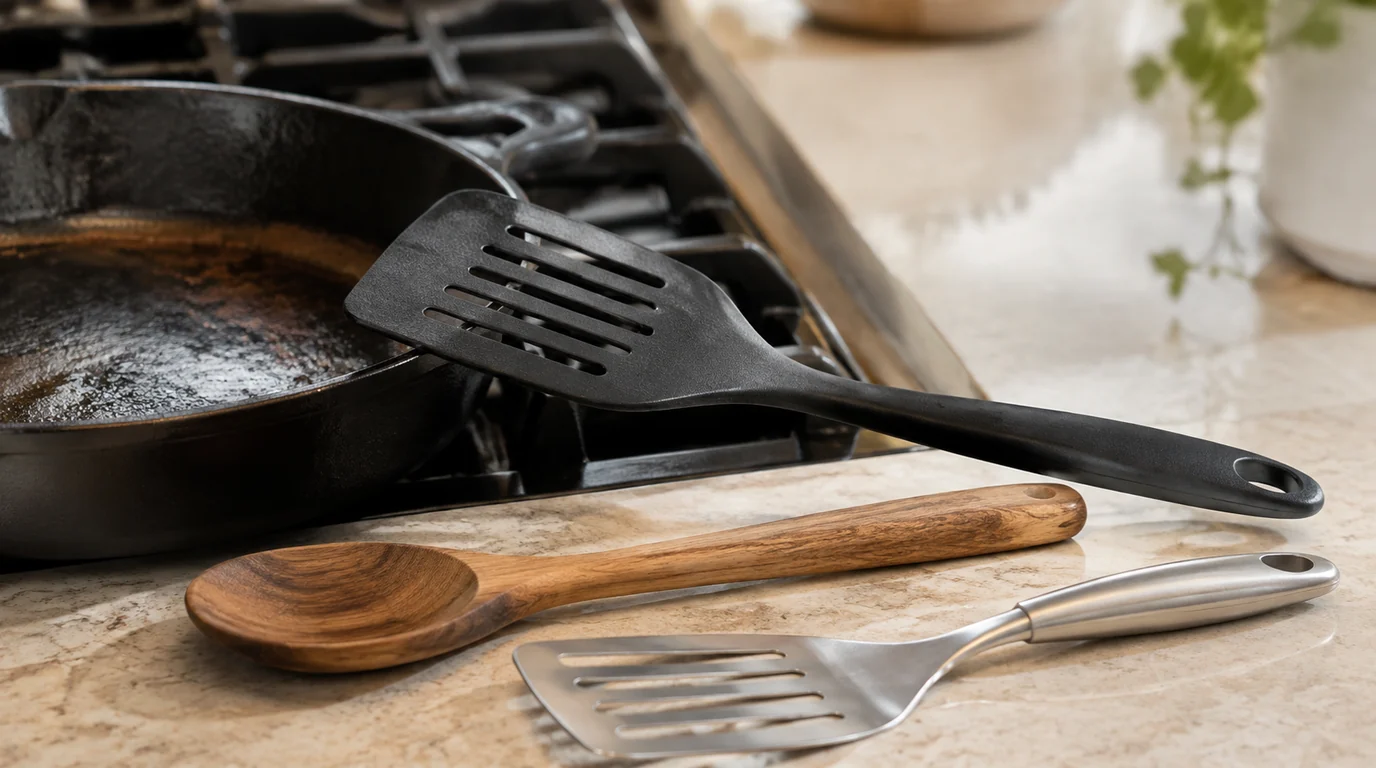
They are popular because they are less likely than bare metal to scratch a coated pan. The tradeoff is heated plastic contact. An intact nylon turner used briefly below its stated rating is a different situation from a spatula left against the pan wall until its edge shines, softens or warps.
Wood often supplies the same scratch protection for stirring. A documented heat-rated silicone tool may help when flexibility is required, though it still needs inspection and has its own polymer surface. Stainless steel is durable for uncoated stainless, carbon steel and cast iron but can damage nonstick coatings.
| Cooking job | Practical material | Why | Tradeoff |
|---|---|---|---|
| Stirring soup or sauce | Uncoated hardwood | No synthetic contact surface; gentle on pans | Hand-wash and dry promptly |
| Flipping on cast iron/stainless | Stainless steel | Durable at cooking temperatures | Can scratch coated cookware |
| Flexible scraping in nonstick | Rated silicone or wood | Protects the coating | Inspect silicone; wood is less flexible |
| Cold salad or serving | Any intact suitable tool | High-temperature migration is not the main condition | Still retire damaged surfaces |
| Deep frying | Stainless spider/tongs or rated wood | Avoids prolonged hot nylon contact | Match tool shape to the task |
Use the App
Identify the utensil before you replace it
Scan the moulded PA, nylon, PP or silicone mark, add the cooking temperature and visible condition, and compare a tool that performs the same job with less heated plastic contact.
When should you replace a nylon spatula?
- Melted or glossy edge: the tool has exceeded a useful heat boundary.
- Fuzzy, rough or deeply scratched surface: the food-contact face is physically degrading.
- Chips, cracks or missing corners: retire it rather than waiting to find the fragment in food.
- Persistent odour or staining after proper cleaning: replace when the surface can no longer be maintained hygienically.
- Unknown tool used at very high heat: move that job to steel or wood instead of guessing its rating.
Do not replace every intact tool at once if that creates cost and waste. Move the highest-heat, longest-contact job first, stop resting nylon in a pan, and keep intact tools for cold or brief-contact work. The broader cooking-utensil material guide and our nylon-utensil product assessment put those swaps in context.
What the MicroPlastics app checks
- Moulded material marks such as PA, nylon, PP and silicone.
- Cooking temperature, contact time and visible utensil condition.
- A wood, steel or silicone alternative that performs the same task.
- A modeled material-contact signal—not identification of molecules or particles released by your utensil.
Frequently Asked Questions
Is nylon considered plastic?
Are nylon cooking utensils safe?
Do nylon utensils release microplastics?
What temperature is too hot for nylon utensils?
Are nylon or silicone utensils better?
When should I throw away a nylon spatula?
Sources
- German Federal Institute for Risk Assessment (BfR) (2019). Polyamide Kitchen Utensils: Keep contact with hot food as brief as possible. BfR Opinion No. 036/2019.
- Abe Y, et al. (2016). Isolation and Quantification of Polyamide Cyclic Oligomers in Kitchen Utensils and Their Migration into Various Food Simulants. PLOS ONE.
- Canellas E, et al. (2021). The use of ion mobility time-of-flight mass spectrometry to assess the migration of polyamide 6 and polyamide 66 oligomers from kitchenware utensils to food. Food Chemistry.
- Kiralan S, Toptanci İ, Ramadan MF (2026). Aromatic amine migration from commonly used kitchen utensils marketed in Turkey: detection and quantification using LC-MS/MS. International Journal of Environmental Health Research.
- European Commission (2011). Commission Regulation (EU) No 10/2011 on plastic materials intended to come into contact with food. Official Journal of the European Union.
Your next product question
Start with your most-used spatula or cooking spoon.
Find the molded material mark, model and permitted use. Colour alone cannot identify the polymer or establish release during cooking.
Use the exact product name, model and label to check the information behind an assessment. A photo does not measure particles or personal health risk. The examples above are research subjects, not a verified app-coverage list.
Build a product-routine reading plan →Go deeper
Less-travelled research from our archive that follows directly from this page.
Related Research
Does Parchment Paper Have Plastic? Silicone Is the Key Detail
Most parchment is cellulose paper coated with cured silicone, not polyethylene film. The direct shedding evidence is limited, and plastic-coated freezer paper is a different product entirely.
Read moreThe Steel Ball Changes What a Plastic Shaker Bottle Releases
The first direct shaker-bottle study tested polypropylene, polycarbonate and Tritan. Every bottle shed; the steel ball increased abrasion; and the annual estimate is simultaneously 74,000–146,000 particles and only 42–72 micrograms of mass.
Read moreThe Cup Noodle Study Everyone Cites Never Counted the Particles
Instant noodle containers have one government safety assessment — Hong Kong, 2009 — and it cleared them on chemistry: styrene, heavy metals and total migration all inside the limits. It never counted particles, and nobody has since. Meanwhile the one fix that halves release in disposable cups, rinsing before use, is impossible when the food is already in the cup.
Read moreThe Slow Cooker Liner Is Not a Sandwich Bag
Liners are nylon rated to 400 °F, not polyethylene — the film is nowhere near its limit in a crock. But nylon 6 is made from caprolactam and nylon 66 is not, the manufacturer says only “a blend of nylon”, and that omission decides which migration question applies to dinner.
Read moreThe PFAS Left Microwave Popcorn Bags. The Plastic Film Did Not.
US manufacturers stopped selling grease-proofing PFAS for food packaging in February 2024, so the warning most articles still repeat is out of date — and the study everyone quotes runs on data from 2003–2014. But every bag still holds a metallized PET susceptor film that reaches about 450°F against the food.
Read morePFAS in Cooking Oil: When the Plastic Doesn't Come From the Bottle
A third-party test found PTFE — a fluoropolymer, and therefore a PFAS — suspended in an olive oil whose squeeze bottle is not made of PTFE. That mismatch points upstream at processing equipment rather than packaging. Plus the regulatory science on why fat extracts more from plastic than any other food.
Read more