Do Plastic Salt Grinders Shed Microplastics? A 2026 Test Says Yes

Last reviewed: by the MicroPlastics Research Desk. Submit a correction or see our editorial standards.
Quick Answer
Got a different brand in the cupboard? Review its packaging inputs and Product Contact Signal, then compare a lower-contact option.
Scan my product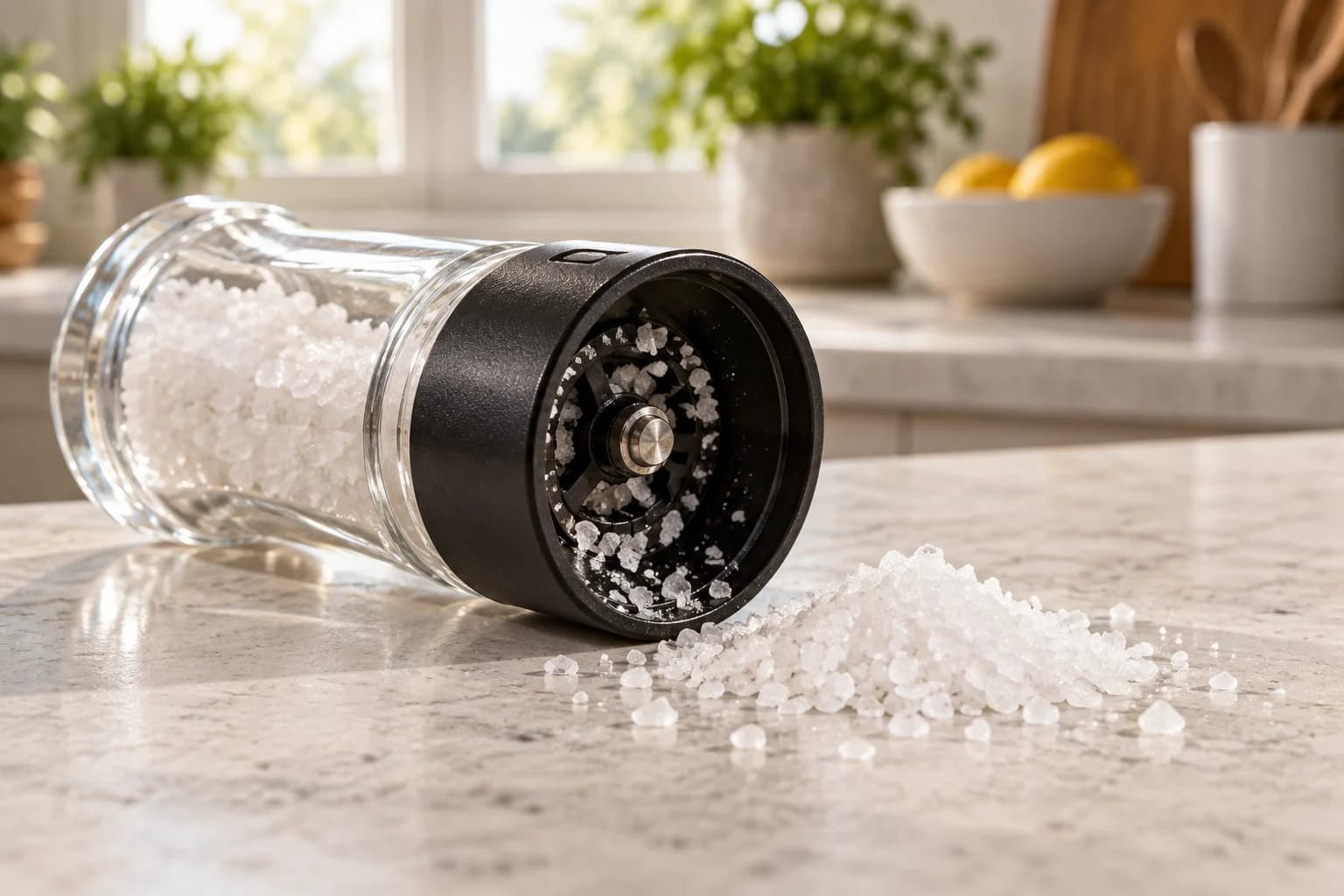
Key Takeaways
- The grinding mechanism was the source: most identified particles matched the PET or polycarbonate head.
- The three tested products differed by more than an order of magnitude, so “plastic grinder” is not one exposure number.
- The two PET designs released an estimated 1,091 and 2,420 particles per 50 g; the PC design released 15,743.
- Detected PET fragments averaged about 50–55 µm in the two PET products.
- The experiment measured particle release, not illness or a safe-versus-unsafe intake threshold.
- Best swap: loose salt plus a refillable ceramic- or steel-burr grinder.
What the 2026 grinder test measured
- particles from PET grinder A
- 1,091
- estimated release while grinding 50 g of salt; ±239, n=3 grinder heads
- Yang et al. 2026
- particles from PET grinder B
- 2,420
- estimated release per 50 g; variability was wide at ±1,805
- Yang et al. 2026
- particles from the PC grinder
- 15,743
- estimated release per 50 g; ±1,858 under the study protocol
- Yang et al. 2026
- mean PET-fragment size
- ~50–55 µm
- for the two PET grinder products; the method did not count every smaller particle
- Yang et al. 2026
Why a salt grinder creates plastic wear
A disposable grinder forces hard, angular salt crystals through teeth while two parts of the mechanism rotate against one another. Salt is the product, but it is also an abrasive. Each twist adds compression, scraping and friction at the exact point where the food exits.
That makes a grinder different from passive plastic packaging. The question is not merely whether salt touched a polymer jar. It is whether a plastic cutting surface was deliberately stressed while the salt moved through it. The new study isolates that mechanism more convincingly than a finished-food survey can.
What did the researchers actually test?
Yang and colleagues bought salt grinders from three local retailers. Products A and B used PET grinding heads; product C used polycarbonate. For each retail product, three grinder heads were tested while processing 50 g of salt. The researchers also ground salt with a ceramic mortar as a control, ran procedural blanks and checked particle recovery.
Suspected fragments were collected on filters and a subsample was identified with optical photothermal infrared spectroscopy. Most particles from the commercial grinders matched the polymer in the head. The procedural blanks contained zero, one and zero particles across the three test groups, making ordinary laboratory fallout an unlikely explanation for the large grinder counts.
| Tested design | Grinding-head material | Estimated particles / 50 g salt | What it means |
|---|---|---|---|
| Retailer A | PET | 1,091 ± 239 | Direct wear was measurable even in the lowest-release design |
| Retailer B | PET | 2,420 ± 1,805 | Large variation between the three heads limits precision |
| Retailer C | Polycarbonate | 15,743 ± 1,858 | Material and construction can change release by over an order of magnitude |
| Control | Ceramic mortar | Minor salt background | Supports the grinder—not the salt alone—as the added source |
Does this mean every plastic grinder releases 15,743 particles?
No. That number belongs to one polycarbonate product under one protocol. The study tested three commercial designs, not every salt brand, burr geometry or polymer formulation on the market. Even the two PET heads produced different averages, and product B had a large standard deviation.
The right conclusion is mechanistic: plastic grinder heads can add particles during normal grinding, and design matters greatly. The wrong conclusion is that the largest result can be pasted onto every disposable mill or converted into an exact particles-per-meal number. A 50 g test represents many servings, and households differ in grind size and the amount of salt used.
Is pre-ground salt better?
Pre-ground salt removes this particular point-of-use abrasion. It is not guaranteed microplastic-free: salt can acquire environmental particles before harvest and additional contamination during processing, transport and packaging. But a plain paperboard box or refill pouch feeding a durable non-plastic grinder avoids repeatedly machining food through a disposable plastic head.
Source still matters. Our broader guide to microplastics in salt compares sea, lake and mined salts. The new grinder evidence adds a separate layer: even relatively clean salt can pick up particles at the final turn of the wrist.
Use the App
Scan the grinder, not only the salt label
Capture the grinder-head material, refillability, visible burr wear and how often you use it. The app separates contamination already in salt from abrasion created at the point of use.
Scan my salt grinderWhat should you replace it with?
- Choose a ceramic-burr refillable grinder. Ceramic is hard, corrosion-resistant and was the study's low-background control material.
- Choose a stainless-steel mechanism. Verify that the burrs themselves are metal; a metal-look collar can still hide plastic teeth.
- Buy loose or pre-ground salt. This avoids paying for a new plastic cutting assembly with every container.
- Retire worn mechanisms. Rough motion, visible chips, cracked teeth or black dust are reasons to stop using the grinder.
- Prioritize the repeated habit. A grinder used at every meal is a more useful target than a disposable mill opened once on vacation.
Is this a health emergency?
The experiment shows exposure, not disease. It did not feed grinder particles to people or define a dose that causes harm. The FDA says current evidence does not demonstrate that micro- and nanoplastic levels detected in foods pose a human-health risk. EFSA likewise says dietary exposure and health-effect data remain limited and is preparing a full scientific opinion for 2027.
That uncertainty is not a reason to invent reassurance or panic. It is a reason to make easy source-control changes when the trade-off is trivial. A refillable ceramic or steel mechanism performs the same kitchen job and removes a directly measured wear source.
Continue the September 2026 food-contact investigations with the new evidence on microwaving food in its original plastic wrapper and the 20-sample survey of microplastics in plastic-wrapped candies.
What the MicroPlastics app checks
- The actual burr or grinding-head material—not the decorative outer shell.
- Disposable versus refillable design and frequency of use.
- Visible wear, rough rotation and salt crystal size.
- Lower-contact replacements without pretending any salt is particle-free.
Frequently Asked Questions
Do plastic salt grinders release microplastics?
How many microplastics come from a salt grinder?
Is a ceramic salt grinder better?
Is pre-ground salt microplastic-free?
Should I throw away my plastic grinder?
Sources
- Yang C, Li K, Gowen A, Xu J-L (2026). Investigating microplastic release from plastic grinder heads during salt grinding. Science of the Total Environment.
- European Food Safety Authority (2025). Literature review on micro- and nanoplastic release from food contact materials during their use. EFSA Supporting Publications.
- European Food Safety Authority (2026). Microplastics and nanoplastics in food. EFSA.
- US Food and Drug Administration (2026). Microplastics and Nanoplastics in Foods. FDA.
Audit your whole pantry, not just the 5 foods in this article
The app keeps a running scan history for every packaged food you own, every brand swap you make, and every reformulation a brand quietly pushes. The article is a snapshot. The app is the trend line.
Download on the App Store- Free on iOS
- 3 free scans
- No sign-up
- Result in seconds
“Really cool to scan stuff around the kitchen and see what's actually in it. The swaps it suggests are realistic.” App Store review · 5.0★
Android · early access
Get the launch email the day Android opens.
One email. No spam. We send when the Android app is in the Play Store, and never again unless you opt in.
Related Research
Are Compostable Coffee Cups Plastic? PLA Is Still a Polymer Lining
Many compostable paper cups use PLA plastic lining. A new study found about 12× higher released particle mass than PE cups, while earlier nanoplastic counts found the opposite—why both results can be true.
Read moreAre Nylon Cooking Utensils Plastic? Yes—Heat Is the Real Test
Nylon is polyamide plastic. Studies from 2016–2026 measured oligomers and aromatic amines rather than one universal particle count; heat, contact time and visible damage decide the practical response.
Read moreDoes Parchment Paper Have Plastic? Silicone Is the Key Detail
Most parchment is cellulose paper coated with cured silicone, not polyethylene film. The direct shedding evidence is limited, and plastic-coated freezer paper is a different product entirely.
Read moreThe Steel Ball Changes What a Plastic Shaker Bottle Releases
The first direct shaker-bottle study tested polypropylene, polycarbonate and Tritan. Every bottle shed; the steel ball increased abrasion; and the annual estimate is simultaneously 74,000–146,000 particles and only 42–72 micrograms of mass.
Read moreThe Cup Noodle Study Everyone Cites Never Counted the Particles
Instant noodle containers have one government safety assessment — Hong Kong, 2009 — and it cleared them on chemistry: styrene, heavy metals and total migration all inside the limits. It never counted particles, and nobody has since. Meanwhile the one fix that halves release in disposable cups, rinsing before use, is impossible when the food is already in the cup.
Read moreThe Slow Cooker Liner Is Not a Sandwich Bag
Liners are nylon rated to 400 °F, not polyethylene — the film is nowhere near its limit in a crock. But nylon 6 is made from caprolactam and nylon 66 is not, the manufacturer says only “a blend of nylon”, and that omission decides which migration question applies to dinner.
Read more