Microplastics in Salt: Should You Switch Brands?
Last reviewed: by the MicroPlastics Research Desk. Submit a correction or see our editorial standards.
Quick Answer
Got a different brand in the cupboard? Review its packaging inputs and Product Contact Signal, then compare a lower-contact option.
Scan my product
Key Takeaways
- Sea salt: up to 600 microplastic particles per kg, highest among dietary salts.
- Rock salt and mined Himalayan salt: lowest, predate modern plastic pollution.
- Plastic content mirrors source ocean. Mediterranean and Asian sea salts test highest.
- 2026 context: salt is high in concentration but low in contribution, you eat only a few grams a day, so switching salt is a cheap swap but a small lever.
The Salt on Your Table May Contain Plastic
Salt is one of the most universal ingredients in the human diet. We sprinkle it on eggs in the morning, season soups and sauces at dinner, and consume it in virtually every packaged food on grocery store shelves. It is so fundamental that we rarely think about what else might be hiding in those familiar white crystals. But a growing body of research has revealed an unsettling truth: the salt you use every day very likely contains microplastics.
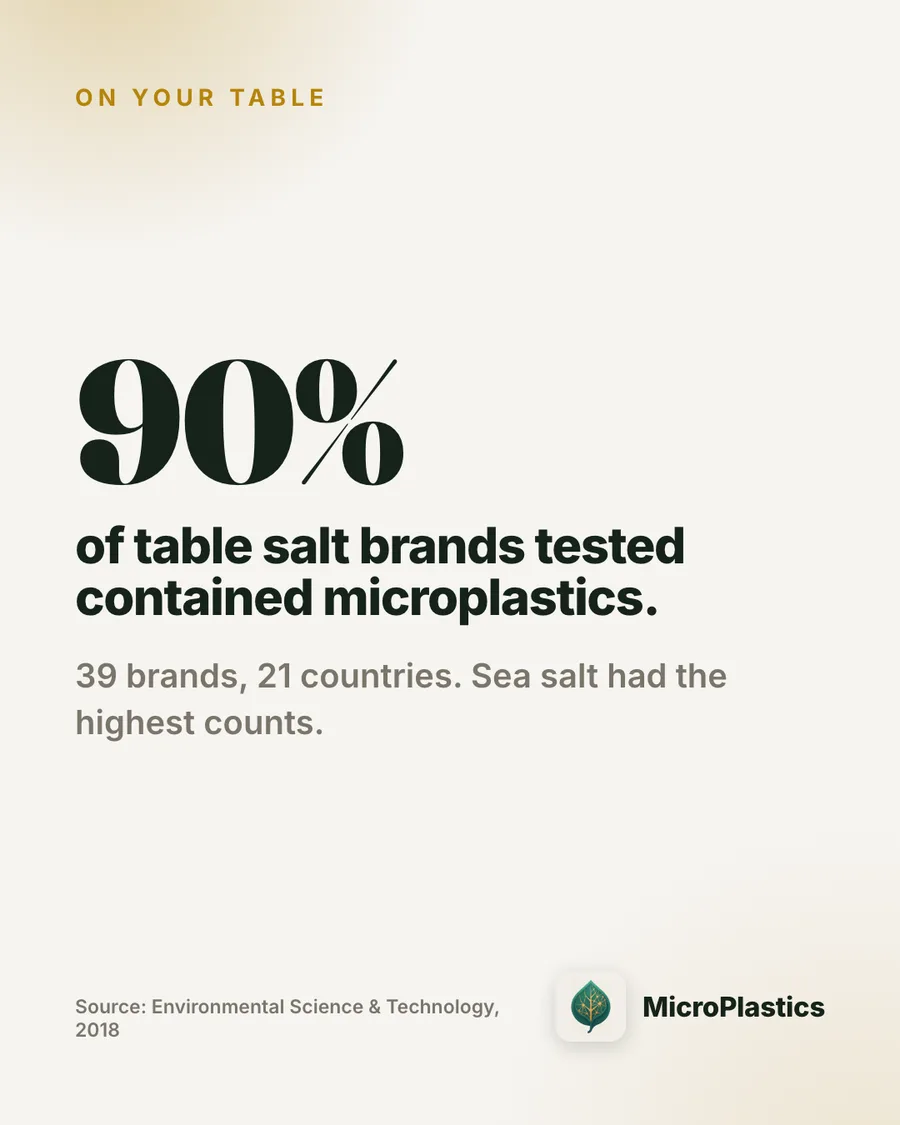
A landmark global study published in Environmental Science & Technology found that 90% of sea salt brands tested worldwide contain microplastics. The researchers analyzed 39 salt brands from 21 countries across six continents, and the results were striking. Only three brands were entirely free of microplastic contamination. That means the vast majority of salt consumed around the world carries tiny fragments of plastic directly into our bodies with every meal.
If you have been reading about microplastics in other parts of your diet, this may not come as a complete surprise. Our guide on microplastics in food covers the broader picture of how plastic particles have infiltrated everything from seafood to rice. But salt deserves its own closer look because of how universally and frequently it is consumed, and because the type of salt you choose can make a meaningful difference in your exposure.
2026 Context: High Concentration, Small Total Contribution
Salt reliably appears near the top of any "most contaminated foods" list, and per gram that ranking is deserved -- sea salt is literally evaporated seawater, so whatever was suspended in the water ends up in the crystal.
A 2026 University of Amsterdam study in the Journal of Hazardous Materials put that in proportion. Measuring across 13 food categories including salt, sugar, honey, grains, produce, meat, shellfish and beverages, it found that fruit, vegetables and grains together contribute roughly 99.5% of daily microplastic particle intake. Salt did not dominate, for a simple reason: you eat a few grams of it a day.
This is the distinction that most coverage collapses. Concentration (particles per gram) and contribution (particles per day from that food) are different questions, and salt scores high on the first while scoring low on the second. A food eaten by the gram cannot outweigh foods eaten by the hundreds of grams, however contaminated it is.
The practical consequence is reassuring: switching salt is one of the cheapest swaps available -- rock salt and well-sourced mined salt avoid the marine contamination route entirely -- but it is a small lever, and it should not be mistaken for a meaningful reduction in total exposure.
What the Global Salt Study Found
The most comprehensive study on microplastics in salt to date was led by researchers from South Korea and Greenpeace East Asia. They collected salt samples from across the globe and used micro-Fourier transform infrared spectroscopy to identify and count plastic particles in each sample. The findings painted a clear picture of widespread contamination.
Out of the 39 brands tested, 36 contained microplastics. The density of plastic particles ranged dramatically, from zero in the cleanest samples to over 1,674 microplastic particles per kilogram in the most contaminated sea salt brands. The types of plastic identified included polyethylene (the most common plastic in the world, used in bags and packaging), polypropylene (found in bottle caps and food containers), and polyethylene terephthalate (PET, used in water bottles and food packaging). These are the same plastics that dominate ocean pollution, and their presence in salt is a direct consequence of the plastic waste crisis in our waterways.
The study also found a strong correlation between the level of microplastic contamination in salt and the level of plastic pollution in the waters where the salt was harvested. In other words, the more polluted the ocean or lake, the more microplastics end up in the salt produced from it.
Sea Salt vs Rock Salt vs Himalayan Salt: Which Is Safest?
Salts differ widely in microplastic contamination. The source of the salt and the method used to produce it have a profound impact on how many plastic particles end up in the final product.
Sea Salt: The Highest Microplastic Levels
Sea salt consistently shows the highest microplastic contamination of any salt type. Studies have detected anywhere from 0 to 1,674 microplastic particles per kilogram of sea salt, with most brands falling in the range of 600 to 1,800 particles per kilogram. Some Asian sea salt brands have tested at concentrations exceeding 13,000 particles per kilogram in separate analyses. This makes sense given that sea salt is produced by evaporating seawater in open pans or shallow pools. As the water evaporates, every contaminant in the water -- including microplastics -- becomes concentrated in the remaining salt crystals.
Lake Salt: A Middle Ground
Salt harvested from inland lakes shows moderate contamination levels, averaging around 350 microplastic particles per kilogram. While lower than sea salt, lake salt still reflects the microplastic pollution present in freshwater systems. Lakes receive plastic contamination from rivers, stormwater runoff, wastewater discharge, and atmospheric deposition. The level of contamination varies significantly depending on how industrialized and populated the surrounding area is.
Rock Salt and Himalayan Salt: The Cleanest Options
Rock salt, including Himalayan pink salt, consistently shows the lowest microplastic contamination. Studies have found rock salt to contain roughly 50 to 280 microplastic particles per kilogram -- significantly less than sea salt. The reason is straightforward: rock salt is mined from ancient underground deposits that formed millions of years ago, long before plastic was ever invented. These deep geological formations have had virtually no exposure to modern plastic pollution. Himalayan salt, mined from the Khewra Salt Mine in Pakistan, comes from deposits that are approximately 250 million years old and is among the least contaminated salt options available.
That said, even rock salt is not completely free of microplastics. Small amounts can be introduced during the mining, processing, and packaging stages. But the baseline contamination from the salt deposit itself is dramatically lower than what is found in ocean-derived products.
Geographic Differences: Why Location Matters
Where your salt comes from matters almost as much as what type it is. The global study revealed stark geographic differences in contamination levels, and these differences map closely to regional ocean pollution patterns.
Asian sea salts showed the highest microplastic concentrations, particularly those from Indonesia, the Philippines, and China. This aligns with data showing that Asian rivers and coastal waters receive some of the highest volumes of plastic waste in the world. Indonesia alone is estimated to discharge over 600,000 metric tons of plastic into the ocean annually. Salt produced by evaporating these heavily polluted coastal waters naturally concentrates the plastic particles present in them.
European and North American sea salts showed lower levels on average, though contamination was still present in the vast majority of samples. Salt from remote oceanic regions, such as certain brands harvested from less industrialized coastlines, tended to have the lowest sea salt contamination levels -- but even these were not zero.
The takeaway is clear: if you do prefer sea salt, sourcing it from regions with cleaner ocean water can reduce your exposure. However, no sea salt on the market can guarantee zero microplastic content given the global scale of ocean plastic pollution.
How Microplastics Get Into Salt
Understanding the contamination pathway helps explain why sea salt is so much more affected than mined salt. The process is actually quite straightforward.
Every year, an estimated 8 to 12 million metric tons of plastic waste enter the world's oceans. Over time, sunlight, wave action, and microbial activity break this plastic down into increasingly smaller fragments. These microplastic particles, measuring less than 5 millimeters in diameter, become suspended in seawater at every depth and in every ocean basin that has been studied.
When sea salt is produced, seawater is pumped into large, shallow evaporation ponds. As the sun and wind evaporate the water over a period of weeks or months, the salt crystallizes and is harvested. But the microplastics do not evaporate. They become trapped within and between the salt crystals, concentrating as the water volume decreases. The result is a product that directly reflects the microplastic burden of the source water.
Additional contamination can occur during processing and packaging. Salt that is ground, sieved, or packaged using plastic equipment and containers may pick up extra particles. A 2026 controlled study now gives that last contact point its own measurement: see how many particles three plastic salt-grinder heads released while grinding 50 g of salt. This is why the contamination levels in rock salt, while much lower than sea salt, are not zero -- the mining and processing chain introduces some degree of plastic contact.
Health Impact: How Much Microplastic Are You Getting From Salt?
To put the numbers in perspective, let us consider how much salt the average person actually consumes and what that means for microplastic intake.
The average global salt intake is approximately 10 grams per day, though health organizations recommend no more than 5 to 6 grams. At 10 grams per day, if you are using a typical sea salt with around 600 microplastic particles per kilogram, you would ingest roughly 6 microplastic particles per day from salt alone. Over the course of a year, that adds up to approximately 2,190 particles. If you happen to use one of the more contaminated brands with 1,800 particles per kilogram, your annual intake from salt alone jumps to over 6,500 particles.
On its own, that number might sound alarming -- or it might sound manageable. The context matters. Researchers estimate that the average person ingests between 74,000 and 121,000 microplastic particles per year from all dietary sources combined, plus an additional significant amount through inhalation. Salt contributes a relatively small fraction of your total microplastic exposure compared to sources like bottled water, seafood, and airborne particles. However, because salt consumption is so consistent and lifelong, even a small daily dose accumulates significantly over decades.
Is the Amount Dangerous?
The honest answer is that scientists are still working to determine the precise health effects of chronic low-level microplastic ingestion. What we do know is that microplastic particles can carry harmful chemical additives such as phthalates, bisphenol A, and flame retardants. These chemicals can leach from the plastic surface into body tissues after ingestion. Microplastics have also been shown to act as carriers for heavy metals and persistent organic pollutants that adsorb onto their surfaces in contaminated water.
Laboratory studies have demonstrated that microplastics can cause gut inflammation, disrupt the gut microbiome, trigger oxidative stress, and interfere with endocrine function. Nanoplastics -- the smallest particles -- are capable of crossing cell membranes and have been detected in human blood, lung tissue, and placental tissue.
While the microplastic dose from salt alone is unlikely to cause acute harm, the precautionary principle applies. Every source of microplastic exposure adds to your cumulative body burden. Reducing intake where it is easy to do so -- and switching salt brands is one of the easiest changes you can make -- is a sensible step toward lowering your overall exposure. For a broader look at minimizing microplastics across your entire lifestyle, see our comprehensive guide on how to avoid microplastics.
Best Salt Choices for Minimizing Microplastics
Based on the available research, here are the best options ranked from lowest to highest typical microplastic contamination:
- Himalayan pink salt -- Mined from ancient geological deposits with minimal exposure to modern pollution. Consistently among the lowest contamination levels tested. Choose brands that package in glass jars or paper bags rather than plastic.
- Mined rock salt -- Similar to Himalayan salt in that it comes from underground deposits. Look for brands that are minimally processed and avoid those packaged in plastic grinder mechanisms.
- Refined table salt -- While often sourced from sea salt or rock salt, the refining process can remove some microplastic particles through filtration and washing. However, the degree of removal varies by manufacturer and is rarely disclosed.
- Sea salt from cleaner regions -- If you strongly prefer sea salt for its flavor and mineral content, choose brands sourced from less polluted waters. European Atlantic sea salts and those from remote Pacific islands tend to have lower contamination than Asian coastal varieties.
Regardless of which salt you choose, storing it in glass containers and choosing a refillable ceramic- or steel-burr grinder removes the directly measured plastic-abrasion step.
How Much Salt Should You Be Eating?
Setting aside the microplastics question, it is worth noting that most people consume far more salt than is recommended for good health. The World Health Organization recommends a maximum of 5 grams of salt per day (about one teaspoon), while the American Heart Association suggests an even lower ideal limit of 3.75 grams per day (1,500 milligrams of sodium). The global average intake is roughly double the WHO recommendation.
Reducing your overall salt intake has a dual benefit in the context of microplastics. Not only does lower salt consumption reduce your risk of high blood pressure, heart disease, and stroke, but it also directly reduces the number of microplastic particles you ingest from salt. If you cut your salt intake from 10 grams to the recommended 5 grams per day, you automatically halve your salt-related microplastic exposure.
Most dietary salt does not come from the shaker on your table -- it comes from processed and packaged foods. Cooking more meals at home with fresh ingredients and seasoning with herbs, spices, citrus, and vinegar instead of reaching for the salt shaker are effective strategies for reducing both sodium and microplastic intake simultaneously.
How the MicroPlastics App Helps You Choose Safer Salt
With so many salt brands and types on the market, figuring out which ones carry the lowest microplastic risk can be overwhelming. That is exactly the kind of problem the MicroPlastics app was designed to solve.
The app lets you scan any salt product using your phone's camera or by searching the product name. Within seconds, you receive a microplastic exposure score based on the salt type, source region, packaging material, and the latest research data. The scoring system accounts for whether the product is sea salt, rock salt, or refined, and factors in the geographic origin and packaging type to give you a clear, actionable risk assessment.
Beyond individual product scans, the app suggests lower-risk alternatives in the same product category. If you scan a sea salt and it scores high for microplastic risk, the app will recommend specific Himalayan or rock salt options that score lower. This makes it practical to make better choices right at the point of purchase, without needing to memorize research studies or brand comparisons.
The app also tracks your cumulative microplastic exposure over time, so you can see how switching salt brands -- along with other changes in your diet and product choices -- reduces your overall intake. It is free to download with 3 scans included, and subscription plans unlock unlimited scanning along with detailed breakdowns and personalized recommendations.
The Bottom Line
Microplastics in salt are a real and well-documented phenomenon. The global research is clear: 90% of sea salt brands contain microplastics, with contamination levels varying widely based on salt type and geographic origin. Sea salt carries the highest load, lake salt falls in the middle, and mined rock salt and Himalayan salt are the cleanest options available.
While the microplastic dose from salt alone represents a small fraction of your total daily exposure, it is one of the easiest sources to reduce. Simply switching from sea salt to Himalayan or rock salt, reducing your overall salt intake to healthier levels, and storing salt in glass rather than plastic containers are practical changes that anyone can make today.
Combined with other dietary adjustments -- filtering your water, choosing glass-packaged products, and being mindful of highly contaminated food categories -- switching your salt is one piece of a larger strategy for reducing your body's microplastic burden. Every small change adds up, and the research consistently shows that informed consumer choices can make a meaningful difference.
Ready to find out what is in your salt? Download the MicroPlastics app and scan the salt brands in your kitchen. Knowledge is the first step toward a lower-plastic life.
Related Articles
- Microplastics in Food: Which Foods Contain the Most?
- How to Avoid Microplastics: The Complete 2025 Guide
- Microplastics in Bottled Water: Why You Should Switch to Filtered Tap
- The Health Effects of Microplastics: What Science Says
What the MicroPlastics app checks
- Packaging material. PET, HDPE, PP, PS, multi-layer, glass, aluminum.
- Container condition from the photo, scratches, dents, fade.
- Product category, fresh, packaged, canned, frozen, takeout.
- Use-context flags you log, microwave, heat, reuse, time stored.
- Cited research behind the 0–100 risk score.
Use the App
Use the app as a grocery-store second opinion
Scan the product, check the packaging score, compare alternatives. The app weighs material, condition, brand, and the cited research.
Scan groceries in the appFrequently Asked Questions
Does sea salt contain microplastics?
Is Himalayan salt safer than sea salt?
Does iodized table salt contain microplastics?
Should I switch from sea salt to rock salt?
Sources
- University of Amsterdam research group (2026). Microplastic intake across 13 food categories in the human diet. Journal of Hazardous Materials.
- Hussain KA, Romanova S, Okur I, et al. (2023). Assessing the Release of Microplastics and Nanoplastics from Plastic Containers and Reusable Food Pouches. Environmental Science & Technology.
- Cox KD, Covernton GA, Davies HL, et al. (2019). Human Consumption of Microplastics. Environmental Science & Technology.
- European Food Safety Authority (2016). Presence of microplastics and nanoplastics in food, with particular focus on seafood. EFSA Journal.
- Karami A, Golieskardi A, Choo CK, et al. (2017). The presence of microplastics in commercial salts from different countries. Scientific Reports.
- WHO (2022). Dietary and inhalation exposure to nano- and microplastic particles. World Health Organization.
Audit your whole pantry, not just the 5 foods in this article
The app keeps a running scan history for every packaged food you own, every brand swap you make, and every reformulation a brand quietly pushes. The article is a snapshot. The app is the trend line.
Download on the App Store- Free on iOS
- 3 free scans
- No sign-up
- Result in seconds
“Really cool to scan stuff around the kitchen and see what's actually in it. The swaps it suggests are realistic.” App Store review · 5.0★
Android · early access
Get the launch email the day Android opens.
One email. No spam. We send when the Android app is in the Play Store, and never again unless you opt in.
Related Research
Microplastics in Fruits and Vegetables: How Produce Gets Contaminated
A 2026 Amsterdam study found fruit, vegetables and grains supply ~99.5% of daily microplastic particles, ahead of seafood. Why that is, and what it does and does not mean.
Read moreMicroplastics in Fast Food: What Recent Studies Found
Processed food consistently tests among the highest per gram. The cause is cumulative plastic contact across the chain, and the fix is at the hot final step.
Read moreMicroplastics in Milk and Dairy Products: A Complete Guide
Microplastics are in milk, cheese, yogurt and ice cream, but packaging and heat drive the exposure far more than the dairy itself. The lowest-contact formats, ranked.
Read moreMicroplastics in Meat and Chicken: From Farm to Fork
Meat's microplastic exposure comes from the processing and packaging chain rather than the animal. The 2026 ranking, and the habits that actually cut it.
Read moreMicroplastics in Beer and Wine: What Every Drinker Should Know
Beer in glass tests near 100 particles per litre while wine stays low, and the difference is the closure. Why painted crown caps, not the bottle, drive contamination.
Read moreMicroplastics in Soda and Energy Drinks: What Tests Reveal
A French food-safety study found glass-bottled soda carried 5-50x more microplastics than plastic, traced to scratched paint on the caps. The counterintuitive result explained.
Read more