Are Oven Bags Safe for Turkey? The Question Isn’t Microplastics
Last reviewed: by the MicroPlastics Research Desk. Submit a correction or see our editorial standards.
Quick Answer
Got a different brand in the cupboard? Review its packaging inputs and Product Contact Signal, then compare a lower-contact option.
Scan my product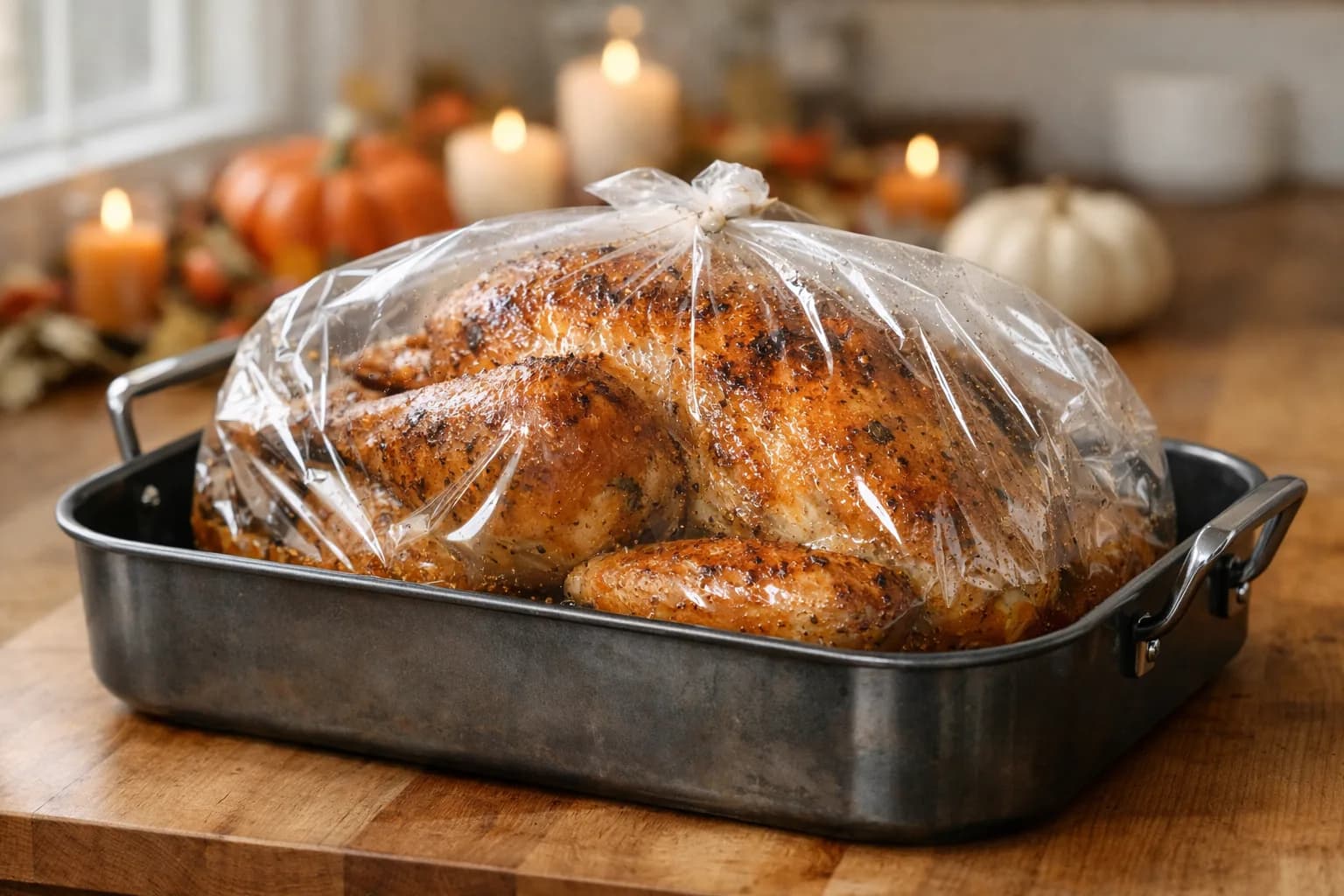
Key Takeaways
- The material is nylon. Reynolds says “heat resistant nylon”, BPA-free, safe to 400 °F. It does not say which nylon.
- The migrants are molecules, not particles. Hot nylon releases caprolactam and cyclic oligomers, and fatty food pulls them out best.
- Roast chicken, 1998: 7.48 mg/kg of nylon oligomers migrated during a 2-hour roast at 200 °C. The authors judged it no hazard.
- The benchmark: Germany’s BfR treats 5 mg/kg of food as acceptable for these oligomers, and 10 of 33 nylon kitchen utensils it reviewed went over.
- New in 2026: heated nylon-bag leachate immobilised water fleas; PET bags released less material and showed no detectable toxicity.
- USDA prefers a commercial oven bag to a paper bag, which it says can ignite and emit toxic fumes.
- The zero-film option: a lidded roasting pan or a loose foil tent.
What the oven-bag evidence actually measured
- nylon oligomers in roast chicken
- 7.48 mg/kg
- bag of nylon 6,6 with some nylon 6, 200 °C for 2 h; 16% of the bag’s non-volatile compounds
- Gramshaw & Soto-Valdez 1998
- acceptable group value for cyclic nylon oligomers
- 5 mg/kg
- BfR recommendation for nylon kitchen utensils, not a legal limit; no lifelong studies exist
- BfR Opinion 036/2019
- Reynolds’ maximum
- 400 °F
- the FDA’s listed melting range for nylon 6 starts at 392 °F; nylon 66 melts at 475–495 °F
- Reynolds; 21 CFR 177.1500
- toxicity from PET bags in 2026 test
- PET: none detected
- nylon bags heated to cooking temperatures immobilised Daphnia; PET released substantially less
- Ekvall et al. 2026, Chemosphere
What is an oven bag made of?
In the US, almost everyone means Reynolds Kitchens Oven Bags. Reynolds answers the question directly: they are made of “a heat resistant nylon that is FDA-compliant for cooking”. The company also labels them BPA-free and rates them to 400 °F (200 °C). It does not say which nylon. That matters, because nylon 6 and nylon 66 are made from different starting chemicals, and the FDA’s own table lists different melting ranges for them: 392–446 °F for nylon 6 and 475–495 °F for nylon 66. The roasting bags analysed in 1990s UK studies were nylon 66 with some nylon 6 mixed in.
Nylon is used because it survives an oven; the polyethylene in a sandwich bag would not. The other heat-proof option is PET polyester, which the FDA separately authorises for oven cooking above 250 °F. PET roasting bags are common in Europe. If you want to know which one you have, the box usually says, and “polyester” or “PET” is the answer you want. For Reynolds’ slow-cooker liners, which are also nylon, see our slow-cooker liner audit.
What does a nylon oven bag release into a turkey?
Mostly small molecules left over from making the plastic. Nylon 6 is built from caprolactam, which the EU limits at 15 mg per kg of food. Both nylon 6 and nylon 66 also contain cyclic oligomers, short rings of the polymer that dissolve out when hot and oily food sits against the film. The measurements are old, but they are specific:
- 1997: Leeds researchers found 5.0–35.5 mg of caprolactam per bag. When they heated olive oil in the bag at 175 °C for an hour, 19.2 mg of non-volatile compounds per bag moved into the oil. That was 41.8% of what they measured in the plastic.
- 1995: the FDA measured 15.5 µg/g of nylon 6/66 oligomers migrating into oil from an oven baking bag after 30 minutes at 176 °C. That was 43% of the oligomers in the bag.
- 1998: a whole chicken roasted in a nylon bag at 200 °C for 2 hours absorbed 7.48 mg/kg of seven cyclic monomers and oligomers, or 8.26 mg per bag. The authors concluded the transfer was not a hazard.
The modern benchmark came from Germany in 2019. The Federal Institute for Risk Assessment (BfR) judged 5 mg/kg of food to be a toxicologically acceptable group value for cyclic nylon oligomers. It noted that high doses affect the liver and thyroid in animals, and that there are no studies of lifelong intake. When German authorities tested 33 nylon kitchen utensils, 10 went over it. BfR’s advice is to keep hot nylon’s contact with food brief, especially above 70 °C.
So the 1998 chicken is in the same range as the German benchmark and above it. That is not the same as failing it. The benchmark was written for utensils, it counts a slightly different set of compounds, and the bags were made three decades ago. Nobody has repeated the measurement with today’s bags, or with a turkey.
What did the 2026 Lund study find?
In July 2026, a Lund University team led by Tommy Cedervall published the first toxicity test of what oven bags release. They heated nylon and PET bags and tested the resulting liquids on Daphnia magna, a water flea that is a standard organism in toxicity testing. Liquid from bags kept at room temperature had no significant effect. Material released at cooking temperatures caused significant immobilisation.
The key result came when the team separated the liquid by size. The toxicity was mainly in the small-molecule fraction, not the larger particles. PET bags released “substantially less material” and showed “no detectable toxicity under the tested conditions”. A 2025 master’s thesis from the same lab reached the same split: the bags shed particles when baked, boiled or blended, but the harm to test organisms came from dissolved molecules.
Keep this in proportion. A water flea is an environmental model, not a stand-in for a person, and the published abstract does not name the molecules or the bag brands. What it does show is that the concern is chemical, not microplastic. It also backs up BfR’s older advice that hotter means more.
Does the fat in a turkey matter?
Yes. Oil pulls nylon oligomers out of film far better than water does: in the 1990s tests, 42–43% of the measurable oligomers moved into hot oil within an hour. Roast turkey skin is about 39% fat by weight, according to USDA nutrient data, and it presses against the bag for the whole cook. Temperature probes show the food-packaging surface in a conventional oven reaching 92–194 °C over long periods.
A turkey has two things in its favour: Reynolds’ 350 °F is cooler than the 200 °C chicken test, and a big bird has less bag surface per kilogram. Against it, the cook runs 2–3 hours. Nobody has measured a turkey, so any “oligomers per serving” figure is invented.
| Method | What touches the turkey | What the evidence says | Verdict |
|---|---|---|---|
| Lidded roasting pan | Steel or enamel; no film | No plastic migration question | Best swap |
| Open roast with loose foil tent | Brief foil contact on the breast | Aluminium moves mainly into acidic or salty food over long contact | Good; keep acidic glazes off foil |
| PET (polyester) roasting bag | PET film | Much lower release; no detectable toxicity in the 2026 test | Better bag, if you can find one |
| Nylon oven bag (e.g. Reynolds) | Nylon film against fatty skin for 2–3 h | Oligomer migration measured; heated leachate toxic to Daphnia | Acceptable once a year; follow directions |
| Brown paper grocery bag | Recycled paper, ink and glue | USDA: fire risk and toxic fumes | Never |
Use the App
Check the roasting bag, the liner and the brine bag
Scan the box before the big cook. The app identifies nylon, PET and polyethylene films, flags heat and fat contact, and suggests a no-film swap. It won’t invent a migration number the research never measured.
Scan my oven bagsWhat about BPA and other chemicals?
Reynolds states its bags are BPA-free. The one oven-bag BPA study, of unnamed Turkish brands, found up to 63.78 ng/g in chicken and judged it no risk; the bags also cut heat-formed heterocyclic amines by 12–69%. A USDA screen of oven and microwave bags and trays tentatively identified 74 migrating compounds, which shows how much is uncharacterised rather than proving harm.
Is an oven bag better than a paper bag?
Much better, and USDA says so plainly. Its turkey guidance tells cooks not to use brown paper grocery bags because they “may cause a fire, and may emit toxic fumes” from ink, glue and recycled materials, and adds: “Instead, use commercial oven cooking bags.” USDA also says not to use an oven bag for a turkey cooked from frozen, and it recommends one if you microwave a turkey. An oven bag is a legitimate tool. The question is only whether you need the film at all.
If you use an oven bag this Thanksgiving
- Cook at 350 °F and never above 400 °F. Don’t use the broiler and don’t use timed-bake settings. Hotter means more migration.
- Follow the anti-burst steps. Shake 1 tablespoon of flour in the bag, cut six ½-inch slits, and use a pan at least 2 inches deep.
- Keep the film off hot metal. Tuck the bag ends inside the pan. It must not touch heating elements, oven walls or racks, and it should never sit on or around a metal rack.
- Get the bird out once it has rested. Carve and store leftovers in glass or foil. Reynolds itself says not to reuse the bag or store food in it.
- Consider making gravy from stock. This is a precaution rather than a measured benefit: the bag juices are the fattiest liquid in contact with the film for the whole cook.
- Brine in a food-grade brining bag or bucket in the fridge, not in the oven bag. Reynolds warns the oven bag’s seam can burst. Cold brining is a much smaller migration question than roasting.
The simplest swap
Use a lidded roasting pan, or a loose foil tent over the breast for the first part of the roast: the same self-basting moisture, with steel or enamel as the only contact surface. An enamelled Dutch oven works for a smaller bird. Most parchment is silicone-coated paper; see does parchment paper have plastic? For the utensils that stir the gravy, the same nylon chemistry applies; see are nylon cooking utensils plastic? And for the leftovers, see why reheating in the original plastic is a separate question.
What the MicroPlastics app checks
- The film type on the box: nylon, PET or polyethylene.
- Heat rating against how you actually cook: oven temperature, broiler, contact with the pan and oven walls.
- Fat and contact time, the two factors that drive migration from hot plastic.
- A no-film alternative from the cookware you already own.
Frequently Asked Questions
Are oven bags safe to cook a turkey in?
What are Reynolds oven bags made of?
Do oven bags release microplastics?
Are PET oven bags safer than nylon?
Can an oven bag melt in the oven?
Can I brine a turkey in an oven bag?
Sources
- Ekvall MT, Boo K, Lundqvist M, Cedervall T (2026). Temperature dependent leaching of substances from polyamide oven bags is toxic to zooplankton Daphnia magna. Chemosphere 410:145032.
- Gramshaw JW, Soto-Valdez H (1998). Migration from polyamide “microwave and roasting bags” into roast chicken (7.48 µg/g; 16% of non-volatile compounds in the bag). Food Additives & Contaminants 15(3):329.
- Soto-Valdez H, Gramshaw JW, Vandenburg HJ (1997). Determination of potential migrants present in nylon “microwave and roasting bags” and migration into olive oil. Food Additives & Contaminants 14(3):309.
- Begley TH, Gay ML, Hollifield HC (US FDA) (1995). Determination of migrants in and migration from nylon food packaging (15.5 µg/g oligomers into oil from an oven baking bag, 176 °C / 30 min). Food Additives & Contaminants 12(5):671.
- German Federal Institute for Risk Assessment (BfR) (2019). Polyamide kitchen utensils: keep contact with hot food as brief as possible — Opinion No 036/2019. BfR.
- Mutsuga M, Yamaguchi M, Ohno H, Kawamura Y (2010). Migration of monomers and primary aromatic amines from nylon products (migration at 95 °C and 121 °C about 3× and 10× the 60 °C level). Shokuhin Eiseigaku Zasshi 51(5):228.
- Castle L, Jickells SM, Gilbert J, Harrison N (1990). Migration testing of plastics and microwave-active materials for high-temperature food-use applications (92–194 °C at the food–packaging interface in conventional ovens). Food Additives & Contaminants 7(6):779.
- Savaş A, Oz E, Oz F (2021). Is oven bag really advantageous in terms of heterocyclic aromatic amines and bisphenol-A? Chicken meat perspective. Food Chemistry 355:129646.
- Sapozhnikova Y, Nuñez A, Johnston J (USDA-ARS) (2021). Screening of chemicals migrating from plastic food contact materials for oven and microwave applications — 74 compounds tentatively identified. Journal of Chromatography A 1651:462261.
- US Food and Drug Administration (2026). 21 CFR 177.1500 — Nylon resins (melting points: nylon 66 475–495 °F; nylon 6 392–446 °F). eCFR.
- USDA Food Safety and Inspection Service (2026). Turkey: Alternate Routes to the Table — “Do not use brown paper bags… Instead, use commercial oven cooking bags.”. USDA FSIS.
- Reynolds Consumer Products (2026). Reynolds Kitchens Oven Bags — “A heat resistant nylon that is FDA-compliant for cooking”; BPA-free; oven-safe up to 400°F; cooking chart and directions (retrieved 21 September 2026). Reynolds Brands.
Audit your whole pantry, not just the 5 foods in this article
The app keeps a running scan history for every packaged food you own, every brand swap you make, and every reformulation a brand quietly pushes. The article is a snapshot. The app is the trend line.
Download on the App Store- Free on iOS
- 3 free scans
- No sign-up
- Result in seconds
“Really cool to scan stuff around the kitchen and see what's actually in it. The swaps it suggests are realistic.” App Store review · 5.0★
Android · early access
Get the launch email the day Android opens.
One email. No spam. We send when the Android app is in the Play Store, and never again unless you opt in.
Related Research
Do Plastic-Wrapped Candies Contain Microplastics? 20 of 20 Did
A 2026 study detected microplastics in all 20 plastic-wrapped candies tested. The average was 6.73 particles per gram—but brands were blinded and the wrapper was not the only possible source.
Read moreCan You Microwave Food in Its Plastic Wrapper? New 2026 Evidence
A 2026 study detected PE micro- and nanoplastics from microwaved onigiri wrappers and lined cartons. See what appeared within 1–3 minutes, what the cell test cannot prove and when to transfer food.
Read moreDo Plastic Salt Grinders Shed Microplastics? A 2026 Test Says Yes
Yes. Three plastic grinder heads released an estimated 1,091 to 15,743 particles per 50 g of salt. The polymers matched the mechanisms; ceramic or steel burrs are the direct swap.
Read moreAre Compostable Coffee Cups Plastic? PLA Is Still a Polymer Lining
Many compostable paper cups use PLA plastic lining. A new study found about 12× higher released particle mass than PE cups, while earlier nanoplastic counts found the opposite—why both results can be true.
Read moreAre Nylon Cooking Utensils Plastic? Yes—Heat Is the Real Test
Nylon is polyamide plastic. Studies from 2016–2026 measured oligomers and aromatic amines rather than one universal particle count; heat, contact time and visible damage decide the practical response.
Read moreDoes Parchment Paper Have Plastic? Silicone Is the Key Detail
Most parchment is cellulose paper coated with cured silicone, not polyethylene film. The direct shedding evidence is limited, and plastic-coated freezer paper is a different product entirely.
Read more