Chemex and Microplastics: Glass, Filters and the Full Brewing Path

Last reviewed: by the MicroPlastics Research Desk. Submit a correction or see our editorial standards.
Quick answer
Got a different brand in the cupboard? Review its packaging inputs and Product Contact Signal, then compare a lower-contact option.
Scan my product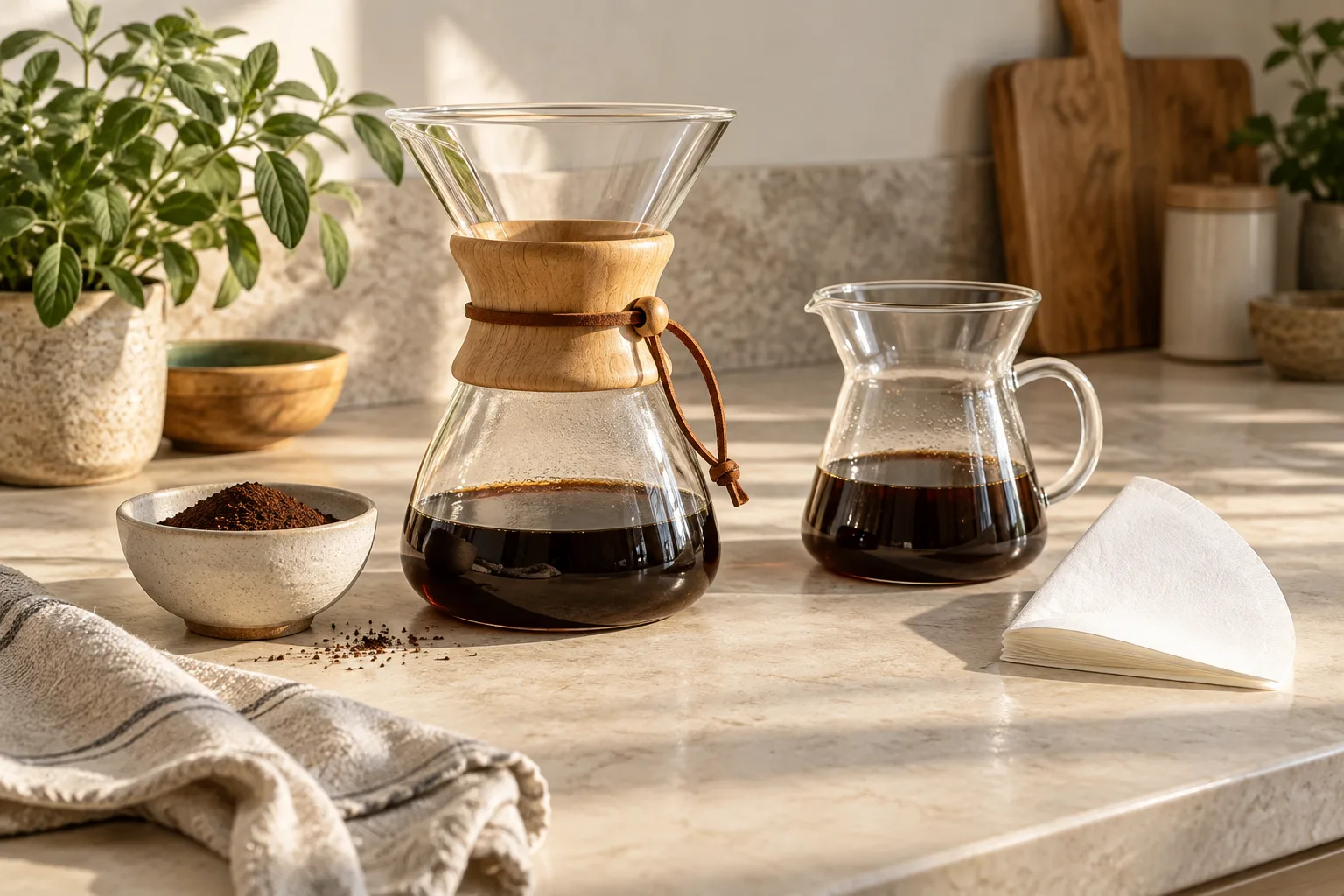
Key Takeaways
- Check the exact brewer, accessories and receiving cup rather than treating the whole Chemex range as one construction.
- Wood around the outside of a glass vessel is not a plastic brewing chamber; exterior parts and drink contact are separate checks.
- Keep the Funnex brewing gasket in place as instructed. Removing a functional part is not a sound way to simplify the materials list.
- The manufacturer’s paper and brewing declarations do not certify removal of every microplastic or nanoplastic.
- Glass-carafe care cannot be applied to an Ottomatic appliance, kettle or unrelated look-alike brewer.
What the Chemex material declarations actually cover
A manual Chemex combines the cone and receiving vessel in one glass body. For someone trying to avoid a plastic cone or enclosed brewing chamber, that is a useful construction difference. It also makes much of the path visible: hot water enters the paper and grounds, filtered coffee collects below, and the drink leaves through the glass spout.
The Classic support page identifies borosilicate glass, rubber-wood collar and bead, and full-grain leather tie. The six-cup product is labeled CM-6A, with a 30-ounce capacity. “Six cups” therefore does not mean six large travel mugs. These are manufacturer declarations reviewed on October 6, 2026, not our independent chemical analysis of a purchased unit.
| Reviewed version | Declared construction / distinction | What to check separately |
|---|---|---|
| Classic CM-6A | Borosilicate vessel; exterior wood collar and leather tie | Paper, kettle, optional cover and serving cup |
| Clear glass handle CM-8GH | 40-ounce glass-handle brewer; no Classic collar | Exact variant, filter fit and added accessories |
| Funnex | Double-wall borosilicate dripper with silicone brewing gasket | Required support, receiving vessel and half-moon filter |
| Ottomatic 2.0 plus a Chemex carafe | Powered water delivery in addition to the glass carafe | Tank, internal water path, sprayhead, clip and carafe compatibility |
Exterior supports are not automatically immersed in the drink. Equally, a photograph of a clear vessel cannot document every added accessory, previous repair or third-party replacement. Compare the item number and the assembled product with the relevant source. This review does not cover every coloured handle, historical model or similarly shaped brewer sold under another brand.
Classic versus glass handle: choose the practical difference
The clear eight-cup glass-handle listing identifies CM-8GH. For a reader who wants to avoid the Classic’s leather tie, or who prefers cleaning without removing a collar, the handle design addresses that requirement. It does not create evidence that one version releases fewer particles than the other during the same brew.
The Classic’s collar is a grip outside the vessel. Calling it a polymer-lined brewer because it has a collar would confuse exterior handling with the normal beverage path. Consider stability, the grip you find comfortable and whether the capacity fits your routine. A large full carafe can be awkward even when its material matches your preference.
Glass construction also has handling limits. A damaged spout or crack is a reason to pause use and seek replacement advice, rather than trying to polish away the defect. Our borosilicate profile separates glass chemistry, breakage and the evidence for particles in a finished drink. A nonplastic vessel does not identify the quality of the water or coffee you put into it.
What Chemex says about its paper filters
The materials page describes Bonded filter paper as virgin pine wood pulp, with an oxygen-cleansing process for the white paper. That is useful disclosure. It is not a complete analytical report on every ingredient, production lot or particle released under brewing conditions. We do not turn a manufacturer’s flavour or residue claims into an independently verified absence of every substance.
White versus natural brown is not a demonstrated microplastic-removal ranking. Nor does the word “bonded” by itself establish a synthetic-plastic adhesive. If your purchase depends on a specific paper additive, ask for a current formulation or specification instead of inferring it from the filter’s colour, name or compostability statement.
| Brewer | Manufacturer-listed paper |
|---|---|
| Three-cup Chemex and Funnex | FP-2 / FP-2N half-moon filters, folded before use |
| Larger manual brewers described in the getting-started guide | FC-100, FS-100, FSU-100 or FP-1; check the exact model |
| Ottomatic | Use the compatible carafe’s paper and the appliance’s own list |
The getting-started guide maps these formats to brewers. Filter fit is a concrete, checkable property. It should not be confused with a micron rating or a certification for drinking-water treatment. A filter that works well for coffee extraction has not thereby been validated for every environmental contaminant.
Does a paper filter remove all microplastics?
The reviewed Chemex documents do not give a polymer-specific removal percentage across a defined microplastic and nanoplastic size range. To make that claim, a test would need to measure particles upstream and downstream, identify their sizes and materials, account for contamination, and use the actual filter and brewing flow. “Cleaner tasting” is a different outcome from particle removal.
The 2022 NIST study concerned selected nylon products and polyethylene-lined cups. It did not test Chemex paper or compare its output with a plastic pour-over cone. Borrowing that paper’s large counts would give a false impression of a Chemex experiment. Coffee-filter results should also not be borrowed from a household water-filter certification.
We report no Chemex-specific release count from the sources reviewed here. That is a boundary of this review, not proof that the drink contains zero particles or that no relevant study could ever exist. Our coffee evidence overview explains the separate contributions that a careful equipment study would need to distinguish.
Funnex adds a gasket and a separate receiving vessel
The Funnex listing specifies double-wall borosilicate glass and a silicone gasket, with a 5–15-ounce brewing range. It instructs users to keep the gasket in place when brewing directly over a vessel for airflow. This is a different assembly from the Classic’s one-piece collecting carafe.
Do not discard the gasket to make a “glass only” claim. Check the intended fit on your mug or thermos, whether the assembly is stable and what the coffee contacts as it exits. A support part’s presence does not by itself measure its contribution to the drink. Silicone is also not interchangeable with glass in a parts inventory; our silicone guide explains the relevant distinctions.
The receiving container matters too. A glass dripper placed over a travel mug does not remove the mug’s interior coating, drinking lid or seals. Inspect the complete setup you will actually use. For example, the AUTOSEAL guide follows a steel travel mug beyond its body to the drinking assembly.
Ottomatic is a separate water-path question
The Ottomatic 2.0 listing describes a tank, automated heating and sprayhead, plus a compatible glass carafe. Its glass receiving vessel does not establish that every upstream water-contact part is glass. The reviewed listing does not provide a complete material map of that internal path or a finished-appliance particle-release test.
Ask about the actual reservoir, heater connections, tubing, sprayhead and accessories if their materials determine your purchase. Do not infer a resin from black colour or a metal path from a shiny exterior. No disassembly or plumbing modification is needed to make that enquiry; use the manufacturer’s documentation and service channel.
Carafe compatibility also has limits. The listing includes selected Classic, glass-handle and handblown sizes, but excludes the eight- and thirteen-cup handblown brewers. Follow that compatibility list rather than assuming a larger glass vessel fits. A manual Chemex comparison cannot stand in for an assessment of the powered appliance.
Care: glass permission is not permission for every heat source
The manufacturer FAQ permits dishwasher cleaning of the glass carafe after removing the collar and tie, with secure placement to avoid collisions. It also permits cleaning the Funnex gasket in the dishwasher. The same FAQ says Chemex products should not be reheated in a microwave. Borosilicate is a material description, not a blanket microwave permission.
Follow the exact product’s instructions for warming and cleaning. Do not transfer any Chemex stove-warming advice to an unrelated glass server, or place an empty carafe on an improvised heater. For a manual brewer, removing the specified exterior parts for washing is different from removing a required Funnex support during brewing.
Ottomatic care is an appliance routine: the product page recommends descaling at 40 brews or three months, whichever comes first, followed by at least two water-only cycles and a 5–10-minute cooldown between cycles. Those instructions address maintenance; they are not evidence of a particular percentage reduction in microplastics.
A useful buying checklist for your whole setup
Start with a requirement you can verify: manual glass vessel, no leather collar, single serving with the required silicone support, or automated brewing with documented upstream parts. Then choose compatible paper, inspect the kettle and receiving cup, and read the cleaning instructions. Keep a record of exact model numbers if you expect to replace parts later.
If you already own an intact brewer, this evidence does not establish a health benefit that requires replacing it. If you are comparing a separate cone and server, our Hario V60 guide traces the cone, finish and holder. The brewing-method comparison extends the same contact-path questions to presses, moka pots and machines without inventing a universal safety order.
Use the App
Review the setup beyond the glass carafe
Keep material declarations and evidence limits together. The app does not test or count particles in your brewed coffee.
Explore product assessmentsFrequently Asked Questions
Is Chemex plastic-free?
Do Chemex filters contain plastic?
Does Chemex remove nanoplastics?
Can I microwave a Chemex?
Is Ottomatic an all-glass coffee machine?
Sources
- Chemex (2026). Classic Series support: materials and model codes (accessed October6).
- Chemex (2026). Six Cup Classic, CM-6A (accessed October6).
- Chemex (2026). Clear Eight Cup Glass Handle, CM-8GH (accessed October6).
- Chemex (2026). Materials and Process: paper declaration (accessed October6).
- Chemex (2026). Getting Started: filter formats (accessed October6).
- Chemex (2026). Funnex: gasket, filter and assembly instructions (accessed October6).
- Chemex (2026). Ottomatic 2.0: compatibility and maintenance (accessed October6).
- Chemex (2026). FAQ: washing and microwave restrictions (accessed October6).
- Zangmeister, Radney, Benkstein and Kalanyan (2022). Sub-100nm particles from selected single-use products; not a Chemex or filter test.
Your next product question
Start with your exact Chemex brewer and filter.
Identify the vessel and filter you actually use. Review their construction and care information without treating the brewing method as a whole-cup particle assay.
Use the exact product name, model and label to check the information behind an assessment. A photo does not measure particles or personal health risk. The examples above are research subjects, not a verified app-coverage list.
Build a product-routine reading plan →Android · early access
Get the launch email the day Android opens.
One email. No spam. We send when the Android app is in the Play Store, and never again unless you opt in.
Related Research
Hario V60: Plastic, Glass, Ceramic and Steel Compared
Compare classic plastic, current Tritan NEO, glass holders, porcelain and coated versus bare steel. Exact materials and care are documented; a V60 particle count is not.
Read moreContigo AUTOSEAL: Steel Body, Lid Care and Testing Limits
Check two adult West Loop mugs, the lid disclosure gap, model-specific cleaning and conflicting body-care documents. BPA-free and spill resistance do not supply a particle count.
Read moreAre Oven Bags Safe for Turkey? The Question Isn’t Microplastics
Reynolds oven bags are FDA-compliant nylon, and USDA prefers them to paper bags. But hot nylon releases oligomers into fatty food, and a July 2026 study found heated nylon-bag leachate toxic to water fleas while PET bags were not.
Read moreDo Plastic-Wrapped Candies Contain Microplastics? 20 of 20 Did
A 2026 study detected microplastics in all 20 plastic-wrapped candies tested. The average was 6.73 particles per gram—but brands were blinded and the wrapper was not the only possible source.
Read moreCan You Microwave Food in Its Plastic Wrapper? New 2026 Evidence
A 2026 study detected PE micro- and nanoplastics from microwaved onigiri wrappers and lined cartons. See what appeared within 1–3 minutes, what the cell test cannot prove and when to transfer food.
Read moreDo Plastic Salt Grinders Shed Microplastics? A 2026 Test Says Yes
Yes. Three plastic grinder heads released an estimated 1,091 to 15,743 particles per 50 g of salt. The polymers matched the mechanisms; ceramic or steel burrs are the direct swap.
Read more