Thanksgiving Dinner Plastic Swaps: What to Change, What to Keep
Last reviewed: by the MicroPlastics Research Desk. Submit a correction or see our editorial standards.
Quick answer

Check the brand in your cupboard
Scan the label to see its packaging, what drives its contact score, and a lower-plastic swap.


Free · 3 scans · iOS and Android
Key Takeaways
- Heat, fat and knives are the pattern. Swap plastic where all three meet: oven bags, carving boards and microwave reheating.
- Oven bags are a molecule question, not a particle one. Hot nylon releases oligomers into fatty food; a covered roasting pan avoids the film.
- Cold contact matters less. A food-grade brining bag in the fridge and plastic wrap over a cold bowl are low on the list.
- Your nonstick pan can stay if the coating is intact and you keep metal tools and high heat away from it.
- Leftovers go in glass, or at least come out of plastic before they go into the microwave.
- Don’t let swaps slow you down. Food safety (165°F, two hours, three to four days) outranks every item here.
What the kitchen studies measured
- microplastics added by steel and glass kitchenware
- None
- plastic sets added particles; jelly simulant; no per-item figure
- Cole et al., Sci Total Environ 2024
- estimated microplastics per person per year from polyethylene boards
- 7.4–50.7 g
- 49.5 g from polypropylene boards; modeled from chopping tests
- Yadav et al., ES&T 2023
- nylon oligomers in chicken roasted in a nylon bag
- 7.48 mg/kg
- 200°C for 2 hours; molecules, not particles
- Gramshaw & Soto-Valdez 1998
- microplastics per cm² of container in 3 minutes of microwaving
- 4.22 million
- highest result; water and 3% acetic acid simulants, not food
- Hussain et al., ES&T 2023
Which Thanksgiving plastics are worth swapping?
A holiday kitchen runs on plastic for a week: bags for thawing and brining, film over bowls, a big board for carving, a gravy separator, tubs for the leftovers, and a stack of disposable plates when the family arrives. Most of it touches food cold and briefly. A few items touch hot, fatty food for hours, or meet a knife, and those are where the evidence points. The table sorts the whole meal by that logic.
Thanksgiving plastic triage: swap, keep or low priority
- Item
- Nylon oven bag for the turkey
- Verdict
- Swap
- Why
- Hours of contact with hot fat; nylon oligomers migrate into food
- Easy alternative
- Lidded roasting pan, or foil tented over the bird
- Item
- Plastic cutting board for carving
- Verdict
- Swap
- Why
- Knife scoring releases particles; a turkey means a lot of cutting
- Easy alternative
- Wood carving board with a juice groove
- Item
- Reheating leftovers in plastic tubs
- Verdict
- Swap
- Why
- Microwave heat drove the highest release in container tests
- Easy alternative
- Move food to glass or ceramic before heating
- Item
- Plastic gravy separator
- Verdict
- Swap if easy
- Why
- Near-boiling fat and drippings in plastic
- Easy alternative
- Glass or stainless separator, or skim with a ladle after chilling
- Item
- Worn nylon or black plastic turners and spoons
- Verdict
- Swap
- Why
- Hot contact; some black plastics carry recycled additives
- Easy alternative
- Wood or stainless, matched to the pan
- Item
- Nonstick skillet in good condition
- Verdict
- Keep
- Why
- Damage, not normal use, is the main particle route
- Easy alternative
- Wood or silicone tools, medium heat
- Item
- Foil roasting pan
- Verdict
- Keep
- Why
- Aluminum, no plastic layer; support it on a sheet pan
- Easy alternative
- Reuse it, or use a steel or enameled roaster
- Item
- Food-grade brining bag in the fridge
- Verdict
- Low priority
- Why
- Cold contact; the brine is not fatty or hot
- Easy alternative
- A stockpot or food-grade bucket if it fits
- Item
- Plastic wrap over cold dishes
- Verdict
- Low priority
- Why
- Cold, brief, mostly not touching food
- Easy alternative
- Plates or lids over bowls; wrap off before microwaving
- Item
- Paper plates and plastic cutlery for guests
- Verdict
- Low priority
- Why
- One meal, short contact, mostly warm not hot
- Easy alternative
- Real plates if you have them; avoid foam for hot gravy
Are oven bags safe for turkey?
Oven bags are safe in the food-safety sense and widely recommended for moist roasting. Reynolds describes its bags as “a heat resistant nylon that is FDA-compliant for cooking” and labels them BPA-free. The issue is what hot nylon gives off. In a 1998 test, chicken roasted in a nylon bag at 200°C for two hours took up 7.48 mg/kg of nylon oligomers, small ring-shaped molecules from the polymer. Germany’s BfR treats 5 mg/kg of food as its group guidance value for those oligomers and advises keeping hot contact with nylon brief. In 2026, a Lund University study found heated nylon-bag leachate toxic to water fleas, while PET bags released less and showed no detectable toxicity under the tested conditions. That is a hazard signal in an aquatic test, not evidence of harm to people.
For one turkey a year the exposure is small. But a lidded roasting pan or a foil tent does the same job with no film touching the bird, so it is an easy swap. If you still use a bag, follow the maker’s directions: one tablespoon of flour shaken inside, six half-inch slits in the top, no toaster ovens or grills, and an oven at 325°F or higher. Our oven bag guide has the full evidence, including why PET bags are the lower-release option.
Are foil and disposable roasting pans OK?
A plain aluminum foil roasting pan has no plastic coating, so it does not belong on a microplastics swap list. Its real risk is mechanical: a 15-pound bird in a flimsy pan can buckle when you lift it and spill hot fat. Set it on a rimmed sheet pan and lift by the sheet. Some disposable pans are plastic, usually ovenable trays sold for ready meals. If a pan is not foil and the label does not give an oven rating that covers your roasting temperature, do not use it for the turkey. A stainless or enameled roaster you already own avoids the question and lasts decades. The non-toxic cookware guide covers those materials.
Should you carve the turkey on a plastic cutting board?
Carving is the most knife work most kitchens do all year, and plastic boards shed under a blade. Yadav and colleagues chopped on polyethylene and polypropylene boards and estimated 7.4 to 50.7 grams of microplastics per person per year from polyethylene boards and 49.5 grams from polypropylene. Polypropylene released more by mass and by count in their tests. Those are modeled yearly figures from daily chopping, not a dose from one turkey. Still, a deeply scored plastic board is the one prep item where a swap clearly removes a measured source.
A large wood board with a juice groove handles the bird and the drippings. Keep raw poultry hygiene the same whatever the material: wash the board in hot soapy water after the raw turkey touches it, and don’t move cooked meat back onto an unwashed surface. Our cutting board guide compares wood, bamboo and plastic in detail.
Nonstick vs stainless for the sides and the gravy
You do not need to replace a nonstick pan before Thursday. Particle release from PTFE coatings is mostly about damage. Luo and colleagues estimated that a single surface crack in a nonstick coating could release about 9,100 particles, in a test with no food or oil. So the practical rules are about wear: keep metal whisks and tongs out of the pan, don’t preheat it empty on high, and retire it when the coating is chipped or flaking. The FDA still lists nonstick cookware coatings as an authorized PFAS use.
Gravy is a good job for stainless anyway. Fond sticks to steel, and those browned bits are the base of a good pan gravy. Whisk it in stainless with a metal whisk, then use the nonstick pan for eggs on Friday morning with a wooden spatula. The spatula-by-pan guide matches each tool to each surface.
What about the gravy separator?
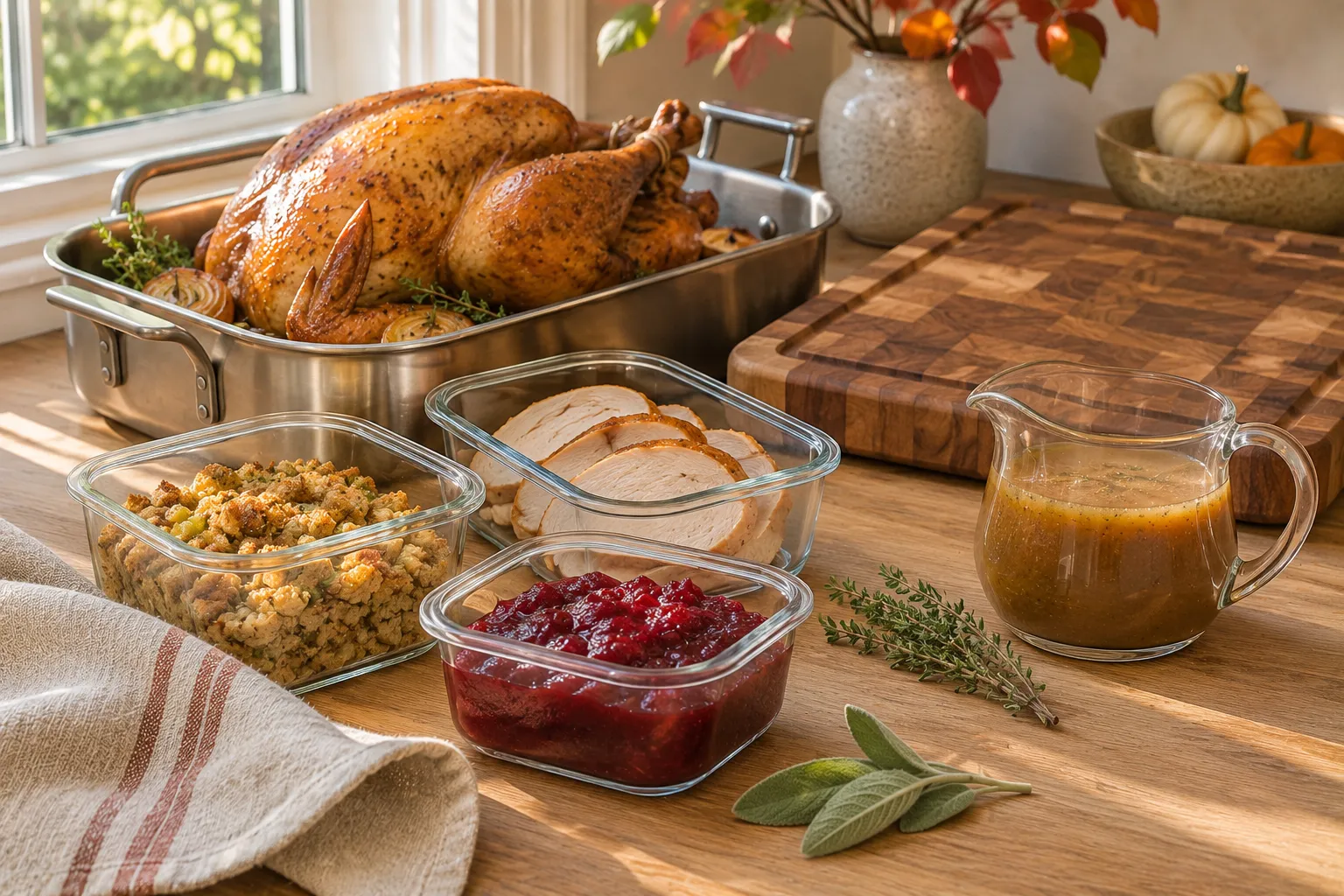
Most gravy separators are clear plastic, and they get filled with drippings straight from a 325°F roaster. No study we found tested a gravy separator. The nearest evidence is category-level: Cole’s plastic kitchenware set added particles to food while steel and glass did not, and Hussain’s container tests found heat raised release. That justifies a cheap swap, not alarm. Glass and stainless separators exist. The free alternative works too: pour the drippings into a glass jug or measuring cup, let the fat rise for a few minutes, and spoon it off, or chill the drippings briefly so the fat firms on top.
Use the App
Check your holiday kitchen before Thursday
Scan your roasting pan, carving board, gravy separator or leftover containers. The app records each item’s declared material and heat rating, flags the ones that touch hot food, and suggests a glass, steel or wood swap you can make this week.
Sides, slow cookers and pies
The turkey gets the attention, but the sides run through the same three questions: is the plastic hot, is the food fatty, and does a tool scrape it? Run each dish through those before Thursday.
- Slow cooker liners. Mashed potatoes or stuffing held for hours in a liner is the side-dish version of the oven bag. Reynolds says its liners are a nylon blend, so the same oligomer reasoning applies, for even longer contact. The crock is glazed ceramic: grease it and skip the liner, then soak it after dinner. Our slow cooker liner guide has the details.
- Casseroles and roasted vegetables. Glass, ceramic and metal baking dishes need no change. If a casserole arrives in a disposable dish, check whether it is foil (fine in the oven) or plastic (check the label before it goes in).
- Mixing and mashing. A hand masher or a metal whisk in a steel or glass bowl beats an old, scratched plastic bowl with an electric mixer scraping its sides. That is a small swap, not an urgent one.
- Pies and rolls. Parchment paper is cellulose with a silicone coating, not a plastic film. Stay under the temperature on the box, and don’t substitute wax paper or plastic-coated freezer paper in the oven. The parchment guide explains the difference.
If you only change one thing
Change reheating. The turkey roasts once, but leftovers get reheated across four days by several people, often straight from a plastic tub, with no one watching the microwave. It is the step with the most repeat contact, the strongest container evidence and the cheapest fix: a plate. If you have time for a second change, roast in a covered pan instead of a bag. A third, carving on wood, is worth it if your plastic board is deeply scored.
Everything else on the low-priority list can wait until something wears out. Replacing every bag, bowl and utensil the week of a big meal adds cost and stress and changes little. When a plastic item cracks, warps or clouds, replace it then with glass, steel or wood.
Brining bags and thawing: low priority
Brining bags are usually multilayer plastic, and the turkey sits in them for a day or more. That sounds worse than it is for this question. The brine is cold, watery and salty rather than hot or fatty, and the studies that found high release used heat. Keep the bird and brine refrigerated the whole time and use a bag sold for food. If your fridge has room, a stockpot, a large food-grade bucket or a cooler kept cold works without a bag. The same logic applies to thawing in a sealed bag in cold water: cold, short, and done for food safety, so leave it alone.
Leftovers: wrap, store and reheat without plastic heat
This is where most of the week’s plastic contact happens, so it is worth a plan. Storage is fine in whatever you own. Cold contact in a container or under wrap is low priority. Reheating is the step to change. Hussain and colleagues found microwave heating released far more particles from plastic containers than fridge or room-temperature storage, with the highest result at 4.22 million microplastics and 2.11 billion nanoplastics per square centimeter of container in three minutes. Those figures come from water and dilute acetic acid, not turkey and stuffing, and they are per area of plastic rather than per serving. The direction is consistent, though: heat plus plastic is the combination to avoid.
- Pack leftovers in glass or ceramic if you have enough. Shallow containers cool faster.
- If you use plastic tubs, tip the food onto a plate or into a bowl before it goes into the microwave.
- Cover with a plate, not film, when reheating. Our guide to microwaving food in plastic explains what “microwave safe” does and does not promise.
- Reheat gravy in a saucepan. The FDA says to bring sauces, soups and gravies to a rolling boil when reheating, which is easier on the stove anyway.
- Send guests home with food in containers you don’t need back, but tell them to reheat it on a plate.
Food safety sets the timetable. The FDA says to refrigerate leftovers within two hours and use them within three to four days. Don’t leave the turkey out longer because you are hunting for a glass dish.
Disposable plates and cutlery for guests
For a single meal, disposables are low priority. Contact is short and the food has cooled on its way from the platter. Two details are worth knowing. Foam plates and cups are polystyrene, so don’t ladle boiling gravy onto them; our polystyrene foam guide explains why heat matters. Plastic forks and knives that bend and scrape against plates are covered in disposable cutlery and microplastics. On paper plates, the FDA reports that PFAS grease-proofing agents for paper are no longer sold into the US food-contact market. That does not tell you what an older or imported pack contains, so plain uncoated paper or real plates remain the simple choice if you have them.
What the evidence does not establish
- A particle count for a Thanksgiving dinner. No study we found measured particles from a turkey roasted, carved and served the usual way.
- That oligomers are microplastics. Oven-bag results are molecules that migrate into food; they cannot be converted into a particle count.
- That cold storage is zero. Long storage released particles in container tests too, just far fewer than microwaving. Low priority is not no contact.
- A health outcome. The FDA says current evidence does not show that the levels of microplastics or nanoplastics detected in foods pose a risk to human health. The water-flea result for nylon bags is an aquatic test.
A five-step plan for the week
- Sunday: check your roaster and carving board. If you have no roaster, a foil pan on a sheet pan is fine. Borrow or buy a wood board if yours is scored plastic.
- Tuesday: count glass and ceramic containers for leftovers. Plates over bowls work as lids.
- Wednesday: brine or thaw in the fridge in whatever food-grade vessel fits.
- Thursday: roast covered in the pan, carve on wood, make gravy in stainless, and skim fat in a glass jug.
- Friday on: reheat on plates or in pans, never in the plastic tub, and finish leftovers within four days.
What the MicroPlastics app checks
- The declared material of a scanned roasting pan, oven bag, board, separator or container, such as nylon, PET, polypropylene, aluminum, glass or stainless steel.
- Maker heat ratings and use limits where the product information gives them.
- Which items in your kitchen touch hot or fatty food, so you can prioritize swaps.
- Product information only: the app does not measure particles or chemicals released into your food.
Frequently Asked Questions
Is it safe to cook a turkey in an oven bag?
Is it OK to use a disposable foil pan for turkey?
Should I carve turkey on a plastic or wood cutting board?
Can I brine a turkey in a plastic bag?
Is it safe to reheat Thanksgiving leftovers in plastic containers?
How long are Thanksgiving leftovers good for?
Sources
- Cole M, Gomiero A, Jaén-Gil A, Haave M, Lusher A (2024). Microplastic and PTFE contamination of food from cookware. Science of the Total Environment 929:172577.
- Yadav H, Khan MRH, Quadir M, Rusch KA, et al. (2023). Cutting boards: an overlooked source of microplastics in human food?. Environmental Science & Technology 57(22):8225–8235.
- Hussain KA, Romanova S, Okur I, Zhang D, et al. (2023). Assessing the release of microplastics and nanoplastics from plastic containers and reusable food pouches: implications for human health. Environmental Science & Technology 57(26):9782–9792.
- Gramshaw JW, Soto-Valdez H (1998). Migration from polyamide “microwave and roasting bags” into roast chicken. Food Additives & Contaminants 15(3):329.
- German Federal Institute for Risk Assessment (BfR) (2019). Polyamide kitchen utensils: keep contact with hot food as brief as possible (Opinion No. 036/2019). BfR.
- Ekvall MT, Boo K, Lundqvist M, Cedervall T (2026). Temperature dependent leaching of substances from polyamide oven bags is toxic to zooplankton Daphnia magna. Chemosphere 410:145032.
- Luo Y, Gibson CT, Chuah C, Tang Y, et al. (2022). Raman imaging for the identification of Teflon microplastics and nanoplastics released from non-stick cookware. Science of the Total Environment 851:158293.
- Reynolds Kitchens (2026). Oven bags: material, directions and use limits (retrieved November 8, 2026). reynoldsbrands.com.
- US Food and Drug Administration (2026). Food safety tips for healthy holidays (retrieved November 8, 2026). FDA.
- US Food and Drug Administration (2026). Authorized uses of PFAS in food contact applications (retrieved November 8, 2026). FDA.
- US Food and Drug Administration (2024). Microplastics and nanoplastics in foods (retrieved November 8, 2026). FDA.
Your next product question
Start with the roasting pan, oven bag, carving board or leftover container you will use this Thanksgiving.
Record each item's declared material and heat rating, then swap the ones that touch hot or fatty food. A material check does not measure particles or chemicals released into your meal.
Use the exact product name, model and label to check the information behind an assessment. A photo does not measure particles or personal health risk. The examples above are research subjects, not a verified app-coverage list.
Read the oven bag evidence →Related Research
Are Takeout Soup Containers Safe? Plastic, Foam and Paper
Winter soup arrives in polypropylene deli tubs, foam cups or plastic-lined paper. What hot-water and microwave studies tested, how close they are to real soup, and the transfer-and-reheat routine that avoids the hottest contact.
Read moreMicroplastics in Sugar: What the Studies Found, and One That Was Retracted
Sugar studies report anywhere from 75 suspected particles per kilogram to about 300 per gram, depending on how small the lab looked. We compare the 2026 Greek and Italian studies, explain the retracted Bangladesh paper, and cover white vs brown vs raw and packaging.
Read moreAluminum Foil vs Plastic Wrap: Which to Use for Each Job
Foil, cling film, beeswax wraps, parchment, silicone lids or glass? A task-by-task guide for the fridge, freezer, microwave and oven, with what EFSA, the BfR and lab tests found on aluminum and plasticizer migration.
Read moreIs Fellow Aiden Plastic-Free? What Fellow Says It’s Made Of
No. Fellow lists Aiden’s materials as plastic, stainless steel and silicone and names the plastic as PPO, without saying which parts. Compared with Moccamaster, Ratio, Caraway, Breville and OXO by what touches hot water.
Read moreDoes a Moka Pot Have Microplastics? The Gasket, the Valve and the Aluminum Question
Stovetop moka pots are metal apart from the gasket. We trace Bialetti Moka Express, Brikka and Venus, Alessi 9090 and an electric model, and explain the aluminum study: at most 4% of the EU weekly limit.
Read moreDoes a French Press Have Microplastics? Every Part, Model by Model
Traces the beaker, lid, frame and filter stack of the Bodum Chambord, Brazil and Caffettiera, ESPRO P3/P7 and Frieling. Shows which presses keep plastic out of the coffee, and why diterpenes are a separate issue.
Read more