Is HexClad Non-Toxic? It Depends on When You Bought It
Last reviewed: by the MicroPlastics Research Desk. Submit a correction or see our editorial standards.
Quick Answer
Different container in your kitchen? Review its confirmed or estimated material and Product Contact Signal, then compare a lower-contact option.
Scan my product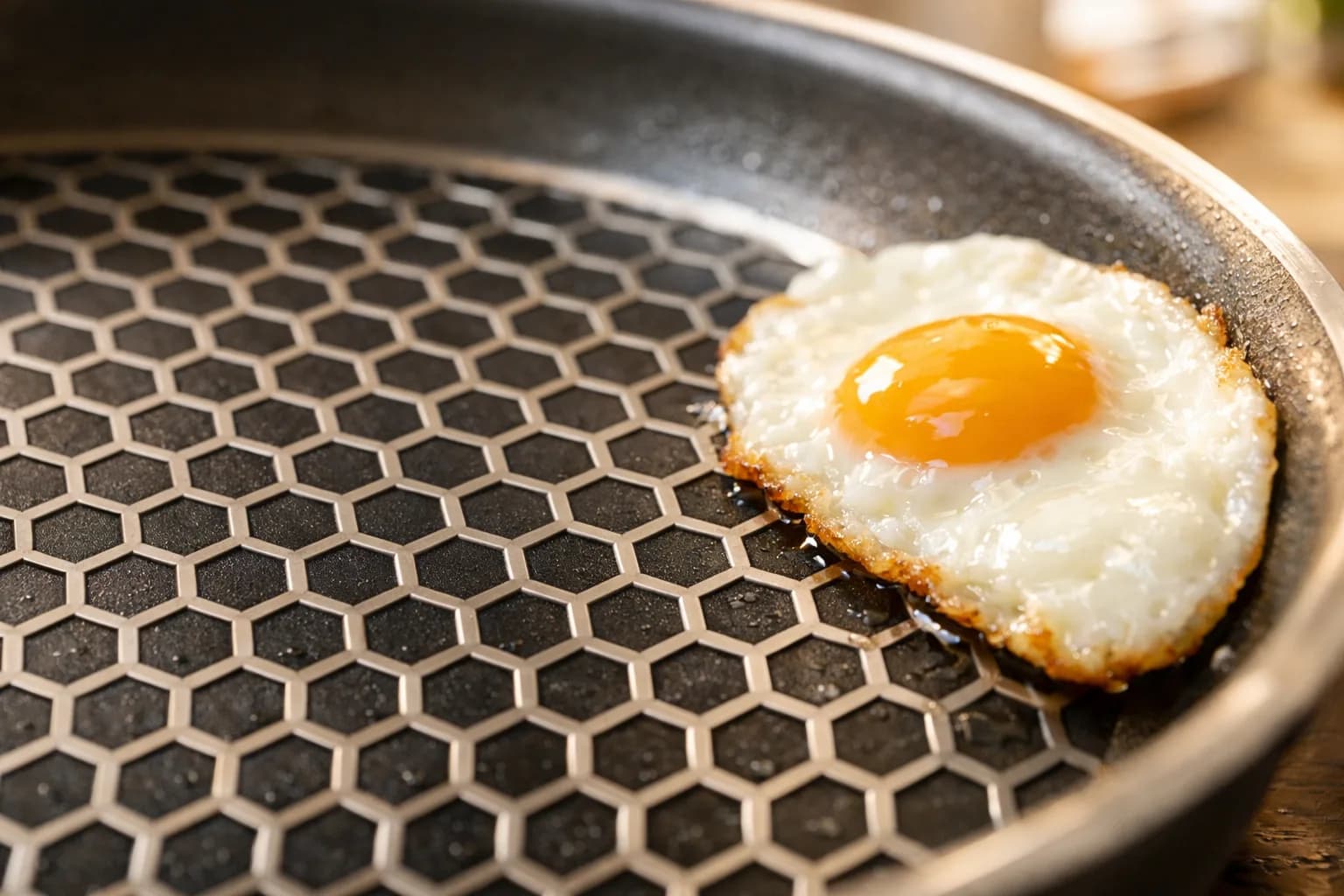
Key Takeaways
- Two different pans share one name. HexClad’s FAQ said the coating contained PTFE in 2023–24; since late 2024 it says all products use PTFE-free TerraBond ceramic.
- The settlement was about wording. $2.5 million, and no more “non-toxic”, “PFAS free” or “PFOA free” on anything containing PTFE. HexClad denied wrongdoing.
- The oven gap: today’s pans are rated to 900 °F. A PTFE-era listing said 500 °F, which is about where PTFE starts to break down.
- Wear is the microplastic question. Scratched PTFE can release “thousands to millions” of particles in simulated cooking, and a June 2026 study found fluoroplastic particles in food cooked in nonstick pans.
- TerraBond’s PFAS-free claim rests on HexClad’s own “Non-Detect” table. The lab report isn’t published.
- The truly coating-free option is fully clad stainless, cast iron or carbon steel.
HexClad, in the company’s own words and the court papers
- HexClad FAQ, May 2023 – Jan 2024
- “contains PTFE”
- “Our nonstick coating contains PTFE, which is listed in the Biomonitoring California Priority Chemicals List.”
- hexclad.com FAQ via Wayback Machine
- class-action settlement fund
- $2.5M
- buyers from 1 Feb 2022 to 31 Mar 2024; HexClad denied wrongdoing
- Cliburn v. One Source to Market, settlement agreement
- oven rating now vs a PTFE-era listing
- 900°F vs 500°F
- today’s TerraBond pans vs a pre-switch listing quoted in the court complaint
- hexclad.com; amended complaint exhibit
- HexClad’s PFAS table for TerraBond
- Non-Detect
- PTFE, PFOA, PFOS and others listed as non-detect by a third-party lab; report and detection limits not published
- hexclad.com product page, 21 Sep 2026
What is a HexClad pan made of?
HexClad calls its design “hybrid”. The body is tri-ply: a magnetic stainless-steel base, an aluminium core for even heating, and a stainless cooking surface. A raised hexagon pattern is laser-etched into that surface, and the nonstick coating sits in the low “valleys” between the steel peaks. The idea is that spatulas ride on the steel ridges and don’t scrape the coating, which is why HexClad markets its pans as metal-utensil safe.
So the safety question is about the coating in the valleys, and HexClad’s answer to “what is it?” has changed. Today, its science page says the valleys contain “our high-grade proprietary ceramic nonstick called TerraBond™ which is PTFE-free and free from forever chemicals.” Its product pages show a table of results from a third-party lab listing PTFE, PFOA, PFOS and other PFAS as “Non-Detect”. HexClad has not published the lab report, the test method or the detection limits.
Did HexClad pans contain PTFE?
HexClad said so itself. The company’s FAQ has changed several times, and archived copies show how its answer shifted:
| Archived | What the FAQ said |
|---|---|
| January 2022 | “Our pans are coated with a non-toxic ceramic non-stick coating. We never use PFOA or PFAS” |
| May 2023 – January 2024 | “Our nonstick coating contains PTFE, which is listed in the Biomonitoring California Priority Chemicals List.” |
| September 2024 | Most products use TerraBond, which is free of PTFE; some still contain PTFE |
| November 2024 – today | “Our cookware products use our proprietary HEXCLAD TERRABOND™ ceramic nonstick coating, which is PTFE-free and PFAS-free.” |
Quotes are from hexclad.com FAQ pages captured by the Internet Archive. The September 2024 row is paraphrased. Product names such as the 12″ Hybrid Pan stayed the same across the change.
The practical point is that the name on the pan doesn’t tell you which coating you have; the purchase date comes closer. If yours was bought before late 2024, assume it has the PTFE coating unless HexClad tells you otherwise for your order. Its customer support can check against an order number.
What was the HexClad lawsuit about?
Buyers sued in 2023, first in federal court and then in Los Angeles Superior Court (Cliburn et al. v. One Source to Market, LLC, which trades as HexClad Cookware). They alleged that HexClad had marketed its pans as free of PFAS and PFOA, and as “non-toxic”, while the nonstick coating was PTFE, which California law counts as a PFAS. The complaint relied on HexClad’s own public statements rather than on lab tests of the pans.
The case settled. HexClad agreed to pay $2,500,000 into a fund for US buyers of the listed products between 1 February 2022 and 31 March 2024, and it continued to deny any wrongdoing. The claim deadline was 14 November 2025. Law-firm settlement trackers report the court gave final approval on 9 March 2026. The fund is split pro rata among valid claims, so individual payments depend on how many people claimed. The more lasting part is the injunction, in paragraph 46 of the signed agreement:
- HexClad “will cease to market or advertise any product containing PTFE or any chemical in the PFAS family as ‘PFAS free’ or ‘PFOA free’”.
- It “will cease to market or advertise any product containing PTFE or any chemical in the PFAS family as ‘non-toxic’”.
- It may keep calling products “metal utensil safe”, and may call products that don’t contain PTFE “non-toxic” or “PFOA-free”, for example ceramic-coated pans.
No court ruled on whether PTFE cookware is harmful. The settlement governs what HexClad can say, not what the science says. Today’s product pages avoid the word “non-toxic” and use “PTFE-free” and “free from forever chemicals” instead.
Is PTFE actually dangerous?
At normal cooking temperatures, intact PTFE is very stable. The FDA says that because the coating is applied at very high temperatures, only negligible amounts of PFAS migrate into food. PFOA, the processing chemical behind the original Teflon controversy, was phased out of US production by 2015 under an EPA stewardship programme. The two real issues are heat and wear.
- Heat. Overheated PTFE, roughly 260 °C (500 °F) and up, gives off fumes that can cause “polymer fume fever”, a short-lived flu-like illness. The fumes can kill pet birds. An empty pan on a high burner gets there in minutes.
- Wear. Australian researchers used Raman imaging on scratched nonstick pans and estimated that “thousands to millions” of Teflon micro- and nanoplastics might be released in a simulated cooking process. In June 2026, a Chinese team found “high abundances” of fluoroplastic microparticles in food prepared with nonstick cookware. Health effects at those doses are unknown, but it is plastic in food, which is this site’s subject.
HexClad’s FAQ says a scratch “is only cosmetic, and it will not affect the performance or safety of the cookware.” That answer doesn’t distinguish between the old coating and the new one. We haven’t found any independent test of how much coating the hexagon design saves from wear, on either version.
Is the new TerraBond HexClad non-toxic?
By HexClad’s account, TerraBond contains no PTFE or other PFAS, which fits a silica-based sol-gel coating. Those have their own trade-offs: a silicone-type matrix, faster loss of slickness, and titanium nanoparticles released under scratching in one 2017 study. See is ceramic cookware safe? In short: PTFE-free is a real improvement if forever chemicals are your concern, but no coating lasts forever or sheds nothing.
Use the App
Which HexClad is in your cupboard?
Scan the pan or its box. The app separates PTFE-era and TerraBond-era cookware, checks the heat rating you should actually follow, and suggests a coating-free swap if the nonstick is worn.
Scan my cookwareWhat if I own an older, PTFE-era HexClad?
- Don’t follow the 900 °F rating. That is for TerraBond pans. A PTFE-era listing said “oven-safe up to 500 degrees Fahrenheit”, and lids to 400 °F. Treat 500 °F as the ceiling and don’t put the pan under a broiler.
- Don’t preheat it empty on high. This is the most common way any PTFE pan overheats. Add oil or food first and use medium heat. The stainless ridges and aluminium core spread heat well enough.
- Ventilate, especially if you keep birds. Use the range hood and keep birds away from the kitchen.
- Retire it when the valleys are worn. If the dark coating is visibly gone, flaking or deeply scored, the pan is shedding coating. That is the point to replace it, not a surface scratch.
- Don’t panic-bin an intact pan. Used correctly, an intact PTFE pan is a low-exposure item. The biggest step is avoiding the high-heat, worn-out end of its life.
Where can HexClad’s PTFE pans no longer be sold?
States have started banning cookware with intentionally added PFAS, and PTFE counts. In the industry challenge to Minnesota’s law, a federal court noted that PTFE, FEP and PFA “all meet the Statute’s definition of PFAS”, and dismissed the challenge in August 2025.
| State | Rule | From |
|---|---|---|
| Minnesota | Sale of cookware with intentionally added PFAS banned (Amara’s Law) | 1 Jan 2025 |
| Colorado | Cookware with intentionally added PFAS banned (SB24-081) | 1 Jan 2026 |
| Maine and Vermont | Cookware with intentionally added PFAS banned | 1 Jan 2026 |
| California | Online and label disclosure; no “free of” claims for a chemical class if a member is intentionally added (a proposed ban was vetoed in 2025) | 2023–2024 |
These laws apply to new sales, not to pans already in your kitchen. Details and exemptions vary by state.
Is HexClad worth it if you want to avoid plastic entirely?
If you want no coating at all, no hybrid pan fits: clad stainless, cast iron and carbon steel have nothing to wear off and cost less, though they need proper preheating and fat. If you want nonstick without PTFE, the current TerraBond HexClad delivers that, as a consumable coating. Gordon Ramsay’s endorsement and the lifetime warranty, which covers defects rather than wear from heat or misuse, don’t change the chemistry.
Related: the best non-toxic cookware, ranked, our Our Place pan review, and what nonstick air-fryer baskets shed.
What the MicroPlastics app checks
- The coating era of a named pan: PTFE, ceramic sol-gel, or uncoated.
- The heat limit that applies to your version, not just the current marketing.
- Visible wear signs that mean a coating is shedding.
- A coating-free swap from stainless, cast iron or carbon steel.
Frequently Asked Questions
Is HexClad non-toxic?
Does HexClad contain Teflon (PTFE)?
What was the HexClad lawsuit about?
Is a scratched HexClad pan safe to use?
Can HexClad go in a 900°F oven?
Is HexClad PFAS-free now?
Sources
- HexClad (2026). HexClad science — TerraBond™ “PTFE-free and free from forever chemicals”; tri-ply construction (retrieved 21 September 2026). HexClad.
- HexClad (2026). 10" Hybrid Pan product page — TerraBond ceramic; oven-safe to 900°F; third-party PFAS “Non-Detect” table (retrieved 21 September 2026). HexClad.
- HexClad (2023). FAQ — “Our nonstick coating contains PTFE…” (Internet Archive capture, 29 May 2023). Internet Archive.
- HexClad (2022). FAQ — “non-toxic ceramic non-stick coating… We never use PFOA or PFAS” (Internet Archive capture, 25 January 2022). Internet Archive.
- Cliburn et al. v. One Source to Market, LLC d/b/a HexClad Cookware (2024). Settlement agreement — $2,500,000 fund; class period 1 Feb 2022–31 Mar 2024; ¶46 injunctive relief. Los Angeles Superior Court No. 23STCV28390.
- Cliburn et al. v. One Source to Market, LLC (2023). First amended class action complaint (includes a PTFE-era listing: “oven-safe up to 500 degrees Fahrenheit”). Los Angeles Superior Court.
- Cookware Sustainability Alliance v. Kessler (2025). Memorandum opinion granting motion to dismiss — “PTFE, FEP, and PFA all meet the Statute’s definition of PFAS”. US District Court, D. Minnesota, 0:25-cv-00041.
- Minnesota Legislature (2023). Minn. Stat. §116.943 — products containing intentionally added PFAS (cookware from 1 January 2025). Office of the Revisor of Statutes.
- Colorado General Assembly (2024). SB24-081 — Perfluoroalkyl and polyfluoroalkyl chemicals (cookware ban from 1 January 2026). State of Colorado.
- US Food and Drug Administration (2025). Authorized uses of PFAS in food contact applications. FDA.
- Luo Y, Gibson CT, Chuah C, Tang Y, Naidu R, Fang C (2022). Raman imaging for the identification of Teflon microplastics and nanoplastics released from non-stick cookware. Science of the Total Environment 851:158293.
- Li S, Wang X, Wang J, et al. (2026). Establishment of a spectral detection method for microfluoroplastics: revealing widespread pollution and conventional digestion-induced underestimation. Environmental Science & Technology 60(25):18011.
Compare your kitchen contact pattern over time
The app turns saved scans into a modeled household contact pattern based on what you cooked in, stored in, and heated this month. The trend describes the assessed mix, not health or bodily exposure.
Download on the App Store- Free on iOS
- 3 free scans
- No sign-up
- Result in seconds
“Really cool to scan stuff around the kitchen and see what's actually in it. The swaps it suggests are realistic.” App Store review · 5.0★
Android · early access
Get the launch email the day Android opens.
One email. No spam. We send when the Android app is in the Play Store, and never again unless you opt in.
Related Research
Is Ceramic Cookware Safe? “Ceramic” Means Four Different Things
Ceramic nonstick is PFAS-free but held together by a silicone matrix, enamel is safe until it chips, solid ceramic has trace lead, and lead-glazed clay is the real risk. The evidence for each type.
Read moreNon-Toxic Rice Cookers: What the Makers’ Own Chemical Filings Say
Zojirushi lists PTFE or PFA for its rice cookers, “platinum” included, and a “ceramic” Tiger lists PFAS. Uncoated stainless pots start near $55, and rinsing rice matters more than either.
Read moreKourtney Kardashian's Poosh Kitchen Swaps: A Microplastics Check
Kourtney Kardashian's Poosh recommends plastic-free kitchen swaps. Compare glass, steel, lids, silicone and bamboo labels before changing your food storage.
Read moreThe Bamboo Plate Is Melamine in 20 Cases Out of 21
A 2025 Food Control analysis detected melamine in 20 of 21 food-contact articles sold as bamboo — and the EU never authorised bamboo flour in plastics at all, because bamboo is a grass and the wood-flour clearance does not reach it. The label is not a test you can run.
Read moreBlending Ice for 30 Seconds Released Hundreds of Millions of Plastic Particles
Thirty seconds of blending ice in a plastic jar released an estimated 0.36–0.78 billion micro- and nanoplastic particles. The mechanism is abrasion, not heat — which is why "BPA-free" and "Tritan" do not answer the question, and why the fixes are mechanical and mostly free.
Read moreCan You Microwave Rubbermaid? The 30-Second Rule Nobody Follows
Rubbermaid says reheating only, and defines it as a short peak: "maintaining temperatures at 165°F or higher for more than 30 seconds is considered cooking, and is outside the intended use of these products." The twist is that the premium Brilliance line is capped at 165°F while the budget TakeAlongs handles 212°F.
Read more