Our Place Essentials Pan Trio Review: The Microplastics Verdict

Last reviewed: by the MicroPlastics Research Desk. Submit a correction or see our editorial standards.
Quick Answer
Different container in your kitchen? Review its confirmed or estimated material and Product Contact Signal, then compare a lower-contact option.
Scan my product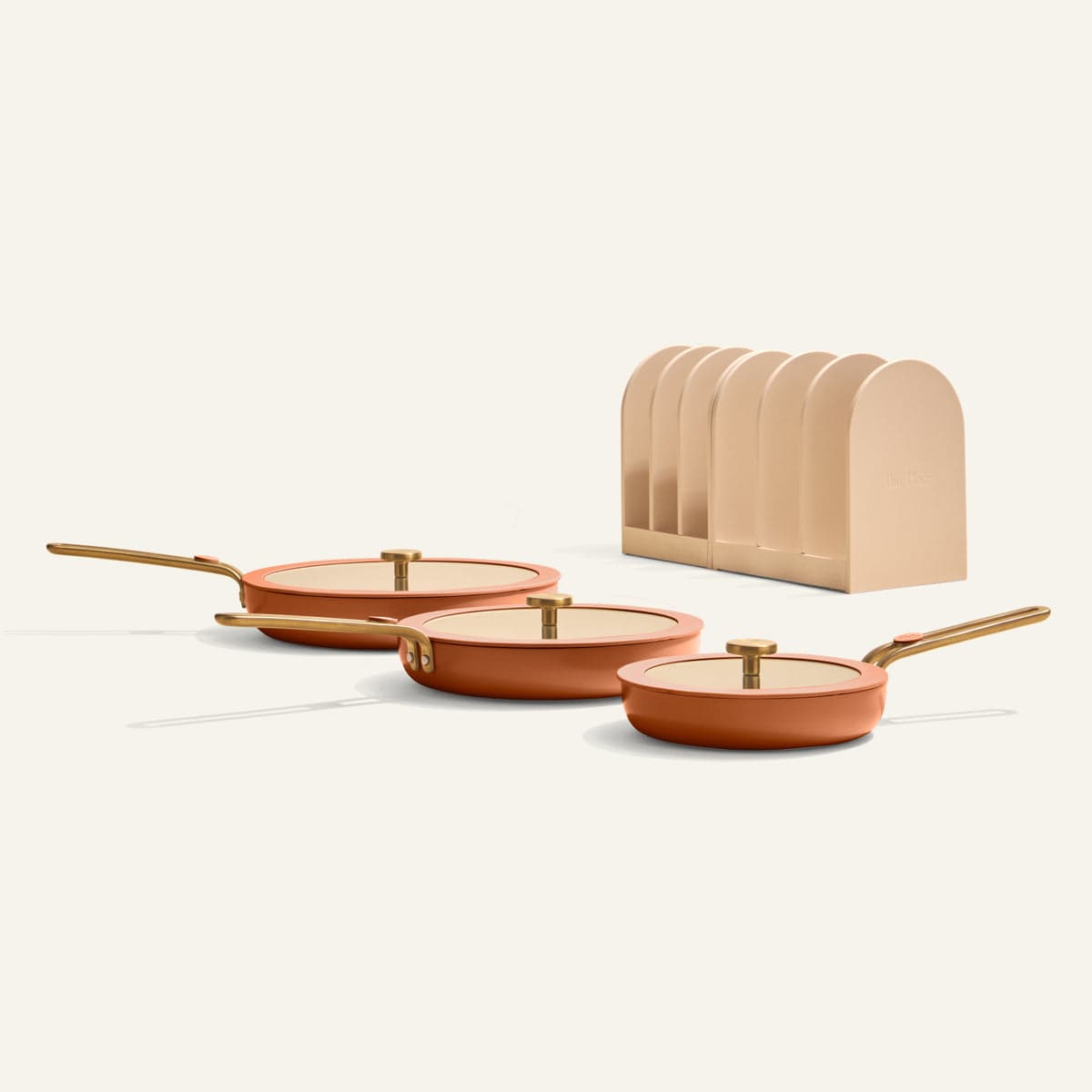
Gifted sample · affiliate links · we may earn a commission — full disclosure
Our Place Essentials Pan Trio (8 piece)
Best-in-class on the thing this site measures — there is no fluoropolymer in the cooking surface, so there is nothing to shed as microplastic. Marked down for a two-to-three-year coating lifespan and an undisclosed full formulation. Scoring breakdown below.
Key Takeaways
- Ceramic sol-gel is not plastic. Thermakind is cured silica — chemically far closer to glass than to Teflon. This is the single strongest reason to prefer it on a microplastics basis, and it is not a marketing distinction, it is a materials one.
- It passes the egg test. Eggs released cleanly with no sticking and no welded ring at the edge of the white, and meat cooked well within the specified heat range. What it will not do is sear at cast-iron temperatures — no ceramic pan will.
- The PTFE comparison is not close. Luo et al. (2022) measured ~9,100 particles from a single scratch and ~2.3 million from a broken coating. Those are lab figures under deliberate abrasion, not a per-meal dose — but the mechanism is specific to polymer coatings and silica does not have it.
- Independent verification exists, which is genuinely rare here: Consumer Reports found none of 96 PFAS compounds in the Always Pan (2022). Caveat: 96 is a panel, not the full universe of thousands of PFAS.
- The weak point is lifespan, not safety. Sol-gel coatings lose release properties in 2–3 years, mostly through thermal stress rather than scratching. This costs it a full point in our scoring and it is the honest reason not to buy it as your only cookware.
- Pressed aluminium body. Never a food-contact surface while the coating is intact, and the reason the pans are light and heat fast. It is also why a chipped pan should be retired, not nursed.
- Our Place does not publish the full coating formulation or its own third-party test reports. “Made without PFAS, PTFE, PFOA, lead, cadmium” states what is absent, not what is present.
How we scored this, and what our score is based on
A number is worthless if you cannot see how it was reached, so here is the whole rubric. We weight heavily toward the things this site actually has expertise in — coating chemistry, particle shedding, independent testing — and comparatively lightly toward things every other cookware review already covers well.
Basis of assessment. Materials, chemistry, published specifications and independent laboratory testing are assessed directly from primary sources, all cited at the foot of this article. Cooking performance is scored from our own hands-on cooking on the set, described in full below, cross-checked against Our Place's published specifications and the aggregate owner rating on the product page (4.6 out of 5 across 68 reviews, checked 30 July 2026).
What we do not yet have is long-term wear data. Every ceramic pan performs well in its first weeks — the entire question in this category is what it looks like at month eighteen. Our durability score below reflects the known behaviour of sol-gel coatings generally, not a claim about this specific set over time, and we will update this review as the coating ages rather than leave a first-impressions verdict standing as if it were a long-term one.
| Criterion | Weight | Score | Reasoning |
|---|---|---|---|
| Microplastic shedding risk | 30% | 10 / 10 | No fluoropolymer in the cooking surface. There is no polymer present to release as micro- or nanoplastic particles. This is the maximum achievable for a nonstick pan. |
| Durability & lifespan | 20% | 7 / 10 | 2–3 years of realistic service life. Average for sol-gel ceramic, well behind PTFE (3–5 years) and nowhere near cast iron or stainless. The category's weak point, not a defect unique to Our Place. |
| Cooking performance | 15% | 9 / 10 | Eggs released cleanly with no sticking and no edge weld; meat cooked well within the specified heat range; light, fast and even from the pressed-aluminium base. Held back one point only because no ceramic pan can sear at cast-iron temperatures. |
| Materials & build | 10% | 9 / 10 | Cast stainless handles, tempered glass lids with silicone rims, stainless knobs. No plastic anywhere in the heat path — a meaningful detail that many competitors get wrong with phenolic handles. |
| Independent verification | 10% | 8 / 10 | The 2022 Consumer Reports 96-compound PFAS screen is real third-party testing and rare in this category. Docked because 96 compounds is a sample of thousands, and the test covered the Always Pan rather than this specific coating generation. |
| Value for money | 10% | 9 / 10 | $249.95 for three pans, three lids and two storage racks against a $332 individual-purchase value, plus free shipping, a 100-day trial and free returns. Strong on purchase price. (Cost per year is handled under lifespan, so it is not double-counted here.) |
| Transparency | 5% | 7 / 10 | Clear, specific exclusion claims and full published care instructions and dimensions. Docked because the complete coating formulation is not disclosed and Our Place has not published third-party test reports of its own. |
| Weighted total | 100% | 8.7 / 10 | Excellent on chemistry and materials; held back by a consumable coating and incomplete disclosure. |
What is in the box
The Essentials Pan Trio is an 8-piece set: ceramic nonstick fry pans in 8″, 10″ and 12″, a tempered-glass lid for each, and two storage racks. List price $249.95 against a stated $332 value bought individually. Four colourways — Cream, Terracotta, Char, Blue Salt. Our Place sent us Terracotta; we chose the colour, not the contents.
| Component | Material | What it means for exposure |
|---|---|---|
| Cooking surface | Thermakind® sol-gel ceramic nonstick | Silica-based, not a fluoropolymer. No PTFE means no fluoropolymer particles to shed. This is the reason the set scores 10/10 on our heaviest-weighted criterion. |
| Pan body | Pressed aluminium | Conductive and light. Never contacts food unless the coating chips — which is the point at which the pan should be replaced, not repaired. |
| Lids | Tempered glass, silicone rim, brushed stainless knob | Glass over the food rather than plastic. Silicone is not a meaningful microplastic source in normal use. |
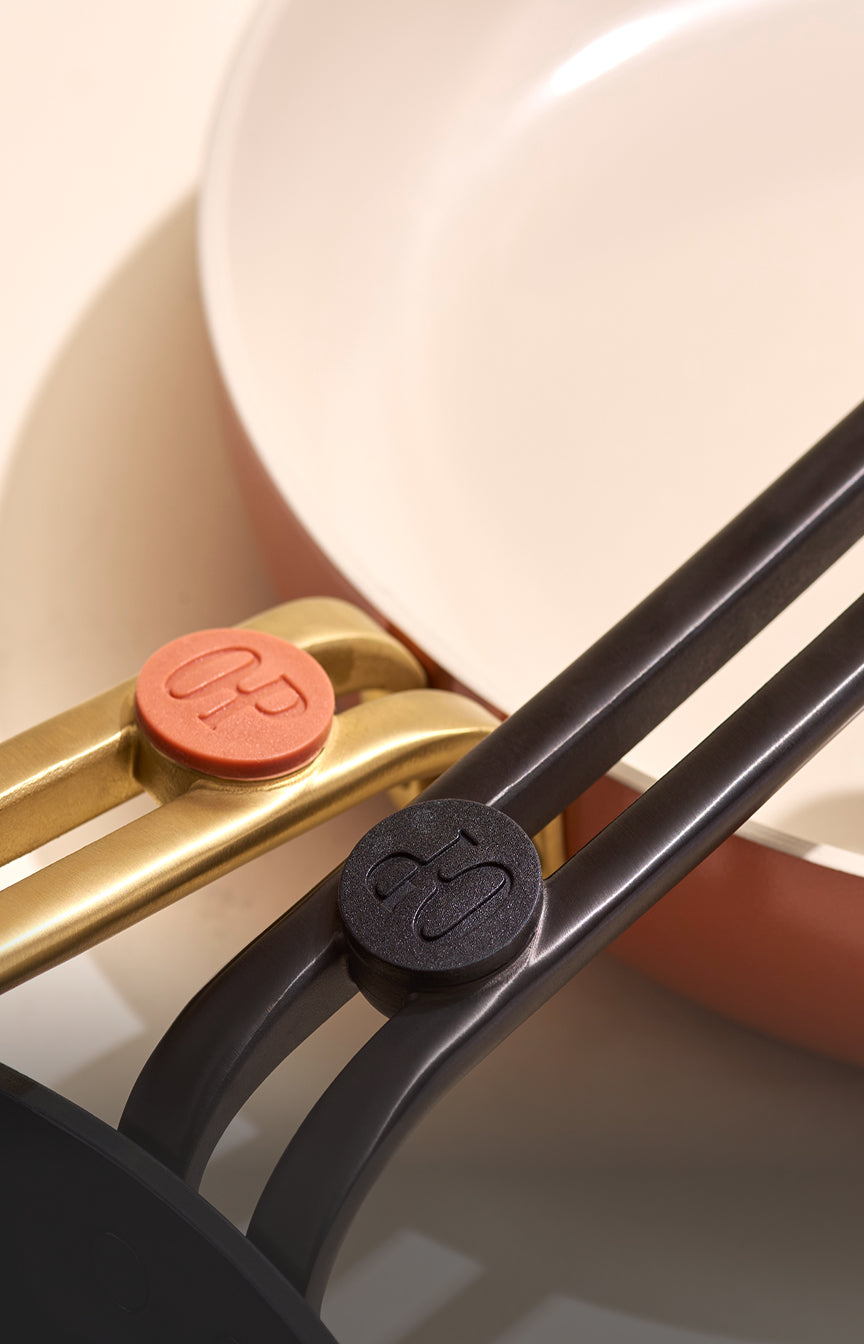
| Handles | Solid cast stainless steel, silicone node | No phenolic or filled-plastic handles anywhere in the heat path. |
| Stated exclusions | Made without PFAS, PTFE, PFOA, lead, cadmium | Our Place's own claim, independently supported for PFAS by the 2022 Consumer Reports screen — which covered 96 compounds, not all of them. |
| Heat limits | Oven safe to 450°F; glass lids to 425°F | Lower than cast iron or stainless. Not a pan for broiling or ripping-hot searing. |
| Care | Hand wash only; no metal utensils; low to medium heat | Adherence here is the single biggest variable in how long the coating lasts. |
| Purchase terms | Free shipping, 100-day trial, free returns | Genuinely lowers the risk of trying it — you can return it after months of use. |
How it actually cooks
Chemistry is why this set is on the site. It is not why you would actually enjoy owning it, so: we have been cooking on it.
Eggs are the honest test of any nonstick pan, and it passed cleanly. Fried and scrambled, the eggs released without sticking and without needing to be chased around the pan with a spatula. Nothing gripped the surface, nothing tore, and there was no welded-on ring left behind at the edge of the white — which is the usual failure point on a mediocre ceramic pan and the first thing to go as a coating ages. Clean-up was a wipe rather than a scrub.
Meat was the more interesting test, because it is where ceramic pans usually reveal their limits. Ceramic wants low-to-medium heat, and searing wants high heat, so the two goals are in tension by design. Cooked within the range Our Place specifies, it handled meat well, and the pressed-aluminium base is genuinely quick and even to heat — you are not fighting cold spots.
The caveat is structural rather than a fault: if you want a hard crust on a steak, this is not the pan, and no ceramic pan is. That is what cast iron and carbon steel are for. Push a sol-gel coating to searing temperatures and you will get your crust once, then spend the next year watching the release properties disappear. Used as intended, for everyday cooking rather than restaurant-style searing, it performs.
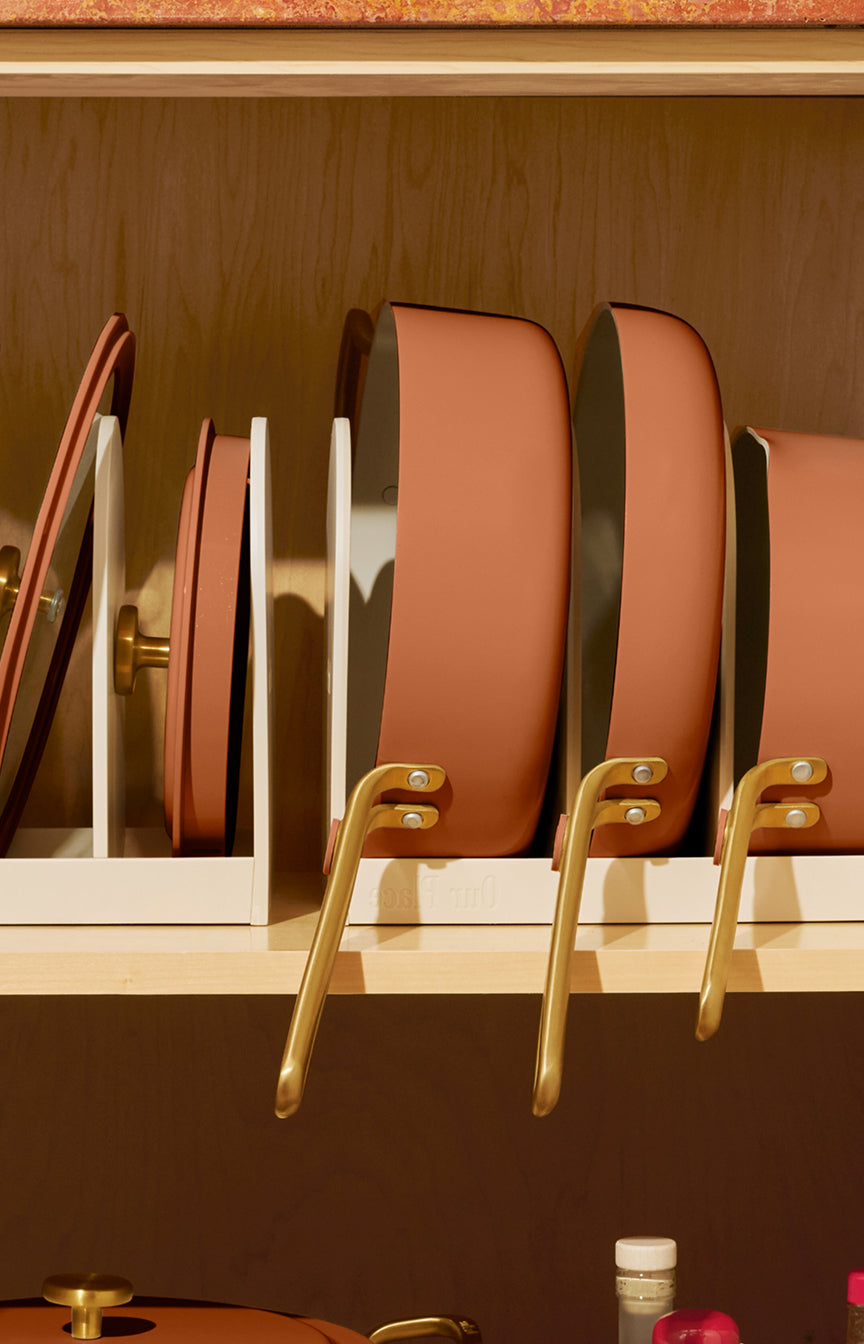
On handling, the specifications translate into real-world behaviour: the pans are noticeably light for their size, the cast stainless handles stay cool enough to grab on the stovetop, and the three-size spread covers most of what a home kitchen actually does day to day. The storage racks looked like a marketing flourish and are not — stacking bare pans is the most common way ceramic coatings get scratched, and keeping them separated is a genuine contribution to lifespan rather than a countertop aesthetic.
First impressions after initial use. We will add long-term findings as the coating ages, including whether release holds up past the twelve-month mark, which is the point at which ceramic pans typically start to decline.
The part that actually matters: sol-gel ceramic vs PTFE
Most cookware coverage treats “nonstick” as a single category with a safety asterisk. For microplastics specifically, the two dominant coatings are not comparable, and the gap is wider than most buyers realise.
PTFE, sold as Teflon, is a plastic. Polytetrafluoroethylene is a fluoropolymer. When the surface is damaged, it releases polymer fragments into food. Luo and colleagues quantified this in 2022 using Raman imaging and a purpose-built counting algorithm: a single scratch released roughly 9,100 particles, and a broken, degraded coating released an estimated 2.3 million micro- and nanoplastic particles.
Two honest caveats on that study, because we would rather you heard them from us. Those are laboratory figures produced under deliberate abrasion, not a measurement of what lands on a dinner plate. And PTFE is biologically inert and largely passes through the gut — the concern is cumulative and environmental, not acute poisoning. Anyone quoting “2.3 million particles in your food” is misusing the paper.
Sol-gel ceramic is not a polymer at all. Thermakind is a silica-based coating applied as a liquid sol and cured to a hard, glass-like gel — Our Place describes it as built primarily from silica, water and alcohol. When a silica coating wears, it does not shed microplastics, because there is no plastic in it to shed. It loses slickness instead.
That is the whole case for this set, and it is a strong one. If your reason for replacing cookware is microplastics, moving off scratched Teflon onto any competent ceramic pan is among the highest-value swaps available in a kitchen. This is a competent ceramic pan.
Where we mark it down
Three deductions. All three apply to the ceramic category generally rather than to Our Place specifically, and none of them changed because the set arrived free.
1. It is a consumable (−0.60 weighted, the largest single deduction). Sol-gel ceramic loses release properties faster than PTFE, typically over two to three years of regular use. Crucially, the main mechanism is thermal, not mechanical: repeated high heat gradually breaks down the cured silica network. This has been our standing position on every ceramic pan we cover, including Caraway and GreenPan, and it stays our position now that we earn a commission on this one. At $249.95 on a three-year cycle you are spending roughly $83 a year on three pans. Cast iron costs $25 once.
2. The formulation is not fully disclosed (−0.15 weighted). Our Place states what the coating is made without. It does not publish the complete composition, and it has not released third-party test reports of its own despite indicating some years ago that it would. Sol-gel coatings in this class commonly include metal-oxide additives for colour, hardness and adhesion. Nothing about that is alarming; nothing about it is verified either. Our rule holds: when a brand does not disclose, we say so rather than guessing.
3. Ceramic coatings are not perfectly inert (no separate deduction — it is a usage caveat, not a defect). Ntim et al. (2017) found measurable migration of ionic titanium, silicon and aluminium from ceramic-coated cookware under acidic conditions. That is ionic migration, not particle shedding, and it is not a microplastics finding — but it is a good reason not to simmer tomato sauce for three hours in any ceramic-coated aluminium pan. Use stainless or enamel for that.
How it compares
| Cookware | Coating | Sheds microplastics? | Realistic life | Price |
|---|---|---|---|---|
| Our Place Essentials Pan Trio | Thermakind® sol-gel ceramic on aluminium | No — silica, not polymer | 2–3 years | $249.95 (3 pans + lids + storage) |
| Caraway Fry Pan | Sol-gel ceramic on aluminium | No | 2–3 years | ~$95 (single pan) |
| GreenPan Valencia Pro | Thermolon™ sol-gel ceramic | No | 2–3 years | $75–$120 |
| Any PTFE / Teflon nonstick | Fluoropolymer | Yes — ~9,100 particles per scratch (Luo 2022) | 3–5 years | Varies |
| Lodge cast iron | None — seasoned iron | No | Lifetime | $20–$40 |
| All-Clad D3 stainless | None | No | Lifetime | $100+ |
| Xtrema pure ceramic | None — solid ceramic body | No | Lifetime if not dropped | $80–$200 |
Read that honestly and it says two things. Against other ceramic sets, Our Place competes on design, storage and the fact that its coating has actually been independently screened — not on being chemically different. Against cast iron and stainless it loses decisively on longevity and cost per year, and wins on being genuinely nonstick for eggs, fish and pancakes.
Which is the real recommendation, and it is the one the category rarely makes: ceramic nonstick should be one or two pans in a kitchen, not the whole kitchen. Cast iron and stainless for searing, braising and anything acidic or long-cooked. Ceramic for the handful of things that genuinely need release.
Getting three years instead of eighteen months
Coating lifespan is the single biggest factor in whether this set is good value, and it is almost entirely under your control:
- Low to medium heat, always. Thermal stress kills sol-gel ceramic faster than scratching does. This is the number one rule and the most commonly broken one.
- Never preheat empty. An empty pan reaches damaging temperatures within a minute or two.
- Hand wash only. Our Place is explicit. Dishwasher detergent is abrasive and strongly alkaline and will visibly dull the surface.
- Wood, silicone or nylon utensils. No metal.
- Let it cool before washing. Thermal shock crazes the coating.
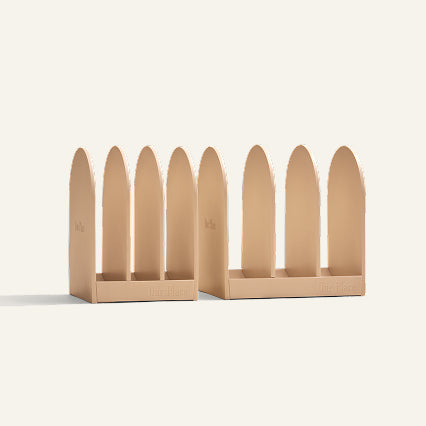
- Use the racks. Stacking bare pans is how coatings get scratched in storage — which is precisely why the storage system is more than a gimmick.
- Skip the cooking spray. Aerosol propellants and emulsifiers polymerise into a sticky residue that is very hard to remove and destroys release.
- Retire it when it chips. Exposed aluminium is a food-contact surface. That is a replacement trigger, not a cook-around-it problem.
Who should buy it
Buy it if you are replacing scratched Teflon; you want nonstick without fluoropolymers; you cook eggs, fish or pancakes regularly; you are short on cabinet space; and you accept a two-to-three-year replacement cycle. The 100-day trial and free returns mean you can test that judgement for months at essentially no risk, which is unusually generous and worth using.
Don't buy it if you want cookware for life; you cook mostly acidic or long-simmered dishes; you sear at high heat; you want everything dishwasher-safe; or you are optimising cost per year. Cast iron and stainless beat it on every one of those, and cost less.
Check current pricing and colours on the Essentials Pan Trio →
Use the App
Cookware is one exposure route. Check the rest.
Storage containers, utensils, kettles and food packaging are usually bigger microplastic sources than your pan. Scan what you already own and get a ranked list of what to change first.
Scan your kitchenSee also our best non-toxic cookware guide, microplastics in cooking utensils, black plastic kitchen utensils, and microplastic-free kitchen swaps.
What the MicroPlastics app checks
- Cookware coating type from the barcode — PTFE, sol-gel ceramic, enamel, bare iron or stainless.
- Whether the coating is a fluoropolymer, the distinction that decides if a worn pan sheds plastic at all.
- Utensil and storage materials, usually a larger kitchen exposure route than the pan itself.
- Heat limits, so you know which pans are oven-safe and which degrade on high heat.
- A ranked replace-first list based on what you actually own.
Frequently Asked Questions
Does Our Place cookware release microplastics?
What score did the Our Place Essentials Pan Trio get?
Is the Our Place Essentials Pan Trio worth $249.95?
Is Thermakind coating safe?
How long does Our Place ceramic nonstick last?
Is the aluminium body a problem?
Can you put Our Place Essentials in the dishwasher?
Ceramic nonstick or cast iron?
What is the return policy?
Sources
- Luo Y, Gibson CT, Chuah C, Tang Y, Naidu R, Fang C (2022). Raman imaging for the identification of Teflon microplastics and nanoplastics released from non-stick cookware. Science of The Total Environment (DOI: 10.1016/j.scitotenv.2022.158293).
- Consumer Reports (2022). You can’t always trust claims on non-toxic cookware — screened the Our Place Always Pan and other pans against 96 PFAS compounds. Consumer Reports.
- Ntim SA, Thomas TA, Begley TH, Noonan GO (2017). Characterisation and potential migration of metals from ceramic-coated cookware under acidic conditions. Food Control / Food Additives & Contaminants.
- Our Place (2026). Essentials Pan Trio (8 piece): published specifications, materials, care instructions, pricing and aggregate customer rating (4.6/5, 68 reviews), retrieved 30 July 2026. fromourplace.com.
Compare your kitchen contact pattern over time
The app turns saved scans into a modeled household contact pattern based on what you cooked in, stored in, and heated this month. The trend describes the assessed mix, not health or bodily exposure.
Download on the App Store- Free on iOS
- 3 free scans
- No sign-up
- Result in seconds
“Really cool to scan stuff around the kitchen and see what's actually in it. The swaps it suggests are realistic.” App Store review · 5.0★
Android · early access
Get the launch email the day Android opens.
One email. No spam. We send when the Android app is in the Play Store, and never again unless you opt in.
Related Research
Pyrex vs Anchor Hocking vs Glasslock: Which Glass Storage Is Actually Safest? (2026)
The glass is the easy part: every mainstream glass storage set ships with a plastic lid, and that is where the remaining microplastic exposure lives. Pyrex vs PYREX explained (the logo rule is a myth: provenance is the real tell), all six brands compared on glass, lid polymer and gasket, plus the lid protocol that costs nothing.
Read moreDoes the Dishwasher Wreck Your Plastic Containers? What the Heat Actually Does (2026)
Yes: measurably. In the one study that actually put containers in a dishwasher, PP lunch boxes shed 14 particles on a cold pre-wash and 166 on a hot 70°C intensive cycle: about 12×. But the real damage is that the dishwasher ages the plastic, so it sheds more every future use. Plus an honest debunk of the viral “920,000 per cycle” claim.
Read moreIs Rubbermaid Safe? Brilliance, Easy Find Lids & the Microwave Verdict (2026)
Every Rubbermaid consumer food-storage line is BPA-free, and for cold storage they are fine. But the line you own matters: Brilliance is rated to only 165°F, while Easy Find Lids and TakeAlongs are polypropylene rated to 212°F. Per-line verdict table, the microwave truth, and why scratches matter more than heat.
Read moreIs Tupperware Safe? BPA, Microwaving, and the Vintage Problem (2026)
Modern Tupperware is BPA-free polypropylene and is fine for cold and room-temperature storage. The two real issues are heat: “microwave safe” does not mean “sheds nothing”: and vintage pieces, where pre-1980s coloured plastics carry documented lead and cadmium pigment concerns. A clear keep/retire rule, with lower-plastic-contact comparisons.
Read moreIs “Microwave Safe” a Lie? What the Label Actually Means (2026)
It means far less than shoppers think. “Microwave safe” is not an FDA certification: it reflects materials-compliance testing that measures chemical migration into food simulants and whether the container melts. It does not count plastic particles. What the label does and does not cover, and what the research actually found.
Read moreAre Vacuum Sealer Bags Safe? FoodSaver, Sous Vide & Freezing: What Releases Microplastics (2026)
Freezing in FoodSaver bags is near-zero risk: cold suppresses migration. Sous vide for hours at 130–165°F is the case worth understanding, and boiling is the one to skip. The full use-case risk ladder for vacuum-sealed food, plus the silicone and glass swaps that close the gap.
Read more