Is Ceramic Cookware Safe? “Ceramic” Means Four Different Things
Last reviewed: by the MicroPlastics Research Desk. Submit a correction or see our editorial standards.
Quick Answer
Different container in your kitchen? Review its confirmed or estimated material and Product Contact Signal, then compare a lower-contact option.
Scan my product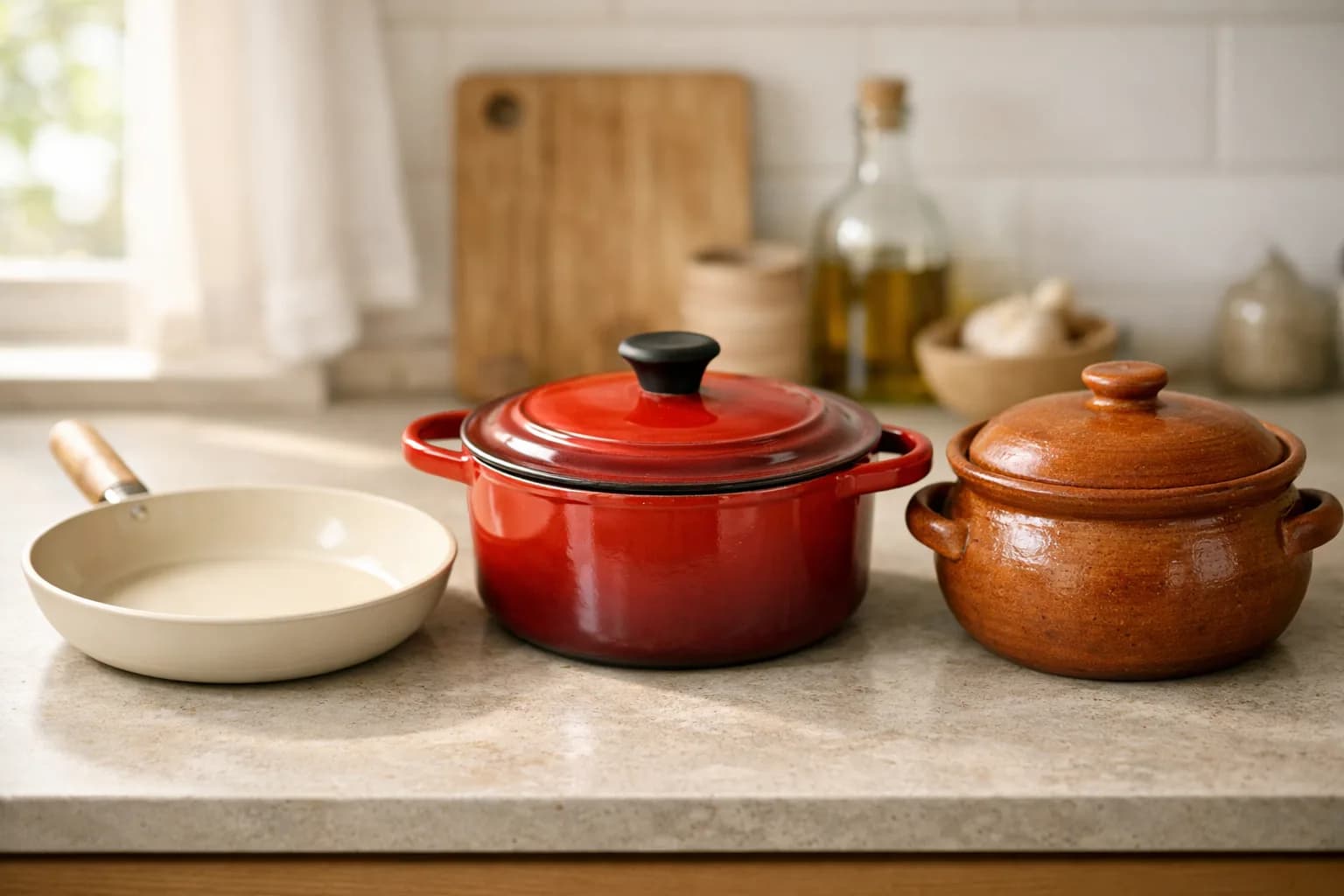
Key Takeaways
- Know which “ceramic” you own. Coated aluminium, enamelled iron, solid ceramic and glazed clay are different materials with different risks.
- Ceramic nonstick is PFAS-free, not plastic-free in the strict sense. Commercial coatings studied contained TiO2 and silica in a silicone polymer matrix.
- Coatings are consumables. Brands limit coating warranties, and once the coating wears through, food touches the aluminium.
- Enamel is fine until it chips. Le Creuset says to stop using a pot with a chipped interior, because the chips could hurt you if swallowed.
- “Lead-free” is rarely literal. Xtrema’s posted total-lead tests found about 30 mg/kg against a 100 mg/kg threshold.
- The clay pot is the one to question. Lead-glazed pots pushed lead in cooked rice above Mexico’s limit.
What the ceramic cookware evidence actually shows
- what holds commercial “ceramic” coatings together
- Silicone matrix
- rutile TiO2 and quartz particles embedded in a silicone polymer, per electron microscopy and FTIR
- Golja et al. 2017
- titanium-containing particles into food simulants
- 861 µg/L
- after 2 hours at 100 °C; scratch tests showed possible nanoparticle release
- Golja et al. 2017
- total lead in an Xtrema skillet test
- ~30 mg/kg
- against a 100 mg/kg Prop 65 settlement threshold; a total-content test, not a leach test
- SGS report posted by Xtrema, April 2024
- lead in rice cooked in lead-glazed clay
- 1.27 ppm
- after 30 minutes; Mexico’s limit is 0.5 ppm
- Cantoral et al. 2026
What does “ceramic cookware” actually mean?
Most articles answer this question for one product type and ignore the rest. Brands that sell ceramic-coated pans define “ceramic” as their coating; brands that sell solid ceramic define it as theirs. In a store, the word covers at least four materials, plus one lookalike:
| Type | What it is | Examples | The real safety question |
|---|---|---|---|
| Ceramic nonstick | Thin sol-gel coating (silica-based) sprayed onto aluminium | Caraway, GreenPan, Our Place Always Pan | Particle wear, and exposed aluminium once worn |
| Enamelled cast iron or steel | Glass enamel fused onto metal at high temperature | Le Creuset, Staub | Chipping; pigments in old or unknown pieces |
| Solid ceramic | Fired clay body, glazed, no metal core | Xtrema, Emile Henry | Trace lead or cadmium in glaze and clay |
| Traditional glazed clay | Hand-made or regional pottery, often lead-glazed | Traditional Mexican cazuelas; unlabelled imports | Lead leaching into food, especially acidic |
| Lookalike: “granite” or “stone” | Often PTFE nonstick with mineral-look specks | Many budget sets | Check the label for PTFE |
Is ceramic nonstick (Caraway, GreenPan) safe?
On the question most buyers are asking, yes: it doesn’t contain PTFE or other PFAS. In August 2025, the National Advertising Division, the ad industry’s self-regulator, reviewed a challenge to Caraway’s marketing. It found Caraway had a reasonable basis to call its own cookware “free of PFAS” and “non-toxic”. It also found Caraway had not supported claims that competitors’ nonstick pans are toxic, and recommended it stop making them. Both halves matter: ceramic is a real alternative to PTFE, and PTFE at normal cooking temperatures isn’t the poison it is sometimes marketed as.
What the marketing leaves out is what the coating is. “Sand-derived” and “mineral-based” are accurate for the silica. But when Slovenian researchers took commercial ceramic nonstick coatings apart with microscopy and spectroscopy, they found micron- and nano-sized titanium dioxide and quartz particles embedded in a silicone polymer matrix. Silicone isn’t a carbon-chain plastic like PTFE, and it isn’t a PFAS. But it is a polymer, and “pure mineral” is not an accurate description.
Does ceramic nonstick shed particles?
Under wear, some. In the 2017 study the coating was heat-stable in normal use, but scratch and wear tests showed titanium-containing nanoparticles can come loose, and used pans showed the same wear. The brands weren’t named, and the health meaning is unknown; it is a different exposure from the titanium dioxide food additive the EU banned after EFSA couldn’t rule out genotoxicity. It does settle the marketing line: a scratched ceramic pan sheds something, just not PTFE.
What happens when the ceramic coating wears out?
Ceramic coatings lose their slickness faster than PTFE, and brands treat them as wear items. GreenPan limits its coating warranty to two years, and Caraway and Our Place exclude heat damage and normal wear. Underneath is usually aluminium: Caraway’s pans have an aluminium body, and Our Place’s Always Pan is cast aluminium. Once the coating wears through to shiny metal, food is cooking on bare aluminium, which moves into food more readily with acidic or salty dishes. That is the point to replace the pan, not when it first starts to stick. Heat speeds the wear, so the brands’ own advice holds: low to medium heat, never preheat empty, and no aerosol sprays, which leave residue that builds up.
Disclosure: MicroPlastics has an affiliate relationship with Our Place. There are no affiliate links on this page, and it did not affect this assessment. See our affiliate disclosure.
Use the App
Which “ceramic” is in your kitchen?
Scan the pan or its box. The app tells coated aluminium from enamel, solid ceramic and glazed clay, flags PTFE hiding behind “granite” or “stone” labels, and tells you when a worn coating means replace.
Scan my cookwareIs enamelled cast iron (Le Creuset) safe?
Yes, while the interior is intact. Enamel is a layer of glass fused to cast iron at high temperature. It has no coating to wear off in the nonstick sense and doesn’t shed plastic. The main hazard is physical. Le Creuset’s care instructions are blunt: “NEVER use a product when the interior enamel has chipped. It is no longer safe to use and you should immediately CEASE USING the product. Chips from damaged enamel could cause personal injury if ingested.” The same instructions warn that high heat and fast temperature changes cause crazing, cracks and chips, which is why the brand advises low to medium heat.
Bright exterior colours on vintage or unknown enamel may use cadmium or lead pigments, a separate question from the cooking surface. For current pans, check the brand’s chemical disclosure for your colour; retire vintage pieces with a chipped or worn interior.
Is solid ceramic (Xtrema) lead-free?
No coating, no metal core and no PFAS. Xtrema describes its cookware as 100% ceramic and says lead is not an ingredient, while noting its raw materials “come from the earth”, so it tests every shipment. Its posted lab reports are worth reading closely. The April 2024 skillet report we opened uses CPSC-CH-E1002-08.3, a method that measures the total lead in the material, rather than how much leaches into food. It found 29–30 mg/kg of lead against the 100 mg/kg threshold used in California Prop 65 settlements, and no detectable cadmium. Total content is the stricter test, since only a fraction ever leaches, so this is a pass. It also means “lead-free” isn’t literal for solid ceramic, which is true of most glazed ware. The practical trade-offs are weight, fragility and a surface that needs oil and low heat to release food.
Are clay pots and traditional ceramics safe?
This is where the real risk is. Traditional glazes have long used lead oxide because it melts at low temperatures, and heat and acidity pull lead out. In a 2026 study of traditional Mexican cookware, lead-glazed pots had extremely high lead on their surfaces. Rice cooked for 30 minutes in them took up 1.27 ppm of lead, more than twice Mexico’s 0.5 ppm limit. In acidic solutions, leaching climbed much higher. Pots with lead-free glazes leached little. The FDA warns that washing or boiling doesn’t remove lead from pottery. Its red flags are hand-made or antique pieces, pieces bought abroad or at flea markets, and bright glazes.
Branded clay cookware is not the same as a traditional lead-glazed pot, but many brands don’t publish leach data. Before using a clay pot for daily cooking, especially acidic dishes or food for children, ask for a lead and cadmium leach test. If there isn’t one, keep it for display.
Ceramic or PTFE nonstick: which is safer?
Ceramic avoids fluoropolymers entirely, which matters if you want to keep PFAS out of your home. Several states now ban new cookware with intentionally added PFAS, starting with Minnesota in 2025. PTFE lasts longer and releases food better, and at normal temperatures intact PTFE is stable. Both coatings wear, and both shed particles when scratched: fluoropolymer from PTFE, silica and titanium from ceramic. If you want no coating at all, stainless steel, cast iron, carbon steel and intact enamel are the only options that don’t wear away. For a brand that switched from one to the other, see is HexClad non-toxic?
| Type | Verdict | What to do |
|---|---|---|
| Ceramic nonstick on aluminium | PFAS-free; low acute risk; a consumable | Low–medium heat, no metal tools; replace when worn to metal |
| Enamelled cast iron | Low risk while the interior is intact | Stop using if the interior chips; avoid thermal shock |
| Solid ceramic | Low risk from brands that publish tests; not literally lead-free | Read whether tests are total content or leach |
| Traditional glazed clay | Highest risk if lead-glazed | No acidic food; ask for a leach test or don’t cook in it |
| “Granite” / “stone” nonstick | Often PTFE under another name | Check the label for PTFE |
Related: the best non-toxic cookware, ranked, our Our Place pan review, and why “ceramic” rice-cooker pots aren’t always PFAS-free.
What the MicroPlastics app checks
- Which of the four “ceramic” types a pan actually is.
- PTFE hiding behind “granite”, “stone” or “diamond” labels.
- Wear signs that mean a coated pan is at the end of its life.
- Whether a brand’s lead testing is a leach test or a total-content test.
Frequently Asked Questions
Is ceramic cookware safe?
Is Caraway non-toxic?
Is ceramic nonstick better than Teflon?
Is Le Creuset non-toxic?
Does Xtrema cookware contain lead?
Is scratched ceramic cookware safe?
Sources
- Golja V, Dražić G, Lorenzetti M, et al. (2017). Characterisation of food contact non-stick coatings containing TiO2 nanoparticles and study of their possible release into food. Food Additives & Contaminants Part A 34(3):421.
- BBB National Programs, National Advertising Division (2025). Caraway Home, Inc.: NAD finds certain claims supported; recommends Caraway discontinue or modify comparative claims (14 August 2025). BBB National Programs.
- Caraway Home (2026). Fry Pan — ceramic nonstick, PTFE-free, oven safe up to 550°F (retrieved 21 September 2026). Caraway.
- Le Creuset (2024). Care and use — “NEVER use a product when the interior enamel has chipped” (Internet Archive capture, 13 October 2024). Le Creuset.
- Xtrema (Ceramcor) (2026). Product testing — posted SGS California Prop 65 reports; FAQ on lead and raw materials (retrieved 21 September 2026). Xtrema.
- SGS for Xtrema (2024). 9-inch skillet, CA Prop 65 test — total lead by CPSC-CH-E1002-08.3: 29–30 mg/kg (limit 100); cadmium not detected (2 April 2024). SGS.
- Cantoral A, Betanzos-Robledo L, Sefton E, et al. (2026). Lead leaching from traditional Mexican ceramics during cooking and implications for population health risk. Science of the Total Environment 1050:182224.
- US Food and Drug Administration (2017). Questions and answers on lead-glazed traditional pottery. FDA.
- European Food Safety Authority (2021). Safety assessment of titanium dioxide (E171) as a food additive. EFSA Journal.
- Minnesota Legislature (2023). Minn. Stat. §116.943 — cookware with intentionally added PFAS prohibited from 1 January 2025. Office of the Revisor of Statutes.
Compare your kitchen contact pattern over time
The app turns saved scans into a modeled household contact pattern based on what you cooked in, stored in, and heated this month. The trend describes the assessed mix, not health or bodily exposure.
Download on the App Store- Free on iOS
- 3 free scans
- No sign-up
- Result in seconds
“Really cool to scan stuff around the kitchen and see what's actually in it. The swaps it suggests are realistic.” App Store review · 5.0★
Android · early access
Get the launch email the day Android opens.
One email. No spam. We send when the Android app is in the Play Store, and never again unless you opt in.
Related Research
Non-Toxic Rice Cookers: What the Makers’ Own Chemical Filings Say
Zojirushi lists PTFE or PFA for its rice cookers, “platinum” included, and a “ceramic” Tiger lists PFAS. Uncoated stainless pots start near $55, and rinsing rice matters more than either.
Read moreKourtney Kardashian's Poosh Kitchen Swaps: A Microplastics Check
Kourtney Kardashian's Poosh recommends plastic-free kitchen swaps. Compare glass, steel, lids, silicone and bamboo labels before changing your food storage.
Read moreThe Bamboo Plate Is Melamine in 20 Cases Out of 21
A 2025 Food Control analysis detected melamine in 20 of 21 food-contact articles sold as bamboo — and the EU never authorised bamboo flour in plastics at all, because bamboo is a grass and the wood-flour clearance does not reach it. The label is not a test you can run.
Read moreBlending Ice for 30 Seconds Released Hundreds of Millions of Plastic Particles
Thirty seconds of blending ice in a plastic jar released an estimated 0.36–0.78 billion micro- and nanoplastic particles. The mechanism is abrasion, not heat — which is why "BPA-free" and "Tritan" do not answer the question, and why the fixes are mechanical and mostly free.
Read moreCan You Microwave Rubbermaid? The 30-Second Rule Nobody Follows
Rubbermaid says reheating only, and defines it as a short peak: "maintaining temperatures at 165°F or higher for more than 30 seconds is considered cooking, and is outside the intended use of these products." The twist is that the premium Brilliance line is capped at 165°F while the budget TakeAlongs handles 212°F.
Read moreCan You Microwave a Solo Cup? Solo's Own Answer Is No
No, and Solo says so plainly — its cups are "not intended for microwave usage or hot food/beverages". Red cups are #6 polystyrene, which softens around 170°F, below the temperature of hot coffee. Every product line by material, plus the one Solo line that is actually microwavable.
Read more