Can You Microwave a Solo Cup? Solo's Own Answer Is No

Last reviewed: by the MicroPlastics Research Desk. Submit a correction or see our editorial standards.
Quick Answer
Different container in your kitchen? Review its confirmed or estimated material and Product Contact Signal, then compare a lower-contact option.
Scan my product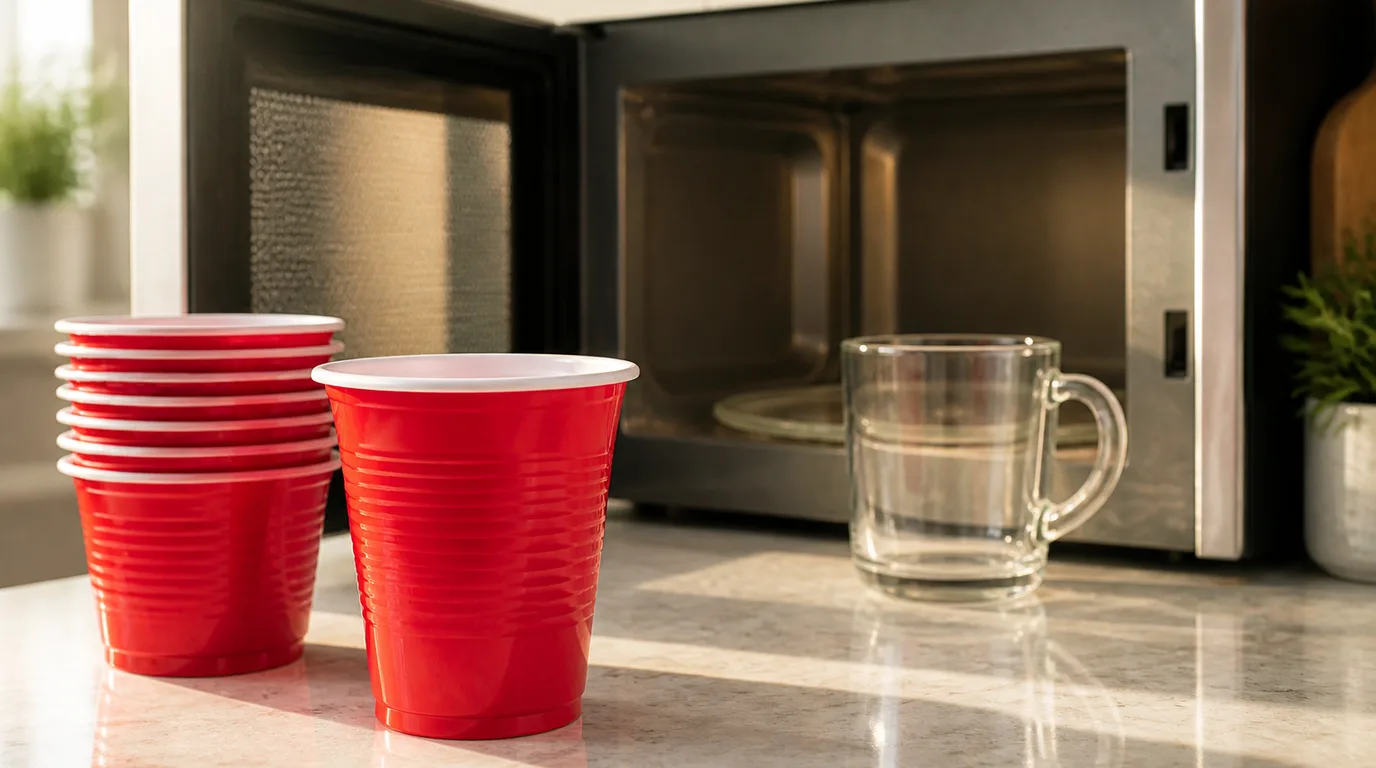
Key Takeaways
- Solo's own product information says red, clear, Ultra Colors and refill cups are not intended for microwave use or hot food and drink.
- Red Solo cups are #6 polystyrene. Clear Solo cups are #1 PET. Neither is microwave-rated.
- Polystyrene softens near 170°F. Coffee is served hotter than that. This is a physical limit, not a legal disclaimer.
- Heating polystyrene is associated with styrene release — a separate concern from particles, and the reason the material is singled out.
- Solo paper plates and bowls can be microwaved, for reheating only. That is the one green light in the range.
- The paper hot cups are for hot drinks but still not for the microwave, and their lids are #6 plastic.
- Polystyrene is also one of the four polymers that crossed a placental barrier model in 2026, which is worth knowing if you are pregnant.
What Solo states about its own products
- red Solo cups, plates and bowls
- #6 PS
- polystyrene — the same resin as foam takeaway containers
- Solo product information
- clear Solo cups
- #1 PET
- also stated as not intended for microwave or hot beverages
- Solo product information
- where polystyrene starts to soften
- ~170°F
- below the serving temperature of hot coffee, never mind a microwave
- polystyrene material properties
- the one microwavable Solo line
- Paper only
- paper plates and bowls, for reheating — not any cup
- Solo product information
Why this question keeps getting a vague answer
Search this and you will mostly find hedging — “it's not recommended,” “probably avoid it.” That is odd, because Solo is unusually direct. Its published product information states outright that the cups are not intended for microwave usage or hot food and beverages.
There is a reason the wording covers hot drinks as well as the microwave, and it is the most useful thing on this page: a red Solo cup is not rated for hot coffee either. The microwave question is really a temperature question, and plenty of people who would never microwave one will happily pour tea into it at a barbecue.
The whole Solo range, by what you can actually do with it
| Product | Material | Microwave? | Note |
|---|---|---|---|
| Red party cups, plates, bowls | #6 polystyrene | No | Solo: not intended for microwave use or hot food/beverages. Cold drinks only. |
| Clear cups (9, 10, 18 oz) | #1 PET | No | Different plastic, same guidance. The 18 oz includes 20% recycled content. |
| Ultra Colors cups and plates | #6 polystyrene | No | Same as the red range. |
| Refill cups (3, 5 oz) | #6 polystyrene | No | The small bathroom-style cups. Same material. |
| Paper hot cups (12, 16 oz) | 95% plant-based, #6 lid | No | Rated for hot drinks but not for microwaving. The lid is still polystyrene. |
| Paper plates and bowls | 99% plant-based | Yes, reheating only | The one green light. Solo warns the plate itself gets hot — take care removing it. |
Two things in that table catch people out. The paper hot cup is for hot liquid but not for the microwave — those are different tests, and a cup that survives being filled with coffee is not necessarily one that survives being heated from the inside. And the lid on that paper cup is polystyrene, so the most heat-exposed component in a hot drink is the part sitting directly above the steam.
What actually happens if you microwave one
Polystyrene begins to soften at roughly 170°F (77°C). A microwave heats the contents, and the contents heat the cup, so a mug of water taken to near boiling puts the wall of that cup well past its softening point.
In practice you get one of three outcomes, and none of them are good:
- Deformation. The cup buckles or the base collapses, usually while you are holding it.
- Leaching. Heating polystyrene is associated with the release of styrene into food and drink. That is a chemical migration question rather than a particle one, and it is the specific reason polystyrene attracts more scrutiny than most food plastics.
- Particle release. Heat is the dominant driver of microplastic shedding from any polymer, which is the same mechanism we covered for Ziploc bags and plastic containers generally.
Worth saying clearly: one accidental cup of microwaved water is not a health event. Nobody should spend the evening worrying about it. The reason to stop is that the habit is easy to break and the alternative is a mug you already own.
The polystyrene footnote worth knowing
Polystyrene turns up more than its share in the research. In a July 2026 study of a human placental barrier model, polystyrene was one of four polymers that crossed — and the one most associated with reduced estrogen in that model.
That study is cells in a dish, not a pregnancy, and we are not going to stretch it into a claim about party cups. But if you are pregnant and looking for a cheap change, swapping foam and polystyrene cups for glass or steel is one of the few that costs nothing and targets a polymer that keeps appearing in the literature.
Use the App
Find the polystyrene in your kitchen
Scan cups, takeaway containers and lids with MicroPlastics to see the resin, a 0–100 risk score, and what to use instead when heat is involved.
Get the MicroPlastics appWhat to actually do
- Use a mug. Ceramic or glass. The entire question disappears and you already own one.
- Do not put hot drinks in red Solo cups either. This is the part most people miss — the guidance covers hot beverages, not just microwaves.
- If you must microwave something Solo-branded, use the paper plates. They are the only line cleared for it, and only for reheating.
- Watch the lid, not the cup. On a paper hot cup the polystyrene lid sits in the steam. Drink without it where you can.
- Never reuse a warped or clouded cup. Deformation means the polymer has already been past its limit.
For the broader safety picture see are red Solo cups safe, which covers party supplies as a whole. For the same question about bags, can you microwave Ziploc bags. For what the label actually promises, can you microwave Rubbermaid, andis “microwave safe” a lie.
Frequently Asked Questions
Can you microwave a Solo cup?
Are red Solo cups microwave safe?
What are red Solo cups made of?
Is any Solo product microwave safe?
What happens if you microwave a Solo cup?
Sources
- Solo (Dart Container Corporation) (2026). Solo product information — materials and microwave guidance by product line. solocup.com.
- van Boxel, J. et al. (2026). Effects of different micro- and nanoplastic polymers on steroidogenesis in a feto-placental in vitro model (polystyrene crossed the barrier and reduced estrogen). Molecular and Cellular Endocrinology.
- European Food Safety Authority (2025). Microplastics and nanoplastics in food (heat and contact time as dominant release drivers). EFSA.
After install · scan this first
Open the camera and scan the cups and lids you actually drink hot things from.
Solo publishes its resins; almost nobody else does. Scan the cup in your hand to see whether it is polystyrene, PET or paper — and whether its lid is the worst part.
Android · early access
Get the launch email the day Android opens.
One email. No spam. We send when the Android app is in the Play Store, and never again unless you opt in.
Related Research
Can You Microwave Ziploc Bags? Reheat Only—Never Cook
Yes for defrosting and reheating only; no for cooking — only Zip’n Steam is cleared for that. What SC Johnson states, why the bag must be vented, and the particle question approval was never designed to answer.
Read moreOur Place Essentials Pan Trio Review: 8.7/10 — The Microplastics Verdict (2026)
Scored 8.7/10 against a published rubric. Thermakind sol-gel ceramic is silica-based, not fluoropolymer, so it has no mechanism to shed microplastics the way a scratched Teflon pan does (~9,100 particles per scratch, Luo 2022). Full scoring breakdown, the Consumer Reports 96-compound PFAS screen, and the 2–3 year replacement cycle we won’t pretend away.
Read morePyrex vs Anchor Hocking vs Glasslock: Which Glass Storage Is Actually Safest? (2026)
The glass is the easy part: every mainstream glass storage set ships with a plastic lid, and that is where the remaining microplastic exposure lives. Pyrex vs PYREX explained (the logo rule is a myth: provenance is the real tell), all six brands compared on glass, lid polymer and gasket, plus the lid protocol that costs nothing.
Read moreDoes the Dishwasher Wreck Your Plastic Containers? What the Heat Actually Does (2026)
Yes: measurably. In the one study that actually put containers in a dishwasher, PP lunch boxes shed 14 particles on a cold pre-wash and 166 on a hot 70°C intensive cycle: about 12×. But the real damage is that the dishwasher ages the plastic, so it sheds more every future use. Plus an honest debunk of the viral “920,000 per cycle” claim.
Read moreIs Rubbermaid Safe? Brilliance, Easy Find Lids & the Microwave Verdict (2026)
Every Rubbermaid consumer food-storage line is BPA-free, and for cold storage they are fine. But the line you own matters: Brilliance is rated to only 165°F, while Easy Find Lids and TakeAlongs are polypropylene rated to 212°F. Per-line verdict table, the microwave truth, and why scratches matter more than heat.
Read moreIs Tupperware Safe? BPA, Microwaving, and the Vintage Problem (2026)
Modern Tupperware is BPA-free polypropylene and is fine for cold and room-temperature storage. The two real issues are heat: “microwave safe” does not mean “sheds nothing”: and vintage pieces, where pre-1980s coloured plastics carry documented lead and cadmium pigment concerns. A clear keep/retire rule, with lower-plastic-contact comparisons.
Read more