CamelBak Eddy+: Tritan Renew, Steel and the Bite Valve

Last reviewed: by the MicroPlastics Research Desk. Submit a correction or see our editorial standards.
Quick answer
Holding a different bottle? Review its confirmed or estimated material and Product Contact Signal, then compare a lower-contact option.
Scan my product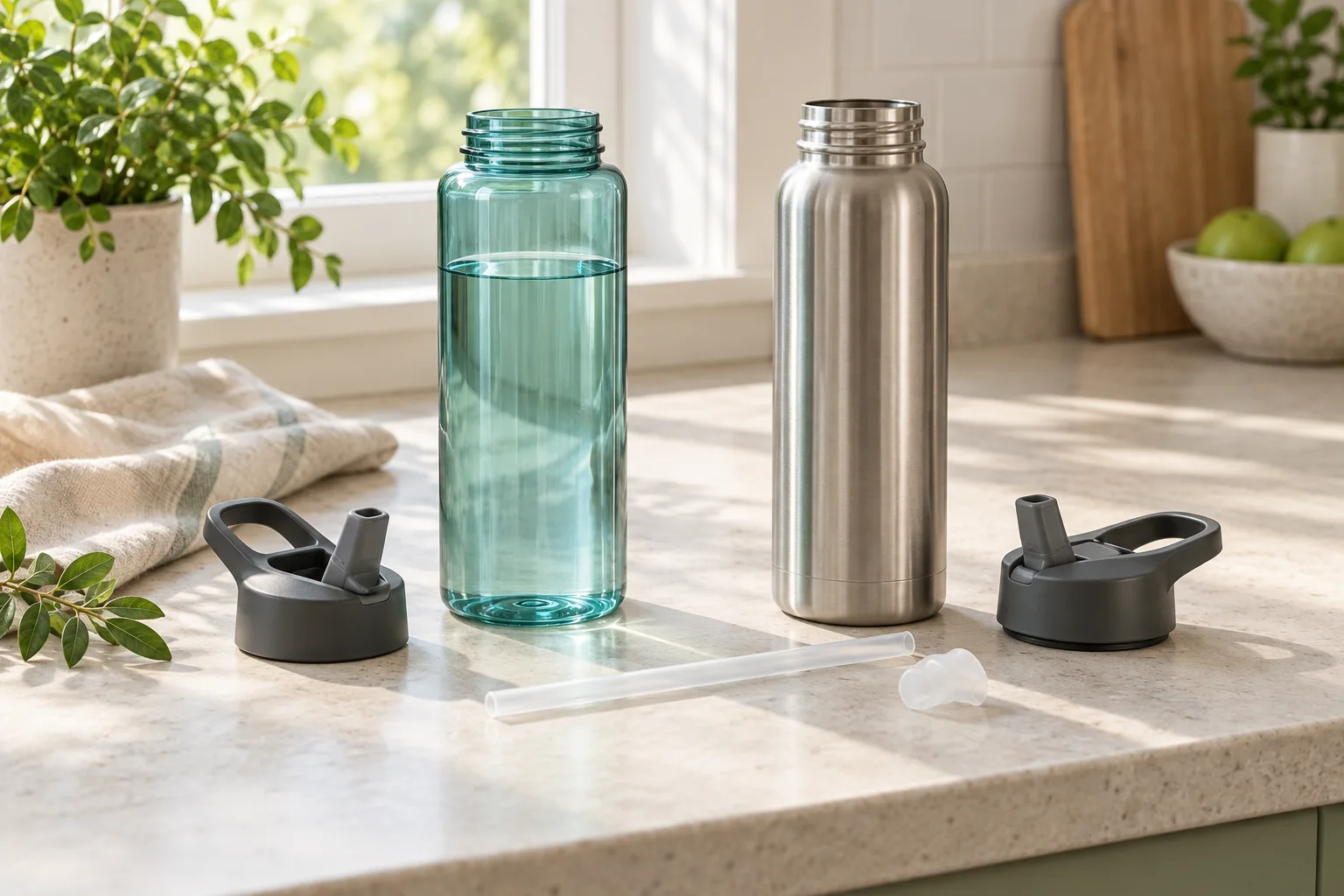
Key Takeaways
- The comparison below uses two named adult 32oz listings, not every product carrying a CamelBak logo.
- A whole-product composition percentage cannot tell you what fraction of a sip touched each material.
- Renew refers to recycled-content sourcing. It does not mean the polymer disappears or is biodegradable.
- The silicone bite valve is a separate part to inspect and clean; do not force a brush through its slit.
- Steel offers a different vessel surface, but a lower particle count needs an actual comparative test.
Start with the exact Eddy+ model
A search for “CamelBak microplastics” can mix adult bottles, children’s bottles, hydration reservoirs and cycling squeeze bottles. That is too broad for a useful answer. This comparison checks the adult Eddy+ 32oz Tritan Renew listing, style CB-2464, against the Black insulated steel 32oz listing, style CB-1650001001. Manufacturer pages were reviewed on October 6, 2026.
The clear-bottle listing identifies Tritan Renew for the vessel. The steel listing identifies 304 stainless steel in its composition table and a plastic cap in its description. Both use the Eddy+ straw-and-bite-valve format. Neither should be described simply as “all plastic” or “all metal”: the assembled bottle contains several materials with different roles.
Check your bottle’s capacity, model and replacement cap before applying the comparison. A borrowed cap, a previous-generation part or a filtered version may change the assembly. Our children’s water-bottle guide covers that separate decision; the adult cleaning sequence is not an instruction to dismantle a child’s valve.
Tritan Renew versus steel: what the listings disclose
| Model | Vessel material | Other listed materials |
|---|---|---|
| Eddy+ Tritan Renew, CB-2464 | 80% Tritan in the composition table | 10% PP copolymer, 5% LDPE, 5% silicone |
| Insulated Eddy+, CB-1650001001 | 80% 304 stainless steel in the composition table | 10% PP copolymer, 5% LDPE, 5% silicone |
These are the manufacturer’s whole-product declarations, not our measurements. The table does not assign every percentage to a named component or describe its analytical basis. We therefore do not label the entire straw LDPE merely because LDPE appears in the list. The manufacturer’s cleaning guidance does specifically identify the bite-valve slit as silicone.
A percentage in a bill of materials also does not measure exposure. The large vessel can dominate an assembly while a small mouthpiece is used with every sip. Conversely, a carry handle may contribute to the materials list without normally touching the drink. Follow the actual use path: stored water, straw, valve and mouth. Include the underside of the lid when the bottle is filled high or carried on its side.
Choosing steel replaces the principal storage wall. It does not automatically replace the rest of that path. If your aim is fewer polymer drinking surfaces, compare the mouth opening and closure as carefully as the vessel. A simple open-mouth design may better match that preference than a complicated straw cap; that is a design comparison, not a verified ranking of particles swallowed.
What “Tritan Renew” and “BPA-free” mean
Eastman describes Tritan as a copolyester plastic and Renew as molecularly identical to Tritan, with up to 50% certified recycled content allocated through ISCC mass balance. That is a sourcing and accounting description. It is not a claim that half the bottle is a nonplastic material, and it does not establish a smaller shedding rate than another bottle.
BPA is a chemical; microplastics are physical particles. The steel Eddy+ listing describes testing for BPA at a stated detection threshold of one part per million or greater. That does not count polymer particles in water. A test for one chemical and a test for pieces of polymer answer different questions, even when both appear in discussions of plastic.
For the same reason, food-contact compliance cannot be translated into “zero particles after years of biting and washing.” Nor does the word plastic establish that using the bottle causes a particular disease. The useful question is what was measured, in which finished product, under what conditions. See our Tritan explainer for the distinction between the material and particles made from it.
Do we know how many microplastics an Eddy+ releases?
The product, care and material sources reviewed for this article do not report an Eddy+-specific release rate. We have not commissioned a bottle test. A numerical estimate would therefore need evidence beyond the declarations above; assigning another brand’s result to CamelBak would create false precision.
Sobhani and colleagues’ 2020 packaging study observed particle generation during tearing, cutting and twist-opening plastic packaging, including bottle caps. It supports the general point that mechanical actions can generate particles. It did not measure the Eddy+ silicone bite valve, its aged straw or the difference between these two vessels. We do not convert its results into particles per CamelBak sip.
A useful comparative study would test new and used assemblies with the same water and cleaning cycle, include blanks for background contamination, identify particle polymers and state the size range the method can detect. It would also separate particles originally present in the fill water from those added during use. Without those controls, changing the vessel could appear to change a result for unrelated reasons.
A September 2026 shaker-bottle study included Tritan and observed measurable release. That is a different mechanism and use pattern from ordinary sipping. It is a reason to examine the vessel as well as the cap, not a particle-count estimate for Eddy+.
The FDA’s current food guidance says available evidence does not demonstrate that detected levels pose a human-health risk. It also describes important research and measurement gaps. This is broad context, not an FDA certification of a CamelBak bottle. Keeping that distinction allows a practical materials preference without presenting an unproven medical benefit.
Clean the valve without damaging it
CamelBak’s adult Eddy cleaning instructions say to remove the straw and bite valve, wash by hand with warm soapy water or on the dishwasher’s top rack, and reassemble as directed. The brand specifically warns that forcing a bottle brush through the slit can tear the silicone. Its general care page includes Eddy+ among dishwasher-safe products and places caps on the top rack.
A clean vessel with an unclean drinking assembly is an incomplete routine. Inspect the removable parts where you can actually see them. If a valve is torn, a straw is cracked or a part no longer fits, seek the correct replacement rather than treating extra scrubbing as a repair. Check the instructions supplied with your own assembly when they differ from a general help page.
Visible damage is a reason to address the part, not a home particle assay. A perfectly clear valve can still be untested for microscopic release; a cloudy appearance does not identify the number or composition of particles. Avoid aggressive experiments intended to “prove” purity by stretching, cutting or abrading a working mouthpiece.
A steel body does not make the straw a hot-drink lid
CamelBak’s UK FAQ advises against boiling-hot liquids and specifically notes the burn risk of drinking through an Eddy straw. The important practical distinction is between insulation and a suitable drinking interface. A bottle’s ability to retain temperature is not permission to put boiling liquid behind every cap it accepts.
Use a mug and closure intended for the beverage you drink, following the exact model’s instructions. Swapping in a metal straw does not establish temperature suitability or remove the cap and seal from contact. It may also change the fit. This is a handling question as well as a materials question; neither should be decided from the word stainless alone.
The filtered Eddy+ is a different product
The reviewed 20oz clear Eddy+ filtered by LifeStraw listing combines a Tritan Renew vessel with a filter assembly. CamelBak claims microplastic removal and says usable capacity is 14oz with the filter installed. Those details belong to that filtered model, not to the ordinary Eddy+ simply because both have a straw.
A removal claim needs a test protocol to define particle sizes, test conditions and service life. It also does not prove that every downstream drinking component adds nothing. We have not verified a complete, finished-bottle nanoplastic-removal result from this listing, so we do not describe its output as particle-free. Buy filtration for a documented water-treatment need and maintain it according to its own instructions.
Which choice makes sense for your routine?
| Your priority | What to compare |
|---|---|
| Replace a plastic vessel wall | A steel body, while acknowledging the remaining straw and cap |
| Reduce polymer contact while drinking | Mouth opening, lid underside, straw, valve and seal as a complete path |
| Keep a useful bottle working | Correct cleaning, intact parts and model-compatible replacements |
| Treat a specific water problem | Exact filtered model, documented performance and cartridge maintenance |
If an intact Eddy+ suits your routine, the evidence reviewed here does not establish that you must discard it. If you are choosing a new bottle, make the preference explicit: a different vessel surface, a simpler drinking path or easier cleaning. Those are observable design differences. A promise of zero microplastics or a quantified reduction in personal health risk would require evidence this comparison does not have.
For another example of the same whole-path assessment, see HydroJug Traveler’s lid and straw. Our steel bottle guide is a place to compare formats; check the current model disclosures before treating a brand name as a material specification.
Use the App
Keep track of the bottles and parts you use
Save product assessments and compare declared materials. The app does not measure particles in your water or calculate a personal health risk.
Explore drinkware assessmentsFrequently Asked Questions
Is CamelBak Eddy+ plastic-free?
Is Tritan Renew still plastic?
What is the Eddy bite valve made of?
Is stainless steel Eddy+ proven to release fewer microplastics?
Does BPA-free mean microplastic-free?
Does every Eddy+ filter microplastics?
Sources
- CamelBak (2026). Eddy+ 32oz Tritan Renew, CB-2464 (accessed October 6).
- CamelBak (2026). Black insulated Eddy+ 32oz, CB-1650001001 (accessed October 6).
- CamelBak (2026). Care and cleaning: adult Eddy and bite-valve instructions (accessed October 6).
- CamelBak UK (2026). FAQ: hot-liquid and straw guidance (accessed October 6).
- Eastman (2026). Tritan and Tritan Renew FAQs, including mass-balance allocation (accessed October 6).
- CamelBak (2026). 20oz clear Eddy+ filtered by LifeStraw, CB-2553101060 (accessed October 6).
- Sobhani Z, et al. (2020). Microplastics generated when opening plastic packaging. Scientific Reports.
- Yang C, et al. (2026). Polymer-specific abrasion and aging govern microplastic release from reusable plastic shaker bottles. Journal of Hazardous Materials.
- US Food and Drug Administration (2026). Microplastics and nanoplastics in foods (accessed October 6).
Your next product question
Start with your exact CamelBak eddy+ bottle and drinking parts.
Identify the current bottle version, cap, valve and straw. Keep component disclosures separate from an estimate or a measurement of particles in a drink.
Use the exact product name, model and label to check the information behind an assessment. A photo does not measure particles or personal health risk. The examples above are research subjects, not a verified app-coverage list.
Build a product-routine reading plan →Android · early access
Get the launch email the day Android opens.
One email. No spam. We send when the Android app is in the Play Store, and never again unless you opt in.
Related Research
HydroJug Traveler: Steel Body, Plastic Drinking Path
Trace the Traveler’s steel vessel, Tritan lid and straw, manufacturer-document inconsistencies, cleaning instructions and the limits of its BPA-free claim.
Read moreDoes Voss Water Have Microplastics? Glass vs Plastic Voss
No study has tested Voss. Three studies found glass-bottled water no cleaner than PET because of the caps, and Voss’s own US report lists US East and West sources alongside Norway. What that means for what you buy.
Read moreDo Plastic Bottle Caps Shed Microplastics? Opening Is the Friction Point
Yes. Direct studies show that opening and closing abrades the cap-neck system. See what changed after ten openings, why the size cutoff matters and when to retire a reused bottle.
Read moreJason Momoa's Mananalu Water: Refillables, Microplastics and the Fine Print
Jason Momoa's Mananalu now uses returnable glass and aluminum bottles. Review the refill model, microplastic claims and questions to ask about finished-water tests.
Read moreSam Leavitt Avoids Microplastics: LSU's Glass-Only Routine, Explained
ESPN says LSU QB Sam Leavitt chooses glass to avoid microplastics. See the original report, glass-versus-steel comparison and habits you can realistically borrow.
Read moreDoes Jaden Smith's JUST Water Have Microplastics? Inside the Carton
Jaden Smith's JUST Water carton contains plant-based plastic. Read the packaging breakdown, reported 2025 testing allegation and practical refill alternatives.
Read more