When to Replace Nonstick Pans: Signs, Studies and Swaps
Last reviewed: by the MicroPlastics Research Desk. Submit a correction or see our editorial standards.
Quick answer

Check the containers in your kitchen
Scan what you heat and store food in to see what drives each score, and one swap worth making.


Free · 3 scans · iOS and Android
Key Takeaways
- Retire on condition. Bare metal showing, flakes, blistering or a warped base means it is done.
- Scratches matter more than age. Particle estimates come from damaged coatings, not intact ones.
- Makers disagree on safety, agree on performance. Tefal says a scratched pan is still safe but should be replaced because it stops working.
- Heat is a separate hazard. PTFE starts to break down above about 500°F; the fumes can cause flu-like illness and kill pet birds.
- Ceramic nonstick wears out too. It has no PTFE fume issue, but makers say overheating and sprays wear the coating faster.
- The swap that ends the question is uncoated stainless, cast iron or carbon steel.
What the nonstick evidence measured
- particles estimated from one surface crack in a PTFE coating
- ~9,100
- Raman imaging and modelling of pan surfaces; an estimate, not particles counted in food
- Luo et al. 2022 via Flinders University release
- particles estimated from a broken coating
- ~2.3 million
- same study; abstract describes "thousands to millions" in a mimicked cooking process
- Luo et al., Sci Total Environ 2022
- microplastics a year estimated into home-cooked food from plastic and PTFE cookware
- 2,409–4,964
- jelly simulant, daily meal assumed; stainless steel and glass added none
- Cole et al., Sci Total Environ 2024
- where PTFE coatings start to break down
- ~500°F (260°C)
- fumes can cause polymer fume fever; birds are far more sensitive
- Poison Control (NCPC)
When should you replace a nonstick pan?
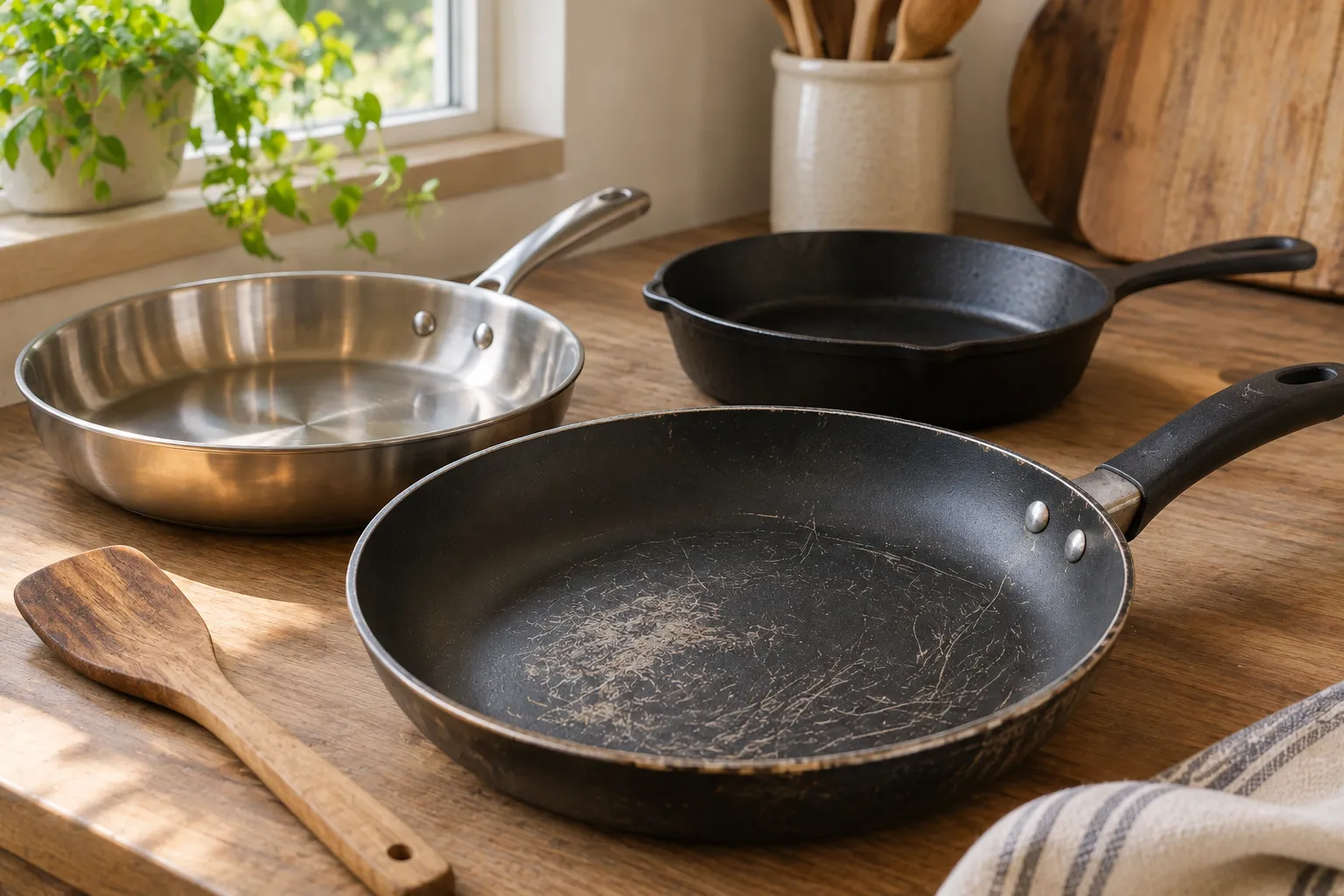
Replace it when the coating no longer covers the cooking surface or no longer works: scratches through to shiny or gray metal, chips, peeling or blistering, a base that rocks on the burner, or food that sticks with oil at medium heat. Fine surface marks that you can feel but not see metal through are a judgment call; they mostly mean the pan is aging.
There is no reliable number of years. Tefal, Caraway, GreenPan and HexClad all publish care rules, and none of the pages we read gives a lifespan. That fits how coatings actually fail: a pan used gently on medium heat with wooden tools can outlast one that goes into the dishwasher and meets a fork every morning. What follows is a checklist you can run on the pan in your hand.
How to check your nonstick pan in 2 minutes
- Wash and dry it, then look at the cooking surface under a bright light, tilting it so scratches catch the glare.
- Look for metal. Silver or gray lines or patches mean the coating is gone in those spots. Any visible metal on the cooking surface: replace.
- Run a fingertip across the center. Flaking edges, raised bubbles or rough patches that catch your nail: replace.
- Set it on a flat counter and press each side of the rim. If it rocks or spins, the base has warped. It will heat unevenly and hot spots will wear the coating faster: replace.
- Check the rim and rivets. Chipped coating where the side meets the base, or around rivets, is common and counts as damage.
- Do the egg test. Cook one egg on medium-low with a little oil. If it sticks badly in a pan that is clean, the coating has stopped doing its job.
- Note any discoloration that will not wash off. Brown film is often baked-on oil, which you can clean gently; a dull, chalky or bleached look on the coating itself usually means wear.
Signs it is time: what each one means
Signs of wear on a nonstick pan and what to do
- What you see
- Scratches through to bare metal
- What it means
- Coating broken; the damage studies link to particle release
- What to do
- Replace
- What you see
- Flaking, peeling or blistering
- What it means
- Coating detaching from the base
- What to do
- Replace now
- What you see
- Warped base that rocks
- What it means
- Uneven heating, hot spots that overheat the coating
- What to do
- Replace
- What you see
- Food sticks with oil on medium heat
- What it means
- Release surface worn out (common with ceramic)
- What to do
- Try a deep clean once; replace if no better
- What you see
- Fine surface marks, no metal visible
- What it means
- Early wear
- What to do
- Keep using gently; check again monthly
- What you see
- Brown sticky film
- What it means
- Polymerized oil or spray residue, usually not coating damage
- What to do
- Soak and clean with a soft sponge
- What you see
- Pan was overheated empty and smoked
- What it means
- Coating may be degraded; fumes released
- What to do
- Ventilate; replace if surface changed
Is it safe to cook with a scratched nonstick pan?
The honest answer is that scratched PTFE pans shed more plastic particles, and no study has shown what that does to people. Makers and regulators frame it in terms of chemicals, not particles. The FDA says studies show “negligible amounts” of PFAS in nonstick coatings migrate to food. Tefal says a scratched, distorted or cracked pan will still be as safe to use, and advises replacing it because the coating will become less effective.
Particle research asks a different question. In 2022, Luo and colleagues at the University of Newcastle and Flinders University used Raman imaging and electron microscopy to look at the surfaces of new and used nonstick pans. Their abstract estimates that thousands to millions of PTFE micro- and nanoplastics might be released during a mimicked cooking process. The university’s release put numbers on it: about 9,100 particles from one surface crack, and about 2.3 million from a broken coating. These are estimates from imaging the pan, not particles counted in food, and they do not tell you a dose per meal.
A 2024 study by Cole and colleagues did put food in the pans. They used jelly as a stand-in for food and took it through heating, cooling, mixing, slicing and storage. Stainless steel and glass cookware added no microplastics. New and old plastic cookware, including PTFE-coated pans, did, with PTFE, polyethylene and polypropylene particles from 13 to 318 µm. If someone cooked a daily meal that way, the authors estimated 2,409 to 4,964 microplastics a year from the cookware. They said the health effects of eating them are still unclear. For the broader PFAS question, see our PFAS explainer.
What do nonstick pan makers say about care and lifespan?
All four makers we checked say the same things: low to medium heat, no metal or sharp tools, gentle hand washing. None gives a lifespan in years. Here is what each first-party page says, in summary.
Maker care guidance for nonstick pans (first-party pages, read November 2026)
- Maker
- Tefal / T-fal
- Heat
- Let a hot pan cool before cold water; thermal shock can distort the base
- Utensils and cleaning
- Coating can handle a metal spatula scrape, not a knife; non-abrasive sponge
- Replacement guidance
- Replace if scratched, distorted or cracked because the coating becomes less effective
- Maker
- Caraway (ceramic)
- Heat
- Low to medium only; oven max 550°F
- Utensils and cleaning
- Wood, silicone, plastic or nylon; hand wash only; no oil sprays
- Replacement guidance
- Says overheating can wear away the coating; no lifespan stated
- Maker
- GreenPan (ceramic)
- Heat
- Low to medium for most dishes
- Utensils and cleaning
- Non-metal utensils; hand wash even if labeled dishwasher safe; no aerosol sprays
- Replacement guidance
- Visible scratches or dull spots, chipping or flaking, or a drop in release
- Maker
- HexClad (hybrid)
- Heat
- Rarely needs high heat
- Utensils and cleaning
- Hand washing recommended; dishwasher may dull it over time; season before first use
- Replacement guidance
- Not stated on the FAQ we read
Note the split on metal tools. Tefal says its coatings can take a metal spatula; the ceramic brands say avoid metal. Either way, a knife or fork on the cooking surface is a fast way to the scratches that matter. Our spatula guide covers wood, silicone and stainless options. HexClad’s coating chemistry changed over time; our HexClad explainer covers which pans have which.
Do ceramic nonstick pans wear out faster than PTFE?
Ceramic nonstick tends to lose its slickness sooner, but it fails differently. Ceramic coatings are a silica-based layer with no PTFE, so there is no PTFE fume risk when they overheat. Their weak point is release: food starts to stick as the surface wears or builds up residue. Both Caraway and GreenPan name overheating as a main cause of coating wear, and both warn against cooking sprays.
The PTFE particle studies above do not apply to ceramic coatings, and we did not find a comparable particle study on worn ceramic pans. That is an evidence gap, not proof of zero release. A chipped ceramic pan should still go, because bare metal under a chipped coating sticks and the edges keep chipping. Our guides to ceramic cookware and Caraway go deeper.
What happens if you overheat a nonstick pan?
A PTFE coating starts to break down above about 500°F (260°C), and the fumes can make people ill and kill pet birds. Poison Control calls the illness polymer fume fever, or “Teflon flu”: chills, fever, headache, body aches and sometimes chest tightness, starting within a few hours and usually gone in one to two days. It says scratched or chipped coatings and preheating an empty pan raise the risk. Birds are extremely sensitive, and the first sign in a bird can be sudden death.
An empty pan on a high burner heats far faster than one with food in it, which is why every maker above says low to medium heat. If a pan smokes while empty, turn off the burner, open windows, run the hood fan, and move people and pets out. Poison Help in the US is 1-800-222-1222. Air fryers with PTFE baskets raise the same heat and scratch questions; see air fryers and microplastics.
Can you repair or re-coat a scratched nonstick pan?
Not in a way we can recommend for a pan you cook in. Repair sprays and kits are sold online, but none of the makers we checked endorses re-coating at home, and Tefal’s advice for a scratched, cracked or distorted pan is to replace it. A home-applied coating is a different material from the factory one, cured under different conditions, and we found no published testing of how such coatings hold up to cooking heat.
What you can fix is buildup. A sticky brown film that makes food catch is often polymerized oil or spray residue sitting on top of an intact coating. Soak the pan in warm soapy water, then work the film off with a soft sponge and a paste of baking soda and water. If eggs release again afterwards, the coating was fine. If the surface underneath is dull, rough or showing metal, the coating itself has worn and no cleaning will bring it back.
Is a discolored or old nonstick pan still safe?
Color alone does not decide it; the surface does. Dark coatings fade and pick up stains with use, and a pan can look tired while the coating is still continuous. Run the checklist above: if there is no bare metal, no flaking and no warping, and food still releases on medium heat, the pan can stay in service. Age matters mainly because older pans have had more chances to be overheated, scraped and dishwashed. If you know a pan was left empty on a hot burner until it smoked, look closely at the surface afterwards. Blistering, bubbling or a change in texture means the coating was damaged, and that pan should go.
Pans made before about 2015 raise one more question: older PTFE coatings were made with PFOA. Under the EPA’s PFOA Stewardship Program, the eight major makers committed to eliminate it from emissions and products by 2015, and the EPA says all met the goals. The FDA says the manufacturing process for nonstick coatings drives off nearly all the small, mobile PFAS molecules. That is about chemical migration from an intact coating, a different question from the particles that come off a damaged one.
How to make a nonstick pan last longer
- Cook on low to medium. Nonstick does not need high heat for eggs, fish or pancakes. Use stainless or cast iron for searing.
- Never preheat it empty. Add oil or food first.
- Use a little oil, not spray. Caraway and GreenPan both say aerosol sprays leave residue that hurts performance.
- Use wood or silicone tools. Never cut food in the pan.
- Let it cool before washing. Cold water on a hot pan can warp the base, Tefal says.
- Hand wash with a soft sponge. Skip steel wool and abrasive powders on the coating.
- Store with a protector or towel between pans so the base of one does not scratch the coating of another.
Use the App
Don’t know what your pan is coated with?
Scan the box, label or product page. The app records whether a pan is declared PTFE, ceramic, hybrid or uncoated, flags the maker's heat and utensil limits, and saves the pan so you can log its condition.
What should you replace a nonstick pan with?
If you want to stop replacing pans, buy uncoated metal: stainless steel, cast iron or carbon steel. In the Cole study, stainless steel and glass added no microplastics to food. Uncoated pans have nothing to scratch off, and they can last decades. The trade is technique: they need preheating, fat and a little practice to stop eggs sticking. Many cooks keep one coated pan for eggs and use uncoated pans for everything else, which also makes the coated one last longer.
Decision table: what to do with your nonstick pan
- Your situation
- Coating intact, only light marks
- Do this
- Keep it; switch to gentle tools and medium heat
- Good next pan
- None needed yet
- Your situation
- Bare metal, flaking or warped
- Do this
- Retire it from cooking
- Good next pan
- Stainless skillet, or carbon steel for eggs
- Your situation
- You mainly cook eggs and fish
- Do this
- Keep one coated pan for those only
- Good next pan
- Carbon steel once seasoned, or a new ceramic or PTFE pan used gently
- Your situation
- You sear, roast and go oven to table
- Do this
- Do not use nonstick for this
- Good next pan
- Cast iron or stainless
- Your situation
- You keep birds
- Do this
- Avoid overheating any PTFE pan; keep birds out of the kitchen
- Good next pan
- Stainless, cast iron or carbon steel
- Your situation
- You want no coating questions at all
- Do this
- Replace coated pans as they wear out
- Good next pan
- Stainless plus one cast iron or carbon steel pan
Our non-toxic cookware guide compares specific stainless, cast iron and carbon steel lines. If you replace a pan, check with your local recycling program before putting it out: Tefal says it asks partner retailers to collect old pans, and some local programs accept metal cookware as scrap.
What the evidence does not establish
- A per-meal particle dose from a scratched pan. The 9,100 and 2.3 million figures are imaging estimates.
- A health outcome from eating PTFE particles. Cole et al. call it unclear; no human study links pan use to disease.
- A safe lifespan in years. No maker we checked publishes one.
- Particle release from worn ceramic coatings. We found no comparable study.
What the MicroPlastics app checks
- The declared coating of a scanned pan: PTFE, ceramic, hybrid or uncoated.
- The maker’s stated heat limits, utensil rules and dishwasher guidance, where published.
- Uncoated alternatives in the same size and type.
- Product information only: the app does not inspect your pan’s surface or measure particles.
Frequently Asked Questions
How do I know when to throw out a nonstick pan?
Is it safe to use a scratched nonstick pan?
How long do nonstick pans last?
What temperature is unsafe for nonstick pans?
Do ceramic pans need replacing as often as Teflon?
What is the best replacement for a nonstick pan?
Sources
- Luo Y, Gibson CT, Chuah C, Tang Y, Naidu R, Fang C (2022). Raman imaging for the identification of Teflon microplastics and nanoplastics released from non-stick cookware. Science of the Total Environment 851:158293.
- Flinders University (2022). Not-so-tough Teflon (October 31, 2022). Flinders University News.
- Cole M, Gomiero A, Jaén-Gil A, Haave M, Lusher A (2024). Microplastic and PTFE contamination of food from cookware. Science of the Total Environment 929:172577.
- Poison Control, National Capital Poison Center (2026). Protect yourself from teflon flu (retrieved November 13, 2026). poison.org.
- US Food and Drug Administration (2025). Authorized uses of PFAS in food contact applications (updated January 3, 2025). FDA.
- US Environmental Protection Agency (2026). Risk management for per- and polyfluoroalkyl substances (PFAS) under TSCA: PFOA Stewardship Program (retrieved November 13, 2026). EPA.
- Tefal (2026). Pots and pans: life cycle, care and recycling (retrieved November 13, 2026). Tefal.
- Caraway (2026). Care and cleaning (retrieved November 13, 2026). Caraway Home.
- GreenPan (2026). How to make your ceramic cookware last (retrieved November 13, 2026). GreenPan.
- HexClad (2026). Frequently asked questions (retrieved November 13, 2026). HexClad.
Your next product question
Start with the frying pan you reach for most.
Identify whether the exact pan is declared PTFE, ceramic, hybrid or uncoated, with the maker's heat and utensil limits. An assessment cannot inspect your pan's surface or measure particles.
Use the exact product name, model and label to check the information behind an assessment. A photo does not measure particles or personal health risk. The examples above are research subjects, not a verified app-coverage list.
Build a product-routine reading plan →Related Research
Do Downy Unstopables Have Microplastics? What the Beads Are Made Of
Downy Unstopables beads are mostly PEG, a water-soluble polymer, so the bead itself is not a solid plastic. The open question is fragrance microcapsules, which Downy does not disclose and the EU restricts from 17 October 2029.
Read moreDo Air Purifiers Remove Microplastics? What HEPA Can and Can’t Do
HEPA is rated for 0.3 µm, smaller than most measured indoor microplastics, but only one real-room study has tested an air cleaner on them. How to size a unit by CADR, and why vacuuming and damp dusting matter for settled fibers.
Read moreAre Hot Water Bottles Safe? Rubber, PVC and Silicone Compared
Rubber, PVC or silicone hot water bottles compared: BS 1970, how to read the daisy wheel, NHS two-year replacement advice, why rupture causes half of burns, PVC plasticizers and fleece-cover shedding.
Read moreAre Artificial Christmas Trees Toxic? PVC, Lead and Real Trees
PVC vs molded-PE artificial trees, what lead and phthalate testing and Prop 65 warnings actually show, how to handle and store a tree, real-tree mold and pesticide trade-offs, and how many years a fake tree needs to beat a real one.
Read moreAre Heated Blankets Safe? Fleece, Wiring and Microplastics
Most heated blankets are polyester fleece over PVC-insulated wire. What fleece sheds, what is unknown about flame retardants, what the EMF studies found, and how to wash one without wrecking it.
Read moreIs the Instant Pot Sealing Ring Safe? Silicone, Heat, Odor and When to Replace It
The Instant Pot ring is food-grade silicone that sits in hot steam every cook. What silicone migration studies show (and why it falls with use), why rings hold odors, Instant’s 12–18 month replacement guidance, the rest of the lid, and gasket-free alternatives.
Read more