Do Downy Unstopables Have Microplastics? What the Beads Are Made Of
Last reviewed: by the MicroPlastics Research Desk. Submit a correction or see our editorial standards.
Quick answer

Check the containers in your kitchen
Scan what you heat and store food in to see what drives each score, and one swap worth making.


Free · 3 scans · iOS and Android
Key Takeaways
- The carrier is PEG. The label lists four ingredients: PEG (perfume carrier), fragrances, an odor blocker and colorants.
- PEG dissolves. It is a synthetic polymer, but a water-soluble one, so it doesn’t form lasting solid particles the way polyethylene beads did.
- “Freshness technology” is undefined. Downy doesn’t say whether the perfume is encapsulated, and encapsulates are the part regulators treat as microplastic.
- EU timing: fragrance encapsulates in all products, detergents included, must go by 17 October 2029.
- Not all boosters are alike. Gain Fireworks shares Downy’s PEG formula; Purex Crystals is built on salt.
- Your clothes shed far more plastic than the bead question suggests. Synthetic fibres are the documented laundry microplastic.
The numbers that decide the bead question
- ingredients on the Unstopables Fresh label
- 4
- PEG, fragrances, odor blocker, colorants
- Downy Unstopables Fresh label (retail transcription)
- solubility above which a polymer is outside the EU microplastic definition
- 2 g/L
- must be proved by the supplier using the regulation’s test method
- Regulation (EU) 2023/2055
- EU end date for synthetic polymer fragrance encapsulates
- 17 Oct 2029
- applies to detergents and fabric care as well as cosmetics
- Regulation (EU) 2023/2055, entry 78(6)(a)
- microplastic release the EU restriction is expected to prevent
- ~500,000 t
- Commission estimate; covers all restricted uses, not laundry alone
- European Commission, 25 Sep 2023
What are Downy Unstopables made of?
The ingredient panel on Downy Unstopables Fresh reads, in full: PEG (perfume carrier), fragrances, methyl di-t-butyl hydroxyhydrocinnamate (odor blocker), colorants. That is the list on the 30.1 oz bottle as transcribed by retailers, which also tell shoppers to check SmartLabel or downy.com for more detail. We could not load P&G’s SmartLabel page, so treat the label as the disclosure we relied on, and check your own bottle, since scents and sizes can differ.
PEG is polyethylene glycol, a chain of repeating ethylene oxide units. It sounds close to polyethylene, the plastic in old face-scrub microbeads, but it behaves differently. Low-weight grades are liquid; heavier grades are waxy solids that melt easily and dissolve in water. The European food additive specification for PEG (E 1521) describes PEG 400 as miscible with water and PEG 3000 to 8000 as very soluble. P&G doesn’t say which grade it uses, but a bead that pours as a solid and vanishes in cold water fits a higher-weight PEG.
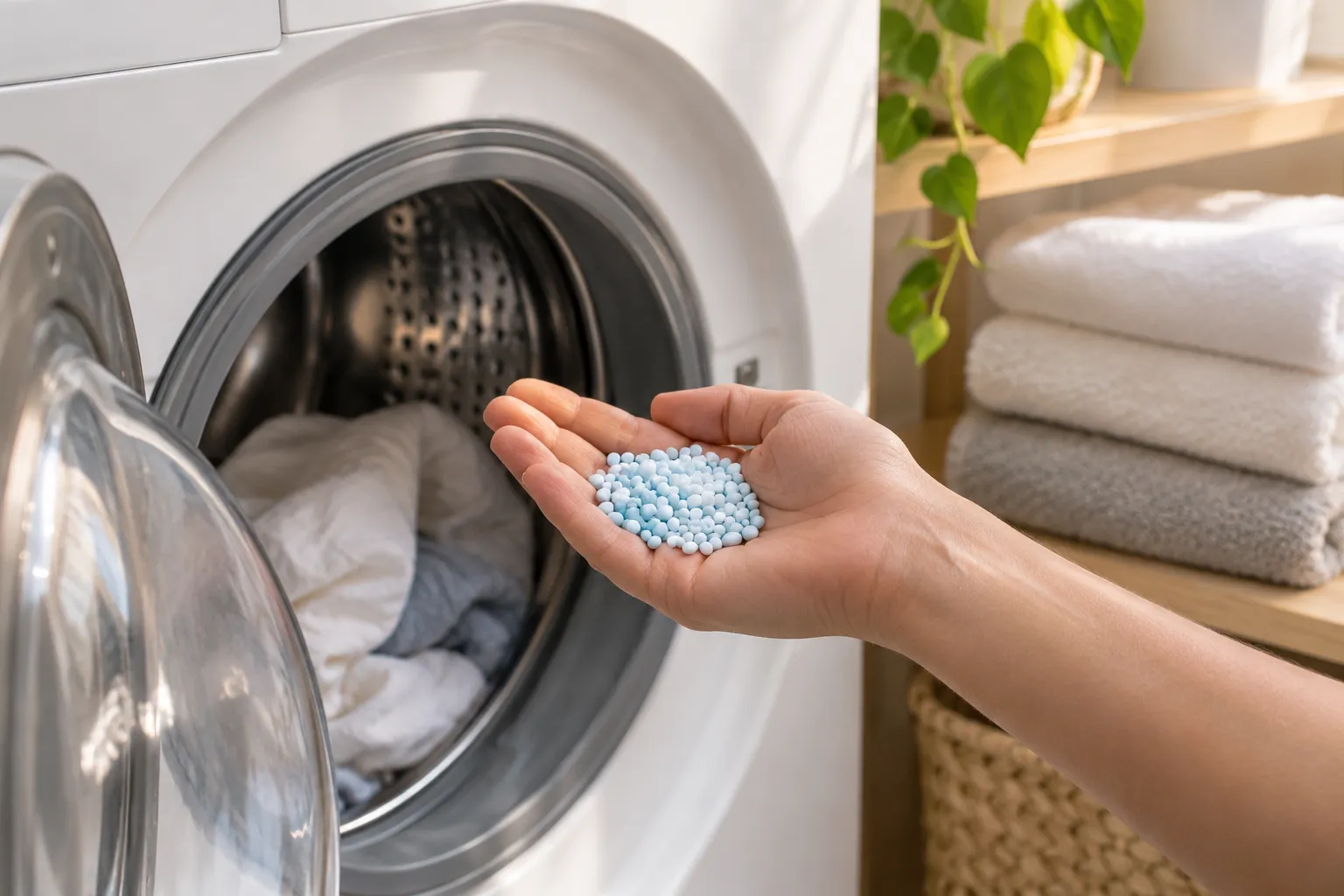
P&G’s own product page describes Unstopables as “water-dissolvable beads filled with concentrated perfume and freshness technology” that are “designed to dissolve completely.” Its beginner guide says they work in HE machines and any water temperature and should go into the empty drum, never the dispenser. The safety data sheet for a 2024 Unstopables scent lists the product as a solid whose hazardous components are nine fragrance substances at 0.1 to 1.0% each. Under “persistence and degradability,” it says no information is available.
Is PEG a microplastic?
It depends on whose definition you use, and the two main ones disagree.
The EU legal definition says no, in most cases. Regulation (EU) 2023/2055, the restriction on intentionally added microplastics, covers solid synthetic polymer particles of 5 mm or less. It then excludes polymers with a solubility greater than 2 g/L, proved with a set test method. The Commission summarized the scope as particles “that are organic, insoluble and resist degradation” (press release, 25 September 2023). Soluble PEG grades should clear that bar easily, though the burden of proof sits with the supplier, and we have not seen P&G’s test.
Some campaign groups say “maybe.” The Plastic Soup Foundation’s Beat the Microbead program puts PEGs on its Orange list of “skeptical” synthetic polymers, a category that also takes in soluble and liquid polymers where, in its view, there isn’t enough information on persistence and toxicity. That is a precautionary flag, not a finding that PEG forms particles.
Both positions are honest about different things. Dissolved PEG is not a speck of plastic you could filter out of rinse water. It is still a synthetic polymer going down the drain, and its fate depends on chain length and on what a treatment plant does with it. Our EU microplastics ban guide explains the definition and its exemptions in more detail.
Do the fragrance capsules count as microplastics?
If a product uses them, usually yes, and this is the part of the Unstopables question that can’t be closed from the label.
Fragrance microcapsules are tiny shells of polymer around a drop of perfume. They stick to fabric in the wash and break when you move, which is how long-lasting scent claims usually work. An EU-funded project on biodegradable alternatives described melamine formaldehyde capsules as the current state of the art and said they fall under the definition of intentionally added microplastics. The Commission’s own list of restricted uses names detergents, fabric softeners and fragrance uses in cosmetics.
What Downy says: perfume plus “freshness technology.” What it doesn’t say: whether any of that perfume is encapsulated, or in what. US labels group fragrance materials under one word, and the SDS lists only hazardous components, so neither document would necessarily show a capsule wall. P&G says it publishes fragrance ingredients down to 0.01% on brand sites and SmartLabel in the US and Canada. A capsule shell is not a fragrance ingredient, so that list may not answer the question either.
The fair summary is that Unstopables may or may not carry encapsulated scent. If they do, those capsules are the microplastic, not the PEG bead around them.
When does the EU ban apply to scent beads?
The restriction entered into force on 17 October 2023, but most uses got a transition period. For laundry products the timetable is:
| Use | Restriction applies from | What it means for scent boosters |
|---|---|---|
| Soluble polymers (solubility > 2 g/L) | Never restricted | A PEG carrier that passes the solubility test is outside the definition |
| Detergents, waxes, polishes, air care | 17 October 2028 | Covers microplastics in these products except fragrance encapsulates and microbeads |
| Synthetic polymer fragrance encapsulates | 17 October 2029 | Applies whatever the product: laundry, softener, cosmetics |
| Rinse-off cosmetics | 17 October 2027 | Shown for comparison; scent beads are not cosmetics |
| Products placed on the EU market | Until the dates above | Products with encapsulates can still be sold legally before 2029 |
Because detergents containing fragrance encapsulates fall under the 2029 fragrance rule rather than the 2028 detergent rule, an EU shelf could legally carry capsule-based scent boosters for almost three more years. Downy is sold as Lenor in Europe, where the bead line is called Unstoppables. The restriction applies only in the EU; we found no US federal rule covering fragrance capsules. The US Microbead-Free Waters Act of 2015 covered plastic microbeads in rinse-off cosmetics only.
How do other scent boosters compare?
Scent beads are not one product. The carrier varies by brand, and so does how much the maker discloses.
| Product | Declared carrier | Full label list | Microplastic reading |
|---|---|---|---|
| Downy Unstopables Fresh (P&G) | PEG | PEG (perfume carrier), fragrances, methyl di-t-butyl hydroxyhydrocinnamate (odor blocker), colorants | Carrier soluble; capsules not disclosed either way |
| Gain Fireworks Original (P&G) | PEG | Same four-ingredient list as Unstopables | Same as Unstopables |
| Purex Crystals Spring Waters (Henkel) | Sodium chloride (salt) | Sodium chloride, fragrances, hydrated silica, propylene glycol, colorants, denatonium benzoate | No polymer listed; Henkel says it has replaced synthetic perfume capsules in Europe |
| Unscented laundry, no booster | None | Nothing added | Removes the question |
| Wool dryer balls with a few drops of essential oil | Wool | Wool plus the oil you add | No synthetic polymer added; scent fades faster |
Purex Crystals list salt, silica and propylene glycol (a small molecule, not a polymer). Henkel, which makes Purex, says it is committed to replacing all synthetic perfume encapsulations with biodegradable materials, has finished in Europe and is still working on other regions. That is a company statement about its whole portfolio, not a disclosure for one US bottle. Gain Fireworks, a sibling P&G product, carries the same PEG-based list as Unstopables.
Scent beads draw other criticism that has nothing to do with plastic. Germany’s Verbraucherzentrale Hamburg called Lenor Unstoppables a “worst case” for the environment in 2023, citing fragrance allergens that are harmful to aquatic life and dosing advice that encourages overuse. Its complaint was about the fragrance load, not particles.
Where laundry microplastics actually come from
If your worry is plastic leaving your washer, the beads are a side issue. Synthetic clothing (polyester, nylon, acrylic, fleece) sheds fibres every wash, and those fibres are solid, insoluble plastic that the EU restriction does not touch, because nobody adds them on purpose. Our laundry microplastics guide covers the wash settings and filters that cut shedding. The pods question is separate again: the film on detergent pods is polyvinyl alcohol, and the laundry pods article walks through that debate. For fabrics, see microplastics in clothing.
Use the App
Is your scent booster salt, PEG or something else?
Scan a booster, softener or detergent. The app reads its declared ingredients, flags synthetic polymers and fragrance-capsule disclosures, and saves the result so you can compare products in your laundry cupboard.
What the evidence does not establish
- A particle count for any scent bead. We found no published test measuring microplastics released by Unstopables or any other booster.
- Whether Unstopables contain fragrance capsules. Neither the label, the SDS nor Downy’s product pages say so either way.
- Which PEG grade is used, or P&G’s own solubility or biodegradation data for the bead.
- A health effect from scented laundry residue. Fragrance allergens can irritate sensitive skin, which is a separate question from microplastics.
What to do if you use scent beads
- Use the smallest dose. The cap line is a maximum, not a target. Less product means less polymer and fragrance down the drain.
- Ask the maker the capsule question. Downy’s consumer line is on the bottle. Ask whether the scent is encapsulated and what the capsule wall is made of.
- Prefer a disclosed carrier. A salt-based booster, or a brand that says its capsules are biodegradable, gives you more to go on than “freshness technology.”
- Try going without for a month. Clean laundry that is dried properly smells of very little, which is the point.
- Spend your effort on fibres. Cold, full, shorter washes and a filter do more about laundry microplastics than switching boosters.
What the MicroPlastics app checks
- The declared ingredients of a scanned laundry product, including carriers such as PEG, salt or propylene glycol.
- Synthetic polymers on the label and how the EU definition and campaign lists treat each one.
- Whether the maker discloses fragrance encapsulation, and lower-fragrance alternatives in the same category.
- Product information only: the app does not measure particles or chemicals released in your wash.
Frequently Asked Questions
Do Downy Unstopables have microplastics?
Are Downy scent beads plastic?
Do Downy Unstopables dissolve completely?
Are scent boosters banned in the EU?
Is Purex Crystals better than Downy Unstopables for microplastics?
Sources
- Procter & Gamble (label transcribed by Hannaford) (2026). Downy Unstopables Fresh In-Wash Scent Booster 30.1 oz: ingredients (retrieved November 8, 2026). Hannaford.
- Downy (Procter & Gamble) (2026). Do scent beads and fabric softeners work? (retrieved November 8, 2026). downy.com.
- Downy (Procter & Gamble) (2026). Scent beads for beginners (retrieved November 8, 2026). downy.com.
- Procter & Gamble (2024). Safety data sheet: Downy Unstopables Sunset Citrus Scent Beads, revision 22 January 2024. P&G Fabric and Home Care.
- Procter & Gamble (2026). Ingredients: fragrance disclosure and microbeads (retrieved November 8, 2026). us.pg.com.
- European Commission (2023). Commission Regulation (EU) 2023/2055 restricting synthetic polymer microparticles (REACH Annex XVII, entry 78). Official Journal of the European Union.
- European Commission (2023). Protecting environment and health: Commission adopts measures to restrict intentionally added microplastics (IP/23/4581). European Commission.
- European Commission (2012). Commission Regulation (EU) No 231/2012: specifications for food additives, including E 1521 polyethylene glycols. Official Journal of the European Union.
- CORDIS (2021). The world’s first biodegradable laundry fragrance microcapsules. European Commission, CORDIS.
- Henkel (2026). Position on microplastics: perfume encapsulation (retrieved November 8, 2026). henkel.com.
- Henkel (label transcribed by Giant) (2026). Purex Crystals Spring Waters In-Wash Scent Booster: ingredients (retrieved November 8, 2026). Giant Food Stores.
- Procter & Gamble (label transcribed by Giant) (2026). Gain Fireworks Original In-Wash Scent Booster: ingredients (retrieved November 8, 2026). Giant Food Stores.
- Plastic Soup Foundation (2026). Beat the Microbead: guide to microplastics, Red and Orange lists (retrieved November 8, 2026). beatthemicrobead.org.
- Verbraucherzentrale Hamburg (2023). Lenor Unstoppables Wäscheparfüm (6 February 2023). vzhh.de.
Your next product question
Start with your scent booster, fabric softener or detergent.
See the declared carrier (PEG, salt or another), which synthetic polymers are listed and whether the maker discloses fragrance encapsulation. A scan cannot measure particles released in your wash.
Use the exact product name, model and label to check the information behind an assessment. A photo does not measure particles or personal health risk. The examples above are research subjects, not a verified app-coverage list.
Read the laundry microplastics guide →Related Research
Do Air Purifiers Remove Microplastics? What HEPA Can and Can’t Do
HEPA is rated for 0.3 µm, smaller than most measured indoor microplastics, but only one real-room study has tested an air cleaner on them. How to size a unit by CADR, and why vacuuming and damp dusting matter for settled fibers.
Read moreAre Hot Water Bottles Safe? Rubber, PVC and Silicone Compared
Rubber, PVC or silicone hot water bottles compared: BS 1970, how to read the daisy wheel, NHS two-year replacement advice, why rupture causes half of burns, PVC plasticizers and fleece-cover shedding.
Read moreAre Artificial Christmas Trees Toxic? PVC, Lead and Real Trees
PVC vs molded-PE artificial trees, what lead and phthalate testing and Prop 65 warnings actually show, how to handle and store a tree, real-tree mold and pesticide trade-offs, and how many years a fake tree needs to beat a real one.
Read moreAre Heated Blankets Safe? Fleece, Wiring and Microplastics
Most heated blankets are polyester fleece over PVC-insulated wire. What fleece sheds, what is unknown about flame retardants, what the EMF studies found, and how to wash one without wrecking it.
Read moreIs the Instant Pot Sealing Ring Safe? Silicone, Heat, Odor and When to Replace It
The Instant Pot ring is food-grade silicone that sits in hot steam every cook. What silicone migration studies show (and why it falls with use), why rings hold odors, Instant’s 12–18 month replacement guidance, the rest of the lid, and gasket-free alternatives.
Read moreDo Humidifiers Spread Microplastics? What Gets Into the Air
No study we found has measured plastic from humidifiers, but ultrasonic units demonstrably put minerals in the air. Ultrasonic vs evaporative vs steam, white dust, which water to use and the EPA cleaning routine.
Read more