Are Heated Blankets Safe? Fleece, Wiring and Microplastics
Last reviewed: by the MicroPlastics Research Desk. Submit a correction or see our editorial standards.
Quick answer

Check the containers in your kitchen
Scan what you heat and store food in to see what drives each score, and one swap worth making.


Free · 3 scans · iOS and Android
Key Takeaways
- The fabric is the microplastic question. Polyester fleece shed about 85 times more fibers than flat polyester fabric in one washing test.
- The wire is a plastic question too, but a sealed one. PVC insulation sits inside the fabric channels; damage is a fire issue first.
- Flame retardants: unknown. We found no measurement for heated blankets or their controllers. Ask the maker.
- Washing is where most shedding happens, and heated blankets need short, cold, gentle washes anyway, which also limits wear.
- EMF is a different evidence base. Keep it separate from the plastics question, and read it accurately.
- Lowest-fiber setup: heat the bed, switch off, sleep under cotton or wool.
What the textile and blanket studies measured
- fibers per m² per liter in one wash
- 7,360 vs 87
- polyester fleece vs flat polyester fabrics; loose and worn textiles shed more
- Carney Almroth et al., Environ Sci Pollut Res 2018
- fibers per gram of fabric in 20 minutes of wear
- up to 400
- four polyester garments in a clean room; 700–4,000 per gram in a 40°C wash
- De Falco et al., Environ Sci Technol 2020
- reach of fleece-blanket fibers from dryer vents
- 30 ft
- pink polyester fleece blankets dried in home dryers; fibers counted on snow
- Kapp & Miller, PLoS One 2020
- fibers per m³ of indoor air
- 1–60
- two Paris apartments and an office; a third of fibers contained petrochemicals
- Dris et al., Environ Pollut 2017
What are heated blankets made of?
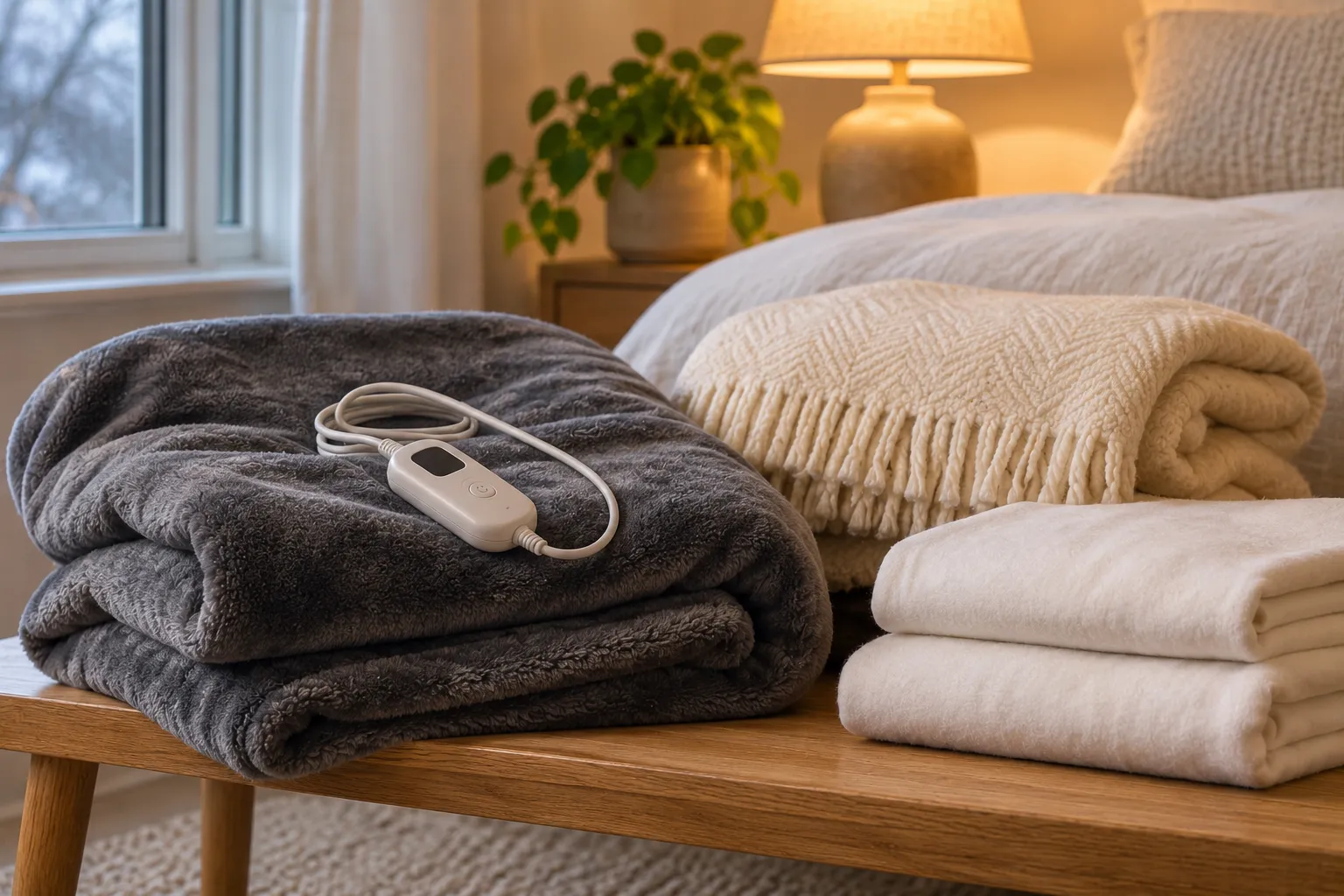
Three parts, and they raise different questions. The shell is almost always a synthetic pile: retail listings for mainstream US heated throws describe polyester fleece, microplush, sherpa or velvet plush, and the Consumer Product Safety Commission’s July 2026 warning about one brand describes its blankets as polyester fleece. Polyester is cheap, warm for its weight and survives repeated washing, which is why it dominates.
Inside, a thin heating wire runs through sewn channels. Patent literature describes the standard construction as heating wire “enclosed by polyvinyl chloride (PVC), with a cotton cover” (US 7,019,262, 2006). That is a description of a common design, not a survey of every blanket sold today, and makers rarely list the insulation on the box. The third part is the controller and connector: a molded plastic housing with electronics, which you unplug before washing.
| Part | Typical material | Main question | What is known |
|---|---|---|---|
| Shell fabric | Polyester fleece, microplush, sherpa or velvet plush | Fiber shedding into air, dust and wash water | Fleece is among the highest-shedding textile constructions tested |
| Heating wire | Resistance wire, commonly PVC-insulated | Overheating, melting, additive chemistry | Sealed inside channels; CPSC warnings concern wires melting through fabric |
| Controller and plug | Molded plastic housing, electronics | Flame retardants in the housing | No published test for heated-blanket controllers found |
| Finish chemicals | Not disclosed on most labels | Flame retardant or water-repellent finishes on the fabric | No measurement found; makers rarely say |
Do heated blankets shed microplastics?
Every synthetic textile sheds, and fleece sheds a lot. In a Swedish study that knitted and washed acrylic, nylon and polyester fabrics, polyester fleece averaged 7,360 fibers per square meter per liter of wash water in one cycle, against 87 for flat polyester fabrics. Loose constructions shed more, and so did worn fabric. A heated throw is a large, loose, brushed pile that gets handled, folded and washed for years. On textile evidence alone it belongs at the high-shedding end.
Shedding also happens without water. De Falco and colleagues had volunteers move around a clean room in four polyester garments and caught up to 400 fibers per gram of fabric in 20 minutes; the same garments released 700 to 4,000 fibers per gram in a 40°C wash (University of Plymouth summary). Those were clothes, not blankets, but the mechanism, fabric rubbing on fabric and skin, is the same one at work when you pull a throw over your shoulders.
Where do those fibers go? Into room air and dust. Air sampling in two Paris apartments and an office found 1 to 60 fibers per cubic meter indoors, far more than outside, and about a third of them contained petrochemical polymers. A UK study estimated that household dust settling onto plates during meals could add 13,731 to 68,415 fibers per person per year. Those numbers describe homes in general, not one blanket, and two-thirds of the indoor fibers were natural, mostly cellulose. Our indoor air guide covers vacuuming and filtration.
Does heating the blanket make it shed more?
Nobody has tested it, as far as we could find. It is a reasonable question: heated blankets run warm rather than hot, and polyester softens far above bedroom temperatures, so ordinary use is unlikely to change the fiber itself. The bigger drivers in the textile studies were construction, wear and mechanical action. A heated throw gets more of all three than a decorative blanket, because people use it every evening and wash it more often. We would not attach a number to “heat-driven shedding” until someone measures it.
What heat clearly does is age the wiring. That matters more for safety than for fibers. CPSC’s warning said the internal wire heating elements in the recalled blankets “can overheat and melt through the polyester fabric,” a burn and fire hazard. A scorched patch, a melted spot or a wire you can feel poking through is a reason to stop using the blanket, not a microplastics footnote.
Do heated blankets contain flame retardants or PVC chemicals?
PVC, probably yes, in the wire insulation. Flame retardants, unknown. We searched for any study that measured flame retardants in electric blankets, heated throws or their controllers and found none. That is a narrower statement than “they contain none”: product labels and maker pages we checked did not disclose either way, and no testing has filled the gap.
Flexible PVC usually needs plasticizers to bend, and older PVC formulations used phthalates. Whether a given blanket’s wire uses them, and whether anything moves from insulation sealed inside a fabric channel to your skin or the room, has not been measured in the sources we found. Treat it as a reason to ask, not a reason to panic. If the maker will tell you the insulation polymer, plasticizer type and whether the fabric or housing carries flame retardant treatment, that answers more than any marketing claim on the box.
If you are comparing fabrics for clothing rather than bedding, the polyester health guide walks through BPA, antimony, dyes and PFAS finishes in polyester.
How to wash a heated blanket without wrecking it
Washing is the moment of maximum shedding and maximum wear, so the maker’s instructions do double duty. Sunbeam’s heated bedding care page is a useful example because it is specific. It says to unplug from the wall first, detach the control cord, and check that wires have not worn through the fabric. Then presoak for 15 minutes in mild soap and cold water, wash on a gentle cycle for two minutes, rinse cold and spin. It warns against commercial or Laundromat dryers, which it says get hot enough to damage the wiring, and recommends preheating a home dryer on low for two minutes, tumbling for 10 minutes on low, then removing the blanket while damp and draping it over a line or shower rod without clothespins. No dry cleaning, bleach, wringer or ironing, and the blanket must be completely dry before you reconnect it.
Those are Sunbeam’s rules for Sunbeam products; read your own label. But the shape of the advice lines up with what reduces shedding: short, cold, gentle washes and little tumble drying. The dryer matters for fibers outside your home too. Kapp and Miller dried pink polyester fleece blankets in home dryers and found the pink fibers on snow throughout a 30-foot radius of the vents, with 35 to 70 mg of lint collected from vent exhaust over three consecutive cycles.
- Wash less. A cotton or wool top layer you can launder freely keeps the fleece cleaner for longer.
- Full, cold, short. Wash it alone or with soft items, never with zips, jeans or towels that abrade pile.
- Air-dry when you can. If you tumble, use the maker’s low and short setting and clean the lint trap afterward.
Washing-machine filters and laundry bags are covered in our laundry microplastics guide.
Use the App
Is your heated throw fleece, sherpa or something else?
Scan the label or product page. The app records the declared fabric, flags polyester pile and missing material disclosures, and suggests a cotton or wool layer for the bed. Save it with your other bedding.
What about EMF from electric blankets?
This is a separate question from plastics, with its own evidence, and it deserves an accurate summary rather than a scare line. Electric blankets produce extremely low frequency (ELF) magnetic fields because current flows through the wire close to the body. Measurements made for a California pregnancy study found a mean of 0.45 microtesla (4.5 milligauss) at the estimated position of a fetus, 10 cm from the blanket.
In 2002 the International Agency for Research on Cancer classed ELF magnetic fields as “possibly carcinogenic to humans,” based on limited evidence for childhood leukemia, as the National Cancer Institute explains. NCI also says most studies of home ELF exposure found no link with breast cancer. Blanket-specific studies say much the same:
| Study | Who | Finding | Limit |
|---|---|---|---|
| Kabat et al. 2003 | Long Island women, 1,354 breast cancer cases and 1,426 controls in the larger stage | No association for ever-use, overnight use or use directly on the body (odds ratios 0.9–1.2) | Self-reported use |
| Kato et al. 2015 | 89,527 women in the Women’s Health Initiative, 12.2 years of follow-up | No association with thyroid cancer (hazard ratio 0.98) | Use reported once at baseline |
| Lee et al. 2000 | Prospective cohort of pregnant women in California | No overall rise in miscarriage among bed-heater users; one small subgroup (20 women, high setting, an hour or less) had higher odds, with no dose pattern | Small subgroups; wide confidence intervals |
| Brabant et al. 2022 | Meta-analysis of childhood leukemia studies | Pooled odds ratio of 2.75 across four studies of electric blanket exposure; overall ELF association was concentrated in pre-2000 studies | Association, not cause; few studies; older exposure data |
So the adult cancer studies are reassuring, and the childhood leukemia question is still open for ELF fields in general. If that uncertainty bothers you, the same habit that cuts fiber contact cuts field exposure: heat the bed before you get in, then switch the blanket off or unplug it. Fields fall off quickly with distance and stop when current stops.
Should you use a heated blanket during pregnancy or with children?
Read your manual’s warnings first. Anyone who cannot feel heat building up or cannot switch the blanket off, such as a baby or a person with reduced sensation, is at risk of burns, which is a far more immediate hazard than fibers or fields. On the evidence, the Lee study did not find a general rise in miscarriage among users, and its authors noted electric blankets contributed less to overnight magnetic field exposure than had been assumed. Preheating the bed and switching off before sleep is a simple middle path many people choose in pregnancy.
Cotton and wool alternatives that stay warm
You do not have to give up heat to get away from fleece. The options below trade convenience against fiber contact. None is tested as particle-free; natural fibers shed too, but they are not plastic.
| Option | Polyester near your face | Warmth | Notes |
|---|---|---|---|
| Wool blanket over cotton sheets | None | High once warm; no power | Wash rarely; air it out; moths are the main care issue |
| Cotton flannel sheets plus a down or wool duvet | None, if the duvet shell is cotton | High | Check duvet shell and fill labels |
| Heated blanket used to preheat, then switched off, with cotton sheet on top | Low | High at bedtime | Keeps the fleece one layer away and cuts EMF time |
| Heated mattress pad under a cotton sheet | Low; pad top fabric varies | High | Check the manual before layering it with any other heat source |
| Fleece heated throw used directly on the body all evening | High | High | Most shedding contact; wash gently and rarely |
Pillows and mattress toppers are their own story, especially foam and polyester fill; our pillows and mattresses guide covers them. If you are reconsidering synthetic textiles in general, see whether polyester clothing counts as plastic.
Buying a heated blanket with fewer unknowns
If you are buying one this winter, you can at least pick the version with the most answers on the label. None of these points proves low shedding or zero chemical release; they narrow what you are guessing about.
- A safety certification mark from a recognized testing laboratory on the blanket and the controller, plus a model number you can check against recall lists.
- Auto shut-off with a timer you can set short. It protects the wiring and limits overnight use.
- A detachable controller and written care instructions that allow a cold, gentle wash and low or no tumble drying.
- A disclosed shell fabric. A flat-woven or tightly knit surface should shed less than long brushed pile, based on how construction affected shedding in the textile studies. If a listing mentions cotton, read the full fiber content: words like “cotton-soft” describe a feel, not a fiber.
- Answers on request. Email the maker about wire insulation, plasticizers and flame retardant treatment. A clear reply is useful information; silence is too.
When to replace a heated blanket
- Any scorch mark, melted spot or exposed wire. Stop using it and unplug it. That is a fire risk.
- A cracked controller, frayed cord or loose connector. Do not tape it.
- A recall or CPSC warning on your model. Check the model number against recall notices.
- Matted, pilled, thin pile. Worn fabric sheds more, and pills are fibers breaking free. Retire it from the bed first.
What the evidence does not establish
- A fibers-per-night number for any heated blanket. The shedding studies tested garments, knitted swatches and unheated fleece blankets.
- That heat increases shedding. Untested in the sources we found.
- Whether heated blankets carry flame retardants, or what plasticizer a given wire insulation uses.
- A health outcome from blanket fibers. Indoor fiber exposure is real; its health effect at household levels has not been shown.
- That EMF and microplastics add up. They are separate exposures with separate evidence.
What the MicroPlastics app checks
- The declared fabric of a scanned blanket, throw or mattress pad, such as polyester fleece, microplush, cotton or wool.
- Whether the label or product page discloses fill, finish or flame-retardant treatment.
- A natural-fiber layer or swap suited to the same job.
- Product information only: the app does not measure fibers shed, chemical content or magnetic fields.
Frequently Asked Questions
Are heated blankets safe to sleep with?
Do heated blankets release microplastics?
Do electric blankets have flame retardants?
Is EMF from electric blankets dangerous?
How do you wash a heated blanket?
What is a non-toxic alternative to a heated blanket?
Sources
- Carney Almroth BM, Åström L, Roslund S, Petersson H, Johansson M, Persson NK (2018). Quantifying shedding of synthetic fibers from textiles; a source of microplastics released into the environment. Environmental Science and Pollution Research 25:1191–1199.
- De Falco F, Cocca M, Avella M, Thompson RC (2020). Microfiber release to water, via laundering, and to air, via everyday use: a comparison between polyester clothing with differing textile parameters. Environmental Science & Technology 54(6):3288–3296.
- University of Plymouth (2020). Wearing clothes could release more microfibers to the environment than washing them (news release, March 9, 2020). EurekAlert!.
- Kapp KJ, Miller RZ (2020). Electric clothes dryers: An underestimated source of microfiber pollution. PLoS One 15(10):e0239165.
- Dris R, Gasperi J, Mirande C, et al. (2017). A first overview of textile fibers, including microplastics, in indoor and outdoor environments. Environmental Pollution 221:453–458.
- Catarino AI, Macchia V, Sanderson WG, Thompson RC, Henry TB (2018). Low levels of microplastics (MP) in wild mussels indicate that MP ingestion by humans is minimal compared to exposure via household fibres fallout during a meal. Environmental Pollution 237:675–684.
- US Consumer Product Safety Commission (2026). CPSC warns consumers to stop using Melinora electric heated blankets immediately due to risk of serious injury from burn and fire hazards (July 16, 2026). CPSC.
- Lu Y-J (2006). Electric blanket with digital temperature sensors, US Patent 7,019,262 B1 (background on PVC-insulated heating wire). US Patent and Trademark Office.
- Sunbeam (2026). Sunbeam heated bedding care and cleaning (retrieved November 8, 2026). sunbeam.com.
- National Cancer Institute (2022). Electromagnetic fields and cancer (fact sheet; retrieved November 8, 2026). NCI.
- Kabat GC, O’Leary ES, Schoenfeld ER, et al. (2003). Electric blanket use and breast cancer on Long Island. Epidemiology 14(5):514–520.
- Kato I, Young A, Liu J, Abrams J, Bock C, Simon M (2015). Electric blanket use and risk of thyroid cancer in the Women’s Health Initiative observational cohort. Women & Health 55(7):829–841.
- Lee GM, Neutra RR, Hristova L, Yost M, Hiatt RA (2000). The use of electric bed heaters and the risk of clinically recognized spontaneous abortion. Epidemiology 11(4):406–415.
- Wilson BW, Lee GM, Yost MG, et al. (1996). Magnetic field characteristics of electric bed-heating devices. Bioelectromagnetics 17(3):174–179.
- Brabant C, Geerinck A, Beaudart C, Tirelli E, Geuzaine C, Bruyère O (2022). Exposure to magnetic fields and childhood leukemia: a systematic review and meta-analysis of case-control and cohort studies. Reviews on Environmental Health 38(2):229–253.
Your next product question
Start with your heated throw, electric blanket or heated mattress pad.
Record the declared fabric and any finish or flame-retardant disclosure, then see a cotton or wool layer for the bed. A material check does not measure fibers shed, chemicals or magnetic fields.
Use the exact product name, model and label to check the information behind an assessment. A photo does not measure particles or personal health risk. The examples above are research subjects, not a verified app-coverage list.
Read the bedding guide →Related Research
Is the Instant Pot Sealing Ring Safe? Silicone, Heat, Odor and When to Replace It
The Instant Pot ring is food-grade silicone that sits in hot steam every cook. What silicone migration studies show (and why it falls with use), why rings hold odors, Instant’s 12–18 month replacement guidance, the rest of the lid, and gasket-free alternatives.
Read moreDo Humidifiers Spread Microplastics? What Gets Into the Air
No study we found has measured plastic from humidifiers, but ultrasonic units demonstrably put minerals in the air. Ultrasonic vs evaporative vs steam, white dust, which water to use and the EPA cleaning routine.
Read moreBest Non-Toxic Spatula: Which Material to Use for Each Pan
Which spatula for which pan: a decision table for wood, one-piece silicone, nylon, black plastic and stainless by nonstick, ceramic, cast iron and steel, with heat limits and what utensil studies actually measured.
Read morePyrex Freshlock vs Snapware: Glass, Lids and Microplastic Questions
Compare exact glass-storage sets, useful vessel counts, closure declarations and replacement compatibility. Read conflicting microwave-lid instructions without inventing a particle-release winner.
Read moreIKEA 365+ Glass Containers: Lids, Seals and Microplastic Questions
Compare identified US and UK glass containers, polypropylene closures and lacquered bamboo lids. Separate body and lid care, regional manuals and particle-test limits.
Read moreNinja Crispi: Glass Bowl, Coated Plate and Microplastic Questions
Follow the glass bowl, coated crisper plate, handles and storage lid. Compare Portable and Pro documentation without turning PFAS-free claims into a particle count.
Read more