Ninja Crispi: Glass Bowl, Coated Plate and Microplastic Questions

Last reviewed: by the MicroPlastics Research Desk. Submit a correction or see our editorial standards.
Quick answer
Save kitchen products and compare their contact assessments in the app.
Scan my product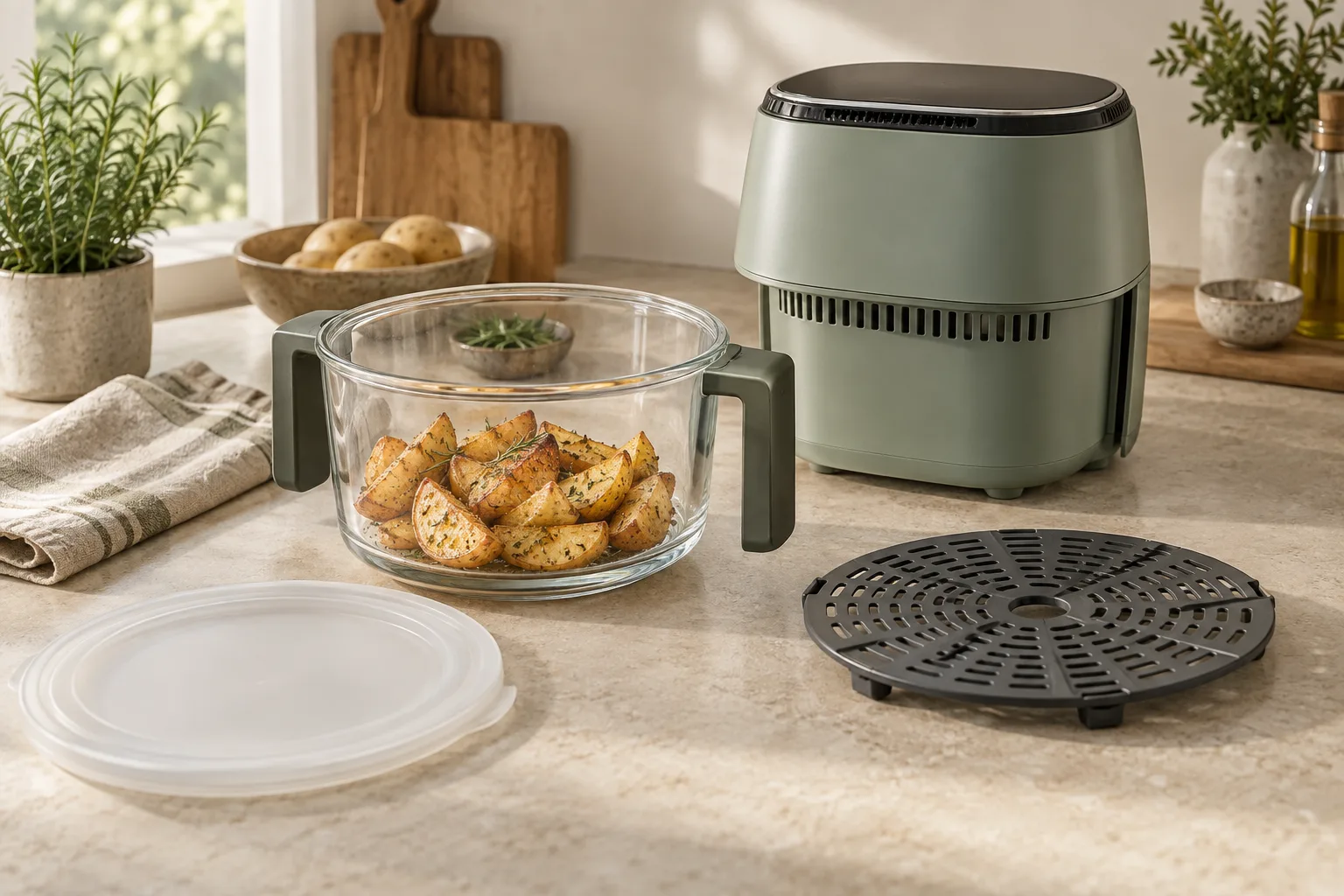
Key Takeaways
- A transparent bowl documents the main vessel; it does not identify every food-contact surface.
- The current Pro manufacturer FAQ describes an aluminium plate with a nano-ceramic coating. That is not the same construction as uncoated glass.
- Portable FN101 and countertop Pro AS101 use different arrangements and container sizes. Check compatibility by item number.
- PFAS-free, BPA-free and particle-release testing answer different questions. None can substitute for the other.
- Use the supplied instructions for your exact appliance. Do not remove supports, substitute cookware or heat a storage lid on the strength of a photograph.
Start with the model, rather than the word glass
A glass cooking bowl can be a useful purchasing requirement. It gives you a visible vessel and a different container wall from a conventional coated basket. That construction choice does not settle everything about the assembled air fryer, the food placed in it or the particles remaining after cooking. A claim about one part needs to stay attached to that part.
We reviewed the US Stone Portable FN101ST listing and Ash Gray Pro AS101DGSN bundle listing on October 6, 2026, and rechecked their current text on October 7. Portable uses a removable PowerPod and selected smaller glassware. Pro is a countertop appliance with a modular base and larger options. Bundles, colours and regional versions can have different contents; the reviewed item codes are the starting point, not a statement about every product carrying the Crispi name.
| Reviewed listing | Arrangement | Separate check |
|---|---|---|
| Portable FN101ST | 1500W removable PowerPod; 6-cup and 4-quart containers | Adapter, plates, storage lids and exact replacement parts |
| Pro AS101DGSN bundle | 1800W countertop system; listing describes 6-quart and 2.5-quart glassware | Selected bundle contents, modular base and model compatibility |
| DualZone and other Crispi variants | Separate products, beyond this assembly review | Their own containers, plate specifications and manual |
More wattage, a larger vessel or more cooking modes cannot be turned into a microplastic score without a relevant experiment. Choose capacity and layout for the meals and space you need. The air-fryer overview discusses the wider materials question; this article addresses the specific documentation and component distinctions within Crispi.
What the material declarations say—and what has changed
The current US Pro AS101DGSN manufacturer FAQ describes borosilicate containers with BPA-free plastic handles, aluminium crisper plates with a nano-ceramic coating, and BPA-free plastic lids. It also describes a BPA-free plastic-and-stainless-steel modular base. Those statements are manufacturer disclosures, not our laboratory identification of a purchased unit.
There is still a documentation limit worth making explicit. The older Pink FN101PK URL now redirects to a Cherry Blossom FN101PK1 product page without that detailed materials FAQ in the retrieved text. The current Pro FAQ discusses both Crispi and Crispi Pro, but a shared FAQ is not a complete part-by-part specification for every FN101ST or AS101 accessory. Match its statements to the exact model and replacement part you are considering.
If the plate composition determines your purchase, request the current specification for the plate item number that will ship. Ask whether the coating has changed, and request the relevant use-and-care document. “Nano-ceramic” is a coating description; its prefix is not evidence that the appliance sheds nanoplastics. A transparent container also cannot reveal a complete coating recipe, handle resin or support-foot composition.
Trace the food contact, not just the exterior housing
Think of the setup as several parts with different jobs. The bowl contains food and liquids. The plate supports food during relevant recipes. A storage lid closes leftovers after cooking. Handles and feet provide support. The heating unit supplies airflow and heat. These functions help you ask specific questions without assuming all visible plastic touches the meal—or that every surface in the system has been identified.
| Part | Useful question | What appearance cannot establish |
|---|---|---|
| Glass bowl | Which genuine container fits this model? | Particles already in ingredients, added utensils or another component |
| Crisper plate | What substrate and coating are declared for this exact part? | Complete formulation, wear behaviour or particles per meal |
| Storage lid | When and how does the manual permit its use? | Permission for air frying, an oven or another heat source |
| Handles, feet and adapter | What supports must remain fitted? | Resin identity, food contact or a reason to remove functional parts |
| Heating unit | What cleaning and operating instructions apply? | An entirely glass appliance or a finished-system particle test |
The glass wall is a real material distinction. It does not demonstrate that omitting a plate, detaching feet or improvising a different bowl improves the setup. Follow the intended assembly. If you want an uncoated food-support surface, ask whether an approved option exists; an unofficial metal insert is not automatically compatible with the appliance.
PFAS-free and BPA-free do not measure particles
The current Portable listing describes glassware designed without PFAS and PTFE, and its comparison panel describes cooking surfaces with the same exclusions. These are relevant manufacturer claims about selected substances and surfaces. They are not a published particle-release experiment, a full ingredient list or independent evidence for every older Ninja air fryer.
BPA-free is a different statement. A plastic can be made without BPA and still be a polymer. Chemical migration is also different from counting and identifying fragments. To evaluate a particular exclusion claim, ask what was tested, which parts and lots were sampled, the analytical method, detection limits and whether the actual report is available. Do not read an absence of one listed substance as an absence of every substance or particle.
We do not assign a Crispi particle total using experiments on a different nonstick coating. A PTFE-pan experiment would need its own sample and method explanation; it cannot directly measure a plate described as nano-ceramic. Likewise, the 2022 NIST research on nylon bags and polyethylene-lined cups did not test this appliance. Its large counts must not become a made-up air-fryer dose.
Read the California disclosure by exact SKU
The manufacturer footer links a 40-page California AB1200 disclosure. Although the URL includes an older filename, the downloaded document visibly says it was updated June 18, 2026. Its first table concerns C200 NeverStick cookware. Chemicals listed in that row cannot be attributed to a Crispi plate just because both products have Ninja branding.
Our searchable review found no FN100, FN101, AS100, AS101 or Crispi match in that document. That is a limitation of the retrieved disclosure and search, not a certificate that a missing product contains no relevant substances. Nor does it overturn a different product’s correctly scoped disclosure. The practical next step is to ask for the entry or material declaration covering your actual appliance and accessory number.
A useful source record includes its revision date, market, item code and covered component. An old screenshot without these details is weak evidence for a current purchase. If a later manufacturer response differs from the current product FAQ, both the exact changed part and the date should be documented rather than hidden behind a universal brand verdict.
Glassware compatibility is specific, not universal
The XSKSFN4QT four-quart accessory lists FN and AS model compatibility and includes a storage lid and crisper tray. The XSKSFN6CUP six-cup accessory is a separate item. Current product comparison text distinguishes Portable’s 6-cup/4-quart options from Pro’s 2.5-, 4- and 6-quart options. Do not assume the largest Pro container fits a Portable PowerPod or that a separate DualZone vessel is interchangeable.
Size alone is not enough: supports, adapter fit and the appliance’s intended arrangement matter. Match the accessory listing to the model on your appliance and confirm ambiguous combinations with the manufacturer. A look-alike glass container that happens to fit under a heater has not thereby been approved for that use.
The current pages describe dishwasher-safe accessories and purpose-built glassware for the system. That does not make the electrical heating unit dishwasher-safe, or grant permission to put the bowl and lid in any oven, microwave or on a stovetop. Where we could not retrieve a complete current manual, we do not fill the gap with a generic borosilicate rule. Our glass material profile explains why composition and appliance-specific care are separate checks.
Care and wear: ask about the actual part
Keep the supplied manual and use the specified cleaning method and accessories. A glass bowl, coated plate, plastic lid and powered unit need separate instructions. Inspect for cracks, chips, loose supports or coating damage and seek the manufacturer’s advice about a replacement. A visible defect cannot tell you a particle dose, but neither should a missing measurement justify continuing with a damaged part.
Do not scrape away a coating, sand a plate, use an improvised bake-out or take apart the heater to pursue a plastic-free claim. These actions change the product and its intended operation. For a material question, a model-specific document or replacement-part specification is more useful than a home experiment that cannot identify polymer particles.
The lid deserves its own check during storage and reheating. Glass below a lid does not make that lid glass. Avoid transferring care instructions from the storage containers in our silicone-bag guide or another brand. Instructions for one formulation and assembly do not establish permission for a different product.
Should you buy Crispi to reduce microplastic exposure?
You can reasonably choose it for a documented glass vessel, visibility or the layout that suits your cooking. The sources reviewed here do not establish a percentage reduction in particles compared with your existing appliance. No particles-per-meal or health-risk ranking follows from the materials inventory alone.
A useful comparison study would identify both exact appliances and plates, control incoming food and background contamination, report particle sizes and polymer identification, and test defined recipes, cleaning and wear conditions. A result under one protocol would still need its own scope. The FDA’s current evidence overview identifies substantial detection and assessment gaps; neither a marketing reassurance nor a dramatic headline resolves them.
Before buying, record the model and plate numbers, confirm the coating declaration, check container compatibility and obtain the care instructions. If you already own an intact appliance, this review does not establish a health benefit that requires replacing it. Ask the specific unresolved question rather than paying for a promise the available evidence cannot verify.
Use the App
Review each part of the cooking setup
Keep material declarations and evidence limits together. The app does not test or count particles in your cooked food.
Explore product assessmentsFrequently Asked Questions
Is Ninja Crispi completely plastic-free?
Does the Crispi plate have a coating?
Does PFAS-free mean no microplastics?
Can all Crispi containers be used on the Portable model?
How many microplastics does Crispi release per meal?
Sources
- SharkNinja US (2026). Portable FN101ST: current construction and product comparison (accessed October 6).
- SharkNinja US (2026). Pro AS101DGSN: current bundle, materials FAQ and glassware options (accessed October 7).
- SharkNinja US (2026). FN101PK: older product URL now redirects without the detailed materials FAQ.
- SharkNinja US (2026). XSKSFN4QT: four-quart accessory and compatibility (accessed October 6).
- SharkNinja US (2026). XSKSFN6CUP: separate six-cup accessory (accessed October 6).
- SharkNinja (2026). California AB1200 disclosure, visibly revised June 18; not a Crispi release test.
- Zangmeister, Radney, Benkstein and Kalanyan (2022). Selected nylon bags and polyethylene-lined cups; not a Crispi experiment.
- US Food and Drug Administration (2026). Microplastics and nanoplastics in foods: current evidence and method gaps (accessed October 6).
Your next product question
Start with your exact Ninja CRISPi vessel and accessories.
Identify the exact cooking system and accessory instructions. A glass vessel does not establish the materials or permitted use of every lid and adapter.
Use the exact product name, model and label to check the information behind an assessment. A photo does not measure particles or personal health risk. The examples above are research subjects, not a verified app-coverage list.
Build a product-routine reading plan →Android · early access
Get the launch email the day Android opens.
One email. No spam. We send when the Android app is in the Play Store, and never again unless you opt in.
Related Research
Ember Mug 2 vs Mug 3: Coating and Microplastic Questions
The current Mug 3 changes cleaning permission, not the need to assess its coated interior. Compare generations, material disclosure limits and the evidence for particle release.
Read moreAre Stasher Bags Safe? Silicone, Heat and the Testing Gap
Stasher bags use platinum silicone, not polyethylene film. What the manufacturer allows, what silicone migration studies actually measured, and when glass makes a simpler reheating choice.
Read moreIs Caraway Cookware Non-Toxic? What Its Own Filings Show
Caraway’s ceramic pans are PFAS-free, and the ad industry’s watchdog agreed. Its own documents also show an aluminium body, a one-year warranty that excludes coating wear, and cadmium in one cast iron colour’s exterior enamel.
Read moreAre Air Fryer Liners Safe? Paper, Silicone and Foil Checked
Paper liners are coated with silicone, wax or something unnamed, and a September 2026 study found new silicone liners release the most in their first uses. What each type is, what the fryer makers allow, and what to use instead.
Read moreTitanium Cutting Boards: A Best-Seller Is Half Plastic
A test kitchen found 2 of 3 “titanium” boards were stainless steel, and Amazon’s No. 2 cutting board is titled “Pure Titanium/PP”. What titanium avoids, what it costs your knives, and what to buy instead.
Read moreNon-Toxic Air Fryers: What Your Food Actually Sits On
We traced air-fryer baskets to the makers’ own documents. Glass fryers still use a coated plate, “stainless” usually means the outside, and SharkNinja lists PTFE for Ninja units made before August 2024.
Read more