IKEA 365+ Glass Containers: Lids, Seals and Microplastic Questions

Last reviewed: by the MicroPlastics Research Desk. Submit a correction or see our editorial standards.
Quick answer
Save kitchen products and compare their contact assessments in the app.
Scan my product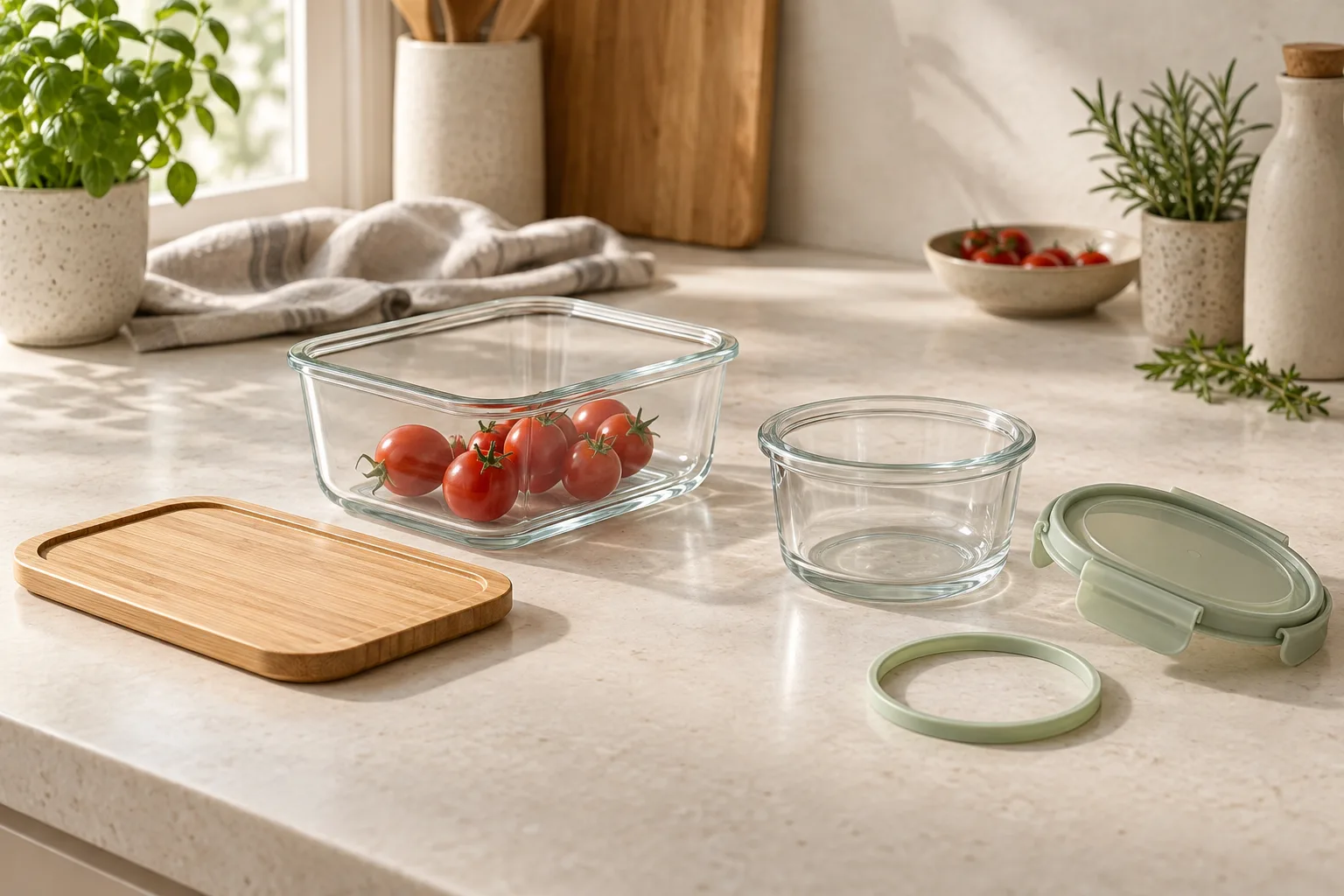
Key Takeaways
- “Glass” identifies the vessel; the closure still needs its own material and care check.
- The selected bamboo lid is coated, hand-wash only and excluded from microwave use.
- An oven-safe base does not make either reviewed lid oven-safe.
- US and UK product numbers differ. A linked regional lid manual adds a specific dishwasher limit.
- Chemical declarations, glass descriptions and customer ratings are not particle-release measurements.
Start with the article number, not just the 365+ name
IKEA 365+ is a series, not one container. A glass dish, a plastic container and a bamboo-lid bundle can share the name while having different parts. For a useful comparison, record the country, article number, shape, capacity and closure. Keep the product page or supplied instructions with that record so a later replacement can be checked against it.
This guide reviews the following current manufacturer pages on October 6, 2026. It is a desk review of disclosed construction and care, not a physical inspection, durability trial or laboratory analysis. The table is deliberately bounded; it does not certify every historical version or every 365+ item available worldwide.
| Article / market | Selected product | Declared construction |
|---|---|---|
| 206.252.52 · US | Rectangular glass, 34 oz, three-pack | Heat-resistant glass; polypropylene lids; silicone seals |
| 806.252.54 · US | Round glass, 20 oz, three-pack | Heat-resistant glass; polypropylene lids; silicone seals |
| 703.591.99 · US | Rectangular glass base, 34 oz | Heat-resistant glass; lid selected separately |
| 795.670.71 · US | Glass/bamboo combination, 61 oz | Glass 703.592.03; lacquered bamboo lid 605.779.42; silicone seal |
| 892.690.71 · UK | Glass/plastic combination, 1 litre | Glass 703.591.99; polypropylene lid 503.617.92; silicone seal |
The rectangular three-pack and round three-pack share a declared material pattern, but their shapes are different. A lid that fits one shape cannot be assumed to fit the other. The 61-ounce glass/bamboo bundle identifies its two component article numbers, which is more useful for replacement than its bundle name alone.
What IKEA says about the glass base
The US 34-ounce base page lists heat-resistant glass in its material field and describes borosilicate in its separate material section. It is therefore inaccurate to say this page never identifies borosilicate. Equally, this manufacturer description is not our own composition analysis and should not become a claim about every glass item in the series.
That base is listed for oven, microwave, freezer and dishwasher use, with air-fryer suitability also stated. Appliance suitability still needs the correct size, permitted placement and the appliance’s own instructions. It does not authorise adding a lid to oven use, placing glass against a heating element, or assuming that every similarly shaped dish has the same permissions.
For a materials preference, the disclosed glass vessel is a specific feature you can verify. It does not show the particle content of the food stored inside. Food, preparation equipment and the closure are separate questions. Our glass evidence page explains why body material and the complete assembled product should remain distinct.
Polypropylene and bamboo lids have different tradeoffs
The selected US rectangular plastic lid, 405.779.43, identifies polypropylene and a silicone-rubber seal. The matching three-packs also disclose those materials for their lids. Transparent appearance is not the basis for that identification; the product’s material record is.
The separate rectangular bamboo lid, 605.779.42, lists bamboo, clear acrylic lacquer and a silicone-rubber seal. A bamboo appearance is not evidence of an uncoated or polymer-free assembly. The listing permits fridge storage, excludes freezer use, and specifies hand washing and no microwave use.
These choices change closure design and upkeep. Neither source supplies a matched particle-release comparison between the two lids. Nor do they fully map how every coated edge or seal contacts food in each filling and transport arrangement. Compare the declared parts and the routine you need without turning a preferred appearance into an exposure ranking.
Read heating permission for the body and lid separately
| Part / source | Heating distinction | Other stated care |
|---|---|---|
| US base 703.591.99 | Oven and microwave permissions concern this glass base | Freezer and dishwasher listed |
| US plastic lid 405.779.43 | Microwave food up to 212°F / 100°C; leave ajar for steam | Freezer and dishwasher listed; no oven permission transferred from the base |
| US bamboo bundle 795.670.71 | Glass body: oven/microwave; bamboo lid: neither | Body: freezer/dishwasher; lid: fridge storage and hand wash |
A search result or shopping card may compress several permissions into one line. The detailed component instructions are more informative: the glass/bamboo combination explicitly excludes its lid from oven, microwave, freezer and dishwasher use. The snap-lid three-pack likewise says the dish is oven-safe while its lid is not.
The plastic lid’s ajar instruction concerns steam release. It is not evidence for a particular reduction in particles. Follow the prescribed operation instead of sealing a container for heating or removing functional parts to pursue an unmeasured benefit.
Storage and heating permissions also do not supply a universal temperature-transition protocol. Check the exact product’s complete instructions rather than transferring a glass-material slogan to any dish already in the cupboard. Where a number or instruction is missing or conflicts, ask IKEA for clarification for that article instead of substituting advice from another brand.
The UK lid manual adds a model-specific cleaning limit
The reviewed UK one-litre glass/plastic combination uses lid 503.617.92, rather than the US replacement number above. Its page links care document AA-2736396-1. The English page specifies dishwasher use up to 70°C / 158°F, warns against sharp metal cutlery and says not to use the product with visible cracks, chips or surface damage.
Those are instructions in the document linked for that UK lid. They should not be silently expanded into a verified maximum for every US lid or every glass body. Conversely, a short “dishwasher-safe” label should not erase a more detailed limit in the manual supplied with your own item.
Check the dishwasher programme against the actual instructions, and seek replacement guidance for damaged parts. This review does not establish a universal replacement interval or a method for predicting particle release from a scratch. Do not improvise abrasive cleaning or a high-temperature treatment based on a general material preference.
A chemical disclosure is not a microplastic test
The reviewed US snap-lid and bamboo-lid pages carry California AB 1200 disclosures listing D4, D5 and D6 siloxanes. Report that as the manufacturer’s chemical disclosure for those products. It does not give a concentration transferred into food, a polymer-particle count, an exposure dose or a clinical outcome.
A study capable of comparing finished-container particle release would need the exact assembly, use and cleaning conditions, suitable blanks, polymer identification and a stated particle-size detection range. It would also need to distinguish the container’s contribution from contamination already in the food and preparation process. Counts obtained from another polypropylene product under different conditions cannot be assigned to this lid.
No matched IKEA particle-release experiment is supplied by the eight manufacturer references reviewed here. That boundary is narrower than claiming no relevant research exists anywhere. Nor does it establish that the glass setup is particle-free, that all lids release the same amount, or that a chemical declaration settles the particle question. Our testing guide explains what a measured result needs to specify.
Replacement lids need a fit check as well as a material check
For an existing container, first find the article number and shape. Then confirm the current replacement listing and the parts included. The selected rectangular plastic and bamboo lids are described for rectangular 365+ containers; that statement is not compatibility with another brand or permission to substitute them for a round lid.
The UK combination is particularly helpful because it identifies a base and a lid separately. If you have an old bundle name, ask for the component record rather than relying on a marketplace photograph. A lid that looks close in size may differ in its seal, locking geometry or supplied instructions.
Availability, prices and bundles change. Verify those details at purchase time. A replacement option can be useful when only one component needs attention, but this desk review cannot calculate the complete lifetime, waste footprint or particle benefit of repairing versus replacing your own setup.
Choose the assembly for the routine you actually use
For meal prep, write down whether you need fridge storage, freezing, reheating, transport or baking. Match each task to the exact body and closure permissions. A convenient storage lid need not be a heating lid, and an oven-safe body can have a closure that must be removed.
If your preference is a glass vessel, check that specific declaration. If it is a polypropylene-free closure, the reviewed bamboo lid changes the lid body but retains lacquer and silicone, with a different care routine. Neither preference by itself establishes a measured health advantage.
Keep four things together: product number, component inventory, regional instructions and unresolved evidence questions. That gives you a defensible comparison and a practical replacement record. For flexible storage, the Stasher guide provides a separate silicone-bag assessment; it does not transfer its instructions or findings to IKEA lids.
Frequently Asked Questions
Are IKEA 365+ glass containers plastic-free?
Is the IKEA 365+ glass base borosilicate?
Can the bamboo lid go in the microwave or oven?
Do IKEA lids have a measured microplastic release rate?
Does dishwasher-safe mean any dishwasher programme?
Sources
- IKEA US (2026). 206.252.52: rectangular glass three-pack, declared components and care; accessed October 6.
- IKEA US (2026). 806.252.54: round glass three-pack and component declarations; accessed October 6.
- IKEA US (2026). 703.591.99: glass base, borosilicate description and use permissions; accessed October 6.
- IKEA US (2026). 405.779.43: polypropylene lid, seal, heat and chemical disclosure; accessed October 6.
- IKEA US (2026). 605.779.42: lacquered bamboo lid and care limits; accessed October 6.
- IKEA US (2026). 795.670.71: glass/bamboo bundle and separate component permissions; accessed October 6.
- IKEA UK (2026). 892.690.71: one-litre combination and lid 503.617.92 care link; accessed October 6.
- IKEA (2026). AA-2736396-1: linked UK lid instructions, English page 4; accessed October 6.
Your next product question
Start with your exact IKEA 365+ container and lid.
Use the product number to find vessel and lid instructions separately. A glass-container heating instruction cannot be transferred automatically to a plastic lid.
Use the exact product name, model and label to check the information behind an assessment. A photo does not measure particles or personal health risk. The examples above are research subjects, not a verified app-coverage list.
Build a product-routine reading plan →Android · early access
Get the launch email the day Android opens.
One email. No spam. We send when the Android app is in the Play Store, and never again unless you opt in.
Related Research
Ninja Crispi: Glass Bowl, Coated Plate and Microplastic Questions
Follow the glass bowl, coated crisper plate, handles and storage lid. Compare Portable and Pro documentation without turning PFAS-free claims into a particle count.
Read moreEmber Mug 2 vs Mug 3: Coating and Microplastic Questions
The current Mug 3 changes cleaning permission, not the need to assess its coated interior. Compare generations, material disclosure limits and the evidence for particle release.
Read moreAre Stasher Bags Safe? Silicone, Heat and the Testing Gap
Stasher bags use platinum silicone, not polyethylene film. What the manufacturer allows, what silicone migration studies actually measured, and when glass makes a simpler reheating choice.
Read moreIs Caraway Cookware Non-Toxic? What Its Own Filings Show
Caraway’s ceramic pans are PFAS-free, and the ad industry’s watchdog agreed. Its own documents also show an aluminium body, a one-year warranty that excludes coating wear, and cadmium in one cast iron colour’s exterior enamel.
Read moreAre Air Fryer Liners Safe? Paper, Silicone and Foil Checked
Paper liners are coated with silicone, wax or something unnamed, and a September 2026 study found new silicone liners release the most in their first uses. What each type is, what the fryer makers allow, and what to use instead.
Read moreTitanium Cutting Boards: A Best-Seller Is Half Plastic
A test kitchen found 2 of 3 “titanium” boards were stainless steel, and Amazon’s No. 2 cutting board is titled “Pure Titanium/PP”. What titanium avoids, what it costs your knives, and what to buy instead.
Read more