Pyrex Freshlock vs Snapware: Glass, Lids and Microplastic Questions

Last reviewed: by the MicroPlastics Research Desk. Submit a correction or see our editorial standards.
Quick answer
Save kitchen products and compare their contact assessments in the app.
Scan my product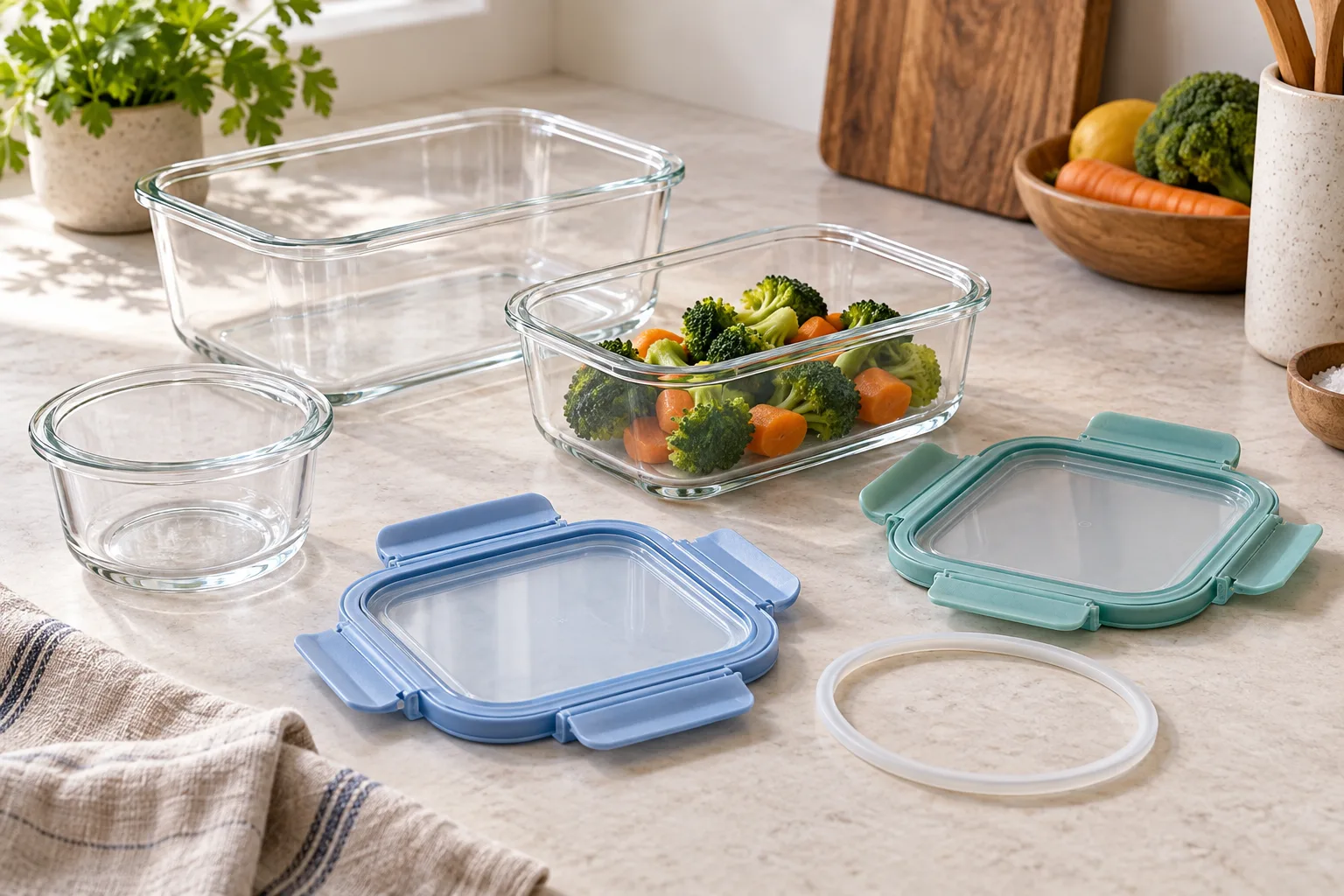
Key Takeaways
- The reviewed ten-piece sets each contain five glass vessels and five lids.
- Equal cup capacity does not establish equal dimensions or cross-family lid compatibility.
- BPA-free is a chemical claim, not a plastic-free or particle-free claim.
- The manufacturer FAQ describes both glass types; it does not identify every reviewed SKU’s glass formula.
- Keep the exact model’s instructions. Conflicting web care text needs clarification, not a guessed exposure benefit.
Compare identified sets rather than the brand names
“Pyrex versus Snapware” is an incomplete question for food storage: the selected Snapware listings explicitly use Pyrex glass. Freshlock is a closure and storage range, while Total Solution includes glass and plastic vessels. Record the full family, SKU, shape and capacity before comparing an existing container or ordering a replacement.
This October 6, 2026 review covers eight manufacturer references. We have not physically tested the containers, timed their latches or measured particles in food. Its purpose is to make the current declarations and unresolved questions easier to compare. Historical packages, other markets and similarly named sets may have different contents.
| Family / SKU | Useful vessel count | Decision detail |
|---|---|---|
| Freshlock · 1133097 | Five vessels + five lids | Two 1-cup squares, two 4-cup squares, one 6-cup rectangle |
| Freshlock · 1149249 | Three vessels + three lids | Three 6-cup rectangles; not six food containers |
| Total Solution glass · 1109331 | Five vessels + five lids | Two 1-cup squares, two 4-cup squares, one 6-cup rectangle |
| Total Solution glass · 1109308 | One vessel + one lid | 1-cup round; listing links a specific replacement lid |
The Freshlock ten-piece set and Total Solution glass ten-piece set have matching listed capacity mixes. However, their six-cup rectangles have different approximate dimensions: 8.5 × 6.5 × 2.25 inches versus 9 × 7 × 2.75 inches. That is a reason to check fit rather than infer that their lids interchange. The Freshlock six-piece set instead repeats one larger size.
A glass vessel and a complete container are different claims
The reviewed listings identify glass vessels and BPA-free plastic lids with four locking tabs. A closed storage container therefore includes polymer components even when the main food-bearing vessel is glass. How a lid or seal contacts the contents depends on filling and use; the product name does not map every contact surface.
The manufacturer FAQ describes polypropylene lids and silicone seals for a broader category called airtight containers. It also distinguishes canisters with other materials. That wording is useful context, but it is not a complete SKU-specific bill of materials for these Freshlock and Total Solution glass assemblies. We do not silently transfer the canister description or identify a particular seal merely from its colour.
If an exact resin or seal matters to your choice, ask the manufacturer for the model-specific declaration. Keep its answer alongside the SKU rather than substituting a marketplace photograph or general brand statement. Our IKEA container guide shows a different example where the selected product pages explicitly name the lid and seal materials.
The Pyrex logo does not identify every glass formula
The current FAQ says the company produces both soda-lime and borosilicate glass. The selected storage listings describe glass without resolving the composition of each reviewed SKU. A logo’s letter case, tint or a familiar brand history is not an adequate replacement for that missing product-specific record.
For an existing dish, retain the markings and supplied instructions. A glass-material preference is legitimate, but it should be grounded in an actual declaration for the item. Choosing a material does not also establish the origin, amount or clinical significance of any particles in food prepared elsewhere and stored in that dish.
Glass composition and appliance permission answer different questions. The glass material profile discusses that distinction. This comparison does not convert a general glass description into unrestricted heating permission or claim that changing one container eliminates all polymer contact in a kitchen.
Microwave lid instructions need a closer read
The selected Freshlock pages list microwave use for vessels and lids. The general Pyrex care page requires plastic lids to be removed or vented at least a quarter inch, with any vent opened. Its online text covers multiple families rather than naming every Freshlock SKU.
Snapware’s web text is inconsistent. The Total Solution plastic-lid section says to unlatch and offset the lid; a later Total Solutions section says to remove it for reheating. Both versions also appear in the reviewed replacement-lid page. We cannot resolve their version history from that page alone.
For the reviewed Snapware glass setup, removing the lid for reheating follows the stricter instruction while awaiting model-specific clarification. Use the instructions supplied with your actual item and ask the manufacturer about any conflict. Do not microwave a sealed, latched container. This operational choice is not a measured particle-reduction result.
Separate storage, cleaning and oven permissions
| Part / source | Selected declaration | Scope to keep |
|---|---|---|
| Freshlock listed vessels | Dishwasher, freezer and microwave | Product-list permissions do not substitute for full heating instructions |
| Freshlock listed lids | Top-rack dishwasher, freezer and microwave | Unsealed heating instructions remain separate |
| Total Solution 1-cup glass | Dishwasher, freezer and microwave | Its closure has separate top-rack care |
| Plastic lids · shared care | No conventional or convection oven | A glass vessel’s oven permission never includes a plastic lid |
Shared glass care requires a preheated oven and avoiding sudden temperature changes. It excludes direct heat and damaged glass. The general Pyrex section also excludes countertop appliances such as air fryers. Use the relevant complete instructions rather than a storage-set title to authorise an appliance.
For day-to-day upkeep, keep a record of which component each instruction describes. A lid’s top-rack label and a vessel’s dishwasher label are not interchangeable. Nor does freezer suitability establish that an assembly can move directly from a freezer into a hot appliance. These distinctions help avoid misreading the permissions; they do not calculate particles per wash or meal.
Replacement lids: check the part number and the family
The Freshlock six-piece page lists replacement lid Model 7211R. The separate Freshlock four-cup round page, SKU 1149538, lists Model 7201-R. These are the identifiers printed on the current pages, not our independent verification that every lid sold under a similar number has the same latch design. Confirm the current replacement’s full description and compatibility before ordering.
The Snapware one-cup round vessel page links the teal-seal replacement, SKU 1134735 / Model 7202R. That replacement page specifically lists the one-cup glass vessel and a 1.21-cup plastic vessel among its compatible items. It also limits broader glass/plastic interchangeability to Total Solution containers of the same shape and size.
That is a bounded compatibility statement, not permission to use a Total Solution lid on Freshlock, Simply Store or any other similarly sized dish. Capacities can match while the rim, dimensions and latches differ. Replacing a single worn component may be practical, but this review does not establish a universal replacement interval or quantify the environmental or particle benefit for your setup.
BPA-free and customer reviews do not rank particle release
BPA-free describes a chemical claim. It does not mean no plastic, no other chemicals, no particles or a demonstrated health advantage over another finished container. A useful particle comparison would need the exact assemblies, repeated use conditions, suitable blanks, polymer identification and a stated detection-size range.
The eight reviewed references supply product declarations and care information, not a matched Freshlock-versus-Total Solution particle experiment. That does not prove relevant research is absent worldwide. A study of a different plastic vessel cannot supply a dose for these lids, and a review mentioning a broken latch cannot quantify particle transfer into food.
Read the product details before relying on a retailer or manufacturer’s automated review summary. The selected Freshlock pages’ summaries mention other storage lines, which is another reason not to use that section to infer construction. Customer experience can help identify a question to ask, but it is not a controlled durability test or a materials analysis. See the testing guide for what measured evidence needs to specify.
Choose useful sizes and documented closures
If you want a mixed-size set, the selected ten-piece listings each supply five vessels. If you repeatedly use larger rectangular portions, the Freshlock six-piece listing supplies three six-cup vessels. Count the containers you will actually use, measure cupboard and fridge space, and check the current regional listing rather than choosing the largest piece-count headline.
For an existing Snapware setup, its selected replacement page gives a more explicit compatibility record. That can make a parts check easier; it does not make Snapware a measured microplastic winner. For Freshlock, verify the replacement identifier and closure design directly. Prices, stock, bundles and available parts can change after this review.
Our recommendation is to compare the exact vessel count, dimensions, closure declaration and care record. Keep unresolved questions visible. Neither source set justifies a numerical exposure ranking or a claim that one complete assembly is polymer-free. The Stasher guide covers a different flexible-storage choice without transferring its findings to these lids.
Frequently Asked Questions
Are Pyrex Freshlock and Snapware glass containers plastic-free?
Does a ten-piece set mean ten food containers?
Do Freshlock and Total Solution lids interchange?
Should the Snapware lid stay on when reheating?
Which range releases fewer microplastics?
Sources
- Pyrex Home (2026). Freshlock 1133097: ten-piece set, capacities and listed construction; accessed October 6.
- Pyrex Home (2026). Freshlock 1149249: three six-cup vessels and replacement identifier; accessed October 6.
- Pyrex Home (2026). Freshlock 1149538: four-cup round and listed replacement identifier; accessed October 6.
- Pyrex Home / Snapware (2026). Total Solution 1109331: glass ten-piece set and bounded lid compatibility; accessed October 6.
- Pyrex Home / Snapware (2026). Total Solution 1109308: one-cup round glass vessel and replacement link; accessed October 6.
- Pyrex Home / Snapware (2026). 1134735 / 7202R: small round replacement, compatible vessels and care text; accessed October 6.
- Pyrex Home (2026). Product use and care: component permissions and conflicting Snapware lid instructions; accessed October 6.
- Pyrex Home (2026). FAQ: glass types and distinctions between airtight-container and canister materials; accessed October 6.
Your next product question
Start with the exact Freshlock or Snapware container and lid.
Compare the vessel, lid and seals with their own instructions. The glass body does not establish that the whole assembly is plastic-free or suitable for every heating use.
Use the exact product name, model and label to check the information behind an assessment. A photo does not measure particles or personal health risk. The examples above are research subjects, not a verified app-coverage list.
Build a product-routine reading plan →Android · early access
Get the launch email the day Android opens.
One email. No spam. We send when the Android app is in the Play Store, and never again unless you opt in.
Related Research
IKEA 365+ Glass Containers: Lids, Seals and Microplastic Questions
Compare identified US and UK glass containers, polypropylene closures and lacquered bamboo lids. Separate body and lid care, regional manuals and particle-test limits.
Read moreNinja Crispi: Glass Bowl, Coated Plate and Microplastic Questions
Follow the glass bowl, coated crisper plate, handles and storage lid. Compare Portable and Pro documentation without turning PFAS-free claims into a particle count.
Read moreEmber Mug 2 vs Mug 3: Coating and Microplastic Questions
The current Mug 3 changes cleaning permission, not the need to assess its coated interior. Compare generations, material disclosure limits and the evidence for particle release.
Read moreAre Stasher Bags Safe? Silicone, Heat and the Testing Gap
Stasher bags use platinum silicone, not polyethylene film. What the manufacturer allows, what silicone migration studies actually measured, and when glass makes a simpler reheating choice.
Read moreIs Caraway Cookware Non-Toxic? What Its Own Filings Show
Caraway’s ceramic pans are PFAS-free, and the ad industry’s watchdog agreed. Its own documents also show an aluminium body, a one-year warranty that excludes coating wear, and cadmium in one cast iron colour’s exterior enamel.
Read moreAre Air Fryer Liners Safe? Paper, Silicone and Foil Checked
Paper liners are coated with silicone, wax or something unnamed, and a September 2026 study found new silicone liners release the most in their first uses. What each type is, what the fryer makers allow, and what to use instead.
Read more