Is the Instant Pot Sealing Ring Safe? Silicone, Heat, Odor and When to Replace It

Last reviewed: by the MicroPlastics Research Desk. Submit a correction or see our editorial standards.
Quick answer

Check the containers in your kitchen
Scan what you heat and store food in to see what drives each score, and one swap worth making.


Free · 3 scans · iOS and Android
Key Takeaways
- The ring is food-grade silicone, which Instant says passed UL, FDA and LFGB tests. It is BPA-free because silicone is not made with BPA in the first place.
- Silicone migration is mostly a new-item problem. In bakery moulds used up to 1,700 times, siloxane migration fell from 11–18 mg/kg to below 1 mg/kg.
- Fat is the driver. Fatty foods pulled the most siloxanes out of silicone moulds; milk-based foods pulled very little.
- The smell is absorption. Silicone takes up fat and flavor compounds, which is why rings carry chili into cheesecake. It is a taste issue, not evidence of breakdown.
- Replace on Instant’s schedule (12–18 months) or sooner if the ring is cracked, torn, stretched or leaks steam. Use genuine rings; third-party ones void the warranty.
- Alternatives still seal with something. Stovetop stainless cookers use a gasket too. Gasket-free metal-to-metal designs exist, mainly as large cast aluminum canners.
What the silicone evidence measured
- Instant’s recommended ring replacement interval
- 12–18 months
- 6–12 months suggested to avoid discoloration and odors
- Instant Pot sealing ring product page
- siloxane migration after heavy use of silicone moulds
- <1 mg/kg
- down from 11–18 mg/kg new; up to 1,700 bakery uses at 180°C
- Helling et al., Food Addit Contam A 2012
- highest siloxane migration into meat loaf from a new mould
- 177 mg/kg
- fatty food, commercial baking mould; EU overall limit 60 mg/kg
- Helling et al., Food Addit Contam A 2010
- stainless steel inner pot on the Instant Pot Duo
- 18/8
- tri-ply bottom; the food contact surface for most of the cook
- Instant Pot Duo 6QT product page
What is the Instant Pot sealing ring made of?
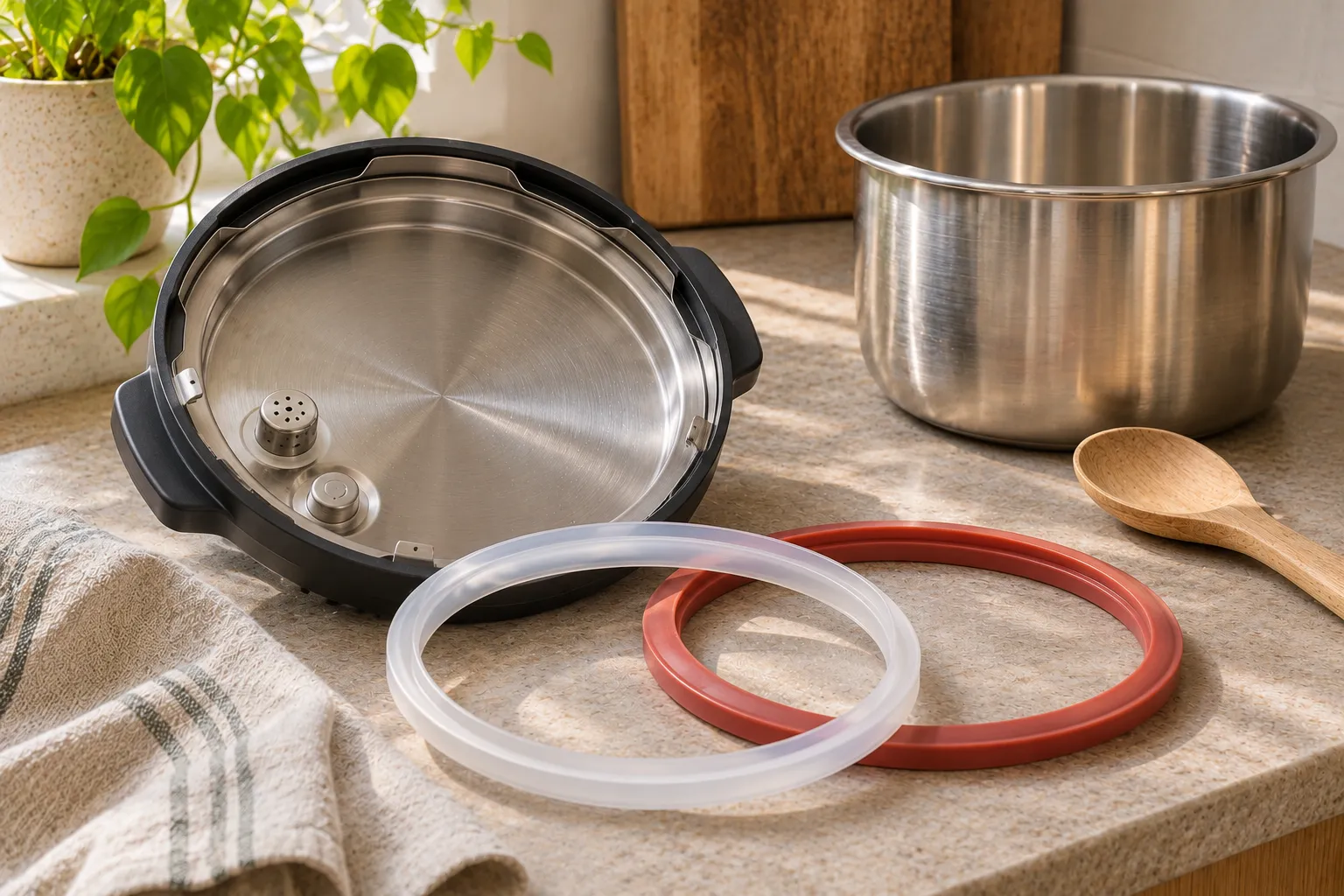
Silicone rubber. Instant’s own sealing ring page describes it as made from “food safe Silicone” that passed UL, FDA and LFGB tests, BPA-free and dishwasher safe. The ring sits in a metal rack under the lid and is squeezed between the lid and the rim of the inner pot as pressure builds, which is what holds the steam in.
Two details on that page matter. Instant says only genuine rings should be used, that third-party rings may have unexpected effects and would void the warranty, and that authentic rings carry an “Instant Pot” or “MDMY-CH-50” style marking. A pressure seal is a safety part. A ring that fits loosely or is the wrong hardness can leak steam or fail to seal, so the warranty point has a practical side.
Read the claims plainly: passing food-contact tests means the material met limits under test conditions, not that nothing ever migrates.
Does the Instant Pot sealing ring leach chemicals?
Silicone can release siloxanes, the short-chain silicone molecules left over from making the polymer. No study we reviewed tested a pressure-cooker ring, so the best evidence comes from silicone bakeware and other kitchen items.
| Study | What was tested | Finding | Relevance to a ring |
|---|---|---|---|
| Helling et al. 2010 | Siloxanes migrating from silicone baking moulds into real foods | Meat loaf up to 177 mg/kg from one new mould; milk-based foods below 2.4 mg/kg; poorly cured moulds migrated much more | Shows fat and curing quality drive migration; moulds touch food directly in dry oven heat |
| Helling et al. 2012 | Bakery moulds over up to 1,700 uses; baby teats over 100 sterilisations | Migration fell from 11–18 mg/kg to below 1 mg/kg; no new migrating siloxanes formed | Strongest evidence that an aged silicone part releases less, not more |
| Chen et al. 2026 | 35 siloxanes from 30 silicone kitchen items sold in China | Most samples exceeded a proposed 2 mg/kg children’s action value for cyclic siloxanes; D4 and D5 low risk; D3 a potential concern | Shows quality varies by product; rings were not among the items described |
Helling and colleagues found that fatty foods pulled the most siloxanes from silicone moulds: meat loaf baked in one commercial mould reached 177 mg/kg, above the EU overall migration limit of 60 mg/kg, while milk-based foods stayed below 2.4 mg/kg even when they were fatty. Moulds that had not been properly tempered, a post-curing heat step that drives off volatile leftovers, migrated considerably more than tempered ones.
Their follow-up is the reassuring half. Moulds used daily in a pizza bakery, up to 1,700 times and roughly 400 hours at 180°C, saw migration drop from 11–18 mg/kg to below the 1 mg/kg detection limit. No new migrating siloxanes formed with age. Baby bottle teats put through 100 simulated uses with microwave sterilisation showed no significant change in extractable siloxanes.
Chen and colleagues tested 30 silicone kitchen items bought online in China and found wide variation between products. Silicone quality varies from maker to maker, which is part of why a genuine part from a known brand is the sensible choice.
Applying this to a ring takes some editorial judgment. A ring touches mostly steam and splashes, not a slab of food baked against it, and most pressure-cooked dishes are water-based. Our reading is that a ring’s contribution is likely smaller than a mould’s, especially after its first few cooks. That is an inference. Nobody has measured it.
Does the Instant Pot sealing ring shed microplastics?
There is no particle study of pressure-cooker rings in the sources we reviewed. Whether silicone counts as a microplastic at all depends on the definition: it is a synthetic polymer, but its backbone is silicon and oxygen rather than carbon. Our silicone explainer covers the definitions and the evidence. A ring is most likely to lose material when it is damaged: torn edges, nicks or age cracks. An intact ring pressed against a smooth steel rim does not face the knife abrasion that wears down a plastic cutting board, which is one more reason to retire a damaged ring.
Why does my Instant Pot ring smell, and is a smelly ring unsafe?
The smell is absorption. Silicone takes up fats and the flavor compounds dissolved in them. In the 2010 study, silicone moulds absorbed up to 8.0 grams of fat per kilogram of silicone over repeated use, and the 2012 study found fat uptake offset the siloxanes that washed out. A pressure cooker drives hot, fatty, aromatic steam into the ring for an hour at a time, so curry and chili linger.
A ring that smells is not necessarily degrading. It is a flavor problem, and Instant treats it that way: it suggests replacing every 6 to 12 months to avoid discoloration and odors, and sells colored pairs so you can keep one ring for sweet and dairy dishes and another for savory ones. Clean the ring after each use, let it dry fully off the lid, and store the lid upside down or ajar so the ring can air out. If a ring still smells after washing and you mind it, that is a fine reason to replace it early.
How often should you replace the Instant Pot sealing ring?
Instant’s product page says it is recommended to replace the sealing ring every 12 to 18 months, and every 6 to 12 months if you want to avoid odors and discoloration. Use those as the outer limit, and replace sooner when the ring shows physical signs.
| What you notice | What it likely means | What to do |
|---|---|---|
| Smells of past meals after washing | Fat and flavor absorbed into the silicone | Keep for savory cooking or replace early; consider a separate ring for sweet dishes |
| Light staining or color change | Absorbed pigments, for example from tomato or turmeric | Cosmetic; replace on the 6–12 month odor schedule if it bothers you |
| Steam leaking around the lid edge | Ring stretched, misseated or worn | Reseat it in the rack; if it still leaks, replace it |
| Cracks, tears or nicks | Physical damage; can shed fragments and fail to seal | Replace now |
| Ring feels loose in its rack or stays deformed | Lost elasticity | Replace now |
| Ring older than 18 months | Past Instant’s recommended interval | Replace with a genuine ring for your pot size |
Use the App
Keep track of the ring and the rest of your cooker
Scan your pressure cooker, its replacement ring or another kitchen appliance. The app records the declared materials of the parts that touch food and steam, and the replacement interval the maker gives, so you know when the ring is due.
What about the rest of the Instant Pot: inner pot, lid and valves?
Most of your food’s contact is with the inner pot. On the Instant Pot Duo, Instant’s product page describes it as stainless steel (18/8) with a tri-ply bottom, and dishwasher safe. Instant also sells inner pots made of aluminum with a ceramic coating; if you prefer bare steel, check which pot came with your model. Scratched coated pots raise their own questions, covered in our non-toxic cookware guide.
The lid carries the ring plus small valve parts that open and close the steam path. Instant’s product page says the lid and its accessories are top-rack dishwasher safe but does not list what each small part is made of. Those parts touch steam and condensation more than food. Keep them clean so the valve moves freely, and replace any that are cracked or warped through Instant’s parts store. If you use a slow-cook setting with a disposable liner, that liner is a bigger polymer contact than the ring: see slow cooker liners.
Are there pressure cookers without a silicone ring?
Hardly any for everyday cooking. Stovetop stainless steel pressure cookers also seal with a replaceable gasket, whether silicone or rubber, so switching from an electric cooker to a stovetop one swaps one gasket for another. Gasket-free designs do exist: All American describes its cast aluminum canners as having a “precision-machined metal-to-metal seal” with no gaskets. Those are large canners, made of aluminum rather than stainless steel, and not a direct replacement for a 6-quart weeknight cooker.
| Option | Seal | Food-contact pot | Trade-off |
|---|---|---|---|
| Electric multicooker (Instant Pot Duo) | Silicone ring; replace every 12–18 months | 18/8 stainless steel | Convenient; small valve parts of unstated material |
| Stovetop stainless pressure cooker | Replaceable silicone or rubber gasket | Stainless steel | Same gasket question; more hands-on |
| Metal-to-metal canner | No gasket | Cast aluminum | Large and heavy; aimed at canning |
| Enameled or bare cast iron Dutch oven | None; not pressurised | Enamel or seasoned iron | Hours instead of minutes for beans and tough cuts |
If the ring is your only concern, managing it well beats replacing the appliance. Choosing a rice cooker instead? Our non-toxic rice cooker guide traces those part by part.
How to use your Instant Pot sealing ring well
- Wash a new ring before first use, and consider running a water-only pressure cycle. New silicone releases the most; early cooks carry most of that.
- Remove and wash the ring after each use, by hand or on the top rack, and let it dry before refitting.
- Keep two rings, one for savory and one for sweet or dairy dishes, as Instant suggests.
- Buy genuine rings for your pot size. Instant says third-party rings void the warranty.
- Mark the date you start using a ring and replace it within 12 to 18 months, or sooner if it cracks, stretches or leaks.
- Don’t cut, scrape or pry the ring with knives or metal tools when removing it; damage is what turns a seal into a source of fragments.
What the evidence does not establish
- How much, if anything, migrates from an Instant Pot ring into food. No ring-specific migration or particle study was found.
- That bakeware numbers apply to rings. Moulds touch food directly in dry heat; rings mostly touch steam.
- That “food safe” or “LFGB tested” means zero release. These mean the material met test limits.
- The materials of every lid part. Instant’s product page does not list them.
- A health effect from using a pressure cooker ring. No study links one to a human outcome. The FDA says current evidence does not show that the levels of microplastics or nanoplastics detected in foods pose a health risk.
What the MicroPlastics app checks
- The declared materials of a scanned pressure cooker, inner pot and replacement ring, such as stainless steel, ceramic-coated aluminum or silicone.
- The maker’s stated replacement interval for wear parts like sealing rings, where product information gives one.
- Other polymer contact points in the same kitchen routine, such as liners, utensils and storage.
- Product information only: the app does not measure siloxanes or particles released by your ring.
Frequently Asked Questions
Is the Instant Pot sealing ring safe?
How often should I replace my Instant Pot sealing ring?
Does the Instant Pot ring leach chemicals into food?
Why does my Instant Pot sealing ring smell?
Can I use a third-party Instant Pot sealing ring?
Is there a pressure cooker without a silicone gasket?
Sources
- Instant Pot (2026). Instant Pot 4, 5 & 6 QT Color Sealing Ring, 2-Pack: material, replacement interval and genuine-ring guidance (retrieved November 8, 2026). instantpot.com.
- Instant Pot (2026). Instant Pot Duo 6QT Multi-Use Pressure Cooker: 18/8 stainless steel inner pot and cleaning guidance (retrieved November 8, 2026). instantpot.com.
- Helling R, Kutschbach K, Simat TJ (2010). Migration behaviour of silicone moulds in contact with different foodstuffs. Food Additives & Contaminants: Part A 27(3):396–405.
- Helling R, Seifried P, Fritzsche D, Simat TJ (2012). Characterisation and migration properties of silicone materials during typical long-term commercial and household use applications: a combined case study. Food Additives & Contaminants: Part A 29(9):1489–1500.
- Chen Y, Li H, Huang H, Shentu X (2026). Migration of 35 siloxanes from silicone food contact materials in China and their potential exposure assessment. Foods 15(8):1387.
- All American (2026). Pressure canners: cast aluminum, metal-to-metal seal, gasket-free (retrieved November 8, 2026). allamericancanner.com.
- US Food and Drug Administration (2024). Microplastics and nanoplastics in foods (retrieved November 8, 2026). FDA.
Your next product question
Start with your pressure cooker, its inner pot and the sealing ring you use now.
Check the declared inner-pot and ring materials and log when the ring was fitted, so you replace it within Instant's 12–18 month guidance. A scan cannot measure siloxanes or particles from your ring.
Use the exact product name, model and label to check the information behind an assessment. A photo does not measure particles or personal health risk. The examples above are research subjects, not a verified app-coverage list.
Read the silicone evidence →Go deeper
Less-travelled research from our archive that follows directly from this page.
Related Research
Do Humidifiers Spread Microplastics? What Gets Into the Air
No study we found has measured plastic from humidifiers, but ultrasonic units demonstrably put minerals in the air. Ultrasonic vs evaporative vs steam, white dust, which water to use and the EPA cleaning routine.
Read moreBest Non-Toxic Spatula: Which Material to Use for Each Pan
Which spatula for which pan: a decision table for wood, one-piece silicone, nylon, black plastic and stainless by nonstick, ceramic, cast iron and steel, with heat limits and what utensil studies actually measured.
Read morePyrex Freshlock vs Snapware: Glass, Lids and Microplastic Questions
Compare exact glass-storage sets, useful vessel counts, closure declarations and replacement compatibility. Read conflicting microwave-lid instructions without inventing a particle-release winner.
Read moreIKEA 365+ Glass Containers: Lids, Seals and Microplastic Questions
Compare identified US and UK glass containers, polypropylene closures and lacquered bamboo lids. Separate body and lid care, regional manuals and particle-test limits.
Read moreNinja Crispi: Glass Bowl, Coated Plate and Microplastic Questions
Follow the glass bowl, coated crisper plate, handles and storage lid. Compare Portable and Pro documentation without turning PFAS-free claims into a particle count.
Read moreEmber Mug 2 vs Mug 3: Coating and Microplastic Questions
The current Mug 3 changes cleaning permission, not the need to assess its coated interior. Compare generations, material disclosure limits and the evidence for particle release.
Read more