Does Bone Broth Have Microplastics? Cartons, Pots and Lead

Last reviewed: by the MicroPlastics Research Desk. Submit a correction or see our editorial standards.
Quick answer

Check the brand in your cupboard
Scan the label to see its packaging, what drives its contact score, and a lower-plastic swap.


Free · 3 scans · iOS and Android
Key Takeaways
- No broth-specific particle test found. Claims that a brand is “microplastic-free” or “full of microplastics” are not backed by a broth measurement.
- Meat itself carried few particles in the one US study. Chicken breast averaged 2 ± 2 particles per serving (45 µm and up); processed products carried more.
- Shelf-stable cartons are mostly paperboard with a polyethylene lining. Tetra Pak says about 70% of an average carton is paperboard.
- Heat plus plastic is the combination to avoid. Microwaving plastic food containers released the most particles in a 2023 test.
- Your pot matters more than the carton for homemade broth. Stainless steel releases some nickel and chromium (metals, not plastic), mostly when new.
- Lead is a separate question. A 2013 study found 7.01 µg/L in chicken bone broth; a 2017 study found per-serving lead low and called the risk minimal.
What has actually been measured
- published microplastic counts in bone broth that we found
- 0
- Searches on November 13, 2026 found studies of meat, packaging and lead, not particles in broth.
- MicroPlastics Research Desk review, November 2026
- particles per serving in chicken breast
- 2 ± 2
- Mean across all 16 products was 74 ± 220 per serving; particles 45 µm and larger only.
- Milne et al., Environmental Pollution 2024
- particles per litre in water from beverage cartons
- 11 ± 8
- Mineral water, not broth; polyethylene particles were linked to the carton coating.
- Schymanski et al., Water Research 2018
- lead in organic chicken bone broth
- 7.01 µg/L
- Tap water handled the same way had 0.89 µg/L. A chemical, not a plastic, result.
- Monro et al., Medical Hypotheses 2013
Has anyone tested bone broth for microplastics?
Not that we could find. We looked for laboratory counts of plastic particles in bone broth, stock or consommé and found none in the peer-reviewed literature or in brand disclosures. Searches for “microplastics” and “bone” mostly return studies of plastic particles in human bone and marrow, which is a different question about what is already inside people, not what is in a pot of soup.
That gap matters because broth sits at the meeting point of three routes people worry about: the animal itself, the long hot cook, and the package. Each route has some evidence, and none of it adds up to a number for a cup of broth. The FDA says current scientific evidence does not demonstrate that levels of microplastics or nanoplastics detected in foods pose a risk to human health. That is a statement about evidence so far, not a test of your broth.
What studies found in meat, bones and animal tissue
The most careful US data come from Milne and colleagues, who bought 16 common protein products in Oregon in 2022, from chicken breasts and pork chops to nuggets, shrimp and tofu, and counted particles of 45 micrometres and larger. The average was 74 ± 220 particles per serving, a spread so wide it tells you how uneven the results were. Chicken breast sat near the bottom at 2 ± 2 per serving; breaded shrimp topped the list at 370 ± 580. Highly processed products carried significantly more particles per gram than minimally processed ones, which points at processing and handling as well as the animal.
No bones or broth were tested, and the method could not see particles smaller than 45 µm. That cutoff misses a lot: in the German water study described below, almost 80% of particles were between 5 and 20 µm. So the study supports a narrow point: whole cuts of meat were not heavily loaded with large particles, and processing added more. It does not tell you how much simmering pulls out of bones, skin or cartilage. Our guide to microplastics in meat covers the wider farm-to-fork chain.
Are bone broth cartons lined with plastic?
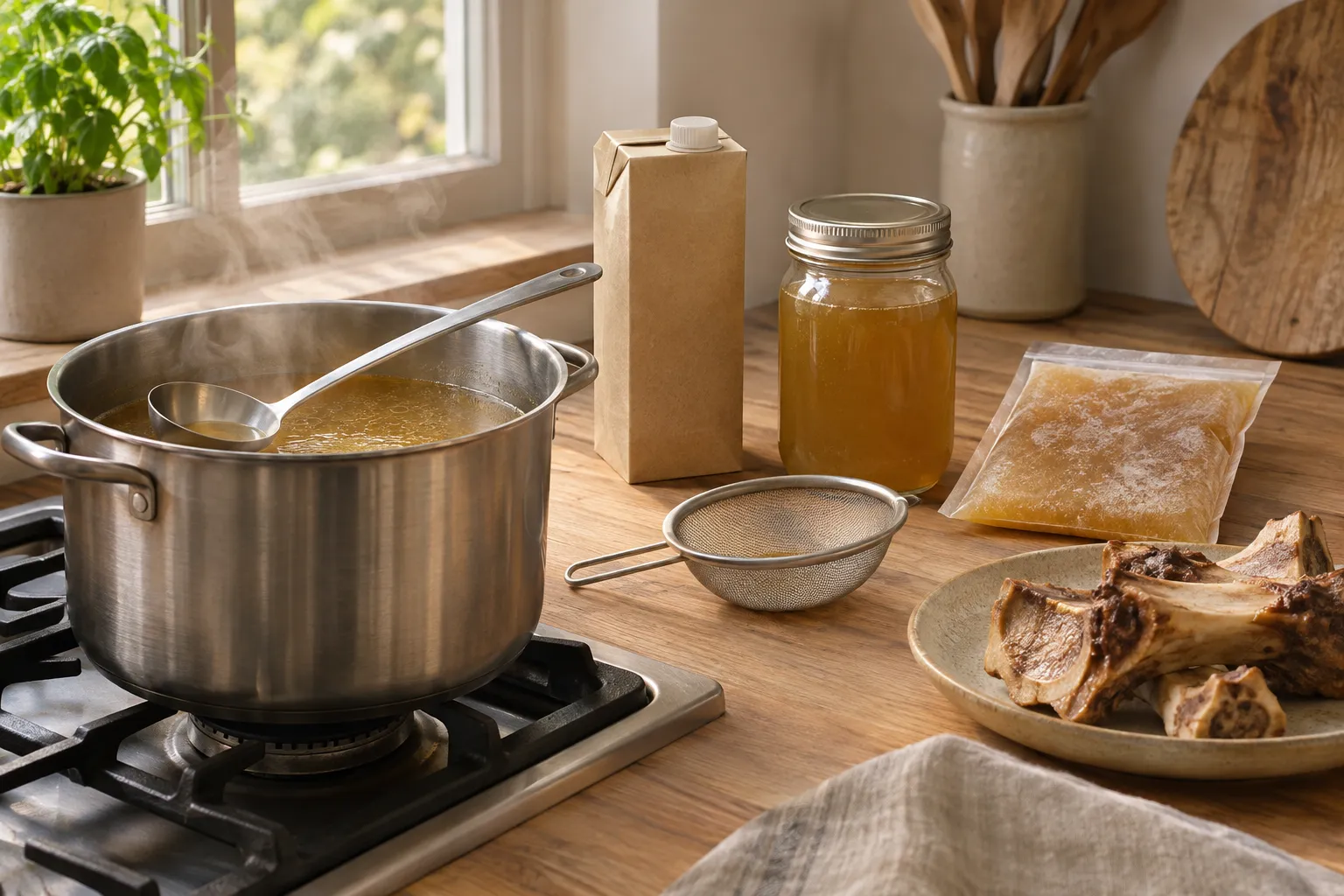
Yes. Most shelf-stable broth comes in an aseptic carton, the kind Tetra Pak and SIG make. Tetra Pak says around 70% of its average carton is paperboard; the rest is polymer layers plus an ultra-thin aluminium foil that keeps out light and oxygen. The polymer is mostly polyethylene, the same plastic as a milk jug, and it is what keeps the liquid off the paper. Broth in a carton is in contact with plastic from the day it is packed until you pour it.
There is one direct measurement of carton-packed liquid. In a 2018 German study using micro-Raman, which can see particles down to a few micrometres, Schymanski and colleagues found about 11 ± 8 particles per litre in mineral water from beverage cartons, and identified polyethylene and other polyolefins that they linked to the carton coating. Water from single-use plastic bottles was similar at 14 ± 14, while returnable plastic bottles had 118 ± 88. That is cold water, not broth that may be filled hot, and it was one market at one time, so treat it as a sign that cartons shed a little rather than a number for broth. For the same question about water, see does boxed water have microplastics.
What the brands say about their packaging
We only list what companies state themselves. None of these statements is a particle test.
- Pacific Foods: its FAQ says all of its cartons are BPA free, tells you not to microwave the carton, and says to refrigerate and use the broth within 7 to 10 days after opening.
- Swanson: Campbell’s says cartons used for Swanson broths are and always have been non-BPA packaging, and that its North American cans now use non-BPA linings.
- Kettle & Fire: its sustainability page says every carton is made with paperboard and names Tetra Pak as a partner. It does not describe the inner layer.
- Kitchen Basics: sold in cartons at major grocers; we found no brand statement on the lining material.
- FOND: says it is canned in glass jars in a retort and is shelf-stable for 2 years unopened. It does not state the lid’s material or lining.
“BPA free” answers a chemical question about one bisphenol. A polyethylene carton lining was never a BPA question in the first place, and the label says nothing about particles.
Plastic tubs, pouches, glass jars and frozen broth
Fresh and frozen broths often come in plastic tubs or flexible pouches, and plenty of home cooks freeze their own broth in deli containers or zip bags. Cold storage is the mild end of the range. The risk climbs when the same plastic is heated. In a 2023 study, Hussain and colleagues microwaved polypropylene baby-food containers and a polyethylene pouch for three minutes and found some released up to 4.22 million microplastic and 2.11 billion nanoplastic particles per square centimetre of plastic. Storage in the fridge or at room temperature released fewer particles, but still released some. Those were baby-food containers tested with water and dilute acid, not broth tubs, but the materials are the same families.
The practical rule is simple: thaw broth in the fridge or in a bowl of water, then pour it into a pot or a glass or ceramic dish to heat. The same logic applies to soup that arrives as takeout; our takeout soup container guide covers polypropylene tubs and foam cups. Broth in metal cans adds a can lining, which our canned food article explains.
Bone broth formats and what touches the broth
- Format
- Shelf-stable carton
- Food-contact surface
- Polyethylene inner layer over foil and paperboard
- What has been measured
- Carton-packed water: 11 ± 8 particles/L (not broth)
- What to do
- Pour out to heat; don’t microwave the carton
- Format
- Metal can
- Food-contact surface
- Polymer can lining
- What has been measured
- Lining chemistry varies; no broth particle count
- What to do
- Transfer before heating; store leftovers in glass
- Format
- Glass jar
- Food-contact surface
- Glass, plus a lined metal lid
- What has been measured
- Glass-bottled water still had particles in one study
- What to do
- Fine choice; keep jars upright so broth rests off the lid
- Format
- Frozen tub or pouch
- Food-contact surface
- Polypropylene or polyethylene
- What has been measured
- Heating plastic food containers released the most particles
- What to do
- Thaw cold, heat in a pot or glass dish
- Format
- Homemade in steel or enamel
- Food-contact surface
- Metal or enamel
- What has been measured
- Steel adds nickel and chromium, mostly when new
- What to do
- Strain through a metal sieve; cool and store in glass
What about bone broth powders and concentrates?
Powdered bone broth, protein blends made from broth, and gel concentrates are sold in plastic tubs, pouches and single-serve sachets. We found no particle test for any of them either. The one pattern worth carrying over comes from the Milne study: products that went through more processing carried more particles per gram than whole cuts. A broth that has been simmered, filtered, dried, ground and packed has more steps where it meets machinery and packaging than a carton of liquid, but nobody has measured whether that adds up to more particles.
If you use a powder, the same rules apply as for liquid broth: scoop it into a mug or pot, add hot water there, and keep boiling water out of the plastic tub or pouch.
Homemade bone broth: stockpot, slow cooker or Instant Pot?
Homemade broth gives you the most control, because you choose every surface the broth touches. A plain stainless steel or enamelled cast iron stockpot puts no plastic in contact with the liquid. The trade-off is metal, not plastic: Kamerud and colleagues cooked tomato sauce in stainless steel for six hours and found nickel rose up to 26-fold and chromium up to 7-fold, with new pots releasing the most and levels falling over repeated cooks until they levelled off around the sixth. Broth is far less acidic than tomato sauce, unless you add a lot of vinegar, so expect less. People with a nickel allergy may still prefer enamel.
A slow cooker’s ceramic crock is not plastic either. The plastic question comes from disposable liners, which Reynolds says are made of a blend of nylon; our slow cooker liner article explains what is and is not known about that nylon. A 12 or 24 hour broth is a long time for any bag to sit in hot fat and liquid. For broth, skip the liner and wash the crock.
An electric pressure cooker cuts a 24 hour simmer to a couple of hours, and its inner pot is stainless steel. The lid carries a silicone sealing ring that sits in steam above boiling point every cook. Silicone migration falls sharply after the first uses and is driven by fat, which broth has plenty of. Our Instant Pot sealing ring guide covers what the ring releases and when to replace it. Don’t overfill past the pot’s maximum line, so less broth boils up into the lid.
Does bone broth have lead?
This is a different question from microplastics, and it should stay separate: lead is a metal stored in bone, not a plastic. The worry traces to a 2013 paper by Monro, Leon and Puri in Medical Hypotheses. They tested three organic chicken broths in a small blinded study and reported 7.01 µg/L of lead in bone broth and 9.5 µg/L in broth made from skin and cartilage cooked on the bone, against 0.89 µg/L in tap water treated the same way. The abstract does not give the number of samples or the cookware used.
A 2017 study by Hsu and colleagues in Taiwan went further. They simmered pig and cow bones for 30 minutes to 12 hours and tested three kinds of commercial broth-based dishes. Lead did not rise significantly with cooking time or differ by species, and estimated intake averaged 1.5 to 2.1 µg of lead per serving, which the authors called a minimal risk. Adding vinegar raised calcium and magnesium about 15 to 17 times but did not significantly raise lead. They noted that Monro’s paper did not describe how its broth was prepared.
So the evidence is two small studies, one hypothesis paper and one controlled extraction study, pointing in different directions on how much it matters. Neither tested US carton brands. If lead is your concern, the levers are the bones you buy and how often you drink broth, not the package. Making it with clean, cold tap water that you have tested, or that your water utility reports as low in lead, removes one variable; the Monro study’s tap water control already contained some lead before any bones went in.
How to make and store bone broth with less plastic contact
- Simmer in stainless steel, enamel or a slow cooker crock without a liner. Season a new steel pot with a few batches of water or stock if you want to reduce early metal release.
- Strain through a metal sieve rather than a nylon mesh bag, and skim with a steel spoon.
- Cool before you pack it. Split a big batch into shallow steel or glass containers so it cools quickly, then refrigerate promptly. Don’t pour boiling broth into plastic.
- Freeze in glass jars or steel containers with headroom for expansion, or in silicone trays if you want portions. Our plastic-free food storage guide compares options.
- For store-bought, pour it out before heating. Pacific Foods says not to microwave its cartons, and the same logic applies to any carton or tub.
- Pick jars if packaging is your main concern, knowing that glass is not a guarantee of zero particles.
What the evidence does not establish
- A particle count for any bone broth. None found, packaged or homemade.
- That long simmering pulls plastic out of bones. Meat studies tested muscle and processed products, not bone extraction.
- A ranking of broth brands. Packaging declarations differ, but no matched test compares them.
- A health effect from broth particles. No study measured one, and the FDA says current evidence does not show a risk from detected levels.
- A settled answer on lead. Two small studies disagree on the size of the issue.
What the MicroPlastics app checks
- The declared package type for a broth or stock: carton, can, glass jar or frozen tub.
- Packaging statements a brand publishes, such as BPA claims and microwave warnings, with their limits.
- Lower-plastic storage and heating swaps for the item you scanned.
- Product information only: the app does not test your broth for particles or lead.
Use the App
Check what your broth is packed in
Scan a carton, jar or tub to see its declared materials and what the brand does and does not disclose. It is not a particle test.
Frequently Asked Questions
Does bone broth have microplastics?
Is bone broth in a carton lined with plastic?
Is homemade bone broth lower in microplastics than store-bought?
Is it safe to make bone broth in an Instant Pot?
How much lead is in bone broth?
Can I microwave bone broth in its container?
Sources
- Milne MH, De Frond H, Rochman CM, Mallos NJ, Leonard GH, Baechler BR (2024). Exposure of U.S. adults to microplastics from commonly-consumed proteins. Environmental Pollution 343:123233.
- Schymanski D, Goldbeck C, Humpf HU, Fürst P (2018). Analysis of microplastics in water by micro-Raman spectroscopy: release of plastic particles from different packaging into mineral water. Water Research 129:154–162.
- Hussain KA, Romanova S, Okur I, et al. (2023). Assessing the release of microplastics and nanoplastics from plastic containers and reusable food pouches: implications for human health. Environmental Science & Technology 57(26):9782–9792.
- Kamerud KL, Hobbie KA, Anderson KA (2013). Stainless steel leaches nickel and chromium into foods during cooking. Journal of Agricultural and Food Chemistry 61(39):9495–9501.
- Monro JA, Leon R, Puri BK (2013). The risk of lead contamination in bone broth diets. Medical Hypotheses 80(4):389–390.
- Hsu D-j, Lee C-w, Tsai W-c, Chien Y-c (2017). Essential and toxic metals in animal bone broths. Food & Nutrition Research 61:1347478.
- Tetra Pak (accessed November 13, 2026). Responsibly sourced materials; Packaging materials. Tetra Pak.
- Pacific Foods (accessed November 13, 2026). Frequently asked questions. Pacific Foods.
- The Campbell’s Company (accessed November 13, 2026). Issues that matter: packaging and BPA. Campbell’s.
- Kettle & Fire (accessed November 13, 2026). Sustainability. Kettle & Fire.
- FOND Bone Broth (accessed November 13, 2026). How FOND is shelf stable; About your FOND jars. FOND help center.
- US Food and Drug Administration (accessed November 13, 2026). Microplastics and Nanoplastics in Foods. FDA.
Your next product question
Start with the broth or stock you buy most, and the container you store homemade broth in.
See the declared package and what the brand does and does not disclose about its lining. A scan cannot count particles or measure lead in your broth.
Use the exact product name, model and label to check the information behind an assessment. A photo does not measure particles or personal health risk. The examples above are research subjects, not a verified app-coverage list.
Read the pressure-cooker ring evidence →Related Research
Microplastics in Meat and Chicken: From Farm to Fork
Meat's microplastic exposure comes from the processing and packaging chain rather than the animal. The 2026 ranking, and the habits that actually cut it.
Read moreIs the Instant Pot Sealing Ring Safe? Silicone, Heat, Odor and When to Replace It
The Instant Pot ring is food-grade silicone that sits in hot steam every cook. What silicone migration studies show (and why it falls with use), why rings hold odors, Instant’s 12–18 month replacement guidance, the rest of the lid, and gasket-free alternatives.
Read moreAre Takeout Soup Containers Safe? Plastic, Foam and Paper
Winter soup arrives in polypropylene deli tubs, foam cups or plastic-lined paper. What hot-water and microwave studies tested, how close they are to real soup, and the transfer-and-reheat routine that avoids the hottest contact.
Read more