Are Artificial Christmas Trees Toxic? PVC, Lead and Real Trees
Last reviewed: by the MicroPlastics Research Desk. Submit a correction or see our editorial standards.
Quick answer

Check the containers in your kitchen
Scan what you heat and store food in to see what drives each score, and one swap worth making.


Free · 3 scans · iOS and Android
Key Takeaways
- Most artificial trees are PVC. Both published life cycle studies modeled PVC needles on a steel frame, made in China.
- Lead was a stabilizer in PVC. Older trees and cords are the likeliest to contain it; reported testing of trees is old and thin.
- The lights may matter more than the needles. A Cornell test found lead in every light set it checked.
- Prop 65 warnings flag a chemical, not a measured dose. A July 2026 notice alleged DEHP in faux tree plants; it is an allegation.
- No study we found measured microplastic shedding from artificial needles, though brittle old trees visibly shed bits.
- Keep it a long time. One independent life cycle study said an artificial tree needs about 20 years to match real trees on climate impact.
What the tree evidence measured
- with lead in PVC branches emitted high lead levels
- 2 used trees
- weekly wipe samples beneath new and used PVC trees for a month; no figures in the public summary
- UNC-Asheville via UGA Extension; Maas et al. 2004
- holiday light sets contained lead
- 10 of 10
- all exceeded EPA/HUD dust limits for equivalent floor and windowsill areas
- Laquatra et al., J Environ Health 2008
- of 69 seasonal products had lead above 100 ppm
- 13%
- garlands, artificial wreaths and greenery, lights; no tree-specific result
- Ecology Center, 2014
- for an artificial tree to match real trees on climate impact
- ~20 years
- Ellipsos 2009 LCA, Montreal; 6-year average use assumed
- Dovetail Partners review, 2018
What are artificial Christmas trees made of?
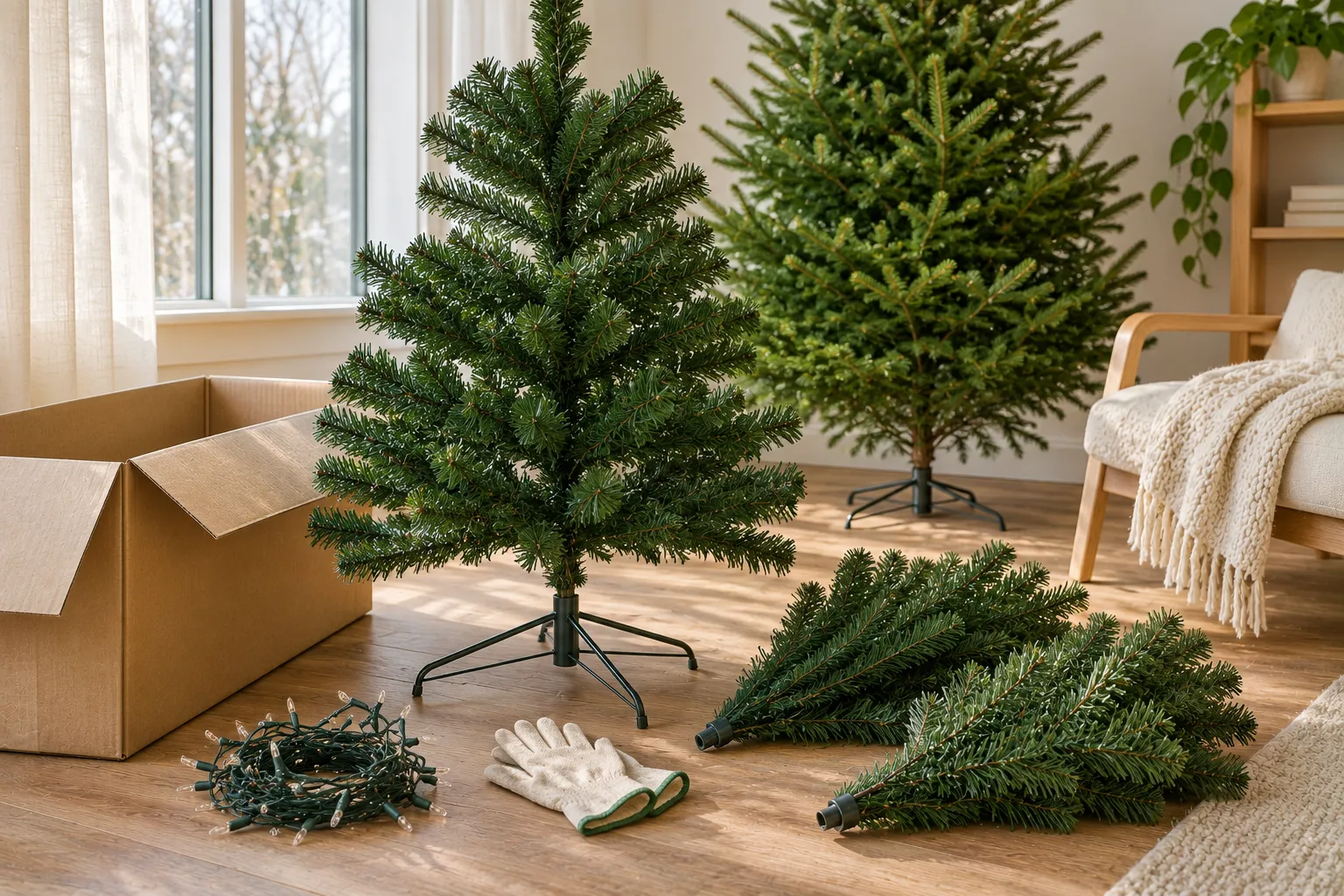
Almost all are plastic foliage on a metal frame. The classic needle is PVC film, pressed thin and cut into flat strips that are twisted around a wire. The two published life cycle assessments of real versus artificial trees both modeled exactly that: PVC resin, steel parts, PVC needles and branches, shipped from China, where Dovetail Partners says the vast majority of artificial trees are made.
Pricier “realistic” trees add branch tips injection-molded from polyethylene, the plastic of milk jugs and many food bags. Molded PE tips look rounder and more like real needles. Sellers commonly describe these trees as PE tips on the outside where you see them, with flat PVC needles filling in toward the trunk. So a “PE tree” usually means less PVC, not no PVC. Pre-lit trees also carry wiring with PVC jackets, and flocked trees add a sprayed-on white coating whose composition makers rarely state.
| Part | Usual material | What to know | What to do |
|---|---|---|---|
| Flat cut needles | PVC film | Historic lead stabilizers; phthalate plasticizers in soft PVC; sheds bits as it ages | Gloves or hand washing; retire brittle, faded trees |
| Molded branch tips | Polyethylene (PE) | No lead stabilizer needed for PE; additives undisclosed | Prefer high PE share if buying new |
| Light wiring | PVC-jacketed copper | Lead found in all 10 sets in a 2008 test | Wash hands after handling; keep kids off cords |
| Flocking | Usually undisclosed | Visibly sheds; contents unknown | Skip if you have crawlers or pets |
| Frame and stand | Steel, often powder-coated; plastic stand parts | Low contact | None special |
Do artificial Christmas trees contain lead?
Some have. Lead compounds were used to stabilize PVC against heat and light, and, as the Regulatory Review noted, federal lead rules do not generally extend to plastics in household goods like decorations. The best-known tree study comes from the Environmental Quality Institute at UNC-Asheville, published by Maas and colleagues in 2004. As University of Georgia Extension summarized it, researchers took weekly wipe samples from beneath new and used PVC trees for a month, and two of the used trees with lead in their branch material emitted high levels of lead. The public summary does not give the amounts, and we could not open the full paper, so we do not quote a number.
The mechanism is simple: PVC breaks down with heat, sun and age, and the surface turns to fine dust that settles on the floor and on presents under the tree. The Extension specialist advised washing hands after touching the tree, cleaning the area thoroughly, and keeping young children away from the tree and its dust. Industry groups have said lead-stabilized PVC is no longer used by their members, as the Regulatory Review reported; that is an industry statement, not a test. Lead stabilizers have been phased down, but a tree bought in the 1990s or 2000s is a different product from one made last year.
Are the lights the bigger problem?
For hands, possibly. Cornell researchers led by Joseph Laquatra tested 10 sets of holiday lights bought new in Nebraska and New York, plus sets from the 1970s, and found lead in every one. All exceeded EPA/HUD limits for the equivalent floor and windowsill areas, with no meaningful difference by brand, purchase year or years of use. They noted lead makes up roughly 2 to 5% of the PVC jacketing. Their advice was that children should not handle the lights and adults should wash their hands right after.
In 2014 the Ecology Center screened 69 seasonal products, including garlands, artificial wreaths and greenery, stockings and figurines. Two-thirds contained at least one hazardous chemical, 13% had lead above 100 ppm, and 12% had bromine above 800 ppm, a marker for brominated flame retardants. Light strings were among the worst. The release did not break out artificial greenery on its own, so it shows the category, not your tree. A pre-lit tree puts those cords on every branch you fluff.
What does a Prop 65 warning on a tree mean?
It means a seller has chosen to warn California buyers that the product can expose them to a chemical on the state’s list, often lead or a phthalate such as DEHP. It does not state how much exposure occurs, and companies often warn rather than test. Private enforcers can also send notices. On July 2, 2026, one 60-day notice to Kohl’s alleged that “Faux Christmas Tree Plants” exposed buyers to DEHP by ingestion and skin contact without a warning. That is an allegation, not a court finding, and it concerns small faux trees rather than full-size ones.
Read a warning as a materials clue. If a tree warns for lead or phthalates, assume the PVC parts contain them, handle accordingly, and ask the seller for third-party test results if it matters to you. Our phthalates explainer covers why DEHP draws attention.
Do artificial trees shed microplastics?
We found no study that measured it. Common sense says they shed something: anyone who has unpacked an old tree has seen bits of needle on the floor, and brittle PVC breaks into smaller pieces over time. Those fragments join the household dust that already contains fibers from carpets, upholstery and clothing, which our indoor air guide explains. Shedding is likely worst during assembly, fluffing and takedown, and from trees that have been stored in hot attics or garages. A tree that crunches, fades or leaves a pile of needles is past its useful life.
Use the App
Not sure what your tree and lights are made of?
Scan the box, tag or product page of a tree, garland or light set. The app records declared materials such as PVC or PE, flags lead or phthalate warnings on the listing, and saves handling notes for setup day.
Is a real Christmas tree safer?
It removes the PVC question and adds others. Researchers at Upstate Medical University found that clippings from staff members’ trees carried a variety of molds, most of them potential allergens. Lead author Lawrence Kurlandsky’s advice, as reported by UPI: hose the tree down outdoors and let it dry before bringing it in, keep it inside for less time, and run an air purifier in the room. He added that families without obvious allergies are unlikely to be bothered.
Pesticides are the other question, and the evidence is thin. Tree farms use them; an OPB investigation reported chlorpyrifos use on Pacific Northwest farms in 2018. Whether residue on a cut tree exposes anyone once it is indoors has not been studied thoroughly, and an Oregon State specialist told OPB he considered it unlikely. If that worries you, ask the farm what it sprays, choose an organic or low-spray grower, and rinse the tree. A potted living tree avoids cutting but has the same pesticide question.
Real versus artificial: the trade-offs that the evidence supports
- Issue
- Lead
- Artificial (PVC or PVC/PE)
- Possible in older PVC and cords; reported test data old
- Real cut tree
- Not a material issue (lights still apply)
- Issue
- Phthalates
- Artificial (PVC or PVC/PE)
- Possible in soft PVC; Prop 65 warnings and notices
- Real cut tree
- Not a material issue
- Issue
- Mold and pollen
- Artificial (PVC or PVC/PE)
- Dust and mold if stored damp
- Real cut tree
- Molds found on clippings; worse the longer it stays in
- Issue
- Pesticides
- Artificial (PVC or PVC/PE)
- Not applicable
- Real cut tree
- Used on farms; indoor residue not well studied
- Issue
- Plastic fragments
- Artificial (PVC or PVC/PE)
- Likely as it ages; never measured
- Real cut tree
- None from the tree itself
- Issue
- Climate
- Artificial (PVC or PVC/PE)
- Needs many years of use to break even (see below)
- Real cut tree
- Lower in both LCAs at short driving distances
How long must an artificial tree last to beat a real one?
Longer than most people keep one, depending on who you ask. The Dovetail Partners review summarized the only two published life cycle assessments. The 2009 Ellipsos study in Montreal assumed an artificial tree lasts 6 years, the average its survey found. Artificial trees did worse in 7 of 15 impact categories and real trees in 7, but the climate impact of the artificial tree was over one and a half times higher, and it would need about 20 years of use to match. A 2010 study by PE Americas, commissioned by the American Christmas Tree Association, found the break-even ranged from 4 years to at least 9, depending on what happens to real trees afterward and how far you drive to buy one.
The association’s later 2018 study by WAP Sustainability put break-even at 5 years, and cited average use of about 10 years; it was released by the industry group. Driving distance swings every result: if the tree lot is 10 miles away rather than 3, Ellipsos’s own numbers favored a long-kept artificial tree. For scale, Dovetail estimated all Christmas tree emissions come to less than 0.1% of an average person’s carbon footprint. The takeaway for an artificial tree you already own: keep using it while it is sound.
How to set up, handle and store an artificial tree
- Assemble with gloves or wash hands with soap afterward, especially after fluffing branches and stringing lights. Do it before you eat.
- Lay a washable sheet under the tree during setup and shake it outdoors when you finish.
- Keep toddlers and pets from mouthing branches and cords. Hand-to-mouth is the main route for dust.
- Damp-dust and vacuum under the tree weekly with a vacuum that has a HEPA filter. The EPA describes HEPA as capturing at least 99.97% of particles at 0.3 µm.
- Keep presents and food off the tree skirt if your tree is old PVC.
- Store it cool and dry in a bag or box, not in a hot attic or sunny garage. Heat and sun break PVC down faster, and damp storage invites mold.
- Retire it on condition: brittle, faded or crumbling needles and cracked cord jackets mean it is shedding.
If you have young children and an older PVC tree, the step with the most payoff is replacing the light strings and washing hands after handling. For broader home exposure, see our room-by-room home guide and, for kids’ products specifically, plastic toys and microplastics.
If you are buying a tree this year
- Buying artificial: choose one you will keep for a decade or more, with a high share of molded PE tips, and ask for the PE/PVC split and any third-party lead or phthalate testing. Unlit trees let you choose and replace lights separately.
- Buying real: buy close to home, ask the grower about spraying, hose it down and let it dry before bringing it in, and keep it inside for as short a stretch as you enjoy.
- Either way: new LED light strings, washed hands, and a HEPA vacuum under the tree do more than the tree choice for dust you touch.
What the evidence does not establish
- Current lead levels in new trees. The tree study we found is from 2004 and its numbers were not in the public summary.
- A microplastic count from any artificial tree. No reviewed source measured it.
- A health outcome from owning a tree. The studies measured content or dust, not illness.
- Indoor pesticide exposure from real trees. Not studied thoroughly.
- That PE tips are additive-free. Makers rarely disclose stabilizers or colorants.
What the MicroPlastics app checks
- The declared foliage material of a scanned tree, garland or wreath, such as PVC or molded PE.
- Prop 65 or other chemical warnings shown on the listing or packaging.
- Handling and storage notes for your saved item, and lower-plastic alternatives.
- Product information only: the app does not test your tree for lead, phthalates or particles.
Frequently Asked Questions
Are artificial Christmas trees toxic?
Do artificial Christmas trees have lead?
Are PE Christmas trees safer than PVC?
Why does my artificial tree have a Prop 65 warning?
Is a real or fake Christmas tree better for allergies?
How long should you keep an artificial Christmas tree?
Sources
- Maas RP, Patch SC, Pandolfo TJ (2004). Artificial Christmas trees: how real are the lead exposure risks?. Journal of Environmental Health 67(5):20–24 (bibliographic record).
- Peppers JF, University of Georgia CAES (2003). Some holiday trees, greenery may contain lead. UGA Extension Field Report.
- Lang SS, Cornell Chronicle (on Laquatra J, Coyne LM, Pierce MR, J Environ Health 71:5) (2008). ’Tis the season to beware of lead in Christmas lights. Cornell University.
- Ecology Center / HealthyStuff.org (2014). Study finds toxic chemicals in a majority of seasonal holiday products. PR Newswire.
- Voorhees & Bailey LLP for Dennis Johnson (2026). 60-day notice of violation to Kohl’s, Inc.: Faux Christmas Tree Plants, DEHP (July 2, 2026; allegation). California Attorney General Prop 65 notices.
- Leibson H (2021). Are artificial Christmas trees safe?. The Regulatory Review.
- Bowyer JL, Groot H, Erickson G, et al. (2018). Environmental assessment of natural vs. artificial Christmas trees. Dovetail Partners Consuming Responsibly Report No. 3.
- American Christmas Tree Association / WAP Sustainability (2018). 2018 life cycle assessment (industry-released). ACTA.
- UPI (2011). Christmas trees cause allergic reaction (on Kurlandsky L, Annals of Allergy, Asthma and Immunology). UPI Health News.
- Schick T (2018). A toxic pesticide once targeted for a ban was probably sprayed on your Christmas tree. OPB.
- US Environmental Protection Agency (2026). What is a HEPA filter? (retrieved November 8, 2026). EPA.
Your next product question
Start with your artificial tree, garland or pre-lit light set.
Record the declared foliage material and any lead or phthalate warning, then save handling and storage notes. A material check does not test your tree for lead, phthalates or particles.
Use the exact product name, model and label to check the information behind an assessment. A photo does not measure particles or personal health risk. The examples above are research subjects, not a verified app-coverage list.
Read how household dust collects plastic →Related Research
Are Heated Blankets Safe? Fleece, Wiring and Microplastics
Most heated blankets are polyester fleece over PVC-insulated wire. What fleece sheds, what is unknown about flame retardants, what the EMF studies found, and how to wash one without wrecking it.
Read moreIs the Instant Pot Sealing Ring Safe? Silicone, Heat, Odor and When to Replace It
The Instant Pot ring is food-grade silicone that sits in hot steam every cook. What silicone migration studies show (and why it falls with use), why rings hold odors, Instant’s 12–18 month replacement guidance, the rest of the lid, and gasket-free alternatives.
Read moreDo Humidifiers Spread Microplastics? What Gets Into the Air
No study we found has measured plastic from humidifiers, but ultrasonic units demonstrably put minerals in the air. Ultrasonic vs evaporative vs steam, white dust, which water to use and the EPA cleaning routine.
Read moreBest Non-Toxic Spatula: Which Material to Use for Each Pan
Which spatula for which pan: a decision table for wood, one-piece silicone, nylon, black plastic and stainless by nonstick, ceramic, cast iron and steel, with heat limits and what utensil studies actually measured.
Read morePyrex Freshlock vs Snapware: Glass, Lids and Microplastic Questions
Compare exact glass-storage sets, useful vessel counts, closure declarations and replacement compatibility. Read conflicting microwave-lid instructions without inventing a particle-release winner.
Read moreIKEA 365+ Glass Containers: Lids, Seals and Microplastic Questions
Compare identified US and UK glass containers, polypropylene closures and lacquered bamboo lids. Separate body and lid care, regional manuals and particle-test limits.
Read more