Are Insulated Food Jars Safe? Lids, Gaskets and Lead

Last reviewed: by the MicroPlastics Research Desk. Submit a correction or see our editorial standards.
Quick answer

Check the brand in your cupboard
Scan the label to see its packaging, what drives its contact score, and a lower-plastic swap.


Free · 3 scans · iOS and Android
Key Takeaways
- The bowl is steel; the lid is the plastic part. Thermos lists polypropylene #5 and 18/8 stainless for its FUNtainer line, and Stanley uses polypropylene on the outside of its stoppers.
- Hot food touches the lid through steam. Condensation forms on the underside and runs back into the food. Headspace keeps the food itself off the lid.
- The lead question is about the base seal, not the food surface. Ask each brand. Answers range from “includes lead, covered by steel” to “lead-free glass plugs”.
- Preheat for safety, not only warmth. USDA guidance is to keep insulated lunch food at 140°F (60°C) or above until it is eaten.
- The gasket is where residue hides. Thermos tells owners to remove it and wash it separately every time.
- Never microwave the jar or heat food in it. Heat food in a pan or a glass bowl, then pour it in.
Food jar numbers worth knowing
- minimum holding temperature for hot lunch food
- 140°F
- keep the insulated container closed until lunch
- USDA FSIS fact sheet (archived)
- preheat time with hot tap water, lid on
- 5–10 min
- Thermos FUNtainer food jar care guide
- Thermos care and use guide
- stated hot-food time for two jars
- 5 h vs 7 h
- Thermos FUNtainer 10 oz (5 h) and Klean Kanteen TKCanister 16 oz (7 h); maker claims, not tests
- Thermos; Klean Kanteen
- longest Thermos says food should stay in the jar
- 24 h
- Thermos’s general food jar guide adds that dairy, homemade soup and tomato can spoil sooner
- Thermos care and use guides
What in an insulated food jar actually touches your food?
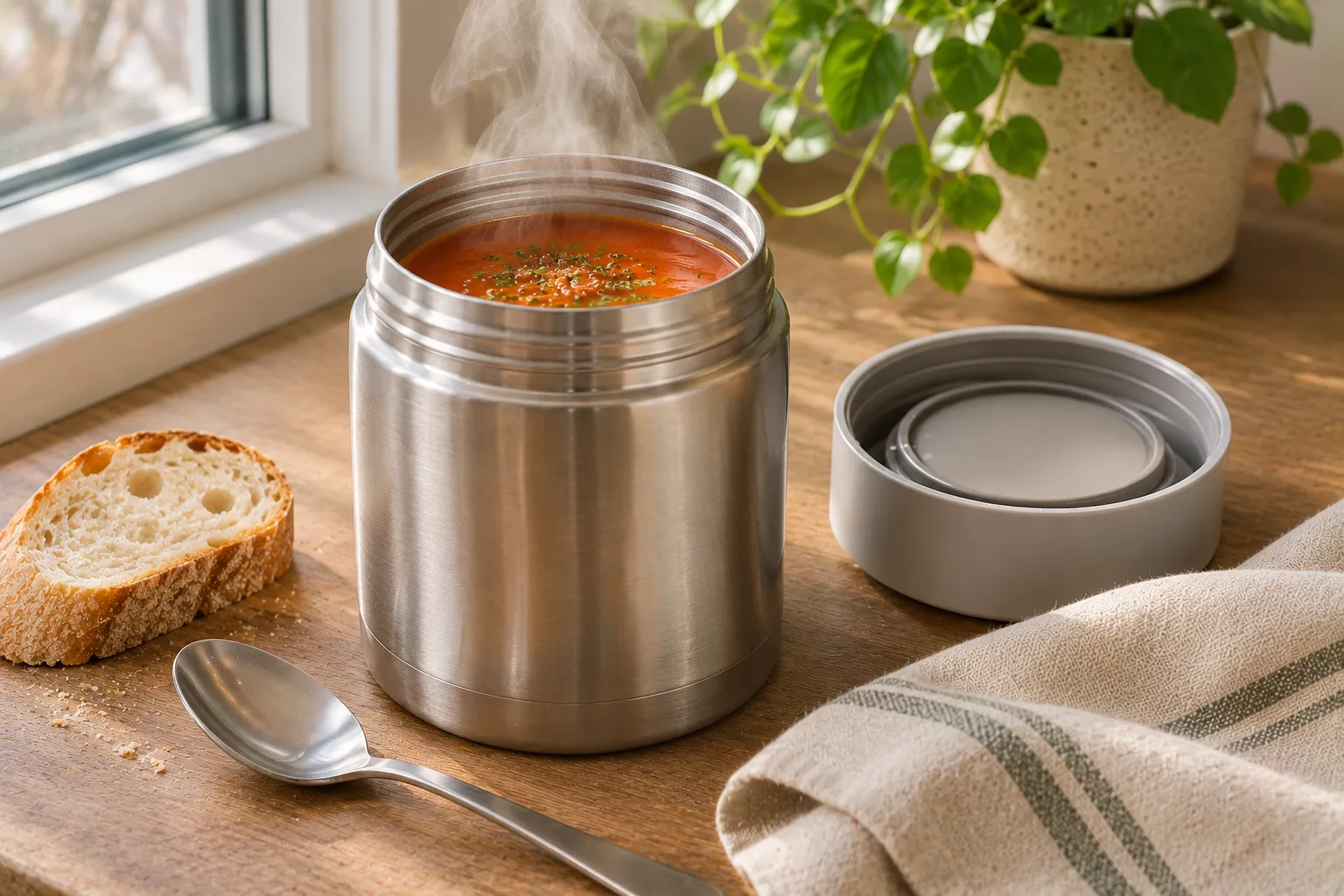
A vacuum food jar is two steel cans, one inside the other, with the air pumped out of the gap. Food sits in the inner can. The parts that matter for plastic contact are on top: a screw lid, usually plastic on the inside, and a flexible ring gasket that presses against the rim to stop leaks. Some jars add a folding spoon in the lid.
Thermos says its stainless products have no interior coating, and that its FUNtainer, Foogo and Thermos Baby lines are made from BPA-free materials “including Polypropylene #5 and food grade 18/8 stainless steel.” The FAQ does not name the gasket material for the food jar. The FUNtainer care guide calls it an o-ring gasket that sits on the underside of the lid. Stanley says it uses BPA-free polypropylene for the outer plastic of its stoppers. Klean Kanteen describes its TKCanister body as 90% recycled 18/8 stainless and the product as BPA-, BPS-, BPF- and lead-free, but the product page does not say what the lid is made of.
So the food-contact map is simple. Steel on the bottom and sides. Polypropylene or another polymer above. A gasket at the joint, which on many jars is silicone, though you should confirm that from your own jar’s paperwork rather than assume it.
| Brand and example | Food-contact body | Lid and gasket, as stated | Vacuum seal and lead | Care rule worth knowing |
|---|---|---|---|---|
| Thermos FUNtainer 10 oz food jar | 18/8 stainless, no interior coating | Line uses polypropylene #5; o-ring gasket under the lid; gasket polymer not named | Says lab testing shows no risk of lead exposure; does not describe the seal | Remove and wash gasket separately; no bleach; top rack only |
| Stanley food jars | Stainless steel | Stopper outer plastic is BPA-free polypropylene | Pellet at the base; sealing material includes lead, covered by a steel layer | Exposed seal from a lost base cap is a warranty case |
| Klean Kanteen TKCanister 16 oz | 90% recycled 18/8 stainless | Cap can be taken apart for cleaning; polymer not named on the page | Says all products are lead-free; uses silica/glass plugs | Dishwasher safe per maker |
These are maker statements. None of them is a particle or migration test of the lid, and “BPA-free” names what was left out of a plastic, not what it releases.
Does hot food in a thermos release microplastics from the lid?
Nobody has measured it for a food jar in the sources we reviewed. That is the honest answer. What exists sits nearby and is worth reading carefully, because the conditions differ.
Li and colleagues (2020) found that polypropylene infant feeding bottles released up to 16.2 million particles per litre during formula preparation, and that sterilizing the bottles and using high-temperature water increased release. Hussain and colleagues (2023) found that microwaving polypropylene and polyethylene food containers released the most particles of any scenario they tested, up to 4.22 million microplastics and 2.11 billion nanoplastics from one square centimetre of plastic in three minutes. Both studies put hot water or food in direct, full contact with a plastic vessel. A food-jar lid is a smaller surface that mostly meets steam and drips, at temperatures that fall through the morning.
The reasonable inference: the lid is the part of the jar where plastic meets heat, so it is the part to keep in good condition and keep the food off. It is not evidence that a food jar adds a known number of particles to soup. For gaskets, migration studies of silicone kitchen items measure siloxane molecules rather than particles. In Chen et al. 2026, 30 silicone food-contact items held at 70°C for two hours released siloxanes at levels that varied widely by product. Gaskets were not among them. Our silicone explainer covers what that distinction means.
Do insulated food jars contain lead?
Some do, in one specific place. To hold a vacuum, the gap between the two steel walls has to be sealed after the air is removed. Stanley says its process currently uses an industry-standard pellet to seal the vacuum insulation at the base of its products, and that “the sealing material includes lead.” It says that area is then covered by a stainless steel layer and that no lead is on any surface that touches the user or the contents. Its FAQ applies to its products generally, which include food jars.
Other makers describe different methods. Klean Kanteen says all its products are lead-free and that it uses silica/glass plugs to make its vacuum vessels. Thermos answers the lead question by saying its products are tested by independent labs and “do not pose a risk of lead exposure to consumers.” That is a statement about exposure. It does not say whether a lead-containing seal is used, so if that matters to you, ask Thermos directly about your model.
In daily use the risk scenario is a damaged base. A covered seal is not in the food path. If the bottom cap or dot on your jar falls off, stop giving that jar to a child, keep it away from food prep and contact the maker. Our Stanley cup audit covers the tumbler side of the same story.
How to preheat a food jar so food stays hot and safe
Preheating is a food safety step as much as a comfort one. USDA’s bag-lunch guidance is to fill the container with boiling water, let it stand a few minutes, empty it and add piping hot food, then keep it closed until lunchtime so the food stays at 140°F or above. Makers are a little more cautious about the water. The Thermos guide says to fill the jar with hot tap water, put the lid on and let it stand 5 to 10 minutes. Stanley says warm tap water for five minutes.
- Heat the food first, separately. Thermos says to bring soup, pasta or other hot food to a boil on the stove, or microwave it piping hot, before filling. Use a pan or a glass bowl, not a plastic tub. Never put the jar itself in a microwave or oven.
- Preheat while the food heats. Hot water in, lid on, 5 to 10 minutes. Pour it out just before filling.
- Fill and leave headspace. Thermos says to leave room for the lid to avoid overflow. That gap also keeps food from being pressed against the plastic underside.
- Close it and leave it closed. Each opening lets heat out. Teach kids to open it only at lunch.
- Size the jar to the meal. A half-empty jar holds heat less well than a full one. A 10 oz jar suits a small child’s portion.
Stated hold times are maker claims under their own conditions. Thermos says up to five hours hot for the 10 oz FUNtainer; Klean Kanteen says seven for its 16 oz canister. A lunch eaten six hours after packing is outside the smaller jar’s claim, so pack it later or use a better-insulated jar.
Use the App
Which food jar is in your kid's backpack?
Scan the jar or its barcode. The app records the declared body, lid and gasket materials, what the maker says about the vacuum seal, and the care rules for that model, so replacement gaskets and lids are easy to find later.
How to clean a food jar and its gasket
Most smells, stains and mould in food jars live under the gasket. The Thermos guide warns that residue can get trapped between parts and under gaskets, and recommends hand washing even though the jar is top-rack dishwasher safe. It also says not to use bleach or chlorine cleaners on any part.
- Every day: twist off the lid, pull out the gasket, wash the jar, lid and gasket separately in warm soapy water, rinse and let everything dry fully before reassembling. Thermos says to refit its o-ring with the flat side facing the lid.
- Smells or film: Stanley suggests soaking the lid area in white vinegar, lemon juice or warm water with baking soda.
- Dishwasher: top rack, where the water is coolest, if the maker allows it. Hot water and harsh detergent are hard on plastic lids over time; our dishwasher and plastic containers guide explains why.
- Avoid: abrasive scrubbers on the steel, bleach, and leaving food in the jar overnight. Thermos puts the limit at 24 hours, and its stainless food jar guide warns that dairy, homemade soup and tomato can spoil sooner.
When to replace a lid, gasket or the whole jar
| What you notice | What it likely means | What to do |
|---|---|---|
| Gasket stretched, cracked, sticky or no longer sits flat | Seal is wearing; residue and leaks follow | Replace the gasket; Thermos says to check it periodically |
| Lid underside scratched, cloudy or warped | Plastic surface is degrading where steam condenses | Replace the lid, or the jar if lids are not sold |
| Food arrives lukewarm after normal packing | Vacuum may be lost (outer wall feels warm when filled hot) | Stop using it for hot food; it can no longer hold 140°F |
| Base cap or dot missing, seal visible | Vacuum seal exposed; may contain lead depending on brand | Keep from children and food prep; contact the maker |
| Dent in the outer wall | Cosmetic, unless insulation stops working | Keep using if food stays hot |
| Rust spots inside | Surface staining or pitting | Stanley suggests baking soda or vinegar and a soft sponge; replace if pitting persists |
What to pack in a food jar, and what to skip
Foods that hold heat well and stay moist do best: soups, stews, chili, dal, congee, mac and cheese, pasta in sauce, oatmeal and leftover rice dishes with some liquid. Dense, wet food keeps its temperature longer than a few dry dumplings rattling around in a big jar. Crisp foods go soft in the steam, so pack crackers or toast separately in a dry container.
A few cautions come straight from the makers. Thermos’s stainless food jar guide warns that dairy, homemade soup and tomato-based food can spoil faster than other contents, and that spoilage can build pressure inside a closed jar. Stanley advises against keeping milk or dairy in its food jars for extended periods. Both warn against dry ice in a sealed jar, and Thermos adds carbonated drinks. For a creamy soup, pack it as hot as possible and eat it at the first chance rather than late in the afternoon.
Food jars work cold too. Pre-chill with cold tap water for 5 to 10 minutes, per the Thermos guide, then add yogurt, cut fruit or pasta salad. Thermos says its 10 oz FUNtainer keeps food cold for up to seven hours, two hours longer than its hot claim.
Food jar or plastic container for a hot lunch?
If the alternative is microwaving leftovers in a plastic tub at school or the office, the food jar keeps heat and plastic apart better: you heat the food in a pan at home and it rides in steel. That matches what the microwave evidence points to, since heating in plastic was the highest-release scenario in Hussain’s tests. A glass container heated at work is also a sound option if a microwave is available. The plastic-free food storage guide compares glass and steel containers, and the school lunchbox guide covers the rest of the lunch: bento boxes, wraps and bags.
One trade-off to accept: a food jar cannot be plastic-free in the strict sense. Every leakproof jar we looked at has a polymer lid or gasket. Steel lids with a gasket exist on some containers, but a gasket is still a polymer. Aim for less hot contact, not zero.
What to look for when buying a food jar
- A named steel grade (18/8 or 304) and no interior coating.
- A stated lid polymer and a removable gasket you can buy separately.
- A clear answer on the vacuum seal. “Lead-free” with a method (such as glass plugs) is more specific than “no risk of exposure”.
- A hold time that covers your gap between packing and eating, with margin.
- A mouth wide enough for a spoon and for cleaning, and a size that matches the portion so the jar is mostly full.
For cold drinks the same steel-body logic applies, with straws and spouts as the plastic part; see the kids’ water bottle guide and our back-to-school checklist.
What the evidence does not establish
- A particle count from any food-jar lid or gasket. The reviewed sources did not include one for Thermos, Stanley, Klean Kanteen or any other brand.
- That baby-bottle or microwave results transfer to a jar lid. Those tests used full contact with hot liquid or microwave heating.
- That a covered lead seal reaches food. Stanley says it does not; no source we reviewed showed otherwise for an intact jar.
- A health outcome from food-jar use. The FDA says current evidence does not show that the levels of microplastics or nanoplastics detected in foods pose a risk to human health. Hussain’s kidney-cell result came from a lab dish at high concentration, not from people.
What the MicroPlastics app checks
- The declared materials of a scanned food jar: body steel grade, lid polymer and gasket where the maker states them.
- What the maker publishes about the vacuum seal and lead, with the date we read it.
- Care limits for the model: dishwasher rack, bleach, microwave and maximum hold time.
- Product information only: the app does not measure particles, lead or chemicals released by your jar.
Frequently Asked Questions
Are insulated food jars safe for kids?
Do Thermos food jars have lead?
Is the plastic lid on a food jar safe with hot food?
Can I put boiling water in a food jar to preheat it?
How do I get the smell out of a thermos food jar?
How long can food stay in an insulated food jar?
Sources
- Thermos (2026). Frequently asked questions: interior coating, lead, BPA-free materials, preheating (retrieved November 8, 2026). thermos.com.
- Thermos (2026). FUNtainer stainless steel food jar 10 oz product page (retrieved November 8, 2026). thermos.com.
- Thermos L.L.C. (n.d.). Care and use guide: FUNtainer water bottle and food jar (F410, F411, F310). Thermos.
- Thermos L.L.C. (n.d.). Care and use guide: vacuum insulated stainless steel food jar. Thermos.
- Stanley 1913 (2026). FAQ: lead in the vacuum seal, stopper plastic, preheating and gasket cleaning (retrieved November 8, 2026). stanley1913.com.
- Klean Kanteen (2026). FAQ: lead-free vacuum insulation with silica/glass plugs (retrieved November 8, 2026). kleankanteen.com.
- Klean Kanteen (2026). 16oz TKCanister food container product page (retrieved November 8, 2026). kleankanteen.com.
- USDA Food Safety and Inspection Service (n.d.). Keeping "bag" lunches safe (archived copy). USDA FSIS via webharvest.gov.
- Li D, Shi Y, Yang L, et al. (2020). Microplastic release from the degradation of polypropylene feeding bottles during infant formula preparation. Nature Food 1:746–754.
- Hussain KA, Romanova S, Okur I, Zhang D, et al. (2023). Assessing the release of microplastics and nanoplastics from plastic containers and reusable food pouches: implications for human health. Environmental Science & Technology 57(26):9782–9792.
- Chen Y, Li H, Huang H, Shentu X (2026). Migration of 35 siloxanes from silicone food contact materials in China and their potential exposure assessment. Foods 15(8):1387.
- US Food and Drug Administration (2024). Microplastics and nanoplastics in foods (retrieved November 8, 2026). FDA.
Your next product question
Start with the insulated food jar you pack for school or work.
Record the body steel, lid and gasket materials and what the maker says about the vacuum seal and lead. A scan does not measure particles or lead released by your jar.
Use the exact product name, model and label to check the information behind an assessment. A photo does not measure particles or personal health risk. The examples above are research subjects, not a verified app-coverage list.
See the rest of the lunchbox →Related Research
Are Silicone Baking Mats Safe? Mats vs Parchment for Baking
Silicone mats release siloxane molecules, mostly when new and into fatty food, not a counted particle load. Heat limits for Silpat and parchment, when to replace a fiberglass-reinforced mat, and when a greased bare pan is the better liner.
Read moreThanksgiving Dinner Plastic Swaps: What to Change, What to Keep
A whole-meal plan for Thanksgiving: swap the nylon oven bag, plastic carving board and microwave reheating in plastic; keep foil pans and an intact nonstick pan; brining bags and paper plates are low priority.
Read moreAre Takeout Soup Containers Safe? Plastic, Foam and Paper
Winter soup arrives in polypropylene deli tubs, foam cups or plastic-lined paper. What hot-water and microwave studies tested, how close they are to real soup, and the transfer-and-reheat routine that avoids the hottest contact.
Read moreMicroplastics in Sugar: What the Studies Found, and One That Was Retracted
Sugar studies report anywhere from 75 suspected particles per kilogram to about 300 per gram, depending on how small the lab looked. We compare the 2026 Greek and Italian studies, explain the retracted Bangladesh paper, and cover white vs brown vs raw and packaging.
Read moreAluminum Foil vs Plastic Wrap: Which to Use for Each Job
Foil, cling film, beeswax wraps, parchment, silicone lids or glass? A task-by-task guide for the fridge, freezer, microwave and oven, with what EFSA, the BfR and lab tests found on aluminum and plasticizer migration.
Read moreIs Fellow Aiden Plastic-Free? What Fellow Says It’s Made Of
No. Fellow lists Aiden’s materials as plastic, stainless steel and silicone and names the plastic as PPO, without saying which parts. Compared with Moccamaster, Ratio, Caraway, Breville and OXO by what touches hot water.
Read more