Plastic-Free Coffee Brewers Ranked: Chemex, Moccamaster & AeroPress (2026)
Last reviewed: by the MicroPlastics Research Desk. Submit a correction or see our editorial standards.
Quick Answer
Got a different brand in the cupboard? Review its packaging inputs and Product Contact Signal, then compare a lower-contact option.
Scan my product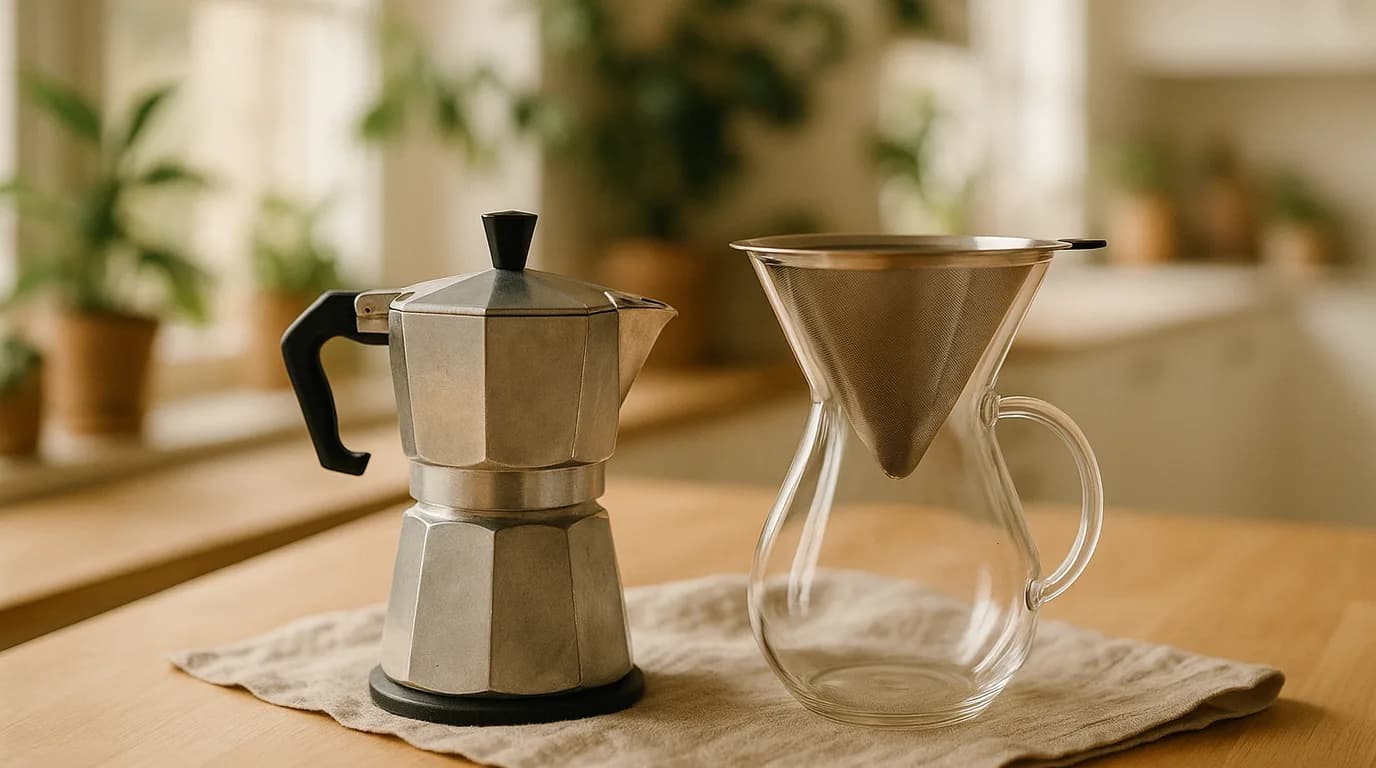
Key Takeaways
- The test that matters is hot-water contact time with plastic, not whether the device contains any plastic at all.
- Chemex, Hario glass or steel cones, and glass French presses with steel filters are the genuinely plastic-free picks.
- AeroPress is polypropylene in direct hot contact. PP is relatively stable, but the standard model is not a plastic-free brewer. The Clear version uses Tritan.
- Moccamaster is widely miscategorised as plastic-free. It is not, but a copper heating element and short dwell time make it much better than standard drip.
- Cheap drip machines are the quiet worst case: water sits in a plastic reservoir and passes through plastic tubing, heated, every single day.
The right test: contact, temperature, time
Almost every coffee maker contains plastic somewhere, a switch housing, a handle, a lid. That is not what matters. Migration and particle release from a polymer are driven by three variables: direct contact with the liquid, temperature, and dwell time. Research on plastic in hot-drink contexts consistently points the same way, higher temperature and longer contact mean more release. Work on disposable paper cups, which are lined with a thin polymer film, found measurable particle release into hot water within about fifteen minutes.
So the useful question for a brewer is narrow: does water above roughly 80°C touch plastic, and for how long? A plastic handle on a glass carafe scores zero on that test. A plastic reservoir that holds water which is then heated scores badly. This reframing is what separates the genuinely clean brewers from the ones that merely look clean.
Every brewer ranked by hot-water plastic contact
| Brewer | What touches hot water | Contact time | Verdict |
|---|---|---|---|
| Chemex | Borosilicate glass + paper filter | 3-4 min | Best. Genuinely plastic-free |
| Stainless pour-over cone (Kalita, Hario steel) | Steel + paper filter, glass carafe | 3 min | Best. Plastic-free, very durable |
| Hario V60 (glass or ceramic) | Glass/ceramic + paper filter | 3 min | Best. Avoid the plastic V60 version |
| Moka pot (stovetop) | Aluminium or steel only | 4-5 min | Excellent. Metal throughout |
| French press, glass + steel filter | Borosilicate glass + steel mesh | 4 min | Excellent. Check the plunger is steel, not nylon |
| Percolator (steel) | Stainless steel only | 5-8 min | Excellent on plastics |
| Moccamaster | Copper element, plastic brew basket | Seconds in plastic | Good, not plastic-free. Best electric drip |
| AeroPress (standard) | Polypropylene chamber + paper filter | 1-2 min direct | Moderate. Real hot contact, stable polymer |
| AeroPress Clear | Tritan copolyester chamber | 1-2 min direct | Moderate, marginally better than PP |
| French press, plastic body (some Bodum) | Plastic body + steel mesh | 4 min direct | Weak. Buy the glass version |
| Standard drip machine | Plastic reservoir, tubing, basket | Hours in reservoir | Weak. The quiet worst case |
| Single-serve pod machine | Plastic tank, tubing, and the pod | Continuous | Worst. See the K-Cup coverage |
The headline is that the cheapest brewers on this list are among the best. A moka pot or a steel pour-over cone costs less than a month of pods, contains no plastic in the water path at all, and lasts decades.
Is the AeroPress plastic-free? No, and here is the honest version
The AeroPress is genuinely excellent coffee equipment and it is also, unambiguously, a plastic brewer. The standard chamber and plunger are polypropylene, and brewing means pouring water at roughly 85–95°C directly into that chamber and leaving it there for one to two minutes under light pressure. That is direct hot contact, not incidental.
Three things make it less alarming than it sounds. Polypropylene is one of the more thermally stable and lower-migrationfood-contact polymers, which is why it is used for things like yoghurt pots and microwave containers. The contact time is short, one or two minutes rather than the hours water sits in a drip reservoir. And it is BPA-free, since polypropylene does not use bisphenol A in the first place.
Two things make it worse than the glass options. It is direct contact with the brew water rather than a brief pass-through. And the chamber is subject to thermal cycling and abrasion over years of daily use, plus scrubbing, which is the mechanical-stress pattern associated with increased particle release. If you love your AeroPress, brew slightly cooler, do not leave the slurry sitting, and replace a visibly scratched or hazed chamber. If you want the format without the polymer, the Clear model is Tritan, and a moka pot or pour-over gets you to zero.
Is the Moccamaster plastic-free? Also no
Moccamaster gets described as plastic-free constantly, and it is not. What it actually has is an unusually good water path for an electric machine, which is a different and more useful claim.
- The heating element is copper. Water is heated in a copper tube rather than sitting in a plastic tank against a heater, which is how most drip machines work. This is the single biggest difference.
- Dwell time is very short. Water passes through the heated path in seconds and goes straight onto the grounds, rather than being held hot.
- But the brew basket is plastic, and hot water sits in it against the grounds for the whole brew. The reservoir is plastic too, though it holds cold water, which matters far less.
- Glass carafe versions beat thermal ones on this measure, since some thermal carafes have plastic lid components in the vapour path.
Verdict: the best electric drip machine on plastics, and not a plastic-free brewer. If you want a machine that switches on in the morning, it is the right answer. If you want zero plastic in the water path, no electric drip machine will get you there, and a Chemex will.
Don't forget the filter and the cup
Getting the brewer right and then undoing it at the last step is common.
- Paper filters are fine, mesh ones vary. Unbleached paper is inert. Reusable “cloth” and nylon mesh filters are polymer sitting in hot water for the whole brew, which is the tea-bag problem in a different shape. Steel mesh is fine. See do coffee filters have microplastics.
- The travel lid matters. A steel tumbler with a plastic sipping lid puts polymer in the hot vapour path for the entire commute.
- Disposable cups are lined. A takeaway paper cup has a polymer film inside it, and research has measured particle release from those liners into hot liquid within minutes.
- Grind and store in glass or steel rather than leaving beans in a plastic bin.
What the MicroPlastics app checks
- Which parts of your specific brewer contact hot water, and what polymer they are if any.
- A 0–100 risk score for your whole coffee setup, brewer plus filter plus cup, rather than one component in isolation.
- A lower-plastic swap at the same price point and brew style, so a pour-over drinker is not told to buy an espresso machine.
- Your running daily-habit profile, since coffee is usually the highest-frequency hot-contact item in a kitchen.
Use the App
Check your brewer and your filter
Most people fix the brewer and keep a nylon filter or a plastic travel lid. Scan your coffee setup with MicroPlastics for a 0–100 score across every part that touches hot water.
Scan my coffee setupRelated: best plastic-free coffee makers, microplastics in coffee by brewing method, microplastics in espresso machines, and do K-Cups release microplastics.
Frequently Asked Questions
Is the AeroPress plastic-free?
Is a Moccamaster plastic-free?
What is the most plastic-free way to make coffee?
Are drip coffee makers bad for microplastics?
Do reusable coffee filters add microplastics?
Sources
- Ranjan VP, Joseph A, Goel S (2021). Microplastics and other harmful substances released from disposable paper cups into hot water. Journal of Hazardous Materials.
- Hernandez LM, Xu EG, Larsson HCE, Tahara R, Maisuria VB, Tufenkji N (2019). Plastic teabags release billions of microparticles and nanoparticles into tea. Environmental Science & Technology.
- Winkler A, Santo N, Ortenzi MA, et al. (2022). Does mechanical stress cause microplastic release from plastic water bottles?. Water Research.
Audit your whole pantry, not just the 5 foods in this article
The app keeps a running scan history for every packaged food you own, every brand swap you make, and every reformulation a brand quietly pushes. The article is a snapshot. The app is the trend line.
Download on the App Store- Free on iOS
- 3 free scans
- No sign-up
- Result in seconds
“Really cool to scan stuff around the kitchen and see what's actually in it. The swaps it suggests are realistic.” App Store review · 5.0★
Android · early access
Get the launch email the day Android opens.
One email. No spam. We send when the Android app is in the Play Store, and never again unless you opt in.
Related Research
Does Canned Tuna Have Microplastics? Brands & Can Liners Compared (2026)
Less than canned sardines, and for a reason worth knowing: tuna is gutted loin, and marine microplastics concentrate in the gut that gets removed. The can liner is the bigger question. StarKist, Wild Planet, Safe Catch and glass jars compared.
Read moreDoes Graza Olive Oil Have Microplastics? The Squeeze Bottle Question
Updated August 2026: an independent LDIR test reported 2 microplastic particles per millilitre in Graza EVOO — one PTFE, one rubber. PTFE is not the squeeze bottle material, which points at processing equipment rather than packaging. Plus why fat extracts more from plastic than water does.
Read moreOlive Oil Brands Ranked by Packaging: Glass, Tin & Squeeze Bottles (2026)
Olive oil is the highest-fat thing in most kitchens, and fat is what pulls additives out of plastic. Dark glass and tin are the clean formats, clear plastic the weakest. Brightland, Kirkland, California Olive Ranch, Graza and Bertolli compared.
Read moreAre Compostable Coffee Cups Plastic? PLA Is Still a Polymer Lining
Many compostable paper cups use PLA plastic lining. A new study found about 12× higher released particle mass than PE cups, while earlier nanoplastic counts found the opposite—why both results can be true.
Read moreAre Nylon Cooking Utensils Plastic? Yes—Heat Is the Real Test
Nylon is polyamide plastic. Studies from 2016–2026 measured oligomers and aromatic amines rather than one universal particle count; heat, contact time and visible damage decide the practical response.
Read moreDoes Parchment Paper Have Plastic? Silicone Is the Key Detail
Most parchment is cellulose paper coated with cured silicone, not polyethylene film. The direct shedding evidence is limited, and plastic-coated freezer paper is a different product entirely.
Read more